

It suddenly hit me five minutes ago that director-writers Joel and Ethan Coen (Inside Llewyn Davis, A Serious Man, No Country For Old Men) need to go a little dumber and sillier for their next film. They obviously do this from time to time (Burn After Reading, Intolerable Cruelty, The Big Lebowski). I happen to regard Inside Llewyn Davis as a kind of glum, sardonic comedy. Every time I watch it (five times now) I go into a kind of serene LQTM mode. I’m just thinking that after the grayish, downhearted, “God more or less hates me and my life is constantly frustrating and depressing” vibes in ILD and A Serious Man (True Grit was more of an adaptation vacation than a deep-down Coen Brothers film) that they need to joke it up a bit more on their next outing. They probably know this better than I. A little change-up for the fans. Can’t hurt.
Bellowing Psychopath
The kids and I caught a 4:30 showing of The Wolf of Wall Street today at Leows 34th Street. A couple of HE people had said “see it with a paying audience and you’ll realize that this really is the new Scarface — people are mostly getting off on the insane manic humor, and very, very few are drawing any moralistic or metaphorical message whatsoever.” It was Jett’s second viewing, Dylan’s first. But right away there was trouble from a big black guy sitting a couple of seats to Dylan’s right. This dude wasn’t just talking all through the film — he was broadcasting his line-by-line, scene-by-scene commentary to the entire front section of the theatre.

When Dylan asked him why he was talking so much and where are his manners, the guy was indignant…”I’m enjoying myself!” The guy’s wife or girlfriend was trying to get him to chill also, but he was off on his own cloud. There was no reaching him, no guilt-tripping, no winning through persuasion or threat — he was (and probably still is at this very moment) a stone sociopath, a complete animal…gone.
We all know that African-American culture has always accepted talking during films, especially in New York. As manners have decreased and society has devolved in recent years incidents like today’s have probably increased. It has always seemed to me that theatre talkers have a certain under-educated je ne sais quoi with a vaguely alcoholic air. They never seem to be executive job material, I know that. I also know that the vast majority of New York theatre talkers I’ve run into in the past seem to be Swedish, Danish, Norweigan or Finnish. Have others noticed this?
Wolf Engages With Commoners
Last night HE’s New Orleans correspondent Dave DuBos wrote the following after catching The Wolf of Wall Street: “I thought the film was a hilariously dead-on satire. But when the lights came up, two women sitting next to me (I didn’t know them), one in her 30s and the other in her 40s, were appalled and disgusted. ‘I can’t get those images out of my mind,’ one said. ‘I want to unsee them and I can’t.’ But when I entered the men’s room, I heard a 20something guy say ‘That’s the craziest fucking movie I’ve ever seen. Were those guys really like that?’ He seemed to be in awe of them while the women were obviously put-off by the behavior.
“I also noticed numerous walk-outs,” DeBos writes. “People were clearly disturbed by that third-act scene when Jordan Belfort punches out his wife (twice) a la Jake La Motta.”
In other words, a typical American middle-class reaction. 90% apparently responded solely to subject matter while ignoring or flat-out missing the metaphor. They didn’t get (or chose not to consider) what it was saying — they only knew how it made them feel. Everything that Joe and Jane Popcorn see is processed as either (a) “whoo-hoo, that was entertaining!” or (b) “uhm, that got me emotionally” or (c) “Jesus, that wasn’t very entertaining” or “whoa, made me feel bad!”
Yes, the punch-out scene is very disturbing, Mrs. Clanton. Anyone with a smidgen of common humanity would and should feel repelled by the behavior in this scene. But there’s this other thing to consider when you’re watching a film, especially an art film about notoriously ill-behaved sociopaths. It’s called context. I know, I know…too intellectual, right?
Wolfies vs. Hustlers
Almost everyone has observed that David O. Russell‘s American Hustle is Martin Scorsese– or Goodfellas-influenced. The general reaction to The Wolf of Wall Street is that it’s Scorsese on rocket fuel — an epic blowout and a wildly satirical takedown of ludicrous 1% greed. Yesterday Awards Daily‘s Sasha Stone suggested that “people seem to be dividing up between Wolf people and American Hustle people. To me one (i.e., Hustle) is good fun but a pretender — a screwball comedy that leaves you with nothing more than a smile on your face briefly but takes you nowhere ultimately. The other? A totally unforgettable experience.” For me The Wolf of Wall Street is the Best Picture of the Year — the only superbly made, dynamic-metaphor, earthquake-level movie out there. It’s insanely alive and knocks you flat on your ass and slams the ball into the upper bleachers. American Hustle is a tasty, well-seasoned, first-rate film by one of my favorite hombres, but it’s a ground-rule double or, at best, a triple because the outfielder fumbled and the runner went for the extra base.
Wells to “All Is Lost” Guys
What are you guys doing with your Robert Redford for Best Actor campaign? A few weeks ago it was Redford’s to lose and now I don’t know. I’m not feeling the pulse.
If you ask me Redford gives a much weightier, far more poignant performance in All Is Lost than Bruce Dern does in Nebraska, but Dern has been campaigning circles around him. Not circles…figure eights! Redford has been so absent from the NY-and-LA “campaign trail”, as it were, that it’s almost as if he’s given up.
A strong performance is the bedrock of any campaign, of course, but as you guys know getting out there and delivering the right message (Dern’s campaign theme has been brilliant) and talking the talk also matters. All I know is that Redford did a flurry of interviews to coincide with the release of All Is Lost in October, and then he more or less disappeared. Maybe I’m completely off my gourd and Redford has this one in the bag. I don’t know. Maybe I’m misreading the atmosphere. But I’m not feeling snapping currents of electricity coming out of the Redford corner at this stage.
I can guess what Redford is feeling or saying to you behind closed doors. Something along the lines of “campaigning for an Oscar like Bill McKay running for U.S. Senator is demeaning.” Or “Roman Polanski won the Best Director Oscar for The Pianist without campaigning so why do I have to hustle around like Hubert Humphrey in the 1960 Wisconsin primary?” Either a performance speaks for itself and merits a nomination or it doesn’t, he’s probably telling you.
Redford probably feels that campaigning cheapens All Is Lost and his performance on some level and perhaps, in a sense, the Academy itself…except no Academy member really feels that way. Redford has always been a bit standoffish (in a good way, I mean — his movie-star coolness is based on this), perhaps a bit too proud to get down in the mud. But this instinct isn’t helping, I’m telling you.
All through last September and October I thought Redford was a near lock to win Best Actor. Now I’m wondering if he can win at all with his absence from the circuit and the image of non-participatory aloofness that he’s put out plus the herculean campaign that Dern and Paramount have put forth.
Are you guys throwing in the towel or what? This is serious shit. We all know that the Best Actor competition is brutal this year along with all the other categories. I’ve heard it said that it’s possible that Redford might not even make the cut. I don’t believe that (his “Our Man” performance is probably the best of his career) but the fact that someone even threw that out there tells you how uncertain the Best Actor thing is at this point.
Reversal of Fortune
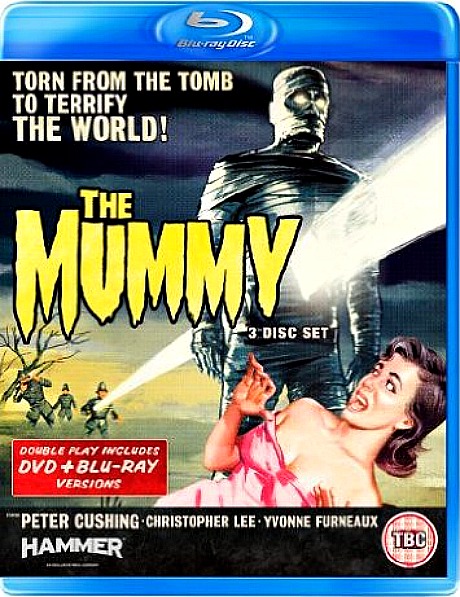
On this side of the Atlantic some people actually cheer when a ’50s or ’60s-era film previously released in a 4 x 3 aspect ratio is cleavered down to a 1.75 or 1.85 aspect ratio for Bluray release. They actually applaud the removal of visual information. But the people behind last month’s British Bluray release of Terence Fisher‘s The Mummy (’59) see things differently. Read this “production information,” 1.85 Aspect Ratio Fascists, and weep: “[This is] the first-ever HD release of Hammer’s classic The Mummy, which has been unavailable on any Region 2 home entertainment format since 2004. The previously available DVD was authored at the incorrect aspect ratio of 1.77:1 and widely criticized by fans. The Region 1 edition, still available as an import, is also presented incorrectly at 1.77:1. This new release…presents the film in its original UK theatrical aspect ratio of 1.66:1 for the first time (the film has never before been released at this aspect ratio)” along with an “alternate full frame aspect ratio version — 1.37:1.” In other words, there are sane, movie-worshipping Catholics in England who also believe, under certain conditions, that “boxy is beautiful.”





Strange Bedfellow
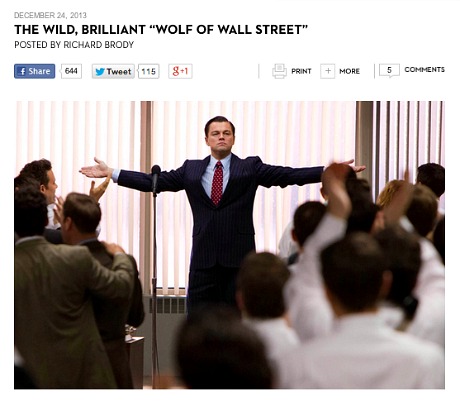
“No, of course Scorsese doesn’t approve of Belfort’s actions; who would? We may wish that such behavior didn’t exist, but its existence is a central part of human nature, and there’s a reason that we can’t stop watching, just as we can’t stop watching the terrifying storm or the shark attack. Within the movie’s roiling, riotous turbulence is an Olympian detachment, a grand and cold consideration of life from a contemplative distance, as revealed in the movie’s last shot, which puts The Wolf of Wall Street squarely in the realm of the late film, with its lofty vision of ultimate things. It’s as pure and harrowing a last shot as those of John Ford’s 7 Women and Carl Theodor Dreyer’s Gertrud — an image that, if by some terrible misfortune were to be Scorsese’s last, would rank among the most harshly awe-inspiring farewells of the cinema.” — from Richard Brody‘s 12.24 New Yorker review of The Wolf of Wall Street. Note: The term is self-evident but for the uninitiated Brody should have used “late film” in quotes. It means a film made by an acknowledged auteur in his/her final stage of output (70-plus).
“All My Life…”
This Macca tune is half-catchy. I wouldn’t post something cheery and lightweight like this (be honest) if it wasn’t Christmas morning with a nice soothing snow blanket covering everything in Croton-on-Hudson, where I happen to be this morning. A nice day to go a little alpha on the HE community. Sorry. I can’t do the scowly-neurotic-judgmental “performance art” thing 365-24-7.
A Bill Simmons Movie?
This looks good, sounds smart, might work. Kevin Costner blends well with films about the spirit, culture and business of sport (Bull Durham, Tin Cup, For Love of the Game). Frank Langella, Jennifer Garner, Denis Leary, Ellen Burstyn, Sam Elliott, Tom Welling, Chadwick Boseman…a good cast. There’s only one thing that could screw it up and that’s director Ivan Reitman, who tends to dumb or downmarket his films down.
A Color Newsreel With Scope Aspect Ratio?
Creating a mock Monuments Men newsreel was a clever idea, but the Sony marketing guys screwed it up by adopting the film’s slightly desaturated color scheme with a 2.4:1 aspect ratio. It’s a WW II-era story, guys…hello? The newsreel should be in scratchy black-and-white with a 1.33 aspect ratio, and the narrator should have one of those barky, “I am the voice of authority!” Drew Pearson-type voices. The Sony ad guys were almost certainly afraid that the under-40 idiots would whisper in alarm, “Hey, is Monuments Men in black and white…?” This is the world we live in — a world rank with technological sophistication re tablets, smartphones and the latest games, and yet few are hip enough to process a boxy black-and-white trailer without assuming the movie itself must be monochrome also. Brilliant! Here’s the new Monuments Men website.