Filling Out “Gatecrashers” Form

And here are HE’s preferential Best Picture rankings as we speak…not Academy predictions but personal heartfelt preferences:

Best Picture: 1. Sentimental Value; 2. Weapons; 3. Marty Supreme (haven’t seen it, spitballing on blind faith); 4. Nouvelle Vague; 5. Roofman; 6. One Battle After Another; 7. Hamnet (haven’t seen it, trusting ectastic buzz); 8. Warfare; 9. Springsteen: Deliver Me From Nowhere (haven’t seen it); 10. Jay Kelly.

Can I just spit it out? 2025 has been kind of a weak year. Feels that way, at least.

You know what I’m doing? I’m going with emotional default choices. I’m not thinking it all through — I’m basically asking myself “what’s the easiest, most defaulty choice I can make?”

There’s nothing lower in the universe than to try to predict what the Academy and guild goons are going to prefer. Go with your own heart and determinations!

“Poor boy, when you’re dead you don’t take nothin’ with you ‘cept your memories of having wasted your life while trying to predict who and what AMPAS members will vote for” — from John Lennon and Yoko Ono‘s “The Ballad of John and Yoko”.

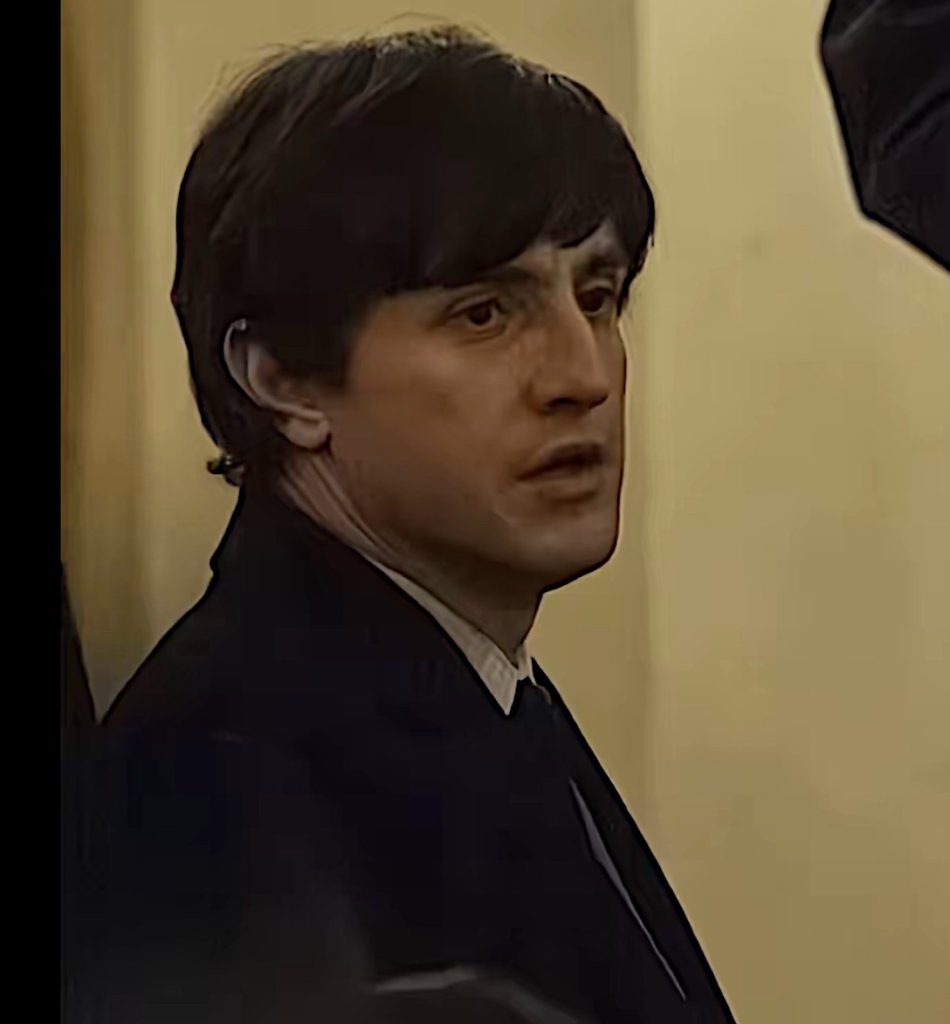
Excerpt from HE’s 4.10.25 Warfare rreview: “One of the SEALS is Joseph Quinn‘s ‘Sam’, and while I felt terribly for the poor guy (in actuality, back in ’06) and his ghastly leg wounds (he moans and wails a lot and who could blame him?) but to be perfectly honest I was also whispering to Quinn, ‘I’m sorry for your character’s terrible pain but on another level you, Joseph Quinn, almost deserve it because you’ll be playing George Harrison for Sam Mendes, and you don’t even faintly resemble Harrison…alabaster skin, auburn hair, eyes that couldn’t be more different than Harrison’s deep browns.”

Surreal Explanation

JFK’s AI voice is perfect…”back theah…behind the fence on the grassy knoll.” Truly impressive.

‘Cheap Texas Broads’ Meets Old-Man Feet“, posted on 6.2.22 but originally posted from Hue (Vietnam) on 11.19.13:

I was reminded of a famous JFK quote when I read Cathy Horyn’s 11.14.13 N.Y. Times piece about the legend and the whereabouts of Jackie Kennedy‘s pink suit (“a classic cardigan-style Chanel with navy lapels”) that she wore on 11.22.63.

In an interview with Death of a President author William Manchester, Mrs. Kennedy recalled that her husband wanted her to make a stylistic statement during their Dallas visit. “There are going to be all these rich Republican women at [a lunch they were scheduled to attend], wearing mink coats and diamond bracelets,” JFK told her. “[So] be simple — show those cheap Texas broads what good taste really is.”

In a subsequent dispute with publishers of Manchester’s book, Mrs. Kennedy managed to dilute “cheap Texas broads” into “rich Texas broads” and then “those Texans.”

I’m mentioning the original quote because (a) it makes JFK seem more human and less iconic and (b) because I relate to withering aesthetic judgments. It reminded me that Kennedy was capable of remarking how gauche or clueless some people dressed. It suggests that had he survived into his 90s and found himself at my rooftop restaurant in Hue — I realize this sounds like a stretch but it isn’t really — he too would have been appalled at the sight of old-man feet inside rubber and leather sandals. Not to mention the shorts and the golf shirts. Maybe.

Glenn Kenny: “One hears a lot of dumb, gratuitous and outright asshole-ish ‘JFK, c’est moi’ statements over the course of a lifetime, but this one really has a certain je ne sais quoi.”

6.6.22 explanation: I posted this four days before the 50th anniversary of JFK’s murder, when historical perspective essays were flooding the internets. I was recoiling from the sight of sandaled old-man feet at this Hue hotel, and so my free-associating mind wondered “how would a 96 year-old JFK had reacted to such a sight?” I’m confident that he would’ve felt that even in Vietnam, ugly, unpedicured man toes should always be concealed.

Monoculture Nostalgia Makes Me Weep On Occasion

This morning Matt Walsh posted a video essay about the last peak period of movies (“06 through ’08) and the all-but-total disappearance of our shared American monoculture.

This is arguably the best essay Walsh has ever written. The basic thought is “don’t it always seem to go, that you don’t know what you’ve got ’til it’s gone.”

Alternate theme or slogan: “Over the last 18 years I’ve been suffering the slow spiritual death of a thousand cuts…blood drop by blood drop.”

8:35 excerpt: “We have lost something very important. We no longer have a shared cultural experience, or what some have called the ‘monoculture’ or what you might just call ‘mainstream culture.’ The monoculture began its march to extinction in 2007. Today the march is over. The process is complete. The monoculture gave way to the fragmented culture…a culture broken and divided into 300 million little pieces.”

HE to Walsh: “I 100% agree about ‘06 through ‘08 being a great movie era, and probably the last great one. But I don’t think that oppressive wokeness started with Barack Obama. The first fumes of wokeness started wafting around in 2016, but it was essentially launched when the Harvey Weinstein story broke in the fall of ’17. But the loss of a mono culture is 100% real, and your lament almost brought a tear to my eye.”

AI sez: “The monoculture was killed by the rise of the internet and digital streaming services, which broke up mass media consumption and allowed for a more personalized and fragmented media landscape. Factors like streaming algorithms, social media, and a greater focus on niche interests replaced the shared cultural experiences of the past, leading to a decline in a single, unifying mainstream culture.”

2007 is the New 1999,” posted on 4.17.99. “25 in 2007“, posted on 9.21.21.

Read more

“Dont Take Ambien More Than Three Nights In a row”

Ella McCay (20th Century, 12.25) is obviously a hot mess, but I still want to see it for the usual nostalgia reasons….I’ll always be a serious die-hard fan of the great Brooks films of the ’80s and ’90s (Terms of Endearment, Broadcast News, As Good As It Gets)…all brilliant, incisive, emotional empathy scenarios that wrestled with real-life adult stuff, and in a way that really and truly touched the bottom of the pool. And something inside me wants to return to that place.

I know deep down that the old Brooks film vibes are gone with the wind and that none of us can go home again, and that I’m dreaming. I know this, I know this.

If only the not-hot-enough Ayo Edibiri wasn’t playing the younger brother’s (Spike Fearns) girlfriend. Just remove Fearns and Edibiri from the finished cut and everything will be greatly improved.

Read more

Pacino / Corleone Arc in “The Godfather, Part II”

The arc experienced by Al Pacino‘s Michael Corleone’s in The Godfather, Part II is quite the downer, but it somehow feels right or even fulfilling at the finale — a powerful, frosty, crusty man, stuck in a spiritual hole that he can’t get out of, gradually digs himself in deeper, and then confesses to his mother that he’s trapped, and then doubles down on his demonic paranoid nature (tosses out wife, kills brother) and ends up in a colder, lonelier place than when he started. Yeah!!

The Real Dr. Strangelove

Kissinger, the three-hour American Experience PBS documentary on Henry Kissinger (1923-2023), is just around the corner. It will air in two parts — Monday, 10.27, and Tuesday, 10.28, at 9 pm eastern. The film will be available to stream on PBS.org and on the PBS app, etc.

Kissinger was quite the influential diplomatic maestro during the Nixon and Ford administrations, but his bottom-line reputation has been disdained or at least debated for many decades, particularly by aged and traumatized residents of Cambodia and Chile and their descendants.

My own brusque opinion is that Kissinger was a brilliant, audacious, cold-blooded chess player whose initiatives and achievements were generally unaffected by humanitarian concerns.

Many of us would be interested in any solid, verified reporting about Kissinger’s dalliances with high-powered industry women back then….Shirley MacLaine, Jill St. John, Marlo Thomas, Candice Bergen, Liv Ullmann, etc.

Nuzzi’s Forthcoming “American Canto” Doesn’t Sound Cool Because…

In the forthcoming “American Canto”, Olivia Nuzzi will reportedly write about her “digital affair” with Robert F. Kennedy, Jr., Trump’s Secretary of the US Department of Health and Human Services.

This is fair game, of course, but sharing personal intimate messages feels a tad icky. To me, at least.

There’s titillation in sharing private texts, of course, but not much personal honor. I’m no fan of RFK Jr.’s thinking about vaccines and whatnot, but revealing allegedly intimate texts that he sent to Nuzzi is ethically questionable or, if you will, a bit slimey. (It would be different if Nuzzi had somehow obtained transcripts of texts that RFK, Jr, had sent to another would-be digital lover…that’s a different deal.)

Roughly the same thing happened to me when the careless James Mangold forwarded a private email that I’d sent to him. Out of the emailed 15-paragraphs my thoughts contained a single paragraph that touched very briefly on private voyeurism. Embarassing, yes, but also private. Mangold in turn sent it to Lionsgate’s Tim Palen, who in turn forwarded it to Nikki Finke because she wanted to “get” me because I had shared a relatively minor anecdote about Finke with some N.Y. Daily News guys back in’94.

It was a cheap and callous move on Mangold’s part, because it was meant for his eyes only and yet he violated that trust without blinking an eye. Mangold could have copied and pasted the content of a single live-wire paragraph in my email that he figured Lionsgate would want to know about (i.e., I’d spoken with Elmore Leonard about Mangold’s 3:10 to Yuma) but naaahh….too much trouble, right?

Peacock’s Gacy Miniseries Should’ve Stuck To POV of Cops and Prosecutors

Last night I watched the first three episodes of Patrick MacManus‘s Devil in Disguise: John Wayne Gacy, a new eight-episode Peacock series about the infamous serial killer from a suburb northwest of Chicago.

Gacy was a fat, gay sociopathic beast who had an amiable personality and liked dressing up like a clown, but who also murdered around 34 young men in the ’70s (mostly during the Jimmy Carter era)…he buried most of his victims in a crawl space under his home, and some under his garage’s cement floor. And he dumped a few in the Des Plaines river.

As long as McManus sticks to the Gacy investigation by the Norwood Park cops (and then the prosecution in the later episodes), Devil in Disguise is aces…gripping and fascinating and appropriately gloomy. It has story tension, realism, a strange Midwestern eeriness.

But when it starts veering into the lives of some of the victims and the anguish of their families after they’ve disappeared, you can feel the tension dissipating more and more…you can feel the narrative padding slowing things down.

HE to MacManus: We’d rather not familiarize ourselves with the young gay victims, and we really, really don’t want to deal with the grief of their parents. Bohhr-innnng! If you’d just stuck to the cops and the prosecutors and cut all the dramatic flotsam and jetsom, you’d have a perfect miniseries. Read the “investigation” section of Gacy’s Wikipage…it sucks you right in.

The girthy Michael Chernus, whose Gacy perf sorta kinda reminds you of John Candy in Uncle Buck and Planes Trains and Automobiles, is fairly great as this suburban monster. The last time I wrote about Chernus was when he played the extra-marital boyfriend of Stephanie Allynne in a glum 2015 Sundance comedy called People Places Things. My basic thought was “why would the pistol-hot Allyne want to cheat on her husband with a not-all-that-handsome overweight guy?”

Read more