Remember “Mandy” in Stanley Kubrick‘s Eyes Wide Shut? The heroin-addicted hooker who nearly od’ed at Sydney Pollack‘s mansion, and then apparently attended the big orgy only to end up in a Manhattan morgue locker?
She was played by Julienne Davis, who’s now 62 or thereabouts. Davis has written a smart, well-honed piece (paywalled) about the parallels between EWS and the Jeffrey Epstein history, as well as the Epstein echoes contained in Kubrick’s Lolita (’62).
HE is hereby divested from the Nancy Guthrie disappearance case. The trail has apparently gone cold. The Pima County bozos can’t even find that dumbshit ski-mask-and-backpack video doorbell guy. Benoit Blanc could maybe crack it, but local investigators are obviously in over their heads.
And the reporting-and-speculating YouTube brigade has nothing…nothing at all. I can’t stand watching Ashleigh Banfield now…she has zip on her plate and knows it, but she can’t stop milking this thing. It’s kinda pathetic, really. Poor Brian Entin…a good reporter but he has nothing, nothing, nothing.
It’s all a dead end, a dry gulch. Nobody wants to admit that poor Nancy has almost certainly passed, but she probably has. She may have died the first night.
When will the Banfields and the Entins call it a day, pull up stakes and go home? This case could be the new Picnic at Hanging Rock.
Once he’s found guilty of murdering his parents, Nick Reiner will live out the remainder of his life in an eternity of grim confinement. A more humane resolution would be a death penalty. A firing squad, I’m thinking. Seriously…bullets in the chest would be a more compassionate sentence.
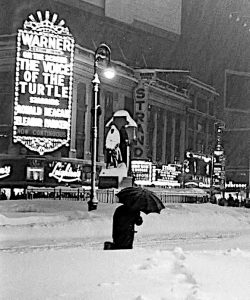
Manhattan is glorious after a big snowfall. I’ve done it a few times. So much energy and camaraderie to be shared. If you’re dressed for it, walking around the West Village is heaven. Wonderland vibes.
Congrats to Sinners costar Wunmi Mosaku after taking the Best Supporting Actress trophy during yesterday’s BAFTA awards. She plays Annie, the estranged, Hoodoo-practicing wife of Michael B. Jordan‘s Smoke Moore. I was looking at one of her Sinners clips this morning and saying to myself, “Yup, she brings it.”
But I have to be honest — when Mosaku was Oscar-nominated a while back I could barely remember a single stand-out scene that she was in. Ditto when she won yesterday. For the first time in the history of the BAFTAs I had to pull clips to jog the memory. Face it — Mosaku’s big one-on-one scene with Jordan is on the flat side.
Maybe she won because she’s a Brit — born in Nigeria, raised in Manchester. Or because the voters were attracted to the idea of making history, Mosaku being the first black British winner of this particular BAFTA award.
When I think of Sinners the principals appear in a recollection cavalcade — Jordan, Hailee Steinfeld, Jack O’Connell, Miles Caton, Buddy Guy, Delroy Lindo, the KKK guys. Mosaku? Not so much.
The Tourette’s-afflicted John Davidson, whose personal saga is dramatized in Kirk Jones‘ I Swear, made a mess out of yesterday’s BAFTA awards. To no one’s condemnation, Davidson blurted out the N-word while Sinners‘ Michael B. Jordan and Delroy Lindo were on stage. The BB1 footage has since been deleted, of course.
BAFTA host Alan Cumming: “You may have heard some strong and offensive language tonight. If you have seen the film I Swear, you will know that film is about the experience of a person with Tourette’s syndrome. Tourette’s syndrome is a disability and the tics you have heard tonight are involuntary, which means the person who has Tourette syndrome has no control over their language. We apologize if you were offended.”
HE disagrees with the “no control over language” part. Cumming meant to say that that Tourette’s sufferers have no ability to control their tics, spasms and vocalizings, but it’s hard to believe that Davidson’s terminology had nothing to do with Jordan and Lindo being front-and-center. (Davidson is more specifically grappling with coprolalia, or “the utterance of obscene words or socially inappropriate and derogatory remarks.”)
Did Davidson shout out “peacock!” or “muff diver!” or “Lamborghini!” or “Cheerio’s!”? No, he shouted out a racial slur. How can anyone argue that this wasn’t a form of id commentary?
Consider the famous Tourette’s scene from Ruben Ostlund‘s The Square (’17).
During a one-on-one between Dominic West‘s Julian, a famous artist, and Annica Liljeblad‘s Sonja, a Tourette’s sufferer starts interrupting with sexually provocative taunts like “show us your boobs!,” “whore!” and “camel-toe!” These remarks were responses to Liljeblad, an attractive Nordic blonde with great gams. The Square guy didn’t blurt out anything racial or scatalogical — he went sexual for an obvious reason.
If I was producing a live awards show or on-stage interview and some Tourette’s guy started ruining the moment, I would tell the security goons to politely and gently escort the offender out of the room. I wouldn’t stand for it. I don’t care how insensitive this would make me seem.
Note the feeling of frustration in The Square when the wife of the Tourette’s shouter doesn’t lead him out of the room, and the feeling of immense audience satisfaction when the black-tie invitees abandon their composure and beat the crap out of Terry Notary for behaving like an overly aggressive gorilla.
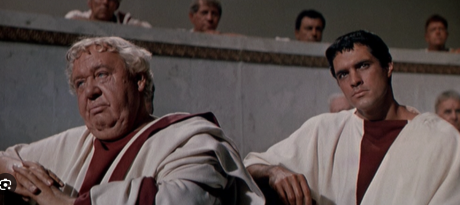
65 years ago Dalton Trumbo wrote the following Spartacus dialogue between Charles Laughton‘s Gracchus and John Gavin‘s Julius Caesar. The subject was Gracchus having arranged with Cilician pirates to provide ships to help Spartacus’s slave army escape from Italy:
Julius Caesar: “So now we deal with pirates. We bargain with criminals.”
Gracchus: “Now, don’t be so stiff-necked about it! Politics is a practical profession. If a criminal has what you want, you do business with him.”
Not so much any more.
The release of the Epstein files has adversely affected POI (people of influence) who had any kind of friendly relationship with the late Jeffrey Epstein during the ’90s, aughts and teens. We’re talking about a “social crime” or “stain” upon reputations, and the ones who’ve suffered the most in this regard are Andrew Mountbatten-Windsor (recently arrested), Kathryn Ruemmler (Goldman Sachs GC…resigned earlier this month after reports she was a friend of Epstein’s), Brad Karp (Paul Weiss chairman), Larry Summers, Casey Wasserman (LA 2028 chair…tarnished by friendly emails with Ghislaine Maxwell).
I’m not aware that these people are guilty of any kind of hard criminal activity with Epstein, according to the files. Maybe I’m overlooking stuff, but as far as I know they were just chatty with the guy. I’m presuming they saw a financial upside in keeping Epstein in their corner. Nothing more than that.
Somebody needs to find Trumbo in heaven and tell him that the rules have changed. If a criminal has what you want, you avoid him like the plague lest you be condemned for merely being loose and friendly with the guy.
After months of HE irritation and complaining due to an apparent commitment on the part of Greenwich Entertainment to under-promote if not suppress Michel Franco‘s Dreams and only days before the film’s limited 2.27 opening, I’ve finally seen this 98-minute film and have come away…well, certainly not annoyed or negative-minded, as some critics have been.
It’s a smart, bracing, well-honed thing by a top-tier auteur known for cold films (I think Franco is one of the toughest, sharpest directors working today). And yet the last 20 minutes left me a bit puzzled.
Dreams is about a passionate sexual affair between Jennifer (the 40ish Jessica Chastain), a privileged, headstrong, San Francisco-based rich woman who runs her family’s arts foundation, which includes a sponsorship of a prestigious ballet school in Mexico City. During her visits there she’s been discreetly “doing” a gifted ballet dancer named Fernando (the 30something Isaac Hernandez), but has been keeping this hot-and-heavy affair from her brother Jake (Rupert Friend) and, more importantly, from her Daddy Warbucks father (the dreary, dull-faced Marshall Bell), who of course covers all the bills.
The story is activated when Fernando decides to expand the cultural perimeters of this relationship by entering the U.S. illegally and then making his way north to San Francisco and into Jennifer’s Russian Hill condo and soon after her bed.
Jennifer, seemingly delighted with all of the dick dick dick dick dick dick dick dick dick dick dick dick dick dick dick dick dick dick dick dick, helps Fernando land an audition with a top-tier SF ballet school, which he aces. And yet Jennifer, we gradually come to learn, is unsettled by Fernando having invaded her home turf. She tries, as noted, to keep their relationship on the down-low, but he smells this and shows resentment, reacts angrily.
Jennifer won’t say this in so many words, but as much as she loves Fernando she wants him back in Mexico City, tucked safely away. She wants the lid kept on.
Franco makes it clear that while Jennifer feigns the brisk and aloof attitude of a cosmopolitan woman of means, she knows where her bread is buttered and therefore does what daddy suggests when he tells her (although not in so many words) to cool it with the beaner. (HE to woke pearl-clutchers: By using the “b” word I’m pretending to think and speak like her flinty father and brother do deep down.)
Dad basically says (a) “you can’t brazenly fuck your Mexican boytoy with all our San Francisco friends looking on”, (b) “fucking this guy is bad for appearances, out of bounds” and (c) “do what you want during your Mexico City trips but not here.”
SPOILER PARAGRAPH: Jennifer winds up doing a really shitty thing to Fernando, and then she feels compelled to admit what she’s done (can’t lie, can’t hold it in) and he gets even angrier and treats her harshly and brutishly (including fucking her in the ass in a rapey way), and then she brings her brother into the situation and Fernando is beaten up and made to howl in pain.
Basic lesson for rich white women: Never fuck the help or your social lessers. But if you do anyway and the lessers start behaving presumptuously or inappropriately, you need to do the hard thing. You need to be cruel in order to make your point.
I didn’t find Jennifer’s harshness toward Fernando dramatically satisfying. Franco basically goes with a “white people are racist shits who don’t give a damn about south-of-the-border people so fuck them and the horses they ride on” message. Except racism always obscures the truth of things, and that’s what this film more or less does.
If you want to be liberal about it, Dreams is an efficient capturing of a certain social malignancy. Chastain and Hernández are excellent in their roles; everything in this film feels steady, straight and believable. HE urges you to catch it.
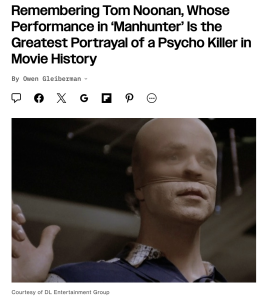
That fascinating scene with the blind Joan Allen and the sedated Bengal tiger…burned into my memory. She’s emotionally open to Noonan’s Dollarhyde (aka “the Tooth Fairy”) and yes, even sexually. Lo and behold they do it. And yet Noonan/Dollarhyde is too fucked up to go with the feeling. Plus he’s killed a guy he sees as a romantic rival. Plus he later decides to kill Allen. A real babe magnet.
Nothing else that Noonan ever did comes close to Manhunter. I don’t even remember What Happened Was. Or, for that matter, his supporting role in Charlie Kaufman‘s Synecdoche, New York.
Brody shares some of the same observations that I mentioned last year, but his review really digs in…it’s more fully considered…plus the construction is smarter, better. Here’s the whole Brody piece, and here’s my favorite portion:
“It’s no surprise that the children’s frantic quest fosters a deep friendship. The pairing is an old one—the principled book-smart girl and the rough-edged streetwise boy—but Hadi revitalizes it with meticulous observation that links their struggles to those of the country at large. The children playing Lamia and Saeed had no training as actors, yet both are fanatically precise, effortlessly expressive, and pensively deep-hearted. The girl achieves perfect comic timing when she holds a recipe in one hand and her pet rooster in the other as it pecks at the paper.
“When things go sour, both kids spew insults and indignation with a matter-of-fact insolence. At moments of exceptional gravity, they play a staring contest that fills the screen with an ingenuous romanticism. The bonds of the children, Bibi, the postman, and a very few others in their circle endow “The President’s Cake” with a grandly humanistic warmth that’s all the stronger for the mighty pressure under which it’s forged.”
5.16.25: “I tend to be impatient with films about young kids but this handmade Iraqi film (apparently the first from that formerly turbulent, war-torn country to be shown in Cannes) is different…it has an impoverished but compassionate Bicycle Thief atmosphere with just a tiny little touch of The Red Balloon and maybe a slight spritzing of Hector Babenco‘s Pixote, and you can tell almost immediately it’s a grade-A, pick-of-the-litter pearl.
“Partially set in the wetland marshes of southern Iraq (which for the 37th time is not pronounced EYE-rack but Uhraq) but mostly in a big city (not precisely identified as Bagdad but shot there) and all of it occuring just before the 2003 U.S. invasion, it’s basically about a nine-year-old girl, Lamia (Banin Ahmad Nayef), who lives in a floating straw hut upon the Mesopotamian marshes with grandmother Bibi (Waheed Thabet Khreibat).
“The plot comes from Hadi’s childhood memory of a school event in which one member of each class is chosen to bake a cake for Saddam Hussein‘s birthday (4.28). Lamia is selected to be her class’s cake-baker. She and Bibi are dirt poor and can barely afford, much less find, the chief ingredients (eggs, flour, sugar) but failing to deliver or, worse, refusing this honor is out of the question.
“And so Lamia, Bibi and Lamia’s pet rooster Hindi head for the big city (Basra, Nasiriyah and Amarah are closest to the marshes). And yet the diabetic, overweight Bibi has a secret agenda in visiting the city, and this freaks Lamia out. So she takes off and hooks up with Saeed (Sajad Mohamad Qasem), a school friend and an Artful Dodger-like thief who’s roughly her age. The heart of Cake is about these two scrounging around Bagdad in a search for the cake ingredients and coping with a few Dickensian twists and turns.
Boiled down, the film is essentially a portrait of Bagdad street life and all kinds of crafty, hustling, struggling denizens (including a devious would-be molester) trying to save or make a buck or otherwise stay afloat.”