

On 7.25 Indiewire contributor Matthew Hammett Knott posted a piece called “Heroines of Cinema: The 10 Most Exciting Young Female Directors in the World Today.” Actually not that young — most of the women mentioned are their mid to late 30s. Anyway, in addition to Sally El-Hosaini (My Brother The Devil), Miranda July (The Future), Celine Sciamma (Tomboy), Lucia Puenzo (Wakolda), Dee Rees (Pariah), Mia Hansen (The Father Of My Children), Lena Dunham (Girls), Haifaa Al-Mansour (Wadjda), Sarah Polley (Take This Waltz, Stories We Tell) and Ava Duvernay (Middle of Nowhere, the forthcoming Selma), I would add Shannah Laumeister, director of the elegant and admirably ballsy Bert Stern: Original Madman, Circumstance director Maryam Keshavarz and Sam Taylor-Johnson (a.k.a., Sam Taylor-Wood), director of the forthcoming 50 Shades of Grey.
Impaled
Stories rise and fall so quickly these days that print media almost always seems to be trailing. John Cuneo’s New Yorker cover portraying the ghastly death of Anthony Weiner‘s mayoral campaign is one of the rare instances in which a dead-tree publication seems right on top of it. I mean, not even a day or two late.

Driving Denial
With James Ponsoldt‘s teenage-boozer flick The Spectacular Now opening next Friday (8.2), it’s time to re-post a bitch rant from last January: “Few things make me more irate than driving-and-talking scenes in which the driver primarily looks at the person riding shotgun (usually a woman) and only glances at the road sporadically. Five or six seconds of eye-contact for every one or two seconds of road-watching. It never works that way in reality, even in the case of sloppy reckless drunks. I never, ever look at a passenger except when we’re at a stop light or stalled in traffic.
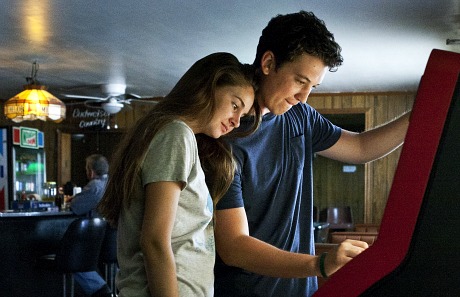
Shailene Woodley, Miles Teller in James Ponsoldt’s The Spectacular Now
Durango Drive
Among the less costly ways of getting to the Telluride Film Festival is to fly to Durango and then rent a car or pay for a limo shuttle. Both ways cost over $300. I’ll be arriving in Durango on Wednesday afternoon, 8.28, and renting wheels and driving the 100 minutes to Telluride and then returning to Durango sometime on Monday, 9.2. I’m looking for one or two folks who’d like to tag along, and all I want is gas. I’ve got the rental — you fill up the tank and keep it filled. At most that’ll cost you….what, $70 or $80 bucks round-trip? Cheap deal.
The Other Hemsworth
The fact that Robert Luketic directed The Ugly Truth, 21, Monster-in-Law and Win a Date with Tad Hamilton! should warn you away from Paranoia (Relativity, 8.16). The trailer suggests it’s a formulaic, second-tier programmer. Mediocrity tip-off #1 is Gary Oldman playing Gordon Gekko by way of Al Pacino‘s Devil’s Advocate character. Tip-off #2 is Liam Hemsworth‘s character talking about wanting to take care of his father who worked hard all his life “with nothing to show for it.” Tip-off #3 is Harrison Ford looking like he’s had chemotherapy. (He has one of those heads that needs hair — I know this because I have one of those heads.) A friend believes that Liam is hotter than his older brother Chris. Maybe so, but Liam having costarred in two Hunger Games films plus The Expendables 2 plus Paranoia tells me he’s probably not a long-distance runner.
Nothin’s Gonna Change My World
A friend saw Lee Daniels’ The Butler earlier today. I asked him how it was. All right, what I really said was “how bad is it?” And then I said, “Be warned — I don’t want to hear how surprisingly good it is. Please don’t tell me this if you had that reaction.” He replied as follows: “Sorry, but I found it movingly corny in the same mold (except with a historical sweep and some stunt casting) as The Help, which it reminded me of. It’s a much more disciplined film than Daniels’ Precious or The Paperboy. Not a good film but an effective one.” I wrote a one-word reply: “Goddammit!” Then he wrote back and said that Showbiz 411‘s Roger Friedman “was applauding at the end, as was the bulk of the (SAG) audience.”
More Backwoods Beardos
You’ve got beards, you’ve got flannel shirts and hunter hats, you’ve got twangy shitkicker accents, you’ve got a flawed loser protagonist, you’ve got the No Country For Old Men-resembling plot…what else you got, man?
Calling Bullshit
Here’s a clip of original Wicker Man director Robin Hardy announcing that a version resembling his original 102-minute cut will be released on Bluray by Studio Canal on 10.14, and will be preceded by a 9.27 theatrical release. The forthcoming Bluay is being called “most complete version of the film possible.” But what kind of shape will it be in? And how interesting and/or revelatory will the restored footage be? Why doesn’t Hardy at least hint at the differences between the 88-minute cut and this new one? I sense deception. I smell a rat.
“…But You’re No Match For Wilson”
DVD Beaver‘s Gary W. Tooze has seen Warner Home Video’s Shane Bluray (streeting on 8.13) and says the following: “Having seen [the] DVD version of Shane probably a dozen times, the new 1080p image really jumps out for me. Not knowing what it looked like theatrically [in 1953], I can only say that I’m very pleased with this appearance. It’s clean [and] colors are very bright [although] some of the indoor and night sequences are a shade dark. Skin tones are warm. There is more information in the frame on all four edges [compared to the DVD] and it’s nice to see some of the original grain in the backgrounds. Incredibly deep black levels at times — almost moiring. I’m seeing some very minor edge-enhancement if I zoom in far enough. Overall I was mesmerized by the areas of improvement over the [2000 DVD].”
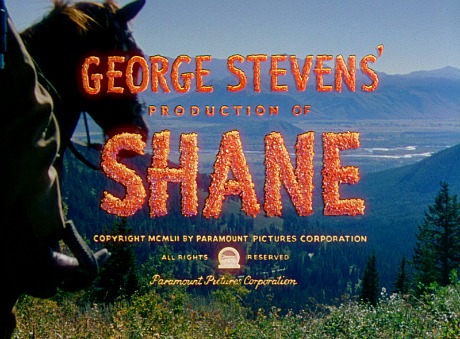

““For the first time I noticed the reddish-violet markings on the pearl-white hand grip on Jack Palance‘s six-shooters.” — from my 4.28.13 review of the restored Shane at the TCM Classic Film Festival.
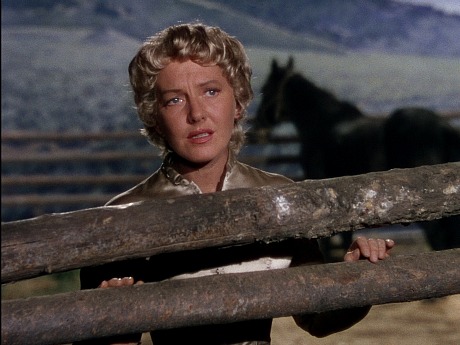
“It was drop-to-your-knees — the most beautiful rendering I’ve ever seen of this 1953 classic. It was like seeing it new and fresh all over again. It was almost like being there on the set. The detail was to die for.” — from my 4.28.13 review.
“Enjoyable” Whatever Wank-Off
I’ll say this about Baltasar Kormakur‘s 2 Guns (Universal, 8.2), the Denzel Washington-Mark Wahlberg drive-around and shoot-’em-up popcorn flick. It’s a lot more engaging — looser, funnier, more entertaining — than last year’s Contraband, which Kormakur directed (and which also starred Wahlberg). It’s basically a silly late-summer jagoff that’s about Washington and Wahlberg playing “catch” with each other — i.e., the old chemistry-rapport-mutual backscratch put-on/goof-off thing. Call it “attitude-surfing.”


There’s not an ounce of real-world credibility in any of 2 Guns, and that’s the point, I think. There’s one really funny line delivered by Wahlberg (which had to have been written after the casting of Edward James Olmos as a Mexican drug kingpin) that I laughed out loud at. For that one instant, for me, the movie came alive. There’s also a pronounced homage to Don Siegel‘s Charley Varrick (’73) that I found highly amusing (and which I mentioned to Marshall Fine after the screening).
I don’t know how much of 2 Guns was improvised by Washington-Wahlberg and how much of it was written on the page, but respect to screenwriter Blake Masters for at least writing a fair amount of the dialogue. I can tell you that the plot, based on the same-titled graphic wank by Steven Grant, is absolute bullshit. The movie has no undercurrent, no themes — nothing except the wank-off vibe of everyone just making the damn thing and collecting their paychecks and taking their dicks out and stroking them as they cash their checks and hack around between takes.
Denzel was really well paid, Wahlberg was really well paid…why can’t I be be like them as I sit there watching this thing? Better paid, I mean. At least that.
I have to go uptown for a lunch thing so that’s the end of this riff, but I’ll add to it sometime later this afternoon.