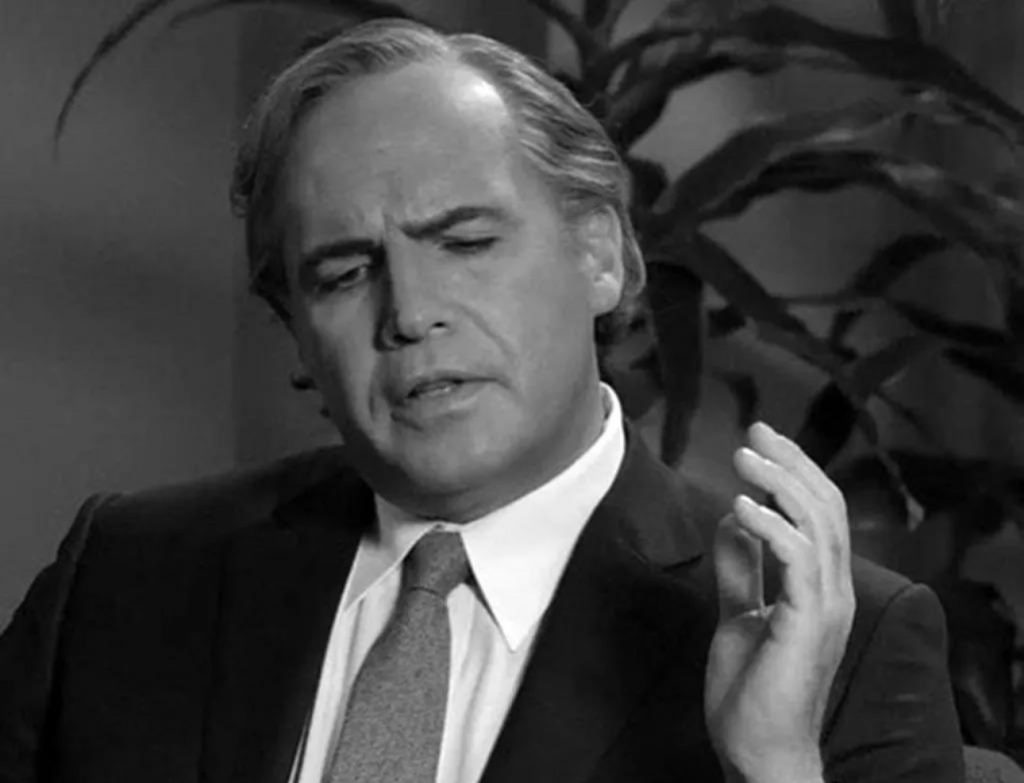
Speaking of Church Services

Posted on 7.3.11: “I saw Terrence Malick‘s The Tree of Life for the second time last night, and it’s still a gentle, layered, highly undisciplined cosmic church-service movie — a quiet spiritual environment to dream inside of and meditate by. But (and I’m sorry to say this in a way) it doesn’t gain with a second viewing. And all very good or great movies tend to do this. So what’s wrong?

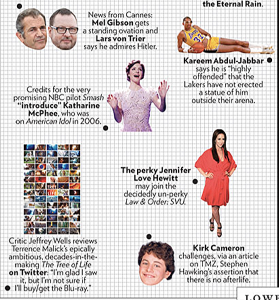
“I was made fun of on 5.22 by New York‘s “Approval Matrix” guy for tweeting from Cannes that I was glad I’d seen The Tree of Life but I’m “not sure if I’ll buy/get the Bluray.” Now that I’ve seen it twice I know I won’t bring the Bluray home. In other words I immediately sensed it wasn’t a two-timer in Cannes and now the proof is in the pudding, so I would say my premonitions have merit.

“For me, The Tree of Life is an amazing film in the sense that it gathers and swirls it all together in the same way that I myself swirl it all together ever day, soaking in my blender shake of childhood memories, present-day ennui, seaside dreams, forest-primeval dreams and dinosaur dreams, catch-as-catch-can impressions and endless variations and meditations about loss and lament and the absence of grace, etc. That plus ‘fuck me because it sure could have been a happier life if it hadn’t been for my gruff, largely unaffectionate, World War II-generation dad who brought darkness and snippiness too many times to the dinner table,’ etc.

“I’m always disengaging from the present and wandering around in the past and thinking about a constant stream of recolections…dinosaurs and Dean Martin,Steve McQueen and Lee Marvin and cap guns and girls in bikinis on beaches and how my mother looked and sounded when she was young, and how sometimes I used to argue with myself about who was worse, she or my father.

“All I know is that except for movie-watching and running around with friends, my childhood was a Soviet prison-camp experience — a spiritual gulag. My parents and the public schools I attended may have made me into a tougher, more resourceful survivor than if they’d been ‘nicer’ and easier on me, but God, what a price.

I’m presuming it’s not just me who takes this head-trip all the time, but each and every person on the planet. Malick is merely taking a grab-bag of his own lamentings and assembling them into a film. That — don’t get me wrong — is a very welcome thing. I’m immensely grateful that a film as nourishing and open-pored as The Tree of Life is playing in the same plex alongside Transformers 3 (a film that gives you no room whatsoever to trip out).

“But I’m not convinced that what Malick has done is all that staggering or transcendent or worth the kind of in-depth explanation piece that Salon‘s Matt Zoller Seitz has written, which reminds me of the sermons that Episcopalian ministers used to deliver when they tried to explain what God and Jesus could or should mean to the average parishioner (i.e., myself).

“I used to quietly groan to myself during these sermons, and then I took LSD when I was 19 and I finally did see God and Jesus, and I realized what tepid and cautious fellows those ministers were.”
Movies Have Lost Their Cultural Urgency

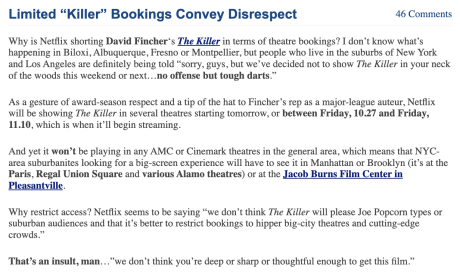
They’re not part of the American cultural bloodstream like they used to be…of course not! The idea of movies being a communal “attending a church service” thing has been steadily weakening for roughly two decades, maybe a bit less. By my own specific yardstick they’ve been losing their cultural mojo since at least the mid to late aughts. I’ve long believed that the beginning of the degradation began with the debut of Iron Man, but that’s me.

I personally blame Millennials, Zoomers, streaming and the pandemic, although not necessarily in that order. These are the four bugaboos, man…the four horseman of the cinematic apocalypse.

This guy is saying what I’ve been muttering to myself for many, many years. It’s like he’s mouthing some interior mantra, played or spoken over and over….the story of my life since 2010 or thereabouts.

Sutton Meets Original “Kong”

Knowing my Millennial sons’ aversion to monochrome films from an early age, I’ve long presumed that Sutton, age 2 and 1/2, would never consider watching any black-and-white movies, classic or otherwise.

Hence my surprise on Sunday when we watched about a half-hour’s worth of the original King Kong (’33), which she was pretty much enthralled by. It was the first time Sutton and I had absorbed a critically approved, historically important movie together. Quite a moment.

Sutton’s basic tastes run to stuff like Bluey and animation, etc. Then again she’s watched The Wizard of Oz, sepia footage and all, so she’s already gotten her feet wet in that regard.

She and Jett had been watching Kong: Skull Island (’17), which is basically (we’ve all endured it) an empty crappo CG-propelled Super-Kong flick.

I asked Jett if she’d ever seen the original, and he flipped it on. We both presumed Sutton would be bored if we started from the beginning as the first 35 or 40 minutes are pure dialogue and set-up, so we went straight to the native sacrifice scene.

I offered no coaching or commentary except in one instance. I explained to Sutton that Kong loves Fay Wray‘s Ann Darrow, and that while she’s very scared by his size and whatnot he’ll never hurt her, that he only wants to care for and protect her.

Alas, harumphy HE commenter “bentrane” disapproved. He asked if I “really think King Kong is suitable for a two-year-old,” blah blah.

HE response: “King Kong is epic and historic and iconic — a film that’s emotional and tragically sad and unmistakably about unrequited love. In short, it’s a human-scaled movie about serious feelings, and one that reflects certain emotional realities, unlike the bullshit super-Kong films of the last decade or so, which are merely about size, spectacle and jizzy CG…basically garbage.

“What you seem to be saying is that the crap-bullshit Kong films and their ruthless super-violence (along with the GodzillaKaiju films) are okay in a common-gruel, eye-candy sense because they’re empty cartoons but an exciting, 90 year-old adventure-spectacle that touches upon serious human behaviors and tragic sadnesses (including cruelty to animals, greed, delusional dreams of glory) should be kept away from little kids.”

HE commenter “riboleh”: “There is a realistic depiction (albeit stop-motion) of Kong ripping open a dinosaur’s jaw. It’s quite violent, and I would suggest you reconsider creating nightmares for her. It’s so obviously not akin to today’s empty spectacle CGI, not because of how it looks, but how it plays…which feels quite real, and certainly to a two-year old.”

My bottom-line feeling is that King Kong is, at the end of the day, a nutritious film, and that today’s entertainment fare, especially the kind aimed at tykes, is wafer-thin and informed by banal sugary sentiment — pretty much dedicated to eliminating nutrition at all costs.

I figured that exposing Sutton to nutritious content on a brief, one-time basis is worth the risk, as she’s unlikely to see any quality films for quite a few years.

Uncertain Future of Girlboss Flicks

Yesterday I wrote that the under-performing of George Miller‘s Furiosa is due to a lack of an unequivocal, no-substitutions Mad Max character in the lead as opposed to a second-banana girlboss figure.

Charlize Theron‘s Furiosa in 2015’s Mad Max: Fury Road was a formidable, enraged, go-for-broke protagonist, but she wasn’t the lead — Tom Hardy was.

No matter how you slice it Anya Taylor Joy faced a daunting challenge — trying to carry a major action franchise flick when she’s not playing an actual, historically verified lead but a strong supporting character.

The failure of Furiosa was due, I wrote, to “the absence of Mad Max and his being replaced by a girlboss, and a story about a girlboss out for vengeance upon Chris Hemworth’s Dementus — essentially a feminist woke plot (i.e., you go get the evil bad guy, girl). Action bros have never felt much passion or enthusiasm for proverbial girlboss characters.”

The biggest exception to the girlboss rule, of course, is Sigourney Weaver’s Ripley in the first two Alien movies. She was unquestionably the lead in both and decisively kicked ass…no question about that.

If you were a senior production exec in a position to make greenlight calls, what would your attitude be about new potential girlboss action projects? Would you be indifferent about what happened to Furiosa last weekend or would you be saying “hmmm…I don’t know”?

Read more

Listen Again to Bertolucci

Jessica Palud‘s Being Maria was screened last weerk (5.21) in Cannes as an out-of-competition premiere. Based on Vanessa Schneider‘s 2018 memoir “My Cousin Maria Schneider“, it allegedly pushes a contrary viewpoint about the making of Last Tango in Paris and the filming of the anal sex assault scene in particular — contrary in that it argues with statements from its late director, Bernardo Bertolucci.

World of Reel‘s Jordan Ruimy, who attended the Cannes screening and is not given to fanciful distortion as a rule, says that Palud’s film “pretends that the rape scene was unscripted. I went into the film not realizing it was about Schneider. What the film suggests is that Marlon Brando and Bertolucci were unsatisfied by a take and plotted to add the rape scene without Schneider knowing it [in advance].”

I wasn’t on the set of Last Tango in Paris and am only going by online accounts, but please consider a piece that I posted on 12.5.16, titled “Bernardo Bertolucci to Last Tango Outrage Crowd: ‘Cool It…You’ve Got It All Wrong’“:

Last Tango in Paris director Bernardo Bertolucci has issued a statement about the anger that ignited after an Elle article summarized comments Bertolucci made during a 2013 interview, specifically about he and Tango star Marlon Brando having surprised the late Maria Schneider with an idea to do a butter-enabled anal sex scene.

The hoo-hah is based on a “ridiculous misunderstanding” of what actually happened, Bertolucci says.

“I would like, for the last time, to clear up a ridiculous misunderstanding that continues to generate press reports about Last Tango in Paris around the world,” Bertolucci wrote.

“[Three] years ago at the Cinematheque Francaise someone asked me for details on the famous butter scene. I specified, but perhaps I was not clear, that I decided with Marlon Brando not to inform Maria that we would [use] butter. We wanted her spontaneous reaction to that improper use [of the butter]. That is where the misunderstanding lies.

“Somebody thought, and thinks, that Maria had not been informed about the violence on her. That is false!”

Bertolucci explained that “Maria knew everything because she had read the script, where it was all described. The only novelty was the idea of the butter.”

This argues somewhat with a Schneider quote given to a Daily Mail interviewer in 2007, to wit: “I felt humiliated and, to be honest, I felt a little raped, both by Marlon and by Bertolucci. After the scene, Marlon didn’t console me or apologize. Thankfully, there was just one take.”

I wouldn’t mention this if it wasn’t a thing, but what difference could it possibly make to anyone what kind of lubricant is used in the matter of backdoor action? If Schneider knew what the scene would be about because it was in the script, why would she be alarmed about the use of butter? What’s the issue as long as something was used…right?

Variety‘s Nick Vivarelli reports that when Schneider died, Bertolucci said to ANSA: “Her death came too soon, before I could tenderly hug her again, tell her that I felt close to her like the first day, and, at least once, say I was sorry. The strong creative rapport we had during the Last Tango shoot had been poisoned with the passing of time. Maria accused me of having robbed her of her youth and only today I wonder whether there wasn’t some truth to that. In truth she was too young to sustain the impact with the unpredictable and brutal success of that film.”

Would That It Were So

“The world has to be reminded that watching a film at home, while scrolling through your phone and checking emails and half-paying attention, is just not the way, although some tech companies would like us to think so.

“Watching a film with others in a movie theater is one of the great communal experiences. We share laughter, sorrow, anger, fear and hopefully have a catharsis with our friends and strangers.

“So I say the future of cinema is where it started: in a movie theater.” — from Sean Baker‘s 5.25 acceptance speech after winning the Cannes Film Festival’s Palme d’Or for Anora.

Support Kapadia’s “All We Imagine As Light” When It Opens Stateside

It’s always a little heartbreaking when a special film connects big-time in Cannes, as Payal Kapadia‘s All We Imagine As Light did last week, and then opens in the U.S. to a certain lack of enthusiasm if not shrugs.

Please don’t let this happen to Kapadia’s film. She’s more than just a confident, first-rate filmmaker, but a master of uncanny simplicity, possessed of an Antonioni-like focus — in my view she’s part of that stellar crew that includes Agnes Varda, Jane Campion, Jennifer Kent, Celine Sciamma, etc.

Accomplished Indian social realism is such a rare thing, plus All We Imagine As Light isn’t the least bit anger- or revenge-driven — it couldn’t be farther from the girlboss mindset. Janus Films and Sideshow have the North American rights…here’s hoping it all works out.

Adjustment Issues Upon Return

I woke up this morning around 3 am…naturally, having operated by a European clock for the last two weeks. Come daybreak I couldn’t do much except sit around and chat with Jett, Cait and Sutton and, you know, do grandfather stuff. And then I crashed for a couple of hours. All to say this is more of a recovery than a filing day.

But I’ll have at least three topics to wade into when I return to Connecticut — watching the original King Kong with 2 and 1/2 year-old Sutton, re-watching the original Ant Man and a rehash of the whole Bernardo Bertolucci-Maria Schneider Last Tango in Paris thing, thanks to Jessica Palud‘s Being Maria, an out-of-competition Cannes film that I didn’t get to but have read about. From what I’ve gathered and have personally been told, it distorts big-time.

Bend Over, Chuck Berry

NYC transit system to weary traveller upon his return from France:

Welcome back, Chuck, and now the ordeal begins.

Nine and a half hours from Nice Airport take-off at 2 pm (or 8 am by a Manhattan clock) to your JFK 5:30 pm touchdown, you say?

Followed by 170 drag-ass minutes (customs, luggage retrieval, endless walking, Air Train, missing the Howard Beach A train by seconds), topped off by your A train’s sluggish arrival at Penn Station at 8:20 pm, thereby causing you to miss your 8:11 pm Jersey Transit train to West Orange.

I had awoken on Saturday morning at the NYC equivalent of 12:30 am.

London and Nice-area mass transit systems are faster, smoother, more comfortable and less arduous, you say? They actually have escalators everywhere, unlike NYC?

I began my Cannes-to-Nice bus voyage (free voucher supplied by Cannes Film Festival staff) at the NYC time zone equivalent of 4:30 am and finally walked through Jett’s door in West Orange last night at roughly 9:15 pm or 3:15 am Cannes time, or nearly 23 hours later.

What do you do, whine for a living? Are you a baby, some kind of chronic complainer? Are you a man or a mouse? Nine and a half hours of flying plus 14 hours of ground transport and waiting on both ends…par for the course.

That Certain Feeling

…that comes over you or creeps in…after flying nine hours from Nice and then you finally touch down at JFK…I shall be released! Actually not so fast because there’s no available gate so your Delta 767 sits on the tarmac for 35, 40 minutes…waiting, waiting…trying to suppress anger. Really nice.

When’s The Last Time

…that a super-famous person was portrayed by an actor who resembled him/her this closely?

Nobody knows how good Waltzing With Brando will be, but even if it’s only so-so Billy Zane will have landed his catchiest, most attention-getting role ever. Zane hasn’t been on a hot streak since his mid ‘90s one-two punch — The Phantom (‘96) and Titanic (‘97). Everyone loves a good comeback.