10 Weeks Ago

I’ve just re-read my 11.8.12 review of Steven Spielberg‘s Lincoln. Since that date I’ve been characterized as an unregenerate hater, but I’ve never changed my mind about the basic cinematic value of this film. I’ve simply maintained all along that it’s not good enough to take the Best Picture Oscar. Daniel Day Lewis for Best Actor? Of course. Tony Kushner‘s script for Best Adapted Screenplay? Okay. Tommy Lee Jones for Best Supporting Actor? I’m a Robert De Niro-in- SLP guy but no argument. But not Lincoln itself.

Steven Spielberg‘s Lincoln (Disney, 11.9) is a somewhat authentic, deliberately paced, honorably acted, highly thoughtful History Channel movie that mostly concentrates on Abraham Lincoln‘s struggle to pass the 13th Amendment (i.e, the abolishment of slavery) in Congress. Spielberg’s approach to the material — an adaptation of Doris Kearns Goodwin‘s “Team of Rivals” by Tony Kushner — is appropriately reverent, sturdy and subdued. It feels like a history lesson, and plays like a musty political procedural literally happening in the mid 1860s. It seems to unfold at the horse-drawn pace of that era.

In other words it’s a highly literate, passionately performed and very thoughtful bore, and for all the right reasons.

I myself was never bored, mind — I love history and period realism — but I would argue that the story of the passing of the 13th Amendment is an interesting saga with some great dialogue (Tommy Lee Jones‘ anger moments might be the best thing about it), but it’s not a riveting one. It’s not really movie material, certainly by today’s standards. It’s Showtime or PBS or History Channel material writ large by the Spielberg brand and the soulful skills of Daniel Day Lewis. Anyone who cares about doing this kind of thing correctly will understand and respect what Spielberg has tried to do, and in many ways has succeeded at.

But they will also admit to themselves that there’s something grindingly dutiful and a bit plodding about Lincoln, and that it gives you the feeling that you’re trudging through the narrative mud like a foot soldier in Grant’s Army. In some ways Lincoln is not that tonally different from Robert Redford‘s The Conspirator. And you know what that means.

It opens with a crassly calculated, totally bullshit scene in which Lincoln shares quiet words with four Union soldiers (two white, two black) under the cloak of night, and it’s amazing how phony it feels when one of the black soldiers, played by David Oyelowo, politely tells President Lincoln that he’s irked and disappointed that men of color aren’t allowed to become officers. And then he recites a portion of Lincoln’s Gettysburg Address, and he walks away from Lincoln as he continues to recite, withdrawing like a member of a chorus in an early 1950s stage production of Brigadoon.

Yes, DDL’s titular performance is quietly arresting. A little recessive and self-regarding, perhaps, but he seems to have genuinely captured the A. Lincoln that I’ve been reading about for decades — the folksy but sly politician, the low-key, self-amused teller of jokes and cracker-barrel tales, the rigorously thoughtful and perceptive lawmaker, patient and wise but dogged by melancholia and a wife who provided little peace. It’s all there. His performance is never quite kicky or adrenalized enough — it’s largely about stillness and speaking softly and stoic restraint — to make you sit up in your seat and go “wow!” And yet it gains upon reflection. I left the theatre thinking this is certainly among the year’s best, and yet I’m not sure I need to savor his performance again. I think I’ve absorbed all there is. Same with Lincoln itself. I have a chance to see it again tonight, and I’m thinking “Eh…maybe not.”

Largely because I was tremendously irritated by dp Janusz Kaminski having gone with that same milky, bleachy lighting style that he’s used in so many Spielberg films. All those desaturated grays and browns and pallid complexions and interior, gas-lit shadows fit into the milieu, of course. They define the tone and mood of the film. But this is a Kaminski signature that we’ve seen time and again (Minority Report, Munich, A.I., The Terminal) so his work on Lincoln doesn’t feel like he’s tried to illuminate a specific story or theme or whatever. It’s Janusz in default mode.

There is so much milky, bleachy light pouring through the windows of the Lincoln White House that you’d think aliens from Close Encounters (the ones who hovered over Richard Dreyfuss‘s pickup truck and gave him a sunburn) have landed on the South Lawn.

Other things about Lincoln disappointed or pissed me off.

Did you know that the chamber of the U.S. House of Representatives inside the Capitol building, which looks almost exactly the same today as it did in 1865, has several large windows, and that milky, bleachy light pours through during daylight hours? You didn’t know that? The chamber has no windows, you say? Well, you’d better check with Janusz Kaminski, my friend!

I didn’t believe that the 16th President travelled around without security protection of any kind. Daniel Day Lewis’s Lincoln never causes any kind of commotion when he shows up here or there. Nobody goes “whoa…it’s the President!” Instead they all go “oh, hey there, Mr. President…how goes it?” He just walks or roams around like any guy, riding in a carriage like some middle-aged tailor or accountant or physician. No oolah-boolah or “stand back!” vibe of any kind.


White House during the Lincoln administration, perhaps in 1862 or 1863.

Below is a photograph (or daguerrotype) of the White House during the Lincoln administration. Looks pretty nice, doesn’t it? A clean shot of the same place but without the fountain. How hard would it have been for Spielberg to create a CG image of the entire structure? Too hard, apparently. There isn’t a single establishing shot of the White House or the U.S. Capitol (the huge dome of which had recently been completed in early 1865) in the entire film. No images of how the White House South Lawn or Pennsylvania Avenue or the Treasury building or the Potomac might have looked. Lincoln never goes for the big wow shot because, I’m guessing, it would have been too costly given the expected modest revenues. But they’ll spend the bucks on big CG compositions when Spielberg shoots Robopocalypse.

In short, the outdoor capturings in Lincoln don’t look like 1860s Washington. They look like period-dressed Petersburg, Virginia, where the film was mostly shot, and other areas in Virginia (including Richmond).

Lincoln‘s interior sets, minimally lighted when those trademark Kaminski floodlights are absent, have been expertly littered with the clutter of papers and ink bottles and leather gloves and snuff boxes, but Lincoln is almost entirely composed of medium shots of shadowy interiors, medium shots of shadowy interiors and, just to break up the monotony, medium shots of shadowy interiors. And 90% of the time containing four or five or more middle-aged men arguing about politics and horse-trading and votes and whatnot. And the occasional young man (or small groups of young men) looking on in wonderment or admiration.

I was half-joking when I said I wished that Lincoln had been shot in Aroma-rama or Smellovision, but I was half serious also. I wrote that I was hoping for an atmospheric bathroom scene with maybe an insert shot of an 1860s toilet or a bathtub or whatever, and of course there isn’t. That was understood from the get-go, but it would have been cool.

Spielberg doesn’t show Lincoln’s assassination in Ford’s theatre, but his decision to go with an alternate way of conveying this event struck me as highly unimaginative.

And if you know your Lincoln history the bed he was placed upon at the Peterson rooming house wasn’t big enough for his tall frame, so he was laid down diagonally, corner to corner. This is ignored in Lincoln. The bed that DDL lies on has plenty of room.

Pretty much every performance has conviction and panache — Sally Field‘s Mary Todd Lincoln, Joseph Gordon-Levitt‘s Robert Todd Lincoln, Gulliver McGrath‘s Tad Lincoln (except for the scene when he learns of his father’s death), David Strathairn‘s William Seward, Jackie Earle Haley‘s Alexander H. Stephens, Bruce McGill‘s Edwin Stanton, Gloria Reuben‘s Elizabeth Keckley, Jared Harris‘s Ulysses S. Grant, James Spader‘s William N. Bilboe, John Hawkes‘ Colonel Robert Latham, Hal Holbrook‘s Francis Preston Blair, etc.

The bottom line? Lincoln is a good film, deserving of respect and worth seeing, but it happens at an emotional distance and feels like an educational slog.

Critical Mass

The question about the Argo turnaround and the Lincoln deflation is whether or not this will hold, or whether something else will happen to shift the dynamic again.

“A few weeks ago, it started to look one of the candidates had become the clear frontrunner,” The Daily Beast‘s Ramin Setoodeh writes in a 1.22 piece. “Even if Steven Spielberg‘s Lincoln puts audiences to sleep like a C-SPAN marathon, [it] landed seven Golden Globe nominations and 12 Oscar nominations, more than any other film. The movie with the most nominations usually wins Best Picture at the Academy Awards.

“But if there’s one thing the Academy loves, it’s a comeback story — and a funny thing happened on the red carpet. The early precursor awards that were supposed to go to Lincoln went to Argo instead. Ben Affleck‘s film about how the CIA (and Hollywood!) heroically saved six diplomats during the 1979 Iranian hostage crisis swept top honors at the Golden Globes and the Critics’ Choice Awards in January.

“Over at Gold Derby, which tracks various Oscar races, 13 pundits still predict Lincoln will win Best Picture compared with 10 for Argo. If anything, though, with a month until the February 24th Oscars ceremony, the momentum seems to be moving in Argo‘s direction, a movie that paints the showbiz industry as an international superpower.”

Fumes

Press and industry types are naturally following each other’s Sundance postings and tweets, but readers (and certainly commenters) outside this realm seem to be few and far between. But every January I feel a need to invest in the future (new filmmakers, perceptions, trends) and take myself out of the Oscar-wank cycle for a couple of weeks. Sundance is a bear to absorb and grapple with, but half the time I feel like I’m spinning my wheels in order to spin my wheels. Three more days (counting today ) remain, and then a Friday wake-up and a 10 am shuttle to SLC airport.

Newlyweeds Guys

I like good pot-high movies (i.e., Wonder Boys) but I haven’t seen Newlyweeds at Sundance, partly because I’m not convinced (based on reviews) that it has a pot-high vibe. But I did run into Team Newlyweeds at the Park City Marriot’s bar/restaurant two or three nights ago, and in the spirit of that encounter and my friendly relationship with publicist Jeremy Walker, here’s a recently-shot portrait of their Sundance premiere.

If It’s Tuesday…

If I hadn’t been shut out of James Ponsoldt‘s The Spectacular Now a couple of days ago I wouldn’t feel obliged to catch it at noon at the Eccles. This means, however, that I have to blow off an 11:30 am press & industry screening of Alex Gibney‘s We Steal Secrets. Great! I’ll be catching a 3 pm P & i of Matthew Porterfield‘s I Used To Be Darker, and then a pair of Eccles screenings in the evening — Very Good Girls (which I’m scared of) at 6:30 pm, and then Lovelace (slightly less scared) at 9:45 pm.

Linklater’s Landmark Classic

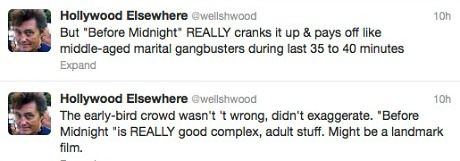
At first I wasn’t sure how much I agreed with the ravers about Richard Linklater‘s Before Midnight, the third (and final?) Ethan Hawke-Julie Delpy exploring-all-things relationship flick (following ’95’s Before Sunrise and ’05’s Before Sunset). I felt intrigued and highly stimulated by this deep-drill, naturally flowing talkfest…but not entirely sold.

But everything changed with the final sequence of this Greece-set film — a one-on-one confrontation of ultimate marital truth in a hotel room (and then outside the hotel at the finale) lasting…oh, roughly 35 to 40 minutes. This is what brought it all home and convinced me that Before Midnight is not only the finest film of the 2013 Sundance Film Festival so far, but the crowning achievement of one of the richest and most ambitious filmed trilogies ever made.

This final portion couldn’t be more primal. Every marriage and serious relationship in the history of post-’60s Western culture has had to deal with this stuff — the comfort of knowing your partner really, really well and the need to accept (and hopefully celebrate) all that he/she is, persistent divorced-parent guilt, the onset of pudgy bods and middle-aged sexuality, dashed expectations vs. the acceptance of real-deal trust and bonding, unfortunate eccentricity and craziness, fidelity, personal fulfillment vs. marriage fortification…the whole magillah.

If there’s any sensitivity and receptivity among the industry rank-and-file, Before Midnight is an all-but-guaranteed contender for writing and acting awards a year from now.

That’s as far as I can go with today’s screening schedule hovering like a hawk, but this, it seems, is the Sundance ’13 film most likely to walk away with an assortment of Jury and Audience awards, and almost certainly the most critically acclaimed and successful Linklater-Hawke-Delpy film once it opens commercially.

Oscar Race’s Mitt Romney!

I love the impassioned myopia of Sasha Stone‘s Awards Daily contemplations. I know her as a friend but I see her from time to time as Swami Shrinivista Stone, ohm-ing and burning incense and dressed in flowing gold robes as she susses out the vaguely aromatic currents and tremors yaddah yaddah.

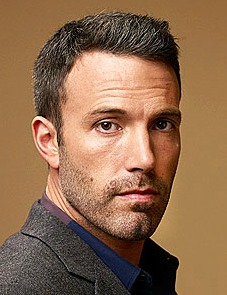
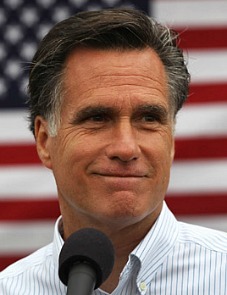
I mean, hundreds of us are up here in Park City, trudging off to new films in the cold, responding as fully as possible to at least one magnificent knockout (Richard Linklater‘s Before Midnight) and three unquestionable goodies (David Lowery‘s Ain’t Them Bodies Saints, Zal Batmanglij‘s The East, Morgan Neville‘s Twenty Feet From Stardom) and there’s Swami Stone down in Los Angeles, proclaiming with muted irony and amusement that Argo director Ben Affleck is the Mitt Romney of the Oscar race.

That’s entertainment!

Zero Dark Thirty is easily the finest and most immaculately crafted film of the year and Silver Linings Playbook is also a brilliant piece and my hands-down emotional favorite, but I too am rallying behind the Great Towering Thundering Affleck if it means the defeat of Lincoln and Steven Spielberg.

“The film that most [have seemed] to settle on as the least offensive of the bunch appears to be Ben Affleck’s Argo,” Stone writes, “which would have no problem taking the frontrunner’s spot right now if Affleck had gotten a director’s nomination. His entire fan base has lifted him up as a martyr for the cause, the only man who could BEAT LINCOLN!

“Once Zero Dark Thirty appeared to be zapped, first by controversy and next by the lack of a director’s nomination (I would argue that the lack of the SAG ensemble nod hurt it the most), Argo would have to be it. Suddenly it was the Mitt Romney — not the best candidate to take on Lincoln but the only one that CAN win.

“For some reason, those opinions has cooled to the other alternate choice, Silver Linings Playbook, and are now full-throttle Argo.

“Meanwhile, if you run the numbers you will find two things. The first, Lincoln still has it by a mile. The second, maybe the numbers are meaningless.”

Shut Out of Fruitvale

For the sin of creative absorption — getting caught up in writing a piece as I sat in the Yarrow Hotel and therefore not rushing over to the Holiday Cinemas cattle tent early enough — I can’t see the 2:30 pm press & industry screening of Ryan Coogler‘s Fruitvale…no room at the inn. And the only chance I have to see it again is late Thursday afternoon, which conflicts with Escape From Tomorrow. Terrific — I’ll flip a coin. The Weinstein Co. has bought distrib rights for $2.5 million.

Four Movies…Okay, Five

In my book Michael Winner, the British director who has died at age 77, was in a good groove as an effective, second-rate action-thriller director from 1972 to ’74, during which time he directed The Mechanic (’72), Scorpio (’73), The Stone Killer (’73) and his semi-mastepiece, Death Wish (’74). There was also the entirely respectable The Nightcomers (’72) with Marlon Brando as Quint.

A Little Escape Action

Nobody and I mean nobody is better than yours truly at missing out on small Sundance buzz films. Just as they’re just starting to break out and be talked about, I mean. I am a stone friggin’ genius at not being in the midst of the early chatter, much less the forefront. Take Randy Moore‘s Escape From Tomorrow, which I missed last Friday evening because I decided to see Don Jon’s Addiction instead and which I missed late Saturday night because I don’t see movies at 11:30 pm, period.


From Randy Moore’s Escape From Tomorrow.

But I’ll catch it it at the Library on Thursday at 5:30 pm…okay? Even if that’s not okay it’ll have to do.

I have a queer little equation that I carry around while covering this festival. The more excited that brilliant, impassioned but sometimes off-on-their-own-orbit critics get about a quirky Sundance film, the less likely Joe Popcorn is going to even hear about it much less see it, if and when it gets commercially released.

And Escape From Tomorrow’s commercial prospects are apparently in doubt, says L.A. Times guy Steven Zeitchick, because it casts a dark, mournful shadow on the Disney Theme Park experience. But maybe (who knows?) it’ll become “one of those films” that everyone wants/needs to see. Or maybe it’ll play a week at the Nuart.

I honestly think it’s different when guys like myself go apeshit over a film. Then it has a chance because I listen to my anti-intellectual instincts, I don’t get all caught up in my own swizzle-stick obsessions, and because my feet are planted squarely on the pavement.

Here’s a key passage from Zeitchik’s 1.19 piece:

“A surrealist, genre-defying black-and-white film,” Escape From Tomorrow “is one of the strangest and most provocative movies this reporter has seen in eight years attending the Sundance Film Festival. And it may well never be viewed by a commercial audience.”

And this: “To me this is the future,” Moore says. “Cameras in your hand. Cameras in your glasses. Anyone can be shooting at any time. And I think it will explode.”

“Moore has never attempted to speak to anyone from Disney, nor has anyone ever contacted him. Still, there is no way the company could be happy with the result, in part because of what many courts might deem rampant trademark infringement but also because of the nature of the thing, a juxtaposition of Disney’s family-friendly corporate imagery with some pretty grotesque behavior.

“Whether a distributor, even a bold one, takes a flier on this is the big question. The media interest would be high. The legal bills would be even higher.

“The film’s rights are being represented by Cinetic Media, which has sold high-profile Sundance titles such as Precious and Napoleon Dynamite as well enigmatic fare such as 2010 Banksy movie Exit Through the Gift Shop. The company’s principal, John Sloss, declined comment for this story, but the feeling in distribution circles is that the movie will have a legal Everest to climb. While trying to censor an independent film tends to blow up in a conglomerate’s face, it would be hard to imagine how Disney would ever allow this film to see the light of day.”