Get ‘Em While They Last

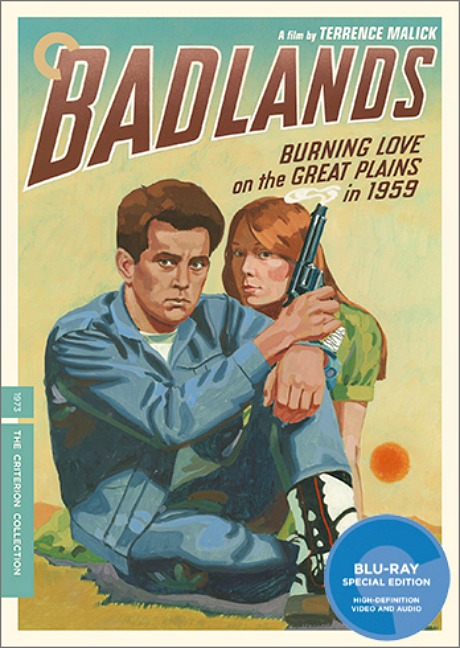
The good news is that Criterion has a Badlands Bluray coming out on 3.19.13. The bad news is that they’ve cleavered the aspect ratio down to 1.78 to 1. The good news is that I still have my copy of a 1999 Warner Home Video Badlands DVD, and it’s presented at 1.37 to 1. [See jump page.]

I don’t know for a fact that this WHV DVD presents the definitive full-frame, open-matte version of Terrence Malick‘s 1973 classic, but it sure looks good. I’ve watched it three or four times and can tell you it has acres and acres of spacious headroom.

Read more

Forgot, Sorry, Milk Spilled

What happened to The Guilt Trip, the Seth Rogen-Barbra Streisand relationship comedy that opened nine days ago and has…what, fizzled? It was killed by 64% of the Rotten Tomatoes critics and has only made a lousy $14.5 million since opening nine days ago so I guess you can call it a bit of a wipe-out. Okay, a shortfaller. It’ll probably end up with…what, $25 million? It cost $40 million to produce plus distribution and marketing costs.

Nobody wants to watch a dramedy about a Jewish mom badgering her emotionally aloof son, right? Looked a little sleepy? Not funny or novel enough? Streisand used to be a draw, but she’s been out of the leading-lady game since the mid ’90s. I think it’s telling that I forgot to run a Guilt Trip review when the embargo broke. I was okay with it. I just forgot. Okay, I couldn’t muster the energy to write it. I guess that’s why it died. Nobody cared that much.

Pic was exec produced by Rogen and Streisand, directed by Anne Fletcher (The Proposal) and written by Dan Fogelman.

It’s basically a Jewish mother-and-son car trip movie. Rogen plays an inventor, Andy Brewster, who’s trying to sell a natural-elements cleaner to the big chains without much success. When he discovers that the beloved ex-boyfriend of his widowed mom, Joyce (Streisand), is living and working in San Francisco, he invites her to join him on a cross-country trip as he tries to sell his cleaner (which has a really hard-to-remember name that kinda sounds like Science Cleaner but is actually Scioclean or something like that) so they can wind up in San Fran and reunited with the old boyfriend.

And yet the way Joyce nags and nudges pisses Andy off and puts him in a bad mood half the time. The film has a nice ending, though — I’ll give it that. Adult chuckles, low-key tone, character-driven, no vulgarity, not classic or landmark but likable and moderately entertaining and occasionally heartfelt.

I was grateful for Rogen’s low-key personality, although he plays it a little too somber and dour here and there. I was grateful that it didn’t go all crude and sloppy in search of lowest-common-denominator animal laughs.

I saw The Guilt Trip 27 days ago at a special invitational screening in Century City that Rogen and Streisand attended.

Blinked, Missed ‘Em

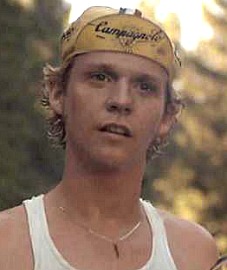
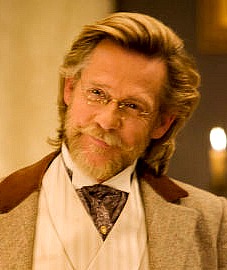
Quentin Tarantino attempted one of his career-resuscitation moves when he cast Breaking Away‘s Dennis Christopher and 48 HRS. and Drugstore Cowboy costar James Remar roles in small Django Unchained roles. Very good for all three. But I’ve watched Django one and a half times and I never recognized Christopher or Remar. Certainly nothing they said or did popped through. I had to read about it, etc.

(l.) Dennis Christopher as Dave Stoller in Peter Yates’ Breaking Away (’79); (r.) as Leonide Moguy in Django Unchained.

That’s because my eyes were half-open and my attention was at half-mast. I shut down early in order to shield myself from the lemme-outta-here Quentin wank effect. I didn’t give a damn who was saying what or playing whom and wearing a sheet with misplaced eye holes or aiming a rifle at whomever. I just wanted to it to stop.

I guess now that I know to look for Christopher and Remar I’ll take take notice if I watch Django again, but the odds of that happening are slim to none.

Fewer Elders Voting For Oscars?

Scott Feinberg‘s 12.27 Hollywood Reporter story about how Academy members are having difficulty with online Oscar voting (possibly due to forgetting passwords, but with more than one industry source describing the site as a “disaster,” says Feinberg) is the equivalent of a weatherman reporting rainshowers on election day.

It simply means that some of the older voters (who tend to vote in a conservative, status-quo, go-along way) might possibly throw up their hands and not vote, which probably means a slight weakening of support for lazy-default favorites like Lincoln, Life of Pi and Les Miserables. I can’t imagine what else it might portend. Older people have always had and always will have trouble with passwords and whatnot, and software guys always have and always will create websites that they know deep down will give a bit of grief to low-tech, slow-on-the-pickup users. They’ll never admit it, but software guys enjoy this on some deep perverse level.

For Those Still On The Fence

There are only five blazingly well-crafted, obviously levitational 2012 films that truly deserve to be Best Picture nominated. Not eight, seven or six…five. One of these is Michael Haneke‘s Amour, although I’m presuming it’s been relegated in most minds to the Best Foreign Language category. The second of these, Leo Carax‘s Holy Motors, has barely been seen and hasn’t a chance. Joe Wright‘s Anna Karenina has been seen, but has been widely dismissed by too many critics (to their eternal discredit) that it’s almost certainly a non-starter.

That leaves Kathryn Bigelow‘s Zero Dark Thirty and David O. Russell‘s Silver Linings Playbook. These are the only two main-event sluggers with that special blend of craft, command and transportation that people remember decades later.

The Gold Derby “experts” who are currently asserting that Lincoln‘s Steven Spielberg is in the lead position for Best Director know a lot less than you might think. In my mind they’re lazy defaulters who are hanging out in the lobby and going “I don’t know but I guess this is how the dullest people are thinking…right?” You can’t give a Best Director Oscar to a hack billionaire whose next film will reportedly be Robopocalypse just because he made a good Abraham Lincoln film. Try to restrain your impulse to show obeisance before power. You will not receive a check in the mail if you vote for Spielberg and he takes the Oscar.

The Stalinist-committee claim that ZD30 should be dismissed because it endorses torture is one of the most vile p.c.-hysteria charges in Hollywood history. But it has stuck to the wall because too many people are letting the sound bite into their heads without considering the particulars, and because Sony management has apparently decided to let ZD30 absorb the slings and arrows without rushing to its defense.

I’ve said more than enough about Silver Linings so let’s let it lay, but it’s the only contender that really generates its own kind of energy and delivers according to its own particular personality terms, and which offers a kind of social-cultural undercurrent (i.e., we’re all crazy-hyper under the skin) that lingers after the credits.

Ben Affleck‘s Argo is a professionally composed, highly satisfying period caper film — hats off, due respect, thumbs-up.

Tom Hooper‘s Les Miserables is madly, wildly loved thing that has alienated too many people (i.e., roughly 25% to 30% of critics and industry types), although it does come together exceptionally, I feel, during the final 40 minutes.

If you separate the performances by Daniel Day Lewis, Tommy Lee Jones, Sally Field, James Spader and David Strathairn, watching Steven Spielberg‘s Lincoln is like listening to the tick-tick of a grandfather clock.

Ang Lee‘s Life of Pi will be Best Picture-nominated in order to round out the field — let’s leave it at that.

Paul Thomas Anderson‘s The Master is a major auteurist-muscle-flex film with a lead performance (i.e., Joaquin Phoenix‘s) that combines anti-social alienation and alcohol-sipping with the behavior of slithery, tongue-flicking serpent-geek, and which peaks somewhere between the halfway and two-thirds point and doesn’t really come together in the end.

Benh Zeitlin‘s Beasts of the Southern Wild deserves a little-engine-that-could Best Picture nomination, but it won’t happen. Tough game, hot kitchen.

Quentin Tarantino‘s Django Unchained is an ugly cheeseball exploitation film that uses slavery as a protection-pass cloak that permits QT to wallow in all kinds of wink-wink blood, venality and racial venom for close to two hours and 40 minutes.

Take No Notice

In a 12.27 “Top Ten Worst movies of 2012” piece, Rope of Silicon‘s Brad Brevet has called Joe Wright‘s Anna Karenina a “dud.” No, it isn’t. It’s a brave and visionary film (in my view the bravest film of the year) that people with Brevet’s sensibility have, to their profound shame and discredit, tried to characterize as some kind of dud embarassment with a litany of flip, snarky comments.

There should be laws and prosecutions and penalties for this kind of thing, I swear to God.

Anna Karenina is in no way, shape or form a shortfaller. The shortfallers, trust me, are the critics. It’s a “serious, drop-your-socks knockout — the first truly breathtaking high-style film of the year, a non-musical successor to Moulin Rouge and a disciple of the great ’70s films of Ken Russell (and by that I mean pre-Mahler Russell, which means The Music Lovers and Women In Love) as well as Powell-Pressburger’s The Red Shoes,” as I wrote on 9.6.12.

Kick The Chair Over

I’ve never called Silver Linings Playbook a romantic comedy, although it is comedic and unmistakably romantic at the end, and it does, to its detractors’ discomfort, use a familiar and formulaic romcom-type ending (although David O. Russell shapes and renders it in a novel, engaging, live-wire way). It’s a much smarter and deeper thing than your typical Kate Hudson or Katherine Heigel film, for sure, and much more skillfully made. But you wouldn’t be wildly off if you called it a “romantic comedy.”

I would call Silver Linings a manic romantic dramedy about anxiety, obsession, family and sports-betting superstition. It obviously doesn’t walk or talk and go for the easy-lay emotion like the other romcoms, but it’s certainly an oddball cousin in the family.

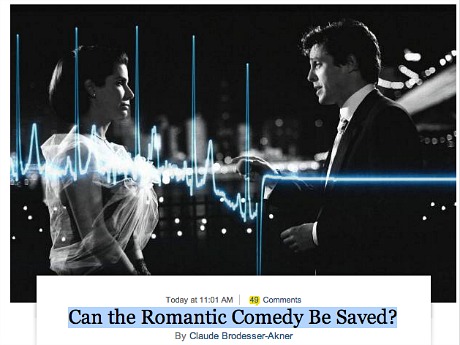
Which is why I find it staggering that Vulture‘s Claude Brodesser posted a piece today called “Can the Romantic Comedy Be Saved?,” and he didn’t even mention Silver Linings Playbook.

My first thought after I caught SLP in Toronto was “finally, a romantic comedy that I can not only stand but I actually like…this is how they should be made!” Brodesser-Akner could have disagreed and written that SLP actually isn’t a romcom and explained why, or mentioned it as a genre outlier or whatnot. But he doesn’t even acknowledge its existence. To him SLP is so far outside the bounds of what a romantic comedy is that he doesn’t even mention that Russell’s film at least vaguely qualifies for the reasons I mentioned above. He doesn’t even bring it up for the purpose of dismissing it. Amazing! Because he’s dead fucking wrong.

Beginning & Ending At The Table

In this Sunday’s N.Y. Times Oscar section, critic Manohla Dargis provides a nice reputational upgrade to David O. Russell‘s Silver Linings Playbook by comparing it Michael Haneke‘s Amour, or more precisely by evaluating them as equally strong and honorable films.

Amour and Silver Linings Playbook “are as different from each other in mood, look, feeling, cinematic technique and visual style as is possible to find in theaters,” Dargis observes. “[And yet] both are love stories. One shows love and a shared life at their inception; the other shows life, and the love that it sustained, ending. How Mr. Haneke and Mr. Russell convey the central relationships in their movies opens a window onto how each director expresses meaning through the dialogue and the performances; through human gestures and camera moves; through what is inside the frame and how everything in it is arranged (carefully or with feigned informality); through editing and its rhythms; through music or its absence.”

Dargis finishes by comparing two sitting-at-a-table scenes featuring the male and female leads (Bradley Cooper and Jennifer Lawrence in Silver Linings, Jean-Louis Trintignant and Emmanuelle Riva in Amour), and how the former is a beginning and the latter is the beginning of the end.

I’m posting this and providing the link because it’s a very wise and well written piece, and also, to be honest, to make things a little more difficult for the SLP haters. Anything I can do to denigrate, diminish or otherwise take this crew down, I’m there.

Oh, Those Nazi Tits

Today I ordered an English Bluray of Liliana Cavani‘s The Night Porter, which in my book is probably the most artistically valid expression of the Nazi-Fascist Perversion cycle of the early to mid ’70s. (Along with Salo and 1900, I suppose.) This scene is arguably the iconic-erotic highpoint of Charlotte Rampling‘s early career. I’m 90% sure someone is now going to write in and say “thanks for the warning…watching this video could get me fired!”

I’m sorry if the title of this post has struck some as vulgar, but (a) I love the sound of it and (b) with what other story or riff could I use it?

Virtual Fisheye Kubrick Tour

The best part of this Throck Morton video is the gas station fill-up. The LACMA Kubrick exhibition tour portion isn’t riveting, but it does give you a pretty good idea of what it is. The fisheye-lens headcam delivers reasonably good quality. I intend to purchase one for my own adventures. I’m thinking of visiting the LACMA Kubrick show sometime this week. I saw the show at the Cinematheque Francais in May 2011, and reported as follows:

“The Stanley Kubrick exposition at the Cinematheque Francais is a very thorough, abundantly detailed and absorbing presentation of Kubrick’s 54-year career, beginning with his photographer period (which began in 1945 when he took a shot of a newsstand proprietor looking forlorn the day that FDR‘s death was headlined) all the way through his last film, Eyes Wide Shut, and including exhibits from the three movies he worked like hell on but never made — Napoleon, A.I. and The Aryan Papers (which was killed by Schindler’s List).

“The icing on the cake is that the Cinematheque has gone the extra mile to put you in the mood — calling its restaurant the Korova Milkbar, laying a replica of the Overlook Hotel carpet on its floors, selling little red Lolita glasses in the gift shop, etc. A Clockwork Orange is screening this evening (i.e., right now) and there were six or seven fans dressed like Alex’s droogs (bowler hats, white shirts and pants, black boots) sitting outside at a table a couple of hours before.”

Here’s another amusing Throck Morton piece that deals in part with Merchant-Ivory and Howard’s End.

Best Cultural Homework Movie of 2012

I told a friend that I had a dream the other night, and in it a well-known critic was murdered. It was a horrible dream. A kind of nightmare really. The friend suggested that the critic was being dispatched because he’s a fan of Lincoln. I laughed and said “that’s funny,” but I reminded her that I’ve never hated Lincoln. I hate the Lincoln Best Picture talk — that’s the difference.

I reminded her that I gave Lincoln a passing grade in my initial review….a pass with reservations. A good, intelligent film that is also a doleful, talky, slow, ponderous civics lesson. Plus that hateful Janusz Kaminski lighting scheme as a kicker. Yeesh.

“But there are worse films than Lincoln that could win Best Picture,” my friend replied. “Good intentions and all of that. Lincoln has made $120 million at the box office and is the highest grossing film so far of the Best Picture nominees. You can’t just discard that.”

My response: “People are going en masse because the legend of Abraham Lincoln has been drilled into them since they were 7 or 8 years old. It’s not the movie, really — it’s the man and the Steven Spielberg brand assurance and the Daniel Day Lewis performance. Nobody is truly aroused or turned on by that film…no one. They’re going because they feel it’s something they ought to do — it’s a kind of cultural duty — and because it’s about the great Abraham Lincoln and because they know that all Spielberg films are safe and schmaltzy and intelligent in their fashion.

“And so they go and they sit and watch like an obedient congregation, and then the lights come up and they stand up and trudge out with those blank or grim expressions (I’ve seen them so don’t tell me), and they tell each other afterwards that DDL was really good (which he is) and yaddah-yaddah. Lincoln is no one’s idea of an ecstatic or rousing or head-turning experience. You know it and I know it. It’s a kind of homework movie that audiences feel they should go see because we’ve all received the Lincoln legend, and we don’t feel we can ignore it or wait for the DVD or the Netflix download.

“It’s a better-than-decent film, I agree, but people have gotten carried away by the awards talk and because they’re saying ‘how can we go wrong if we give the movie about the great Abraham Lincoln our Best Picture award?’ It’s on that level rather than ‘oh,my God, this film is so great…I’ve seen it three times and I could see it again.'”

Ironic Revisiting of 77 Sunset Strip?

77 Sunset Strip and its three Warner Bros. TV spinoffs — Bourbon Street Beat in New Orleans, Hawaiian Eye in Hawaii, and Surfside 6 in Miami — came up in conversation the other night. Four versions of the same detective agency show — essentially the same characters, same colorful sidekicks, same wisecracking secretary. The 77 Sunset Strip scripts were sometimes re-dressed and re-shot for Surfside 6 or whatever. I’ve read that even an occasional cast member from one series would show up in a guest capacity on another…is that true?

The geographical location of the non-existent 77 Sunset Strip office (as well as Dino’s Lodge, the next-door restaurant that actually existed and thrived for 20 years) was at 8532 Sunset, on the south side of Sunset between La Cienega and Alta Loma. The post-premiere after-party for Vincente Minnelli and Glenn Kenny‘s Some Came Running was held at Dino’s Lodge.

Here’s an idea for an honest-to-God 2013 cable TV series. Three slacker-stoner layabouts in their late 20s are time-transported back to a black-and-white 1959 world, and not as losers but as the new 77 Sunset Strip guys. And they get to play games and drive around in T-birds and live these totally cool private-eye slickster lifestyles, booze and babes and fast cars and penthouses, and they also get rich by betting on sports events that they know the winner of. Maybe they also get to influence other historical events…or not.

You could go any which way but the basic idea is that three no-direction-home 2013 guys are “saved,” in a sense, by being thrust into the distant past and being forced to live in a black-and-white world in which they have all the advantages and then some. All kinds of opportunities for frolic and perversity, not to mention reflections on the evolution of our culture over the last 50 years. But it wouldn’t work unless it was shot in black-and-white within a 1.37 to aspect ratio.

This is my idea — I just want to make that clear. Whatever happens, I get a piece of the action.