Wild In The Streets

One of the most inconsiderate things any driver can do is to attempt a standard parallel parking maneuver (i.e., stopping cold and then slowly reversing into a parking spot) on a busy two- or four-lane boulevard. This always forces dozens of others to stop dead and cool their jets while the driver very slowly and always without evident skill backs into the parking space. It always takes them forever. You just want to pull out a Glock and shoot their rear tires.

Don’t most people have power steering these days? The only way to park on a busy street is to ignore what the DMV says and just dart your nose in there and then wiggle around until you’ve got your car more or less parallel to the curb and within 18 inches of it. I would never, ever stop dead on a busy street and effectively say to the people behind me, “Excuse me but I’m going to parallel park now…would you mind stopping and waiting for the next 80 or 90 seconds, and perhaps for the next two minutes? You don’t have anything pressing to do, right?”

If I parallel park I’m out of the driving lane within 5 or 10 seconds and the whole maneuver is complete within 20 or 30 seconds, tops.

The key thing about driving in a major city like Los Angeles, above and beyond observing basic rules of safety, is to never fuck with the flow by getting in people’s way. Yes, sometimes you just have to suck it in and wait and do your breathing exercises. Like when the old Jews in the Fairfax district slowly shuffle across the street with their walkers. I always tell myself “there but for the grace of God” and “they’re doing the best they can.” But I give glares of hate to almost all parallel parkers.

I always take note of the gender and ethnicity of the driver when stuff like this happens, and each and every time I’ve been stuck behind a parallel parker the driver is always female. Why? Because guys are aware of the “never fuck with the flow” rule and would rather go into a concrete parking structure and pay $6 dollars rather than block people.

By the way: I was cruising down Third Street in West Hollywood last night, and out of the wild blue yonder a woman driver just pulled out of a parking lot directly in front of me. I was maybe 75 feet or 90 feet away at the time but going 40 or 45 mph, and if I hadn’t tromped on the brake immediately I would have slammed into her. Did she roll down the window and wave in order to say “sorry…wasn’t looking!” Of course not. She just kept on driving and chatting with some dude who was riding shotgun.

“Defensive driving” means knowing that this kind of thing is going to happen sooner or later and just waiting for it. This is the key to not getting into accidents in this town. You’re going to hit someone if you drive around thinking “here I come…get out of my way!” You have to drive around like Hercule Poirot and say to yourself, “Okay, where are the assholes? They’re out in force so I have to keep a close watch.”

Feel My Pulse

Who cares if End of Watch and House at the End of the Street tied for first place at $13 million each and Clint Eastwood‘s Trouble With the Curve tallied $12.7 million? It could have Clint tied for first with End of Watch and End of the Street in second place or vice versa with a little three-card-monte switcharound. It doesn’t matter. It’s a minus-ten topic of discussion.

It was clear from the Trouble With The Curve trailers that with a few variations Clint is playing the same snarly old guy that he played in Million Dollar Baby and Gran Torino. Trouble didn’t get the reviews it wanted, okay, but if pays off at the end. So why didn’t the Gran Torino crowd show up in greater numbers? Or will they show up in two or three weeks’ time? Did Clint’s “empty chair” routine at the Republican National Convention have anything to do with anything?

A Wing and a Prayer

The closer I put my ear to the tracks, the more convinced I am that Robert Zemeckis‘s Flight (Paramount, 11.2) is going to be the shit when it opens less than six weeks hence, and more precisely after it closes the New York Film Festival on Sunday, 10.14. The trailer tells you it’ll be a smart, above-average situational drama about a commercial pilot with an alcoholic history who saves a planeload of passengers from death despite being half in the bag. Or perhaps on some level because of this condition.

I don’t know the Flight particulars and I haven’t read John Gatins‘ screenplay. But I’m getting the feeling from the trailer and from what I’m hearing that Denzel’s condition when he saves his plane from crashing is what saves the day. If he’d been 100% sober he might not have rolled the plane over and landed it upside down. But even if this isn’t what the film says, I’m thinking that this principle applies to some extent to car driving.

If you’re driving your Lexus drunk your reaction time is slower than if you’re cold sober, and if you’re really stinko you’re definitely a menace to all humanity. But drunk or semi-drunk driving isn’t all bad, and sometimes it works. Or at least it did for me.

I know, I know — did I just say that? In today’s world DUI is a felony punishable by huge fines and jail time in some cases, and rightly so. But in the ’70s tens of thousands of people drove from place to place every night with a buzz-on and in some cases plain shitfaced, and some awful things resulted, I’m sure. But quite often, probably the vast majority of times, drunks just drove home and parked their cars and watched a little TV and went to sleep and all was well.

May God forgive me but in my early drinking days when I lived in Wilton and Westport, Connecticut, I drove late at night with several beers and/or Jack Daniels on the rocks in my system, and I just cruised on through, and I mean weekend after weekend after weekend after weekend. No accidents, no fender benders, nothing. Others plowed their cars into ponds and trees and guard-rails, but not me. There were times, in fact, when I drove down those winding country roads at high speeds and I would focus like a motherfucker, and I was convinced at times that I was driving like Paul Newman at Lime Rock.

I started to tell myself, in fact, that I drove better when half-bombed because I was less intimidated by the possibility of something going wrong. I drove without fear, without hesitation. I took those hairpin turns like a champ.

In short, if you’re as good a driver as I was and you’re not flat-out wasted, driving with booze in your system isn’t such a bad thing. Or at least it doesn’t need to be. Would I drive drunk now? No. I stopped drinking last March and I’m not an asshole. I’m just saying that I got away with it for years, and…well, I’ve said it.

Frack You

Gus Van Sant‘s Promised Land (Focus Features, 12.28) was originally going to be directed by star and cowriter Matt Damon, but Damon gave up the reins due to scheduling issues. It seems to basically be a more solemn Local Hero with a likable young guy in a suit (i.e., Damon) presenting an ostensibly attractive offer to a small town, but representing natural gas interests instead of oil. The story has been more or less fully telegraphed by the trailer.

John Krasinski, Frances McDormand, Rosemarie DeWitt, Lucas Black and Hal Holbrook costar.

Mike’s Murder Refrain

Here’s “Trailer From Hell” wise man Larry Karaszewski on James BridgesMike’s Murder (1984), which I wrote about four and a half years ago. The point was to urge Warner Home Video to release it on DVD, and if possible to release the original Bridges cut.

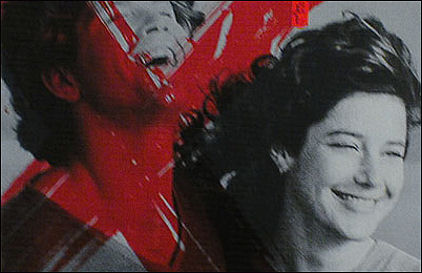
Here’s Pauline Kael‘s mini-review: “Debra Winger, in a superb full-scale starring performance, as a radiantly sane young bank teller in LA who has an affair with a curly-haired clear-faced young tennis instructor called Mike (Mark Keyloun). It’s a wobbly affair: She hears from him randomly over the course of two years — whenever the mood hits him, he phones her. One night, he’s supposed to come over late, but he doesn’t show. When she gets a call telling her he’s dead, it’s abrupt, bewildering. She can’t let go of him so quickly, and she tries to find out everything she can.

“Winger has thick, long, loose hair and a deep, sensual beauty in this movie. James Bridges, who directed, wrote the role for her after directing her in Urban Cowboy, and her performance suggests what Antonioni seemed to be trying to get from Jeanne Moreau in La Notte , only it really works with Winger — maybe because there’s nothing sullen or closed about her. The picture is atmospheric yet underpopulated; at times, it feels thin, and it turns into overheated melodrama in a sequence featuring Darrell Larson.

“But its view of the cocaine subculture (or culture) of LA is probably Bridges’ most original and daring effort, and it has a brief, intense appearance by Paul Winfield (as the record producer who brought Mike to LA) that’s right up there with Winger’s acting. With Brooke Alderson, Robert Crosson as Sam, and Daniel Shor as Richard, the performance artist. The Warner executives refused to release the picture until Bridges made some cuts and changes, and they probably breathed a few sighs of relief as they buried it.”

Here’s part of what I wrote in March ’08: “It didn’t register very strongly in the mid-Reagan era because it didn’t shoot for the stratosphere or deliver fierce visceral thrills, which is what audiences seemed to be responding to more and more back then. (The ’70s heyday had drawn to a close, and blunt-impact movies — sci-fi epics, actioners, tits-and-zits comedies — were gaining big- time.) But it handled itself and its subject — the L.A. drug-dealing scene — in a way that was almost deceptively powerful. It’s a sad and somber little piece that leaves a haunting after-vibe.

“And it had some unusually penetrating performances from Debra Winger, Paul Winfield, Mark Keyloun (a newcomer at the time who seemed to work mostly on television after Mike’s Murder and who retired from acting in the early ’90s) and Darrell Larson. There was real ache and loneliness in their emoting. Which lent unusual gravity to a story that structurally was only a murder-mystery.

“An IMDB posting by James Sanford says that Mike’s Murder has “a beautifully evoked, vaguely creepy atmosphere that hangs over every scene….the crime that sets the story in motion remains unsolved at the end, and perhaps that’s how it should be. It’s not important who really killed Mike Chuhutsky, Bridges seems to be saying. Not when it’s so obvious what killed him.”

“It’s been over ten years since I’ve seen Mike’s Murder, but I remember three things in particular: (a) the look of immense sadness on Winfield’s face as his character, a wealthy gay man who had a thing for Mike, considers the character flaws that led to his death, (b) the horrific howl that comes out of Larson, Mike’s not-very-smart best friend, as he’s about to be murdered by thugs for having stolen cocaine from a major dealer who lives in the hills, and (c) a nifty little sequence in the very beginning that shows a hamburger being prepared at Tomy’s on Pico Blvd.”

Here are several clips from the film.

To Risk Forgiveness

It’s not interesting to hear that Robert Pattinson and Kristen Stewart — a.k.a. Robtsen — have reportedly patched things up and are back together. The shock of loneliness and the pain of separation, being stung by jealousy and betrayal, the drip-drip agony of it all…that’s what we care about. But I did run two or three stories about their breakup so I guess it’s necessary in a symmetrical sense to report the healing. And RPatz still has a bulletproof “get out of jail” card if he ever fucks up.