I’m respectfully taking issue with David Carr‘s new glasses. They don’t compete with his features and thereby interfere to some extent with his manner and personality; they almost overwhelm them. Minimal wire frames required.
CNN’s embed codes are infuriating. I’ve re-scaled the dimensions perfectly to fit HE’s template (460 pixels wide x 413 pixels high) and still they come out smaller than they should.
Why are the Academy’s Oscar nominees and winners criticized so frequently for being traditionally staid and “safe”? Why has the general Academy mentality proven so averse or oblivious to the contours and leanings of the present? We all know the answer. It’s because the Academy is made up of mostly older white guys who aren’t paying close attention, largely because they don’t choose to because they’re looking to maintain their relationships with other older white guys, and who are always looking for a job so why shake things up or otherwise rock the boat?
But all along I’ve been buying the line that the Academy is expanding its roster and getting younger and more inclusive. More members in their 30s and 40s, right? Jonah Hill, Tina Fey, David Gordon Green, Kristen Wiig, Judd Apatow, Seth Rogen, etc.? Well, that’s mostly Academy spin, it turns out.
Because a just-published L.A.Times survey (2.19) led by John Horn, Nicole Sperling and Doug Smith reports that Oscar voters are nearly 94% Caucasian and 77% male, have a median age of 62.
And — here’s the kicker — “people younger than 50 constitute just 14% of the membership.”
“The Times found that some of the academy’s 15 branches are almost exclusively white and male. Caucasians currently make up 90% or more of every academy branch except actors, whose roster is 88% white. The academy’s executive branch is 98% white, as is its writers branch. Blacks are about 2% of the academy, and Latinos are less than 2%.”
Your typical Academy member, in short — the person whose whims are constantly being studied and divined by Sasha Stone, Scott Feinberg, “Safe Dave” Karger, Tom O’Neil, Kris Tapley, Stu Van Airsdale and Pete Hammond — is a graying (or dyed-haired) guy with a paunch and a neck waddle and liver spots on his hands who doesn’t work out as much as he used to, and who listened to Frankie Avalon and the Turtles and Paul Revere and the Raiders in high school, and who tends to watch comfort movies when he’s home instead of Academy screeners, and who sometimes nods out at screenings.
“Men compose more than 90% of five branches, including cinematography and visual effects,” the report says. “Of the academy’s 43-member board of governors, six are women; public relations executive Cheryl Boone Isaacs is the sole person of color.
“The full roster of the Academy of Motion Pictures Arts and Sciences has never been published. Times reporters confirmed the identities of more than 5,100 Oscar voters — more than 89% of all active voting members.
“‘We absolutely recognize that we need to do a better job,’ said writer-director Phil Alden Robinson, a longtime academy governor. But “we start off with one hand tied behind our back…if the industry as a whole is not doing a great job in opening up its ranks, it’s very hard for us to diversify our membership.”
Frank Pierson, a former academy president who won an Oscar for original screenplay for Dog Day Afternoon in 1976, said merit is the primary criterion for membership.
“I don’t see any reason why the academy should represent the entire American population. That’s what the People’s Choice Awards are for. We represent the professional filmmakers, and if that doesn’t reflect the general population, so be it.”
“Some academy members, though, believe the organization should do more to reflect the demographics of the nation. Denzel Washington, who won the lead actor award for 2001’s Training Day,” said the academy needs to ‘open it up’ and ‘balance’ its membership.
“‘If the country is 12% black, make the academy 12% black,’ Washington said. ‘If the nation is 15% Hispanic, make the academy 15% Hispanic. Why not?'”
I don’t quite buy Washington’s calculus. I think you have to demographically survey the ranks of filmmakers in the indie community and all over and determine what percentage in this group — people who are actually trying to get features or shorts made by hook or crook — are black and Latino and whatnot, and then you need to adjust the Academy’s membership accordingly.
You can’t go by the general population. There are millions upon millions of lazy, fast-food-eating couch potatoes of every ethnic stripe out there, and you can’t expect their ranks to be reflected in an organization made up of determined achievers.
You are, at times, an inspired writer and obviously, within the Hollywood internet realm, a famous (or infamous) personality, your fame reaching all the way to London (evidenced by that July 20011 article by the Guardian‘s Tim Adams). But last night, again, you degraded Hollywood Elsewhere by taking a dump on the carpet with your pathetic, infantile, self-pitying sexual melancholia.
Imagine having a party at your home and an exceptionally bright and interesting guest — a friend, in fact — comes over and gets drunk and moons the guests and vomits all over the floor and then leaves. And then you have another party and he comes by and does the same thing again. And again. And again. Honestly, how would you feel? And how would you respond after the eleventh or twentieth vomit-splat?
In the early 1940s Jackson Pollock urinated into the fireplace at a party thrown by Peggy Guggenheim. Yes, she forgave him and supported him after that, but you are not Jackson Pollock and I am not Peggy fucking Guggenheim. And I am not going to buy you the services of a prostitute. I tried to instigate a reader donation fund to give you a weekend at Heidi Fleiss‘s Space Alien cathouse in Nevada, but no one bit and that’s the end of it.
18 months ago I wrote that “the coarseness [and] the self-pity…have to be turned down. Way down. I’m not trying to be Ms. Manners. But there finally has to be an emphasis on perception and love and passion and the glories of good writing. There has to be an emphasis on letting in the light rather than damning the darkness.”
Do this one more time and I will ban you from Hollywood Elsewhere for life. That means you can sign back in under another name and I will erase you again. And again. As long as you want to play this game, I will block you and block you and block you. This is really, really it on my end.
Stop drinking, for Chrissake! PLEASE! I have recently and I feel great. And stop eating dairy and breads and cheese dogs and Fettucine Alfredo and cheeseburgers and ice cream and Danish pretzels. “Eat food. Not too much. Mostly plants.” And lift weights and get some running or walking in every day. And show some balls and write your own column, which I said I’d let you have on the site. And then save some money and fly to Prague for a hair-plug operation. And oh, yeah…STOP DRINKING.
And stop wearing gray cross-training lace-up shoes. When we met at Mel’s Drive-In that one time I gulped when I saw you in those effing things. I knew then and there that you were (a) having problems in life and (b) would continue to have problems in life. Because no one with the slightest sense of style and/or self-respect wears gray cross-training shoes.
It’s been nearly thirteen years since the debut of Alexander Payne‘s Election, and it’s doubtful, frankly, that Reese Witherspoon will luck into a role as good as Tracy Flick again. It enabled her to give her very best performance. Certainly her most memorable, in part because she wasn’t “acting” — Tracy Flick is inside Witherspoon as surely as Tom Dunson and Ethan Edwards were inside John Wayne.
Has Witherspoon ever played a Tracy-ish role since? Of course not. Will she ever? Not likely. Will she ever make anything of any value again, ever? What kind of management puts a feisty adult actress in projects like This Is War and Water for Elephants? One thing Witherspoon will never sell is foxy-sexy; nor softly romantic and vulnerable. She’s too steely and practical. Tracy Flick was lightning in a bottle, and that stuff doesn’t grow on trees.
Hey, Tom O’Neil, Sasha Stone, Kris Tapley, Stu Van Airsdale, Scott Feinberg, et. al.! The Oscars are happening only eight days hence. Are there any more articles or polls or predictions or sideline pieces we can run with over the next few days? You know, just to keep the suspense and excitement going?
HitFix/In Contention‘s Roth Cornetposted one of the finest assessments of Bennett Miller‘s Moneyball that I’ve read this year:
“Many traditional sports movies either overtly or inherently deliver the message that our worth can be discovered, confirmed or solidified in one moment of victory and/or within the framework of a shiny, easily identifiable skill — even if that skill is simply strength of will.
“Moneyball presents an image of the human experience that feels far more reflective of life, one in which we are, as Brad Pitt said in an interview with The Guardian, ‘a series of successes and failures,’ who must make choices based on multiple and nuanced factors.
“The other message of many sports films is that our worth ought to be reflected by outside markers to the degree that a loss of the prize in question would be an insurmountable tragedy. Moneyball reminds us of the times that we hit a home run and are so focused on the wrong thing that we don’t even know it.”
What kind of a woman’s name is “Roth”? It has a very cool ring but I’ve never once heard it used before.
Ceasar Must Die, a reportedly not-great, less-than-commercial documentary by Paolo and Vittorio Taviani, the 80-something Italian filmmakers who creatively peaked 35 years ago with Padre Padrone, has won the Golden Bear at the Berlin Film Festival.
Indiewire‘s Peter Kneght reports that “many had pegged Christian Petzold‘s Barbara or Miguel Gomes‘ Tabu as the likely winner, as both received considerable critical acclaim.”
“Mixed reviews out of Berlin and an experimental production method may hold Caesar back from much of a wide release,” Eric Kohn wrote in his Indiewire review, “although it has enough unique appeal to make its way to an alternative release or perhaps a solid television deal.”
A jury led by Mike Leigh looked at the doc, a portrait of prison inmates putting on a performance of William Shakespeare‘s Julius Ceasar, and apparently decided the following before making their announcement: “Giving the prize to the Taviani brothers is not just a vote of approval for their latest film but also a way of honoring their past works and particularly the cinema of the ’70s and ’80s. We will also be saluting creative endeavor by artists of advanced years, which is something we all need to honor and support because we’ll all be there before you know it. This award will also be perceived as a metaphorical renunciation of the lamentable tendencies of the present.
“So it will be the right thing to do all around, and when it’s done we can all go home and smile at ourselves in the bathroom mirror.”
A guy I speak to from time to time went to last night’s Sleigh Bells concert at Manhattan’s Terminal 5. Which is obviously fine but he also “dropped,” if you catch my meaning. Can you imagine being in this kind of sensory-onslaught environment and going “whoo-hoo!” and raising your pointed index finger in tribute while tripping?
I wrote the guy back this morning and asked, “Sorry to sound like I’m sounding but have you ever thought about looking at LSD the old-fashioned way — as a chemical additive that opens the doors of perception and leads to a parting of the clouds and, for the true seekers, spiritual satori?
“I don’t need to remind you that thousands if not tens of thousands of lives were profoundly affected by LSD during the latter half of the 20th Century. LSD changed a portion of the Harvard University faculty in the early ’60s as well as the music of all the best rock bands of the mid to late ’60s (‘I know what it’s like to be dead’), and it triggered the great spiritual awakening of the late 1900s (roughly 1965 to the late ’70s) and…let me get this straight…you’re dropping it in order to ‘party’ and go whoo-hoo at a Sleigh Bells concert?
“Have you ever heard of Jay Stevens‘ “Storming Heaven,” the book I’ve written about in the column?
“I’m only saying that LSD opened things up spiritually and perceptionally for a whole lot of people in the ’60s and ’70s and gave them a taste of the mystical and sublime, the kind of Eastern enlightenment God-head that had previously been known only to a very select crowd (Aldous Huxley, Hermann Hesse, earnest readers of “Bhagavad Gita” and “Siddhartha,” the mystics of India, Cary Grant, Timothy Leary).
“What form does LSD come in now? Tablet, capsule…? How long does it last? For me the first two or three hours would be ecstatic — ‘elevator in the brain hotel’ — and then it would gradually level out and sink down after eight or ten hours.
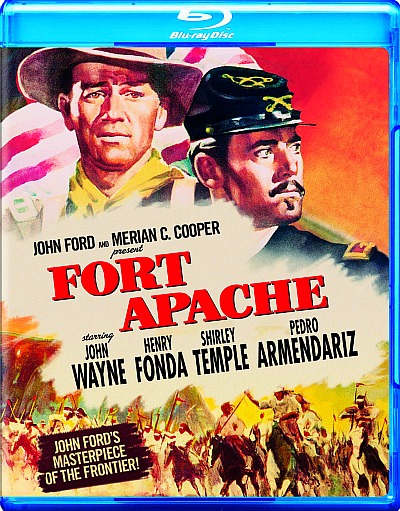
Why would I want to buy a Bluray of a 1948 black-and-white film that, according to Bluray.com’s Jeffrey Kauffman, (a) “isn’t up to the incredible standards of some of the other Warner classics of this era”, (b) was “sourced from a print and not a fine grain master positive or original negative,” (c) suffers from “minor emulsion issues (the opening few seconds are the worst), [and] occasional white flecks and scratches,” (d) could have provided “richer blacks,” and (e) includes “a few scenes are noticeably softer than the bulk of the film”?
The only interesting psychological undercurrent in Fort Apache is that Henry Fonda is playing a facsimile of the cold, heartless prick that Jane Fonda said he was in real life, when she and younger brother Peter were kids. He undoubtedly used this aspect of himself to play his Fort Apache character, an arrogant, George Custer-like general.
And as long as we’re discussing yet another John Ford Monument Valley film, consider once again my post about the utter idiocy of anyone living in Monument Valley in the mid to late 1800s (or the early 1900s even) due to the complete lack of life-sustaining minerals and elements. Ford’s Monument Valley is the biggest truckload of scenic bullshit ever dumped in the lap of the ticket-buying public. Monument Valley is only a slightly more hospitable environment than the surface of the moon, by which I mean it has oxygen and prettier scenery.
About a week ago Bill Murraytold his CNBC hosts that personal responsibility is lacking in this country, and that those who can’t man up and cut the mustard are going to stay in place or become “compost” — essentially a conservative sentiment. And on the other hand he says that super-partisans in Congress who are only trying to take the other guy down and make him look bad (obviously a reference to Boehner, Cantor & the wacko right) are destructive forces who are destroying hope.
This is a very inhumane, non-lefty, Big Hollywood thing to say, but Murray’s compost remark led me to imagine the following: if the government was to announce that in 30 days all homeless people will be rounded up in order to be used as meat filler for dog food, a healthy percentage of homeless people would suddenly be looking for a job or would at least be volunteering their energies for some socially helpful cause. Their ranks would be thinned significantly.
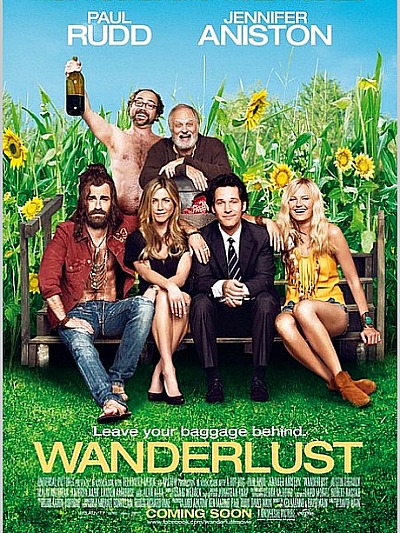
TheWrap‘s Tim Kenneallyreported a couple of hours ago that Wanderlust star Jennifer Aniston recently persuaded director David Wain and/or producers Judd Apatow, Ken Marino and Paul Rudd to digitally and editorially cover her naked breasts in a comedic topless scene, despite the precise point of the scene being that Aniston’s character bares her breasts in front of a local TV news crew.
Notice Theroux’s arm across Aniston’s shoulder. Implied statement: “I’m not only playing a charismatic Mel Lyman-ish hippie clan leader who seduces Aniston’s married character, but I’m also her boyfriend in real life, which means that her naked boobs are for my private pleasure alone…is that understood?”
Kenneally writes that Aniston “pleaded for an alternate version due to her blossoming relationship” with Wanderlust costar Justin Theroux, whom she met during filming and with whom she’s now living.
I have three things to say about this.
One, there’s nothing lamer than an actress saying she wants to water down a scene for a reason that has nothing to do with the integrity of the film. If you change a scene you do it for one reason and one reason only — i.e., to make the scene better on its own terms, and to make sure that the scene more successfully serves the picture as a whole. Only lame-o’s, non-artists and other people with pedestrian mentalities futz around with a scene for personal, non-artistic reasons. The conclusion, no offense, is that the shoe fits, and Aniston is wearing it.
Two, the story makes Theroux sound woefully insecure. Aniston wanted her boobs not shown in the film (and they have been covered up and cut around — I saw Wanderlust last night) because, in Kenneally’s view, she “decided it just wouldn’t be right to share her naked breasts with anyone except her new beau.” In other words Aniston was persuaded that Theroux would feel better about his live-in lady being modest or extra-devotional, or would feel less threatened or insecure or whatever. In other words, Theroux, to his possibly eternal discredit, may have complained and/or pressured her to make the change. If so (and even if he didn’t), what a unstable little wuss! Theroux is threatened by his girlfriend’s boobs being flashed in a totally non-erotic way in a big-studio comedy? What would Pablo Picasso or Ernest Hemingway have said if they were in Theroux’s position? This is the end of Justin Theroux as an actor who can play men of consequence in films. There’s only one way to regard him henceforth — as a wee man, a whiner, a guy who frets.
Three, Wain has demonstrated to the industry that he’s a director with no balls whatsoever. He’s a pushover, and can henceforth be depended upon to give on each and every artistic argument that arises during the making of any film he directs in the future. He has shown his colors, and is now regarded worldwide (or at least industry-wide) as a candy-ass. Ditto producers Apatow, Marino and Judd. They’d all rather comfort and indulge and pet their lead actress than make the film right…or not right. To them the concept of mellow relationships is all.
It would have been one thing if Wain had decided to cut the scene from the film entirely because Aniston’s sudden attack of modesty would make the scene seem ungenuine or half-assed or glossed-over. That I would understand. But agreeing to keep the scene while resorting to editing and digital cover-ups of Aniston’s boobs shows what kind of guy Wain is — a go-alonger, a guy who folds.
Update: Read how the lame-os at E! Online (and more particularly reporter Bruna Nessif) are covering this.
I won’t be attending today’s Bingham Ray memorial gathering (being held from 4:30 to 9:30 pm at Busby’s East at 5364 Wilshire, near La Brea) until 6:30 or 7 pm. But I’ll be there. What the prolonged Tim Russert memorials were to NBC staffers and reporters, the Ray memorials are to the indie film community.