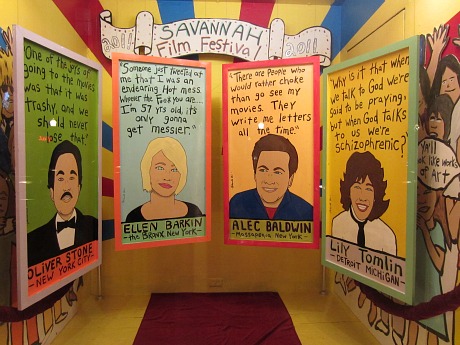
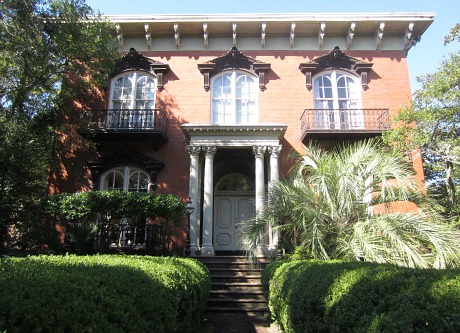
A day or so ago Gold Derby‘s Tom O’Neil posted video chats with Hollywood Reporter columnist Scott Feinberg about likely Best Actor and Best Actress contenders. Savannah hurly-burly kept me from re-posting immediately.
Disappearing Ink
Way back when people from Georgia used to speak with delicate Georgian accents. I remember hearing them at gas stations and diners when I drove through Georgia on my way to Florida. Vivien Leigh‘s Scarlett O’Hara spoke like a Georgian. Jimmy Carter still does, pronouncing “oil” as “awwl” and so on. But I heard no Georgian dialects during my three and a half days in Savannah. Okay, one or two but just about everyone sounded like they came from Connecticut or Maryland.
Atlanta has always been an uptown burgh, but I’ve always thought of Savannah as some kind of genteel hamlet where you could hear elegant, well-bred Southerners talk like elegant, well-bred Southerners. Remember Kevin Spacey‘s mint-julep patois in Midnight in the Garden of Good and Evil? Nobody talked like that in my presence last weekend. I guess you have to hang with the hicks in rural Mississippi or Alabama or Louisiana to hear people talk with any kind of drawl.
The South used to be an exotic place. Different aromas and assumptions, definitely not the North, a realm apart. It was a fabled territory that created literate, cultivated folk like William Faulkner and Harper Lee and Erskine Caldwell and characters like Boo Radley and Valentine Xavier and Blanche Dubois. It was also the culture of dumb-ass bubbas drinking cream soda and driving pickup trucks with shotgun racks and all that. It was just over 40 years ago when Randy Newman described rednecks as guys who “don’t know their ass from a hole in the ground.” I don’t think that line works any more.
I think corporate culture is making everything feel and look and sound more or less the same. This process has been gradually happening since the early ’70s, at least. Rural flavors and particularities are fading away. Everyone eats the same food, watches the same TV shows, wears the same 514, 511 and 501 jeans.
The only non-rural, uptown Southerners who seem to talk Southern-style are U.S. Senators and Congresspersons from southern districts. But I suspect they’re laying it on thick for theatrical effect, or because they suspect that a strong accent will resonate with conservative, low-income voters.
Anger Champ
I’ve long admired a certain veteran publicist for his ability to remain completely focused and lucid while letting go with red-faced rage. It’s a bad idea, of course, to let emotional ferocity color any sort of discussion, but a lot of people go there regardless. Some of us can hold on to our thoughts after getting pissed, but a lot (most?) of us can’t. Anger makes you spit and sputter and your sentences sound lumpy and primitive. The angrier you become the less able you are to deliver your points with any finesse. But this publicist, whom I worked for in the ’80s, used to let people have it with both barrels and still debate with knife-like precision. That’s a mark of exceptional intelligence.
Day in Savannah
Sam Levinson‘s Another Happy Day, which has been on the film festival circuit since bowing last January at Sundance and which will open on 11.18, played last night at the Savannah Film Festival. It’s definitely not The Family Stone, as Levinson exclaimed during the q & a. And it has “Red Twitter Queen” Ellen Barkin delivering the most searing, over-the-waterfall performance of her life as one of the most sensitive and well-intentioned crazy-torpedo moms of all time.
Barkin and Levinson talked a bit after the film ended, and I was there in the second row.
Day is a black family comedy without much serenity or calm or closure to pass around. It has teeth and rage and drug abuse and all the rest of that good stuff that has fueled miserable family dramas going back to Eugene O’Neil‘s Long Day’s Journey Into Night and James Goldman‘s The Lion in Winter…but with cryptic laughs. Everyone is hurting, seething, crippled, screaming, cutting themselves, depressed, despairing…you name it.
As Katherine Hepburn‘s Eleanor of Acquitaine says in Winter, “What family doesn’t have its ups and downs?”
The laughs aren’t my idea of constant, but when they hit the mark they really hit the mark.
It’s about the mother of all dysfunctional family wedding parties (in the Saddam Hussein sense of the term), and particularly about Lynn (Barkin), a mom with an aching heart and a quivering lower lip with a pathological need to constantly express anguish and relive painful moments in her life, and if at all possible to goad others into dredging up their own bad business.
She sees herself as a battered victim and a hard-bitten survivor, and she has taken her lumps, for sure. But she’s made a fetish out of suffering, and she can’t seem to let it go.
Lynn isn’t exactly Mary Tyrone from Long Day’s Journey or Hepburn’s Eleanor, but she’s certainly a woman of similar frustrations and compulsions and long-simmering resentments.
I have to stop filing because I have a 5 pm plane to catch, but Barkin’s costars are quite the handful — Kate Bosworth, Ellen Burstyn, Thomas Haden Church, George Kennedy, Ezra Miller, Demi Moore, Michael Nardelli.
I’m supposed to speak to Barkin and Levinson sometime later this week so I’ll pick it up then.
Wanted
I’ve told a few journalist acquaintances about a Sundance condo share…zip. They’re all set up elsewhere and/or can’t be bothered to reply so I’m going public. It’s a very large & spacious one-bedroom apartment at the Park Regency that easily accomodates three (i.e., myself and a journalist friend plus tenant X.) There’s a whole separate bunk bed area for the third person. The rental term is Saturday to Saturday so we’re taking it for two full weeks (1.14 through 1.28) for $2675. Divided by three = $891 or $89 per day if you’re Sundancing for the full 10 days.
The place has one regular big bedroom (me) with a full bathroom that I can share with someone, two bunk beds in their own area and a living room couch-bed with another full bathroom. It’s not cramped, there’s a decent amount of breathing room, the wifi is solid and it’s ideally located. Walkable to Eccles, walkable to Yarrow, totally walkable to Park City Marriott. It has a shuttle service that takes you anywhere. Big lobby with fireplace, free coffee, heated pool, etc.
$891 and $89 a day for the whole thing sounds pretty good to me, and there’s even room for four if the two newbies don’t mind bunking it down in the same alcove. Four would work out to $668.75 each. I’m always gone in the morning and don’t return until 11 or 12 midnight so I don’t care. Strictly for crashing and showering.
I usually arrive on Wednesday (1.18.12) to get set up and pick up my pass, etc.
Guest List
A filmmaker friend saw The Descendants last night (i.e., Sunday) at West Hollywood’s Soho House screening room. “Amazing movie, should go all the way,” he wrote. “The whole cast including George Clooney and Judy Greer plus all the kids were there along with [director-writer] Alexander Payne w/ Pacino, Jack N., Reese W. and Albert Brooks in the audience.
We’re on the same page then, I replied. “It’s got to be the front-runner,” he said. “And Clooney for Best Actor. Shailene Woodley could get nominated and maybe Judy Greer also on the basis of just four scenes.” Three scenes, I countered. “No, four,” he replied. “Beach, house X 2, hospital.” (I’m not going to explain this.)
“Wasn’t Robert Forster‘s cranky granddad good also? That early scene when he berates Clooney for not providing ‘more thrills at home’ and then later when he says ‘she was a devoted and loyal wife and deserved better.’ A lesser director-writer would have had Clooney say a little bit more in response and perhaps even spill the beans, but instead he just eats it. (I’m not explaining this either.)
“All brilliant,” he said.
Confession
Late this morning I finally saw Neil Labute‘s Sexting, an eight-minute short that premiered at Sundance 2011. A typically sharp and blunt LaBute piece. It’s basically Julia Stiles as the proverbial girlfriend talking straight into the lens but actually or anxiously to the wife of the married guy she’s been having an affair with. The nature of their exchange is hinted at around the 25-second mark.
Baldwin, Toback, Lyndon
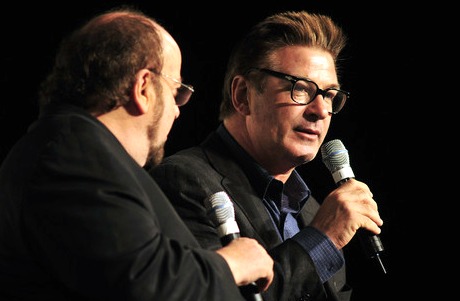
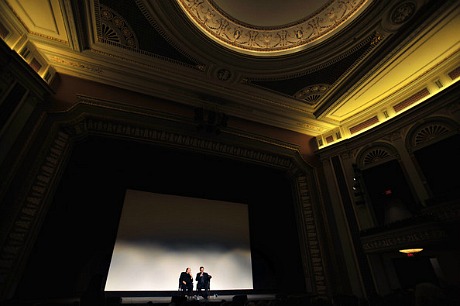
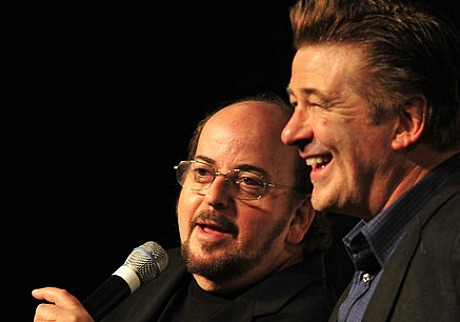
I took two Olympus digital recorders to yesterday’s Barry Lyndon discussion with Alec Baldwin and James Toback. I pushed the record button on the newer one and placed it on the stage just before the session began, and somehow it recorded nothing. I successfully recorded their discussion with an older device from my seat, but after a while I wondered what the point was of having two recordings so I turned it off.
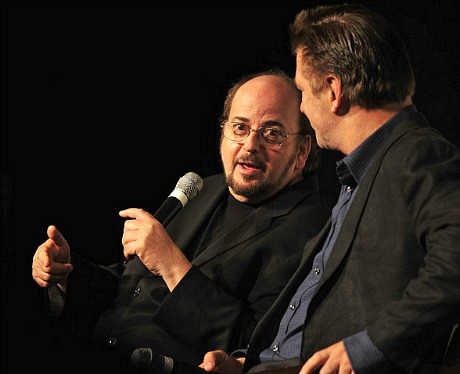
Director-writer James Toback (l.), actor Alec Baldin during yesterday afternoon’s hour-long chat at Savannah’s Lucas theatre.
Baldwin was funny and brilliant and so was Toback, and there I was in the fourth row, technically blowing it all to hell. Here‘s the short miserable clip that I recorded with the older device. Oh, and I accidentally deleted my photos so I had to borrow these shots from another site.
Toback told a funny story that happened during the cutting of Spartacus, which Kubrick directed and Kirk Douglas produced and starred in. The story came from editor Robert Lawrence, who later edited Toback’s Fingers and Exposed.
Kubrick and Lawrence were editing the finale when Jean Simmons, escaping from Rome with the help of Peter Ustinov , is saying goodbye to Douglas, who’s dying on a cross. Kubrick told Lawrence he didn’t want to use what he felt was a grotesque close-up of Douglas. Lawrence said the shot wasn’t so bad and in any case Douglas will surely complain when he notices that his closeup is missing. “I don’t care what he says,” Kubrick said. “I’m the director…take it out.” They later showed the scene to Douglas, and his immediate comment was exactly what Lawrence had predicted — “Where’s my closeup?” Kubrick shrugged and said, “I don’t know, Kirk.” He then turned to Lawrence and said, “Where’s his close-up?”
Waker-Upper
Five Savannah Film Festival-visiting entertainment journalists — myself, Awards Daily‘s Sasha Stone, Hollywood Reporter‘s Tim Appelo, critic Todd Gilchrist and CHUD’s Renn Brown — took part in a confession session this morning with about 25 Savannah film students. It happened in the plush lobby of the Marshall House, and it began, believe it or not, at 8:15 am. Here’s an mp3 file containing some of what was said.
Two Non-Altercations
I almost had words with a driver of a dark sedan during this morning’s bike ride through Savannah’s historic district. “Almost” is actually overstating it. I could have had words with this guy if I had a little less self-control.
I was stopping to take a picture on a small cobblestoned street, and a friend pulled her bike over to the opposite side. Along comes asshole in his dark sedan, and he doesn’t like that she’s taking up 18 to 24 inches of space in the right lane. He stops and waits for her to walk the bike entirely out his way before he proceeds. Except she doesn’t, meaning he’ll have to veer ever so lightly into the left lane to pass her. There was plenty of room, trust me.
So he starts in with the expressions. He scrunches his face up to express his contempt for her bike-riding skills. Then he does one of those head-wagging, “tsk-tsk” loud-exhale expressions that says “my God, this woman is beyond pathetic…the people I have to put up with…Jesus!,” etc.
The next “almost” happened in a touristy area near Congress Street. I raised my camera to take a picture of a couple of Clydesdale horses. A woman who was about to walk in front of my viewing path went “oh” and stopped and waited. She was being polite, of course, but I’ve said before that waiting for someone to snap a photo is a mark of middle-class cluelessness about photography. A good photographer has to roll with what happens, and sometimes you can get a better shot if somebody or something is half-obscuring what you’re shooting. You never know, and you’re better off not knowing. I never stop and wait for a picture to be taken…ever.
In any case, I said “thanks…it’s okay…it’s cool” to the woman. But I didn’t say it the right way. She took umbrage and asked if I had an attitude problem. I was just trying to get out of there but just to mess with her head I said “uh, yeah, I guess I do.” She stopped in her tracks. “What’s your problem?” People like you, I wanted to say. People who don’t understand that one of the tenets of mediocre photography is refusing to accept the natural unruliness of life and to just go with what happens when you’re shooting and stop trying to control everything. But instead I said “it’s cool, doesn’t matter” and turned away.
Boxy Rebellion
At 5 pm (95 minutes from now) Alec Baldwin and James Toback will be leading a post-screening discussion of Barry Lyndon (’75) at Savannah’s Lucas Theatre. The Stanley Kubrick film began showing around 2 pm. I waited in the green room before it began to do a chat with Toback (which I’d been told I was scheduled to do), but he wound up doing a longish TV interview and I was shunted aside. I didn’t care that much. I took a nap in an easy chair instead.
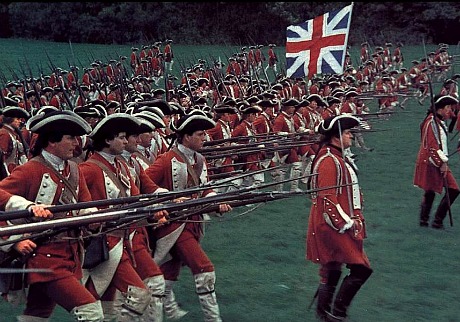
I went upstairs to see how Barry Lyndon looked, and was amazed and very pleased to see it projected at an aspect ratio that almost looked like 1.37 to 1 but was definitely boxier than 1.66 to 1. If any 16 x 9 or 1.85 crop fascists had been there they would have been furious. “Chop those tops and bottoms off!,” their mantra would go. “What’s with all the headroom? This is an outrage! Who’s the projectionist?”
The foot-lambert levels were insufficient, of course — it looked like 8 or 9 foot lamberts, definitely on the dark side — and the focus was hazy. This is what your typical theatrical projection of classic films is mostly like these days, for the most part. What you see is nowhere near as sharp and well-lighted and good-looking as the Bluray. Cheers all the same to the projectionist for staging a mini-rebellion and showing this classic film even a tad boxier than Kubrick himself intended.