Art of the Denouement

I’ll always be a fan of action flicks and suspense thrillers that end hard, clean and decisively and no fooling around, like the last minute or so of John Frankenheimer‘s French Connection 2 (’75).

But I’m an even bigger fan of edgy pulse-pounders that end with great denouements. Denouements are meditative wind-down sessions…summary scenes that provide a nice breather as both the main characters and the audience are given a chance to consider what’s happened, sort out some of the loose ends and maybe imagine what’s to come.

My all-time favorite denouement is the second-to-last scene in Three Days of the Condor (’75) — a nice dialogue scene between Robert Redford‘s “Turner” and Max Von Sydow‘s “Joubert”, standing outside of Leonard Atwood‘s suburban Virginia home at the break of dawn.

Another fave is the final scene in The Social Network, a let’s-get-real moment between Jessie Eisenberg‘s Mark Zuckerberg and Rashida Jones‘ junior attorney at a law office in Palo Alto…early evening.

There could have been an Apocalypse Now denouement that might have mirrored the ending of Joseph Conrad‘s “Heart of Darkness,” which Francis Coppola‘s 1979 Vietnam film is based upon. Martin Sheen‘s Cpt. Willard could have visited the Long Island home of the widow of Marlon Brando‘s Colonel Kutz, whose last words are “the horror! The horror!” When she asks about Kurtz’s final moment of life, Willard tells her that he wept as he called out her name. A good denouement, but Coppola felt that leaving Vietnam and transitioning to Great Neck or Oyster Bay would have been too much of a shock to the system.

Is the final scene in Red River (“You’ve earned it”) an apt and satisfying denouement or a forced and even silly ending that doesn’t quite work? (I’ve always liked it but that’s me.)

The famous Psycho denouement, in which a sandpaper-voiced psychiatrist (Simon Oakland) explains how Norman Bates killed his mother and her lover and thereafter stole her corpse and decided to become his mother in spirit — to “give half his life to her, so to speak” — feels a bit labored by today’s standards. It does, however, set up the final scene between Anthony Perkins and that fly, which is dead perfect.

Please name some other great ones.
Read more

Booo!!!

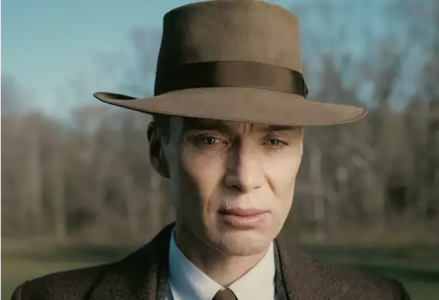
For a last and final time HE strongly objects to a suspected Academy preference for the Best Actor Oscar to be handed to Cillian Murphy.

Murphy gives a far more persuasive performance as an oddball alien from the planet Tralfamadore than as super-physicist J. Robert Oppenheimer in Chris Nolan’s Oppenheimer.

I’ve read “American Prometheus” and seen a great deal of footage of the actual Oppie, and there’s no question that this brilliant fellow was semi-human — that he radiated somewhat human qualities, mannerisms, characteristics. This is the one central thing that Murphy doesn’t convey.

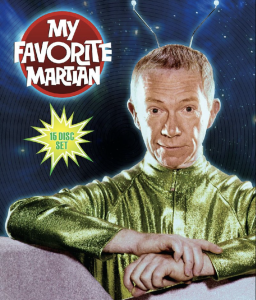
Even with his dual head antennas, My Favorite Martian star Ray Walston was more relatably human than Murphy’s Oppie.

If Murphy wins it’ll strictly be an Oppenheimer coat-tails thing, and I really hate that Academy voters (particularly the SAG-AFTRA knuckle-draggers) are apparently unwilling to show a little mental discipline and differentiate and be fair about this, for God’s sake.

Because it’s wrong, wrong, terribly wrong to blow off Paul Giamatti’s obviously superior, more fickle and flavorful and far more human performance as Barton Academy’s curmudgeonly classics professor Paul Hunham, the lead in Alexander Payne‘s The Holdovers.

Plus Giamatti gave one of the 21st Century’s greatest and most cherished performances as aspiring novelist and wine connoisseur Miles Raymond in Payne’s Sideways (‘04). And he wasn’t even nominated for this! Are you kidding me?

Giamatti obviously owns the winning narrative. They blew him off 19 years ago but they can’t do it twice…c’mon! He’s owed big-time, and the refusal of the Oppenheimer sweep lemmings to step back and acknowledge this is truly, deeply offensive.

Erotic Urgency

“A bush baby” — a birthday gift requested during an earth-to-space-station video call by the very young daughter of Dr. Heywood R. Floyd in 2001: A Space Odyssey (1968).

“A bush baby? Well, we’ll have to see about that.” — Floyd’s response.

Odious Library Guy

Two days ago I was repulsed by the unwelcome (i.e., overly familiar) attention of an older, possibly alcoholic, seemingly unstable dude. It happened in the Wilton Library and it wasn’t cool. The man was sitting nearby and belching, for one thing. Every so often he got up and sauntered around like a drunk. He passed by my work station twice, and too slowly for my comfort.

The first time I said nothing, although I was thinking “what’s his fucking problem?” The second time he stopped and looked down at me as he rested his forearm on the work station partition, like he wanted to chat. “The fuck?” I said, alarmed and recoiling at the possibility. He half-smiled and muttered something about the fact that it was raining outside. I looked at him with disgust, and he promptly ceased all attempts at conversation.

Five or ten minutes later he belched again, sounding like a hog as his throat was being cut.

Running into drunks and nutters on one of the New York City subway lines is unfortunately par for the course, but it‘s beyond the pale in bucolic Wilton.

Not That Much Of An Age Gap

You could call The Idea of You (Amazon Prime, 5.2) a May-December romance, but it’s more like a June-September thang.

In actuality Anne Hathaway, a Scorpio born on my birthday (11.12), is now 41 years old. In the film Hathaway’s boy-toy boyfriend, Nicholas Galitzine‘s “Hayes Campbell”, is supposed to be 24 but is actually 29.

Okay, a 12-year age gap but when I was in my early 20s I had a thing for 30something women, as I had this belief they were better in bed. That wasn’t nececssarily true, I discovered, but I still liked older.

We know how these stories always end, but don’t let me spoil it.

Directed by Michael Showalter (The Big Sick) and based on the same-titled novel by Robinne Lee.

Aspergers Guy at Apple Store

A day or two ago I was inquiring about my iPhone 15 at the local Apple store. It was only a couple of minutes after opening, and there were maybe nine or ten store reps in their royal-blue T-shirts, all looking at me and ready to help.

You never know in advance if the person you’re about to speak to is a tip-top brainiac. Most of them are reasonably bright and always generous in spirit but they rarely know everything, and more often than not they’ll pass along information that they “think” is probably correct, often adding “let me check…hold on.” And that’s fine.

But I knew I’d lucked out when I began talking to a 20something store rep with a knitted skull cap. First of all guys who wear skull caps tend to be ultra-focused in a nerdball way. But I knew this dude was a genius because he pointedly didn’t make eye contact. Right away I said to myself “that’s an Asperger’s thing…this guy is Albert Einstein-y.”

And he pretty much was, as it turned out. Not once did this guy even glance in the direction of my pupils. The whole time he was looking at the tabletop or the belt on my jeans or the fringe tip of my wool scarf. And he was fucking brilliant. It was hugely pleasurable to converse with him.

The vast majority of people in customer service focus on smiling and nicey-nice-ing and emotional caressings, and that’s fine. But when a slightly dysfunctional Genius Bar-type guy comes along, I smile inside and say a little prayer of thanks.

People Who Say “Uhm” While Collecting Thoughts

I can’t abide people who repeatedly say “uhm” in the middle of long explanations or statements or descriptions.

Once they start doing this I immediately stop listening to the substance of what they’re saying and start waiting for their next “uhm.” I don’t want to hear it but at the same time I do.

When the next “uhm” comes along I roll my eyes and let out a slight cough. The more they say “uhm” the stronger my telepathic message: “Stop doing this…say what you need to say without saying ‘uhm’….you’re killing me and yourself in the bargain…dear God, stop it.”

And then they say it again.

“Uhm” is a filler word — a word that signifies (a) you’re a clod and (b) you’re mulling over and preparing your next phrase or sentence.

Okay, I’ll occasionally use “uhhh” as a pause word, but I decided decades ago to never, ever say “uhm.” Or “like” — only idiots say “like” all the time.

I also say “basically” from time to time, but I never say it like a Millennial or Zoomer — “bayziggly.”

Lincoln’s Gettysburg address: “Uhm…four score and seven years ago our fathers…uhm…our fathers brought forth on this continent…uhm…a new nation, conceived in Liberty, and dedicated to the proposition that…uhm, all men are created equal.”

Heavenly Monochrome

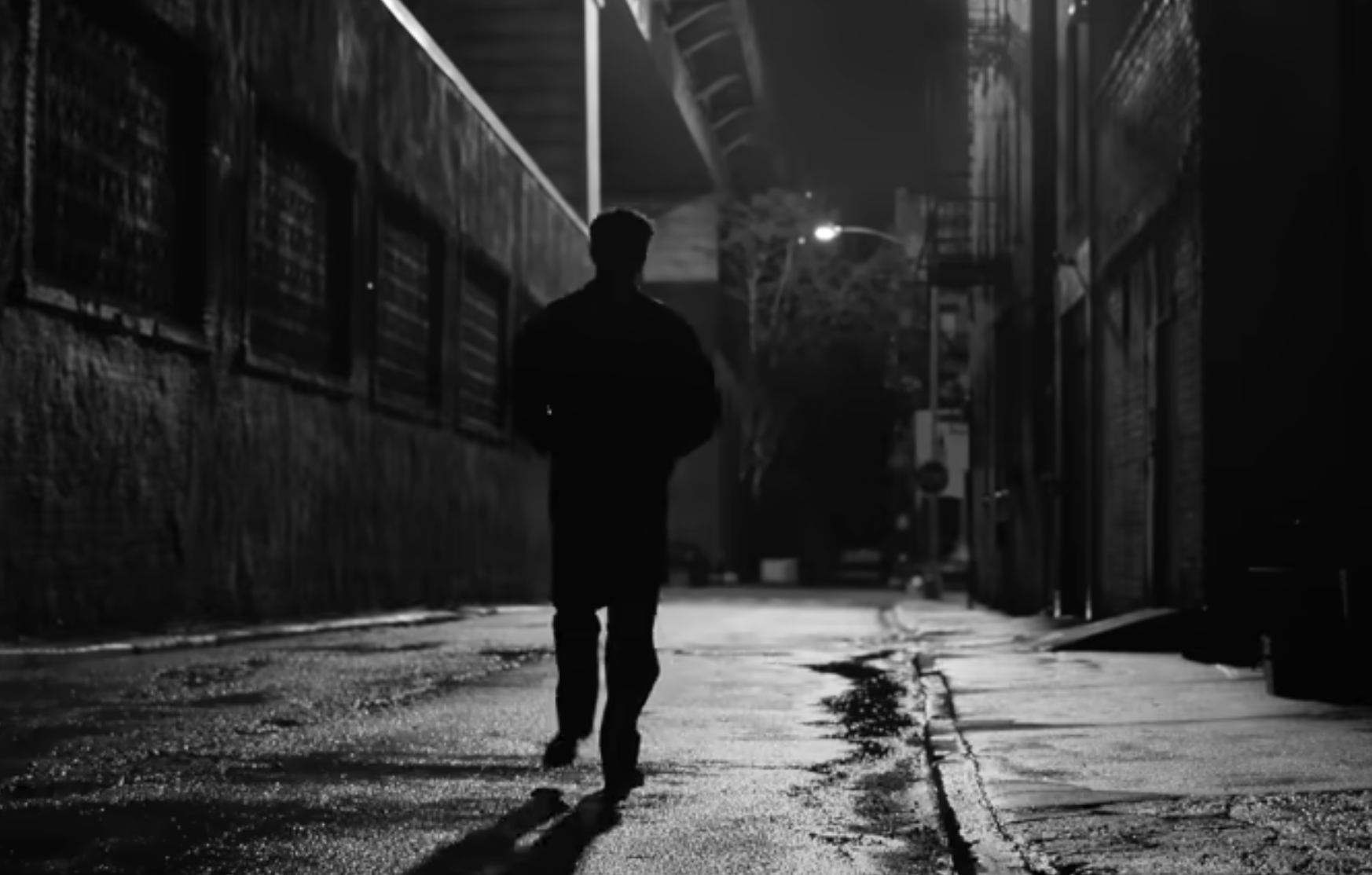
Robert Elswit‘s black-and-white lensing of Steven Zaillian‘s Ripley (Netflix, 4.4, eight episodes) is drop-dead beautiful — that much is certain.

Pic is based on Patricia Highsmith‘s “The Talented Mr. Ripley” (’55) and is obviously a handsomely stylish re-fresh of Anthony Minghella’s 1999 theatrical film version.

The Minghella was set in 1958 (i.e., two years before the release of Rene Clement‘s Purple Noon). The Zallian newbie is set in “the ’60s,” according to the Wiki page.

Scorsese’s Seventh Best Film

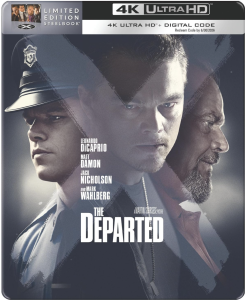
Martin Scorsese‘s The Departed is now close to 18 years old. Ranking ahead on the Scorsese hot list are Goodfellas, Mean Streets, Taxi Driver, Raging Bull, The Wolf of Wall Street and The Last Temptation of Christ.

So The Departed ranks seventh, and that ain’t hay.

A new 4K Bluray of The Departed pops on 4.23.

And I’ll repeat my argument with two Jack Nicholson/”Frank Costello” lines. One, Costello describing Rome as a place with “nicer wops” but “no pizza.” I’ve visited Rome five or six times and pizza joints are everywhere. And two, repeating that cliche about Chinese laundry guys saying “no tickee, no laundry.” Except the line is “no tickee, no washee.”

Read more

Steiner’s Music Matters A Great Deal

I was looking at this Gone With The Wind overture clip, and I found myself curiously melting down over Max Steiner‘s music. Because it’s gentle and sad and lamenting, and because it conveys a sentimental longing for things — customs, attitudes, climates, cultural atmospheres — that are gone and never to return.

I’ve written five or six times that GWTW is not a film about slavery or the antebellum South or even, really, the Civil War. If it was just a Civil War epic or a Southern plantation drama or a marital misery piece it would have faded many decades ago.

It’s basically a parable about hard times and terrible deprivations, and most people (apart from the terminal wokeys) understand that today. It’s about (a) a struggle to survive under ghastly conditions and (b) about how those with brass and gumption often get through the rough patches better than those who embrace goodness and generosity and playing by the rules.

Yes, David O. Selznick‘s 1939 film is an icky and offensive thing here and there, but (I’ve said this also a few times) you can’t throw out the second half of part one…the shelling of Atlanta, the struggle, the crowd scenes, the panic, the burning of Atlanta, the anguish, the soldiers groaning and moaning, Scarlett’s drooling horse collapsing from exhaustion, the moonlight breaking through as she approaches Tara, the radish scene plus Ernest Haller‘s cinematography…you just can’t throw all that out.

Obviously the film’s unfortunate racial attitudes, which were lamentably par for the course 85 years ago, are now socially obsolete. And I wouldn’t argue with anyone who feels that portions of it are too distasteful to celebrate, but it just doesn’t seem right to lock all of that richness inside some ignoble closet and say “no more, forget about it, put it out of your minds.”

Legendary filmmaking is legendary filmmaking, and Steiner’s music is just too affecting, too transporting.

Steiner’s greatest scores: King Kong, The Informer, Slim, Jezebel, Gone with the Wind, Sergeant York, Casablanca, Since You Went Away, The Big Sleep, Key Largo, The Treasure of the Sierra Madre, White Heat.

Read more