Nobody has been slower to post the Horrible Bosses trailer. I have many good excuses — well, one big one — but I’m definitely the caboose.
All Things Shining
Earlier today Matt Zoller Seitz posted Part 2 of a Terrence Malick appreciation piece, focusing solely on Days of Heaven and in tribute to the imminent appearance of The Tree of Life.
Dry, Spare, Full Of Itself
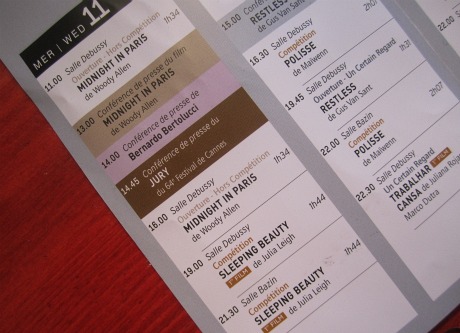
Julia Leigh‘s Sleeping Beauty, which just finished showing at the Debussy, is a highly refined, carefully poised erotic mood piece with oodles and oodles of milky nudity. It’s definitely a LexG movie, and I’ll tell you right now I’m kinda sorry I just wrote that. I only know that all through it I was saying, “This thing is candy for guys like LexG…a bag of Halloween candy. But that’s not what you’re supposed to think.”
Emily Browning‘s Lucy is a student who does this and that to make ends meet — high-end prostitution mostly, but she also holds down jobs at a copy shop and a bar/restaurant. And she goes to classes in-between. The film is more or less about Lucy being lost or zoned out in this oddly meandering, downswirl life. She’s not unhappy as much as numb.
I felt numb watching it. It’s obvious that Leigh knows how to deliver those Cannes Film Festival-tailored, high-end cinematic chops in a kind of…I don’t know, a late-Buneulian or Peter Greenaway sort of way. The movie is a class act but most of the time you’re trying to figure out what’s going on exactly. Stop allowing the violations, you’re telling Lucy all through it. But mostly you’re saying to Leigh, “Can this movie get off its arse and do something, please?”
Three or four times I raised my hands in exasperation, hoping that the screen or Leigh or Lucy or whomever/whatever would feel my plight and respond.
I was tempted to use the term “erotic horseshit” in the headline but that’s not really fair. You’d have to call Sleeping Beauty some kind of lost-in-space movie but — but! — it’s very nicely done for whatever that may be worth. Leigh and Browning definitely make you feel the angst and the agony of being used and stuck and flirting with drifting doom. This is a woman without a plan or a dream or anything, really, except for a kind of suppressed revulsion at the stuff she does.
The film does hold your interest because you’re constantly sensing that something is going to happen. And it does, but that “something” is the fact that Sleeping Beauty ends. And that is something.
And with her brave and memorable performance Browning has certainly balanced out the demerits she got for playing Babydoll in Zack Snyder‘s thoroughly contemptible Sucker Punch. Aaron Hillis just tweeted that the film could be called Fucker Punch — good one. The film subjects you to the sight of three old naked guys getting all sick and pervy with Browning, and that, I can tell you, gets very old. Oh, no…here comes another geezer. Please don’t take your clothes off…oh, Jesus, he’s undressing…God. Please don’t show me another withered hairy dick.
But the best moment in the film comes when one of the old guys (I’ll eventually get the actor’s name) delivers a soliloquy about the agony of aging and withering and the falling apart of bones.
At least the film ends with a scream. Maybe Lucy has finally had enough, you’re thinking. Some in the audience shared that resolve, I suspect. I’m not sorry I saw Sleeping Beauty — I’m a better man for it, I think. But I’m not exactly delighted either. Leigh, a novelist, can certainly compose and frame and abbreviate and…well, direct in what anyone would call a highly oblique, dry-as-a-bone manner.
Light Paris Embrace
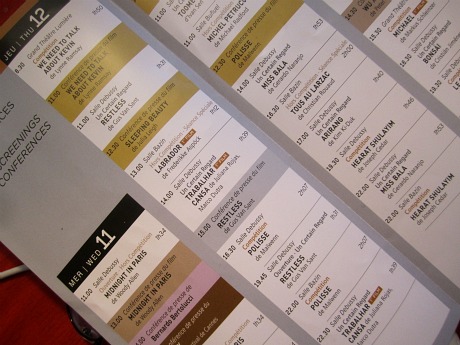
There’s no fair-minded way to put down Woody Allen‘s Midnight in Paris, which I’m calling a relatively minor piece that works very well by way of charm and humor. The key phrase, of course, is “works very well.” When a film does this then words like “minor” or “trifle” go out the window because a film that knows what it’s doing is by definition substantial and not minor. It may not be the startling world-class masterpiece you’re looking to see, okay, but a success is a success.
You can complain like Indiewire‘s Eric Kohn, but you’ll sound like a guy who doesn’t know when to leave well enough alone. He remarked that while Allen’s film is “generally satisfying” and “casually likable,” it delivers “a slight entertaining touch,” using a “magical hook” — i.e., time travel — in “mostly a conventional way” that is “flimsily conceived” with the back-to-the-20s gimmick gradually “growing tiresome.”
And yet Midnight in Paris “does justice to the universe without taking it in any new directions,” he says, and that’s as good as you’re going to get these days from the 75 year-old Allen.
All you can hope for from a filmmaker who’s been around as long as Allen and has made as many films as he has is agreeable reinvention and refinement. All auteurs make the same film over and over again. Whatever idea Allen comes up with at this stage of the game is probably one he first devised 20 or 30 or 40 years ago. It’s very rare for an artist to capture anything that feels like fresh lightning in a bottle. And any film that delivers a basic truism that everyone can agree with — i.e., nostalgia is a trap, a form of denial — is one that can’t help but resonate. And that’s what you have here.
Here’s a nicely written interview-review by Scott Foundas in the L.A. Weekly.
Paris Is Perfect
The advance buzz was correct: Woody Allen‘s Midnight in Paris is a goodie. I don’t think it’s possible to discuss it without using the terms “thinking man’s fantasy film” or “time-trip movie” or “a down-the-rabbit-hole excursion” so I’ll just say it’s his most charming and engaging film in this vein since The Purple Rose of Cairo…how’s that? And certainly his overall best since Match Point.
On one level it’s almost a trifle except that it’s thoughtful and reality-based (whatever that term may be worth in this context) and very funny…although in a way that requires the viewer to be at least glancingly familiar with the world of Paris in the 1920s and 1880s and ’90s (“la Belle Epoque”). In other words, you need to be at least semi-educated. As we all know that leaves out a significant chunk of 2011 moviegoers so we’ll see how it plays.
Life is always vaguely unsatisfying because it always has been and always will be vaguely unsatisfying to those caught up in the striving and sufffering and the hurly-burly (or in other words everyone, including those with heroin habits.) But Midnight in Paris satisfies very nicely. It is time well spent, and a time-trip worth taking. [Posted from iPhone while waiting for the Paris press conference to begin.]
That's It?
In this odd sliver clip from Alexander Payne‘s The Descendants (Fox Searchlight, 12.16), George Clooney‘s Matt King character doesn’t run like a guy who runs in the morning for exercise, but like an ostrich. Plus Clooney is back to his Good German weight. Plus the ukelele on the soundtrack. All in the details.
Bloggers, Pizza, Wine Slurp
The LA-NY film journo gang got together last night at La Pizza and traded the usual high-spirited patter & chatter & razmatazz. Spirits were raised about Woody Allen ‘s Midnight in Paris and lowered somewhat about Paolo Sorrentino‘s This Must Be The Place due to its being slated to screen on Friday, 5.20 — a dead-last slot that sometimes indicates that the Cannes programmers had somewhat mixed feelings about it when they planned the schedule. But maybe not.
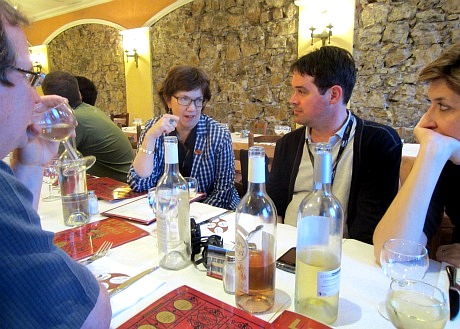
Indiewire‘s Anne Thompson, Brian Brooks, Dana Harris during last night’s dinner.
The revellers included Indiewire‘s Anne Thompson, Eric Kohn, Dana Harris, Brian Brooks plus Deadline‘s Pete Hammond, Awards Daily‘s Sasha Stone, MSN’s James Rocchi, In Contention‘s Guy Lodge, critic/programmer/distributor Aaron Hillis, Film Society of Lincoln Center’s Eugene Hernandez, Relativity’s Sr. VP Adam Keen, IFC Film’s Ryan Werner and Arianna Bocco and myself.
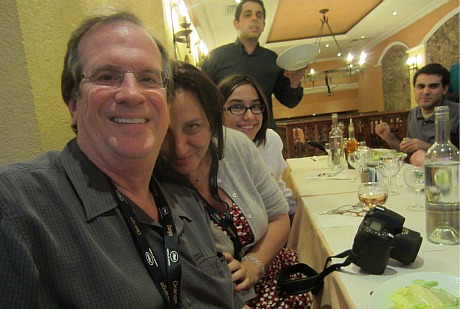
(l. to r.) Pete Hammond, Sasha Stone, Emma Stone.
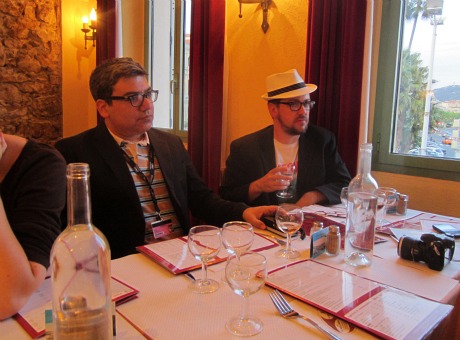
Eugene Hernandez, Aaron Hillis.
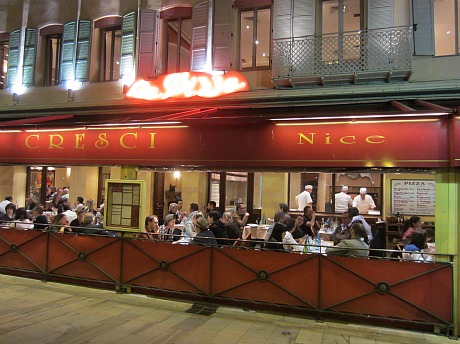
Tuesday, 5.10, 10:50 pm.

No Ceasar salad looks like this in the States — fine with me.
Villa Robie & Saint Jeannet
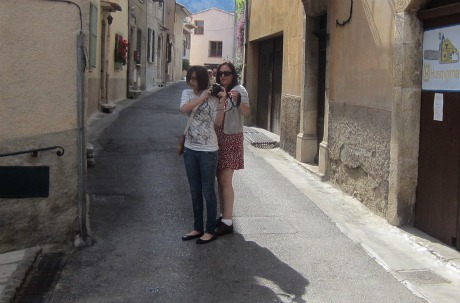
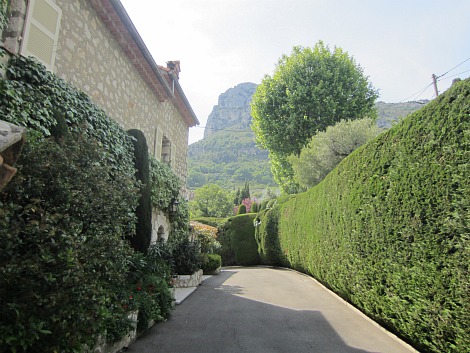
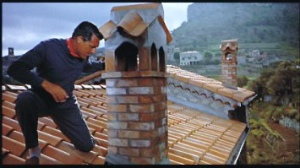
For nearly my entire life I’ve been on extremely familiar terms with John Robie’s (i.e., Cary Grant‘s) mountaintop home in To Catch A Thief. Yesterday Sasha Stone and her daughter Emma and I actually visited the place. It’s located on the main road leading up to the medieval village of Saint Jeannet, and it’s absolutely dead real — relatively unchanged from when Alfred Hitchcock shot his classic 1955 film — with only the addition of a driveway gate and a tall thick hedge in front.
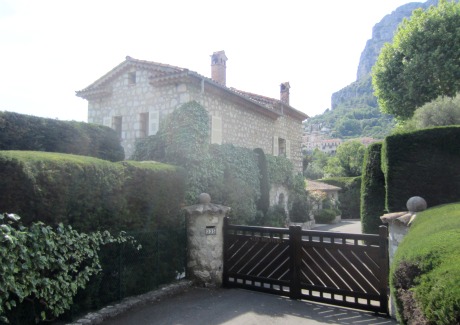
Villa Robie – Tuesday, 5.10, 3:35 pm.

Villa Robie as glimpsed in To Catch a Thief.
The last time I came upon a real-life location with this kind of hot-damn impact was when I visited Oahu for the Pearl Harbor junket and stopped by Halona Blowhole beach — the site of the famous love scene between Burt Lancaster and Deborah Kerr in From Here to Eternity.
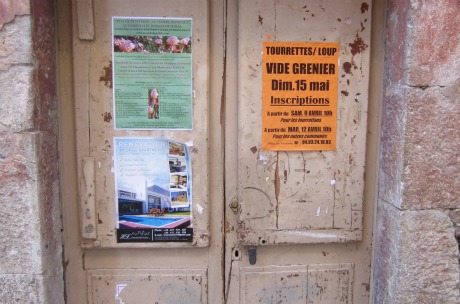
We wandered around the winding, small-scale, centuries-old streets of Saint Jeannet for about 90 minutes and took several photos of the breathtaking rocky peak (i.e., the “Baou”) that towers above. Then we motored down to Tourrettes Sur Loup , another pleasant medieval village only much more touristy. It has nothing to do with Tourette syndrome, although we joked about that (as tens of thousands of previous visitors have also joked, no doubt).



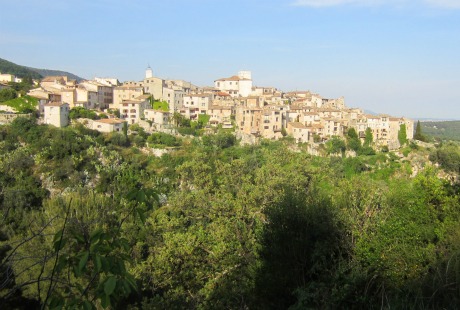
Tourettes Sur Loup — Tuesday, 5.10, 5:40 pm.
Hilarious
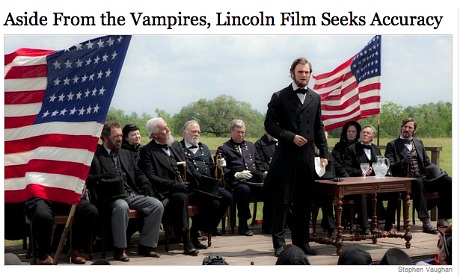
Michael Cieply visiting the Louisiana shoot of Abraham Lincoln: Vampire Hunter has produced the funniest N.Y. Times headline for a movie-location story in years. And the funniest quite in the story is from Russian-based director Timur Bekmambetov (Wanted), whose animalistic sensibilities are an industry legend: “What Lincoln did was like what Jesus did 2,000 years ago — he freed people.”