Folderol

I’d like to buy Nicolas Cage in a historical context, but I can’t. He can only portray present-day wackazoids. I realize that Cage has been making films hand over fist in order to pull himself out of a financial abyss, but there needs to be limits. The second I saw Ron Perlman , I went, “Okay, I know what this thing is.”

Season of the Witch is obviously CG porn. The more they pile on the visual effects, the worse films like this seem. The landscapes in this trailer are somewhat less convincing than those in Disney’s Snow White and the Seven Dwarfs (1937). Some look worse than those swirling sand-cyclone effects in The Mummy.

Zebra Legs


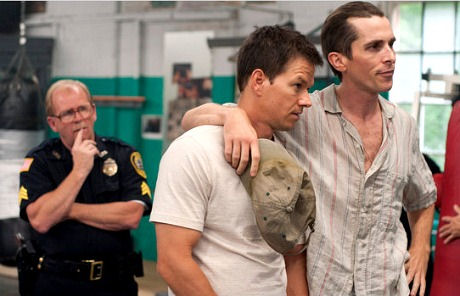
The Fighter director David O.Russell, producer-star Mark Wahlberg following last night’s SAG screening at Manhattan’s Lincoln Square — Thursday, 11.11, 9:10 pm.

The saddest, costliest, most ambitious, most profoundly disorganized, most accident-prone and most-behind-schedule and in-the-red B’way show in a long, long time. And it won’t open for a while yet.

At last night’s after-party for Today’s Special, a somewhat comedic Indian food and ethnic-identity flick that opens on 11.19: (l. to r.) star-coscreenwriter Aasif Mandvi, MSNBC’s Contessa Brewer and Peter Alexander.
Zebra-like stockings, worn by Paris-residing woman with two Manhattan-residing daughters, taken during Musuem of Modern Art tribute event for Hurt Locker and Triple Frontier director Kathryn Bigelow.

Feinberg Explains It All

Those Gurus of Gold Zeligs who recently capitulated to alleged conventional wisdom that The King’s Speech will take the Best Picture Oscar may want to consider a just-posted Scott Feinberg column that offers three reasons why The Social Network will take it instead.

Reason #1, says Feinberg, is that the Academy “has demonstrated a clear preference, of late, for zeitgeist-capturing works (Crash, No Country for Old Men, The Hurt Locker, etc.) over the period-piece dramas that used to be their cup of tea, and The Social Network is clearly more timely/relevant to the world in which we live today than The King’s Speech.”

Reason #2 is that The Social Network “has performed extremely well at the box-office, registered strongly with moviegoers (and Oscar voters) in all demographics, and become an enduring part of our cultural discussion to an extent that I don’t believe The King’s Speech can match.

Reason #3, which Feinberg feels is the most significant, is that The Social Network “has something going for it that The King’s Speech does not — something that has proven to be a deciding factor in numerous other close best picture races: a big-name director, David Fincher, who is overdue-for-recognition from the Academy.”

Battle Cry

I’m feeling Skyline-d, District 9-ed, 2012-ed and Monster-ed out right now. Tired, dusty, battle-fatigued, blitzkreiged, fagged and shagged with aching joints. And now another shaky-cam disaster/alien-invasion movieBattle: Los Angeles — is set to land on 3.11.11. And then JJ AbramsSuper 8 arrives on 6.10.11. Wait…will Peter Berg‘s Battleship (due in 2012) involve aliens?

Does Battle: Los Angeles look good? Yeah. What’s my level of interest in seeing it on a scale of one to ten? About a seven, if that.

Battle: Los Angeles costars Aaron Eckhart, Michelle Rodriguez, Bridget Moynahan, Michael Pena, etc. I’ll get around to listing the others down the line. It would appear that 34 year-old director Jonathan Liebesman (The Texas Chainsaw Massacre: The Beginning is a very ambitious Spielberg-Abrams-Kosinky-Cameron wannabe eager-beaver tech-head….just what the corporations are looking for!

Yogi Brooks

At the end of his 11.10 report about Tuesday’s AFIFest screening of The Fighter, Deadline‘s Pete Hammond wrote the following: “With The Fighter now finally unveiled for the masses and press screenings starting this week on both coasts, there are very few mysteries left in the season.

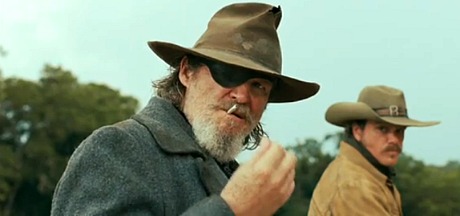
“Paramount’s other holiday entry, the Coen BrothersTrue Grit (12.22), is still to be seen and just about the last that could provide fresh Oscar meat , at least in the major categories. Otherwise, the lineup is fairly clear with no surprises on the horizon — unless Yogi Bear (Dec 17) is better than anyone dreamed.”

The next day it hit me that Hammond had failed to mention the latest film from director James L. Brooks, whose unopened films were once presumed to be at least potentially award-worthy. And yet Hammond, who always hears what’s going on, didn’t mention How Do You Know (Sony, 12.17). I’m not suggesting this is any definitive indicator, but it feels like some kind of telling anecdote. There once was a time (i.e., pre-Spanglish) when such an omission would have been unthinkable.

Kosinski's Alien 3?

With a little more than a month before the 12.17 release date, the buzz has gone south on Joseph Kosinki‘s TRON: Legacy. A second-hand source has seen the heavily-hyped sequel to the 1982 original, and claims it’s “a technical marvel, but uninvolving and remote despite Pixar’s attempts to infuse emotion into the father-and-son scene.”

“The primary source, obviously Pixar-friendly, feels that Team Lassiter (includingToy Story 3 screenwriter Michael Arndt, Incredibles director Brad Bird) “needed to be involved from the beginning, and not consulting after the fact.”

He also reminds that Disney “has decided against re-releasing the original 1982 film on Bluray for fear of alienating the younger audience out of fear they may dismiss it as a cheesy, kitschy movie.

“This obviously creates a problem as evidenced by the latest trailer, since the film is a direct sequel and knowledge of the backstory is necessary. Tracking is said to be disappointing at this stage, but there’s another month to go so here’s hoping.”

Kosinki, who was being called “the new Cameron” last summer, “has a bright future,” the guys feels, “so this may be regarded as his Alien 3 with better things yet to come.”

Moscow Matinee

How bad can Bruce Robinson‘s The Rum Diary be? Who knows, but Anne Thompson‘s 9.27 Indiewire report about the long-delayed Johnny Depp period film based on the Hunter Thompson book, didn’t raise anyone’s hopes. She wrote that producer and Film District partner Graham King “hopes” that The Rum Diary “will go out through FilmDistrict next fall.”

In short, The Rum Diary is such a cool film that the distribution company, which is co-owned by the film’s primary producer, might decide to release it a year from now, give or take. Or not. Nobody’s sure just yet.

One way to hurry things up, according to the notoriously unreliable IMDB, is to grab a New York-to-Moscow flight on 3.30.11 in order to catch The Rum Diary‘s world premiere the following day — on Thursday, 3.31. The round-trip is only $650 and change, but the nonstop flights are roughly ten hours. The trip would be be tax-deductible, of course, and I’ve never been to Moscow, but would it be worth it?

Too Close To Home?

In case you haven’t figured it out, a big reason why a bit more than half of the film critics have gone thumbs-down on Roger Michell‘s Morning Glory is because they see this above-average comedy as an endorsement of the dumb-down currents in the media and the culture that are making their jobs more and more unstable. Seriously — re-read some of the pans with this idea in mind and you’ll see what I mean.


(l. to r.) Rachel McAdams, Diane Keaton, Harrison Ford in Morning Glory.

Critics have obviously been jettisoned from newspapers over the last few years in much the same way that crusty older news guys like Harrison Ford‘s Mike Pomery, an old-school Dan Rather type, have been put out to pasture by TV networks. And so they’re hardly snickering at Pomery’s predicament. They’re saying, “Hey, that’s us!” They resent that Morning Glory presents Ford mainly as a grumpy, semi-alcoholic bear who doesn’t get it, and not as a semi-good guy who represents an in-depth news tradition that’s being slowly weakened or diminished.

And so they don’t see Roger Michell‘s film as a story about a plucky young TV morning-show producer, Rachel McAdam‘s Becky Fuller, trying to survive in a tough racket by pizazzing up a show called Daybreak with any stunt she can think of. They see a film that regards Becky as fairly cute and cool and they’re saying, “Wait…what?”

They feel that Morning Glory ought to condemn or at least frown upon Becky, as Broadcast News clearly condemned and frowned upon William Hurt‘s shallow news anchor Tom Grunick. And they feel that Morning Glory is basically embracing the modern media’s general tendency to embrace fluff over substance, tweets over news articles and Ben Lyons-type movie enthusiasts over critics with experience and taste with a background of serious study and decades of film-watching.

A review by the Christian Science Monitor‘s Peter Rainier spells out this attitude fairly clearly.

Morning Glory is about how Rachel pulls Daybreak out of the basement by, you guessed it, dumbing it down ever further into imbecility,” he writes. “This might be an acceptable premise for a comedy except for one thing: The filmmakers endorse the imbecility. Morning Glory is a tribute to low standards and high ratings – just the sort of thing Hollywood can get firmly behind.

“I realize this movie is, essentially, cotton candy, but it has an acrid aftertaste. Becky, a human whirligig epoxied to her BlackBerry, is portrayed as a vivacious sprite. Her anything-for-ratings ambition is supposed to be, well, cute.

“Her big move comes when she pairs the morning show’s longtime, long-suffering host Colleen Peck (Diane Keaton) with curmudgeonly blowhard Mike Pomeroy (Ford), the network’s resident hard-news legend who has been sitting out his contract after being shifted out of his evening anchor spot. These cohosts despise each other. While Colleen is willing to don a fat suit and tussle on air with a sumo wrestler, the grave-faced Mike, who has won every journalism award known to man, won’t even do one of those obligatory cooking-class segments. (He won’t even utter the word ‘fluffy.’)

“Instead of standing up for the type of journalism that Mike represents, director Roger Michell and screenwriter Aline Brosh McKenna (The Devil Wears Prada) denigrate him as a scowly relic from a distant era. The film’s payoff arrives on cue when, grudgingly, inevitably, he comes around.

“Keaton at least looks as if she’s having fun as the alternately daffy and hard-edged former Miss Arizona who’s seen it all. Ford, however, keeps himself in a constant state of humorless high dudgeon, and his Scrooge routine gets very old very fast. He acts like someone who never told a joke – or heard one.

Broadcast News, of course, is the template for this movie, but a bit of “Network” might have been welcome, too. The dismal dumbing-down that Paddy Chayefsky’s Network predicted for the future of TV has been more than fulfilled, but, whereas Chayefsky was mad as hell about it, the folks behind Morning Glory are just fine with it.

“Is it fair to judge a dippy romantic comedy by its ideas – or lack of them? I think it is, if, as is the case here, the ideas, such as they are, are central to the comedy. Morning Glory isn’t targeting the dumbing down of TV news. It’s pandering to the audience that craves the dumbness.”

Up To It?

Last week a young guy I won’t identify told me he won’t see 127 Hours because he doesn’t want to deal with the arm-carving scene. And I wouldn’t call him the squeamish type. I’ve asked several people if they know anyone, young or old, who’s said “no way, Jose” and I haven’t heard zip so maybe this guy’s just an oddball. But just to be sure I’m asking here and now. Is anyone out there feeling chicken about this acclaimed Danny Boyle film? Do they know of anyone who’s talking about turning tail?

“Pain and bloodshed are so common in the movies. They are rarely amped up to the level of reality because we want to be entertained, not sickened. We and the heroes feel immune. 127 Hours removes the filters. It implicates us. By identification, we are trapped in the canyon, we are cutting into our own flesh.” — from Roger Ebert‘s 11.10 review.

Whispering Bull

The Film Forum is using a Village Voice blurb to promote its 30th anniversary engagement of Martin Scorsese‘s Raging Bull. It urges viewers to “catch all the bloody, bone-crunching action as it was meant to be seen.” But not heard, I would say. Raging Bull has never sounded all that great in movie theatres, certainly not to me. And the Film Forum almost never delivers full-bodied sound (it’s always a little bit soft) so why see it there? Why go through the potential frustration?

Raging Bull has a few dialogue scenes that sound so faint (or have always sounded so faint in the theatrical showings I’ve attended) that you have to cup your ears at times. So why risk it when there’s the option of the Raging Bull Bluray and/or the 2005 DVD, both of which actually allow you to hear each and every line of dialogue?

The first two times I saw Raging Bull was at the all-media press showing at Manhattan’s Beekman, and then at the good old Sutton on 57th Street for a plain public showing. That was almost 30 years ago, and the sound levels, trust me, were atrocious. It was like trying to watch a 16mm Jonas Mekas film at the Collective for Living Cinema with earmuffs on. Especially some of the dialogue scenes featuring Joe Pesci and Cathy Moriarity. The scene when Robert De Niro first talks to Moriarty on that Bronx street next to the public swimming pool was especially irritating. But no longer. Home-theatre technology has saved the day.

Dino De Laurentiis

Italian-born film producer Dino de Laurentiis — a famously vulgar schlock tycoon in the grubby-mitts tradition of Carlo Ponti, Sam Spiegel and Sir Lew Grade — has passed at the age of 91. He was a serious big-shot in his heyday, but De Laurentiis didn’t produce movies as much as finance them. He was one of those slick operators who saw films as product rather than vessels of entertainment or, perish the thought, a mixture of entertainment and art.

De Laurentiis financed a run of half-decent films in the ’70s and ’80s, but was primarily known as a primitive showman. His philosophy was basically that of a wheeler-dealer. He was the kind of guy who was always talking deals, territories, packages, int’l grosses, etc. And he never seemed to really accept or believe in the faith of Film Catholicism.

He was always the colorful swaggering Dino, the short guy with the expensive duds and the limousines and the arm-candy women and the almost comically thick tomato-sauce Italian accent. He became infamous in the mid ’70s for ostensibly saying on the Today show that John Guillermin‘s King Kong (’76), which Dino produced, was about “thees beeg monkey.”

De Laurentiis nonetheless financed (or co-financed) Serpico, Death Wish, Three Days of the Condor, The Shootist, The Serpent’s Egg, Ragtime, Blue Velvet and Manhunter — not bad. And he deserves respect for having co-produced Federico Fellini‘s La Strada and Nights of Cabiria in the mid ’50s.

De Laurentiis was born near Naples in 1919, and was called Torre Annunziata during his youth, and grew up “selling spaghetti produced by his father.” He never really stopped doing this, in a sense. All his life he “made” — financed — lowest-common-denominator spaghetti-popcorn films in order to make money and parade around so he could get more money so he could finance more lowest-common-denominator spaghetti-popcorn films. Except for the half-decent ones, I mean.

De Laurentiis and Ponti founded a certain flamboyant-hustle approach to producing (i.e, international pre-sales, funny-money, three-card monte, etc.) that was later adopted by Menahem Golan, Yoram Globus, Philippe Martinez, Elie Samaha, Giancarlo Peretti, Jean-Marie Messier, Bob Yari and Avi Lerner. None of these guys were ever known for looking at scripts or reading coverage even, and they never seemed to really get into the joy and awe and music of movies the way ambitious Scott Rudin-type producers do.


Dino De Laurentiis during a Cannes Film Festival tribute in 1984.

The late Sterling Hayden once told me a story about De Laurentiis that happened in the mid ’70s. Dino had given him a copy of Lorenzo Semple, Jr.‘s script of Hurricane, in hopes that Hayden would agree to costar. When De Laurentiis asked what he thought, Hayden said, “I gotta tell ya — I think it’s crap!” De Laurentiis replied, “You’re the first person who’s said that!” A day or two later Hayden talked to a De Laurentiis development guy who said, “Naahh…you’re not the first.”

De Laurentiis produced not one but two dreadful King Kong films. He produced the half-decent Barabbas with Anthony Quinn. He nearly killed Richard Harris‘s career with Orca (’77). He sometimes produced rank embarassments like Hurricane (’79). And he didn’t have the smarts or the instinct to get in on producing The Silence of the Lambs, but once that Jonathan Demme film became a hit he got into the Hannibal Lecter business big-time — Hannibal (’01), Red Dragon (’02 — a remake of Manhunter) and Hannibal Rising (’07), an origin story.