

Love and Other Drugs, I regret to say, didn’t play quite as well the second time. I’m still a genuine, whole-hearted fan of Anne Hathaway ‘s performance, but my difficulties with Josh Gad got worse and worse as I began to grumble and moan and shift in my seat when he appeared. My first thought was that it wouldn’t have been a problem if Gad has been picked off with a high-powered rifle. But other scenarios began to take shape in my mind. Gad being hit by a speeding bus, poisoned, garroted by a waiter, stabbed in the shower. No, not the shower.
Colored Girls Earns Less
Last Wednesday Boxoffice.com’s Phil Contrino predicted that Tyler Perry‘s For Colored Girls “should manage $27 million from 2,127 locations.” That didn’t happen. The current Colored Girls projection is for $20.1 million, which is the lowest opening weekend for Perry since The Family That Prays, an ’08 release which took in $17.4 million.
For comparison’s sake, Perry’s Why Did I Get Married 2? took in $29.3 million when it opened earlier this year, I Can Do Bad‘s opening weekend earned about $24 million in 2009, and Medea Goes to Jail did $41 million during its first three days.
Missed
If I had the dough and the freedom to really swagger around, I’d probably be attending a Biutiful below-the-line discussion group, which, as we speak, starts about two hours hence (or 5 pm) at the Linwood Dunn on Vine Street. (Wait…5 pm? That’s for short naps, making a salad, taking showers, walking your dog.) Moderator Guillermo del Toro, director Alejandro Gonzales Inarritu, composer Gustavo Santaolalla, dp Rodrigo Prieto and editor Stephen Mirrione. Alas, I’m sitting on the fake-marble floor of a 42nd Street plex and being told by the manager that I can’t plug into the wall outlet.
Redress
“Keith Olbermann is right when he says he’s not the equivalent of Glenn Beck. One reports facts, the other one is very close to playing with his poop. And the big mistake of modern media has been this notion of balance for balance’s sake. That the Left is just as violent and cruel as the Right…there’s a difference between a mad man and a madman.”
Some Aren't Happy
In a comment thread for yesterday’s “Strange Pundits” story, HE reader PastePotPete wrote that he’d recently seen Darren Aronofsky‘s Black Swan (Fox Searchlight, 12.3) and that people generally seemed to find it “astonishing.” And yet despite that reaction “there were a lot of women [in the audience] who seemed to despise the movie. And I didn’t talk to or overhear a single male audience member disparaging it.
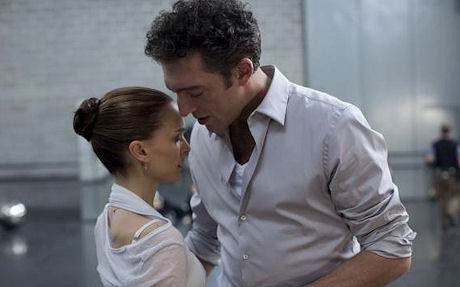
“I think this disparity, which I believe Sasha Stone has brought up on the Oscar Poker podcast, will prevent it from garnering the awards it deserves, aside from Portman’s in-the-bag Best Actress award.”
So I wrote him write back and asked, “Did any of these women explain their feelings?
“My impression since the Venice Film Festival is that some women don’t like Black Swan (and this seems like a very weird reason to slam a film) because Portman’s character is too weak and distraught. Because she’s besieged by feelings of insecurity, anxiety and panic. And because some women resent the fact that she’s allowed herself to become torn and frayed, and is finally undone by her demons.
“Are we to presume that women viewers consider the character of Portman’s performance dishonestly conjured because…what, there are no such women in the performing world? Female artists who are worried about whether they’re good enough or not, about whether they might be replaced, or whether they’ve got enough talent or ambition to really make it? I don’t want to go out on a limb, but I believe there are many male artists out there with the same hang-ups and concerns.
“The implication is that some women don’t like this film because Portman’s self-destructive character isn’t positive enough — that she’s not an upstanding role model and that it’s not good for female characters of this type (or performances about same) to be admired too much or put on a pedestal. Is it me, or is that the single lamest rationale for disliking a film ever put forward in Hollywood history, or at least since the days of Stalinist Russia?
“By the same token did women of 1965 declare that Catherine Deneueve‘s character in Repulsion was also a negative role model, and therefore shouldn’t be admired too highly?”
Noisy Brutes
The big surprise in Laura Israel‘s Windfall, a doc that I saw just before the Toronto Film Festival, is that wind-turbines, the “green” energy source that everyone is in favor of, are oppressors — bringers of discomfort and anguish and headaches and lawsuits. They’re 400 feet tall these days and weigh hundreds of tons and look like huge white Martian invaders out of Spielberg’s War of the Worlds, and they have a proven history of making the lives of people who live near them miserable.
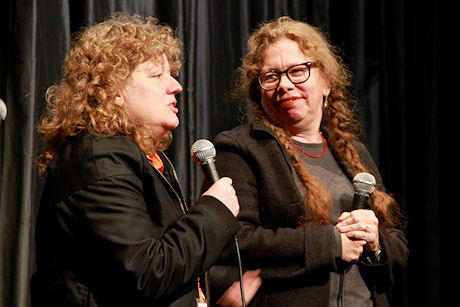
(l.) Windfall director Laura Israel, (r.) cartoonist-activist Lynda Barry
Last night, I’m told, the film played to a sold-out house at the IFC Center. During the q & a Israel and cartoonist Lynda Barry discussed the ravaging and plundering of economically hard-up communiities by the wind turbine industry.
Barry is writing a book about how wind turbines invaded the small burgh where she lives in Wisconsin. She’s already interviewed more than 20 families and has done some initial drawings that have appeared on her website. She also runs the anti-wind turbine development website below.
Furrows
My first thought when I saw this photo was that Mark Wahlberg, star of David O. Russell‘s The Fighter (Paramount, 12.10/12.17), has some serious forehead creasing going on these days. I’m counting at least three if not four rows. I’ve never had creases of any kind. I can contort my forehead all day and it won’t go there.
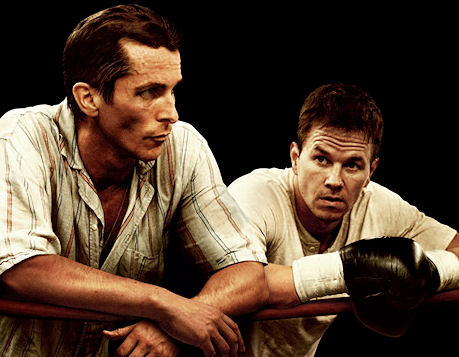
Art for David O’Russell’s The Fighter taken from recently received screening invitation.
Waldorf Drugs
I’m flattered to report that after this morning’s Love and Other Drugs press conference and the “talent” was walking out, director Ed Zwick leaned over and said he’d really enjoyed a piece that I’d written “about Ernest Becker.” I know Becker for his cultural and philosophical writings, but at that particular moment I couldn’t remember what Zwick was referring to. So I searched and found this 8.27.10 piece. Of course. Came right back.
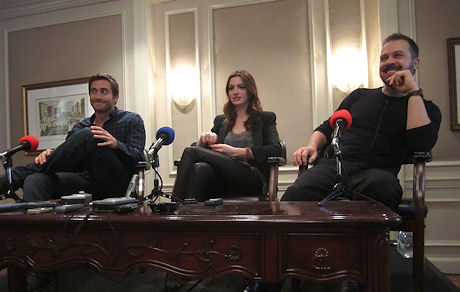
(l. to r.) Love and Other Drugs costars Jake Gyllenhaal and Anne Hathaway, director-co-screenwriter Ed Zwick during this morning’s press conference on the 18th floor of the Waldorf Astoria — Saturday, 11.6, 10:55 am.
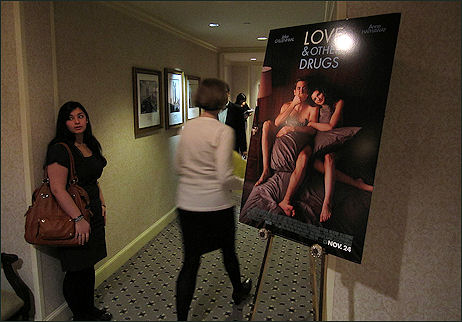
11.6, 11:20 am.
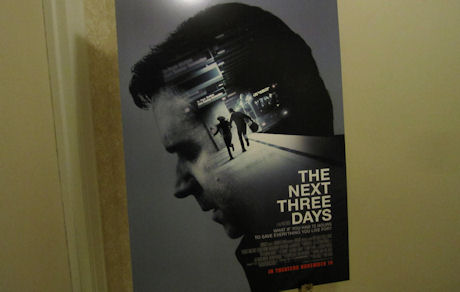
11.6, 11:35 am.
Most Beautiful Eyes
Jill Clayburgh lived, I’m told, a good full life, but in terms of cultural synchronicity and being an iconic, self-defining actress who ignited her own perfect moment, she had four peak years — 1976 to ’79. Arthur Hiller‘s Silver Streak in ’76, Michael Ritchie ‘s Semi-Tough in ’77, Paul Mazursky‘s An Unmarried Woman in ’78, Bernardo Bertolucci‘s Luna (a misfire) in ’79, and Alan Pakula‘s Starting Over later that same year.
Clayburgh’s feminist-icon phase had peaked with An Unmarried Woman, but it seemed to pretty much fizzle out five years later with the failure of Costa Gavras‘ Hanna K. (’83). For all intents and purposes, that was the last “Jill Clayburgh film.” She appeared and acted and certainly had a “life” after Hanna K., but not as a name actress with any exceptional expectations.
Claudia Weill‘s It’s My Turn (’80) was a minor love story (woman-in-relationship falls for Michael Douglas‘s retired baseball player, winds up jilting b.f. Charles Grodin). She played a conservative Supreme Court Justice who tangles with liberal Justice Walter Matthau in Ronald Neame‘s First Monday in October (’81), a tame little film. This was followed by I’m Dancing As Fast As I Can (’82), a valium-dependency, life-crisis drama directed by Jack Hofsis and written by David Rabe.
And then came the Hanna K. death blow. A muddled but interesting pro-Palestinian drama, it was critically panned and abruptly withdrawn from distribution by Universal, apparently due to political pressure from pro-Israeli factions. Clayburgh played an American-Jewish attorney assigned to defend a Palestinian accused of terrorism. But the plot was overshadowed by her character’s conflicting romantic entanglements, one of them with a character played by Gabriel Byrne.
It was three years before Clayburgh’s next film, a injustice melodrama titlled Where Are The Children? Her next, Andrei Konchalovsky‘s Shy People (’87), was a success d’estime costarring Barbara Hershey and Martha Plimpton. It was regarded as a worthy but minor effort, and it had the unfortunate stamp of being a Cannon release.
Clayburgh played a distinctive eccentric in the commercial flop Running With Scissors (’06), and has a too-small role as Jake Gyllenhaal‘s mom (and George Segal‘s wife) in the about-to-open Love and Other Drugs.
Lying Around?
Does anyone happen to have a shooting draft of Florian Henckel von Donnersmarck and Christopher McQuarrie‘s screenplay of The Tourist? Just curious.
Poland Gets It Again
The critics [who’ve] pummeled Love & Other Drugs “were not really watching the movie they were being shown, but were too busy finding a way to disconnect emotionally from a surprisingly emotional film,” MCN’s David Poland has written. “It isn’t a Viagra sex comedy. It’s Love Story and Sweet November combined with a Viagra sex comedy.
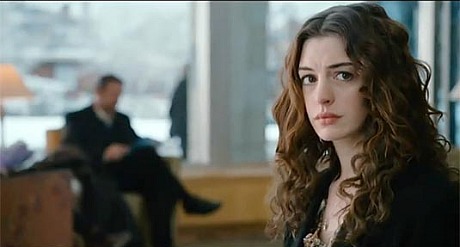
“I got a very strong feeling that [director] Ed Zwick and [producer, co-wriiter] Marshall Herskovitz were going back to the work that they didn’t quite hit out of the park in adapting David Mamet‘s Sexual Perversity in Chicago as About Last Night.
“Here, they get a lot of the raunchiness of Mamet, but in combination with a big melodramatic story that is, by its nature, very close to crossing the line into male-unwatchable mush…and they overcome the obstacles.
“And it’s not, as some would position it, just because we spend a lot of first act time with Anne Hathaway‘s naked body splayed across the screen. It’s because of very smart writing and a truly award-worthy performance by Hathaway. This kind of part has eaten up some really talented actresses over the years and Hathaway just grabs the whole thing by the balls, makes very decisive acting choices, and pulls rabbits out of her hat through the whole movie.
“The only reason Love & Other Drugs isn’t a truly great film is the problem of Jake Gyllenhaal, an actor who I adored when he was younger and who has me more and more perplexed over time. On paper, he is a great choice. Young, dumb, and full of cum. But he needs to evolve in this story. And while he does okay with the role, you just never get the kind of light out of him that seeps out of Hathaway’s every pore.
“I’m not saying this is a perfect film. It’s not. But it is a daring, challenging piece, and deserves to be seriously considered for all of its strengths, as well as the weaknesses. And when I look at Gurus and see that Hathaway has fallen completely off the chart, that’s a shame, because she glides through it with great assurance, no doubt supported by a strong director who helped her push and keep those boundaries.
From my 10.30 review: “It’s not Alexander the Great. It just works, is all. LOAD has charm and pizazz and, okay, sometimes strained humor, and yet it never slows down or goes off the rails, or at least not to any worrisome degree.
“Certain people might get pissy about it. A guy I talked to in the men’s room after the screening was going “eeew, it’s two different movies…eeew, it doesn’t blend…eeew, it veers too sharply between broad comedy and disease-anguish and hot sexuality and heartfelt love and heavy emotionalism.
“LAOD isn’t any one thing, and that’s the fascination of it. It’s not dark enough to be The Apartment, it’s not easy and it’s not ‘farce’ and it’s not just hah-hah funny, and it’s not dramedy as much as comedy with a thorny and guarded edge. The tone is farcical one minute, dry and glib the next, and then it devolves into Josh Gad-Jonah Hill-level humor, but thankfully not too often or for too long. And then it turns melancholy.”