Not A Bad Thing

The first news that I read upon arrival at JFK was Guillermo del Toro‘s decision to abandon The Hobbit…yes! I realize it’s a major heartbreaker for the guy, obviously, but I’ve long regretted his commitment to this project per my staunch belief that nothing of any profound value can result from any kind of Peter Jackson collaboration.

Guillermo is his own man, of course, with his creative hand always decisively in place, but I’m convinced that somehow or some way the hand of Jackson would have made the watching of the two-part Hobbit a laborious, forehead-smacking experience. For people like me, at least. And now that grim prospect has been erased.

I’m sorry for Guillermo and his team — they must be shattered — but I must be honest and confess my gut reaction. Hallelujah!

In a 5.30 statement posted at theonering.net, Del Toro said he had to leave due to “the mounting pressures of conflicting schedules [which] have overwhelmed the time slot originally allocated for the project.”

This statement sidesteps the real reason which, boiled down, is a prolonged delay in locking in a start date due to lack of production funds, chiefly caused by MGM, the co-producer of The Hobbit (along with New Line), being financially strapped and up for sale and all that mishegoss. MGM’s latest James Bond film also fell victim to this situation, forcing director Sam Mendes to walk.

The Wrap‘s Jeff Sneider reported that Del Toro “will continue to co-write the adaptation of J.R.R. Tolkien‘s classic novel.” Will? The scripts for the two-part film (slated to be released in December 2012 and December 2013) haven’t yet been fully written?

“In light of ongoing delays in the setting of a start date for filming The Hobbit, I am faced with the hardest decision of my life”, Del Toro said in the statement. “After nearly two years of living, breathing and designing a world as rich as Tolkien’s Middle Earth, I must, with great regret, take leave from helming these wonderful pictures.

“I remain grateful to Peter, Fran and Philippa Boyens, New Line and Warner Brothers and to all my crew in New Zealand. I’ve been privileged to work in one of the greatest countries on earth with some of the best people ever in our craft and my life will be forever changed. The blessings have been plenty. Both as a co-writer and as a director, I wlsh the production nothing but the very best of luck and I will be first in line to see the finished product. I remain an ally to it and its makers, present and future, and fully support a smooth transition to a new director.”

Nobody Blew It

I was (and am) very pleased with the Easy Rider Bluray that I bought a few months ago. It looks rich and alive and intensely celluloid-y (which is starting to become a welcome distinction). Under-30s who haven’t had the pleasure need to see it this way. The Bluray reminds (or instructs) that this 1969 film is not a dimissable (as David Thomson recently implied) but something that knows itself and the culture from whence it sprung, and which works according to its own mantra and ticker.

Last night EW’s Owen Gleiberman wrote arrestingly about Easy Rider’s director, Dennis Hopper, who died yesterday morning.

“Watch Easy Rider today, and you’ll see that every glinting panoramic shot, every toked-up dialogue rhythm, every situation and jagged dramatic back-alley dovetails as only the work of a born filmmaker can. Hopper, who was in his late teens when he made his screen debut in Rebel Without a Cause (1955), came of age in the outwardly strait-laced, buttoned-down Hollywood of the 1950s, but as a compatriot of the moody, emotionally voluptuous (and bisexual) James Dean , he was already writing the first chapter of the revolution that was to come.

“When he got the chance to make Easy Rider, he poured a decade’s worth of desire, liberation, nihilism, despair and hunger into it, and the freedom of the movie is there in every image. It’s there in the air of discovery that the characters breathe. As an artist, Hopper showed the instinctive sophistication to portray himself and Peter Fonda, the two scruffed-out hippie-biker antiheroes, not just as crusaders but as tragicomic fools.

“I first saw Easy Rider when I was 11 (it was the first adult movie I ever snuck into), and the end of the movie — that falling-away roadside-crash helicopter’s-eye death shot that you realize has already been glimpsed in an acid hallucination — spooked and possessed me like nothing I had ever seen. This wasn’t just a trendy youth-drug-culture movie. It was filmmaking on drugs.”

The Dutch Get It

I got into Amsterdam airport a half-hour ago and went right to my favorite spot — a cool-climate, Jetsons-designed multi-media internet lounge with great wifi and all kinds of desks and chairs and drinks at a nearby bar. It’s beautiful — nirvana for someone like myself. I’ve seen an operation like this in Zurich and maybe one or two other European cities, but I don’t know of any U.S. airport that has anything remotely like it.


A greeting for passengers on their way into the departure terminal at Rome’s Fiumicino airport.

Shane's Moment

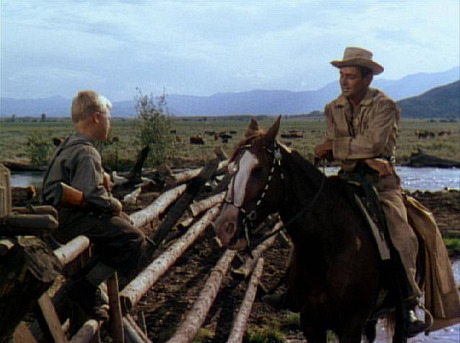
It feels mildly irksome that Paramount Home Video has never to my knowledge stated an intention to issue a Bluray of George StevensShane. Wouldn’t this fit almost anyone’s definition of a no-brainer? It’s all but de rigueur for major studios to give their classic titles Bluray upgrades, so it seems odd that one as beautiful-looking as Shane would be sitting on the sidelines.

It’s been almost seven years since Paramount Home Video’s Shane DVD, which was fine for what it was. But it’s time to step up and do this film proud and give a nice angel erection to George Stevens, who no doubt has been wondering from whatever realm or region why Paramount hasn’t yet bit the bullet on this thing.

The Bluray format (coupled with an exacting, first-rate remastering, of course) would dramatically enhance if not do wonders for Loyal Griggs‘ legendary capturings of this iconic 1953 western. To my eyes Griggs’ richly-hued color lensings — he shot The Buccaneer, The Ten Commandments, The Bridges at Toko-Ri, White Christmas — were on the level of Jack Cardiff‘s.

This morning I asked Paramount restoration/remastering guy Ron Smith (who supervised the superb work on Paramount’s recently-released African Queen Bluray) if a Shane Bluray was at least in the planning stages. Guys like Smith are told to never say “boo” to guys like me without corporate publicity’s approval, but I wanted to at least put this on the table.

Digi-Bathed?

At the end of a thoughtful assessment of Sergio Leone‘s “Man With No Name” trilogy, L.A. Times contributor Sam Adams says that the new MGM Bluray versions (available Tuesday, 6.1) are afflicted with the Patton/Spartacus virus.

“[Featuring] exemplary audio commentaries by biographer Christopher Frayling, the ‘Man With No Name’ set duplicates earlier editions in terms of features, giving the images a high-definition upgrade that is something of a mixed bag,” he writes.

“To minimize natural film grain, The Good, the Bad and the Ugly is rendered mushy and plastic at times. [And] the re-recorded surround-sound on all three movies is an overactive mess, panning dialogue into the side speakers in a fashion that has more to do with showing off than serving the film. (The discs include the original mono as well, although they default to the new soundtrack.)

“It’s unfortunate that the Good, Bad disc includes only the questionably ‘restored’ version of the film, with newly recorded dialogue and scenes that Leone himself cut for release, but some judicious reprogramming can take care of that.”

Boomer Bond

The Special Relationship…ah, yes. An “entertaining period piece” and a pleasurable trio of performances, it is widely agreed, from Dennis Quaid (Bill Clinton), Michael Sheen (Tony Blair) and Hope Davis (Hillary Clinton). I won’t be seeing it until tomorrow night, when I arrive back home, so if anyone’s had the pleasure, please share.

Return to Rome


This morning’s sunrise (taken around 6:15 am) from the deck of the Palermo-to-Napoli ferry that we took last night. Nice quiet cabin w/shower. Good way to go.

I bought a warm salami panini for this guy in Capua this morning, and then laid the slices on the ground before him, and he just sniffed it. No sale.

Hopper Into Space

My all-time favorite Dennis Hopper imprint, on the occasion of his passing earlier today: “You can’t travel in space, you can’t go out into space, you know, without, like, you know, with fractions, man. What are you going to land on — one-quarter, three-eighths? What are you going to do when you go from here to Venus or something? That’s dialectic physics. You either love somebody or you hate ’em.”

I’ve written a few short Hopper articles in recent months: (a) a 10.14.08 riff called “Man of Moods“; (b) a 3.27.10 post called “Thousand Yard Stare“; and (c) a 4.13.10 jotting called “Best-Yet Hopper Tribute.”

And once again, here’s that beautifully cut, perfectly on-target video essay from Moving Image Source‘s Matt Zoller Seitz.

Howell vs. Burton (and Boonmee)

Forgive the tardiness (which I’m blaming on Sicilian distractions), but Peter Howell‘s 5.27 Toronto Star piece on the decision by Tim Burton‘s Cannes jury to hand the Palme d’Or to Apichatpong Weerasethakul‘s Uncle Boonmee Who Can Recall His Past Lives is delicious stuff.

“In the same week that Burton’s box-office champ Alice In Wonderland hit the $1 billion mark globally, one of just six movies ever to do so, he presided over golden laurels for a film so resolutely uncommercial, even Thais can’t figure it out. The gesture struck me as one of the most political and cynical moves ever from a Cannes jury. Burton and his crew, acting on his cue, wanted to show how cool and cutting-edge they were.

“Many critics at Cannes, who are used to seeing challenging material, found Uncle Boonmee to be a shapeless mass of wacky images masquerading as a spiritual journey. I predict that a lot of people will be saying, ‘This won the Palme d’Or?’ when Uncle Boonmeescreens at TIFF this September, as it most likely will.

“I don’t completely disparage Uncle Boonmee [in my review]. I was impressed by the vivid cinematography and by Weerasethakul’s inventive use of special effects, which he achieved with a tiny budget. But did it deserve the Palme, a prize second only to Oscar’s Best Picture for prestige and previously awarded to such classics as La Dolce Vita, Apocalypse Now and Kagemusha? No way.

“As a cinema experience, Uncle Boonmee is about as gripping as watching a variety store security video. There is no acting to speak of, only rote line readings of mystical babble.

“Burton said he was simply enraptured by Uncle Boonmee, precisely because it was so unlike the Hollywood fare that Burton personally chooses to make. He’s delighted to see other people taking chances that he’s afraid to take himself.

“If Burton is so thrilled by such avant-garde experiences as Uncle Boonmee, why doesn’t he try making one himself instead of always swinging for the multiplex with movies starring Johnny Depp, his favorite A-lister, and proven stories like Alice in Wonderland?

“Even better, why doesn’t he use some of his Alice loot to help promote, distribute and champion independent films like Uncle Boonmee, instead of just handing out golden goodies before jetting back to Hollywood for his next Johnny Depp power breakfast?”

Without A Trace

Reviewing Peter Weir‘s recently Blu-rayed Picnic at Hanging Rock (1979) some 31 years ago was a kind of cliff-leap experience. I didn’t know at first how to explain what it actually amounted to (at least according to the cinema-appreciation terms I was used to), or where it had actually “gone” in a narrative sense, but I knew it had a curiously haunting (and haunted) quality, and that the unsolvability of the disappearance of two or three schoolgirls wasn’t the thing as much as how the mystery just hung there in the air, and how the humid Australian sun seemed to gradually melt the characters’ brains.

Martin & Allyson

This clip from a 1978 Jimmy Stewart roast, HE’s third Orson Welles post since Wednesday, includes remarks from emcee Dean Martin and a brief shot of June Allyson laughing along. I was immediately reminded of Nick Tosches‘ descriptions of their 1948 affair, surely one of the strangest extra-marital couplings in Hollywood history, in Dino: Living High in the Dirty Business of Dreams.

There are some couples who just seem “right” together, and there are some that make you wonder how and why. The idea of the cynical but easygoing Martin — married with children, easy-friendly with certain gangsters, and a serious poon-hound in his prime — getting all hot and nasty with Allyson, who always seemed so enveloped in the legend of being “America’s Sweetheart” that it was difficult to imagine her having had sex at all, with anyone, has, for me, always fit into the latter category.

At the time of their affair Allyson was married to actor-director Dick Powell , with whom she had two kids (one adopted, one natural). Martin was on the downslope of a difficult marriage to Betty McDonald, with whom he’d had four kids.

In a N.Y. Times review of Allyson’s sunny and peppy autobiography, which came out in ’82, Janet Maslin wrote that Allyson “presents herself as the same sunny, tomboyish figure she played on screen Hollywood…like someone who has come to inhabit the very myths she helped to create on the screen.”