

HE was attacked by a D-Day-level spam invasion yesterday and this morning. I had to spend about 90 minutes this morning deleting over 300 spam posts, and not just recent ones but in threads reaching back to January and February. Manage comments, ban the poster, delete “comments.” I may have accidentally deleted one or two legit postings.
Strange Vogue
TMZ has posted a year-old Nazi-garbed photo session with Michelle McGee, the lady who had a thing with Jesse James (Sandra Bullock‘s estranged husband) and then ratted him out to In Touch magazine for $30 grand.
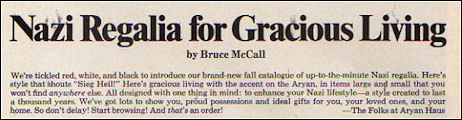
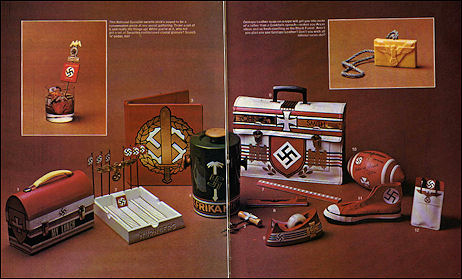
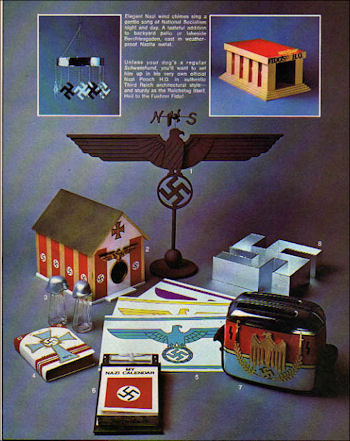
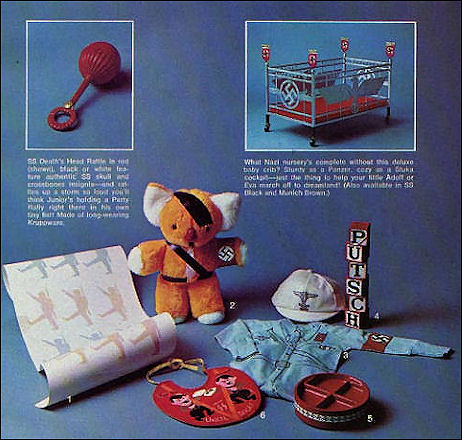
I don’t particularly care about this — James got what he deserved — but the photos took me back to a 1973 industrial-design photo piece in the old National Lampoon called “Nazi Regalia for Gracious Living.”
The article was written by Bruce McCall with photographs by Dick Frank. The product was “manufactured” by Harry Fischman, Alan Rose, Celia Bau, and David Kaestle. Elizabeth Benett did the illustrations.
The satire in “Nazi Regalia for Gracious Living” was aimed at American middle-class values. (I think.) I now believe it was feeding off the same risque cultural pollen that began to manifest about a year later in various arthouse films (as well as some from the sexploitation field). The common idea/attitude in these films was that under the uniforms Nazis (or Italian fascists) had heavily suppressed sex lives with gay, S&M and B&D inclinations.
Tinto Brass‘s Salon Kitty, Liliana Cavani‘s The Night Porter, Pier Paolo Pasolini‘s Salo and Bernardo Bertolucci‘s 1900 all worked this into their narratives. I remember Andrew Sarris describing this cinematic trend as “homosexual Nazi chic.”
Apparent common consensus still insists that the ultimate Nazi sexploitation film was David F. Friedman‘s Ilsa, She-Wolf of the SS.
“Excessive Vulgarity”
Jett went to see She’s Out of My League with a friend last night, and says that any critic who gives it a pass is out of their mind. “It’s as bad as The Ugly Truth, that Gerard Butler-Kathryn Heigel movie,” he says. “It’s a one-joke thing — she’s hot and you’re not.” And yet it has a 51% positive Rotten Tomatoes rating. That’s the easy-lay contingent in action.
I decided months ago that I wouldn’t see She’s Out of My League with a gun at my back. Unless…you know, Scott Foundas or some other tough critic went to bat for it.
Traffic
Nash Edgerton‘s The Spider, a nine minute and 11 second short, will be shown with The Square when it opens in early April. It’s been on the festival circuit for quite some time, but whatever.
Wine After Its Time
Last night I saw Joel and Nash Edgerton‘s The Square (Apparition, 4.6), a James M. Cain-like noir in a low-rent, not-terribly-bright, mullet-wearing Australian way. The Postman Always Rings Twice, Mate. I’ll hold my review for now, but the timing of the release is fair game for discussion, I think.
The Square was shot in ’07 and released in Australia in the summer of ’08. Apparition picked it up at last year’s South by Southwest and then waited for the right moment. I don’t want to sound like a jerk in Apparition’s eyes, but I think that an audience is missing something when watching a nearly three-year-old film in a first-run theatre.
I’m not saying The Square is a “dated ” film — it’s not. (Except for the fact that two blue-collar male characters wear ghastly 1980s mullets.) But there was an original spark that went into the filming of it — a spark and a climatorial vibe that had a lot to do with the specific conditions of life on the planet earth back then. And I think you lose the vitality of that chemical composition when you wait three years to show it. And I sensed a faint weathered factor as I was watching it. That or simply knowing it was shot in ’07 affected my perception.
Wine improves with age but movies — a living, breathing, moving-train art form — don’t. It’s not always true, but you often sense on some level the lack of mollecular immediacy and freshness in a film that was shot 18 months or two years before viewing. And you can really sense if it was shot three years earlier. Life’s particulars change in small and imperceptible ways as the months roll along, and then eventually they begin to stand out in stronger relief.
I don’t know what the rule of thumb needs to be, but it’s best if you see a film within a year or so of principal photography. That way it feels like a movie that belongs to the here-and-now. The initial September ’08 showings of The Hurt Locker, which was shot in ’07, felt more vital on some level than it did upon the commercial opening in June ’09, I can tell you. I’m sure there are dozens of examples.
I get that Apparition needs product and that they fell in love with the Edgerton brothers because suddenly these guys are in vogue. I saw Joel play Stanley Kowalski in A Streetcar Named Desire at BAM.
Heartland Scum
I agree with the guy who says “no handouts…you have to work for everything you get in life.” Damn straight. But the guys in this video are vermin — the absolute antithesis of the compassionate behavior that a certain wandering Hebrew advocated in his sermons.
Monroe Didn’t Kill Him
It’s a given that the elite tend to live healthier lives than the bottom-of-the-barrel K-Mart crowd. And yet by today’s standards, Clark Gable — the one-time King of Hollywood — lived a much more self-destructive life than your typical 2010 addict of whatever social class. For most of his 59 years Gable smoked tens of thousands of unfiltered cigarettes and swilled enough booze to kill a bull elephant. It’s a miracle that he lasted as long as he did.
“Gable died in Los Angeles, California on November 16, 1960,” his Wikipedia bio says. “It happened from a heart attack ten days after suffering a severe coronary thrombosis.
“There was much speculation that Gable’s physically demanding role in John Huston‘s The Misfits contributed to his sudden death soon after filming was completed. In an interview with Louella Parsons, published soon after Gable’s death, Kay Gable was quoted as saying “it wasn’t the physical exertion that killed him [but] the horrible tension…the eternal waiting, waiting, waiting. He waited around forever, for everybody. He’d get so angry that he’d just go ahead and do anything to keep occupied.”
“Marilyn Monroe said that she and Kay had become close during the filming and would refer to Clark as ‘our man’ while Arthur Miller, observing Gable on location, noted that ‘no hint of affront ever showed on his face.’
“Others have blamed Gable’s crash diet before filming began. The 6’1” Gable weighed about 190 pounds (86.2 kg) at the time of Gone with the Wind, but by his late 50s, he weighed 230 pounds (104.3 kg). To get in shape for The Misfits, he dropped to 195 lbs (88 kg).”
And the comes the big “tell,” almost like an anecdotal aside…
“In addition, Gable was in poor health from years of heavy smoking (three packs of unfiltered cigarettes a day over thirty years, as well as cigars and at least two bowlfuls of pipe tobacco a day). Until the late 1950s he had been a heavy drinker, especially of whisky.”
Re-Run
How is this just-released Predators trailer substantially different from the short teaser reel that producer Robert Rodriguez and director Nimrod Attal previewed at South by Southwest on 3.12?
My 3.13 commentary, to also repeat: “I’d be into Predators (20th Century Fox, 7.9) if I was even half-persuaded that it’ll be to the original Predator what James Cameron‘s Aliens was to Ridley Scott‘s Alien — i.e., faster, more intense, emotionally grounded, a general uptick. But of course, that can’t be. Not with Rodriguez’s B-movie aesthetic defining the perimeters.”
Titans Ooh-Rah

Thursday, 3.18, 9:05 pm.

Black List Picks
If anyone has scripts of The Voices, L.A. Rex, By Way of Helena, The Days Before
When Corruption Was King and Motor City, please send ’em this way. Thanks.
A Good Life
Fess Parker of the soft and kindly voice died today at age 85. Playing Davy Crockett made him a legend among boomers, and made him rich (or at least started him on the road to more riches), and cast an easy, friendly glow upon everything he said and did for the rest of his life. Some guys have all the luck and the modesty.
Parker became a political conservative and a friend of Ronald Reagan‘s when he got older, and that’s not cool in my book. But he projected such a soothing vibe that it was hard to think of him in a negative light.
My favorite Parker performance was in Don Siegel‘s Hell Is For Heroes, which costarred Steve McQueen. He was also strong and compelling in three Disney features — The Great Locomotive Chase (’56), Westward Ho, the Wagons! (’56) and Old Yeller (’57). And he delivered a memorable supporting performance in Them! (’54), the classic giant-ant movie.
Parker’s gentle southern accent originated in Texas, where he was born in 1924. I never knew until today that he was the victim of a “road-rage knifing” in 1946. Or that his birthday, 8.16, was only one day removed from Crockett’s on 8.17.
Parker was discovered by actor Adolphe Menjou — an especially despicable conservative said to have encouraged and supported the persecution of alleged Hollywood lefties and former Communists during the late ’40s and ’50s. Menjou reportedly met Parker in Texas, urged him to go to Hollywood, introduced him to his agent, etc.
I have to say I didn’t care for Santa Barbara’s Fess Parker hotel when I stayed there three or four years ago. Too big and sprawling and nouveau riche-y — too tailored to the tastes of people with not much taste.