How Necessary?

I’m trying to decide whether or not to spend $1500-plus so I can attend 2010 South by Southwest (3.12 to 3.20) and in so doing catch the following (which I haven’t yet seen): Bernard Rose‘s Mr. Nice, Michel Gondry‘s The Thorn in the Heart, Alexandre O. Philippe‘s The People vs. George Lucas, Shane MeadowsLe Donk & Scor-zay-zee, Steven Soderbergh‘s And Everything Is Going Fine, Matt Harlock and Paul ThomasAmerican: The Bill Hicks Story, Mike Woolf‘s Man on A Mission, Jacob Hatley‘s Ain’t In It For My Health: A Film About Levon Helm, Mark Landsman‘s Thunder Soul and Daniel Stamm‘s Cotton, as well as the alrready-announced Kick-Ass, Cold Weather, Elektra Luxx, Hubble 3D and The White Stripes: Under Great White Northern Lights.

It may be worth it just to see The People vs. George Lucas. Just after The Phantom Menace opened — more than ten years ago! — I told David Poland in a phone coversation that Lucas was “the devil.” Poland chortled, scoffed. “George Lucas is not the devil, Jeffrey,” he said. He most certainly is, I replied, in the sense that Albert Brooks called William Hurt “the devil” in Broadcast News. Lucas is an embodiment of evil in that he destroyed his own Arthurian mythology and sacrificed the church of millions of Star Wars believers on the altar of commercialism and Jake Lloyd and Jar-Jar Binks action-figures.

Now I have won — the world has caught up to my view. George Lucas is the devil, there’s a SXSW doc about this very point, and Rabbi Dave lacked the foresight to understand the fundamental truth of it.

Did I Do That?

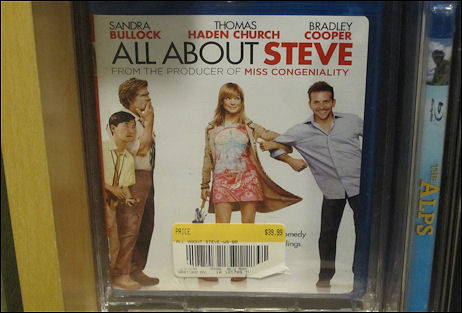
If the 2.9.07 release of the dreadful Norbit damaged Eddie Murphy‘s chances of winning the Best Supporting Actor Oscar for his Dreamgirls performance, will last month’s DVD/Bluray release of the dreadful All About Steve hurt Sandra Bullock‘s bid for a Best Actress Oscar? Probably not, but if Steve had been released theatrically this month, maybe. Is Bullock the first actress to have been nominated for a Best Actress Razzie and a Best Actress Oscar the same year?


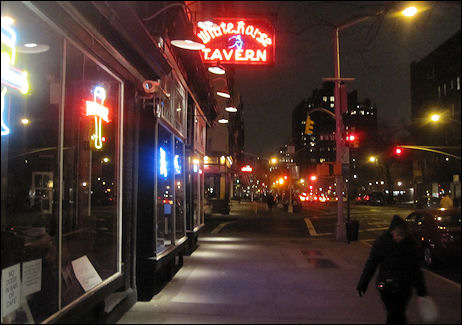
Canal Street and Broadway — Wednesday, 2.3.10, 6:15 pm

Hudson Street just south of Abington Square.

Copy and Paste

The Vancouver Sun‘s Chris Parry has cited numerous instances in which junket critic Paul Fischer — an Australian commonly known for dispensing favorable junket-whore quotes — has used festival notes and synopses to fortify his reviews.

As Parry puts it, “In a case of the world coming full circle, a film reviewer who has made a name for himself being quoted in movie marketing materials is accused of plagiarizing large chunks of his film reviews — from movie marketing materials.” I’m sorry for Fischer, whom I know from the junket/festival circuit, and the woes he must be going through now, but he seems to have made his own bed. Parry’s reporting appears fairly precise. There doesn’t seem to be much room for doubt.

“Movie-Making Maniac”

“Part Peckinpah, part Hong Kong, the movies Luc Besson creates — including Pierre Morel‘s From Paris With Love, which he produced and wrote the story for — are kinetic juggernauts, as carefully plotted with action beats as any of Jerry Bruckheimer‘s or Joel Silver‘s films, but with more wit and adrenaline. There’s no pretense or wasted motion in Besson’s films, and that includes little time spent trying to force sense into the script.

“Rather, Besson’s films are like elaborate wind-up toys that seldom rest. You crank them up, turn them loose and get out of the way. Perhaps the metaphor should be a Roman candle: sparking and exploding, always with one more little ball of fire at the end than you expect.

“Morel obviously studied at the Besson school. In From Paris as in his previous Besson-mentored efforts, District B13 and Taken, he displays no real style of his own. His carefree, breathless style is Besson’s — their tropes are the same. The action flies by, with little time to make sense or do much more than assault the eyeball and tickle the pleasure center (make that the male pleasure center, which is so easily stimulated by explosions and automatic-weapon fire).” — from Marshall Fine‘s 2.2.10 review.

“A Measure of Irony”

In yesterday’s Network thread someone said that Arthur Hiller and Paddy Chayefsky‘s The Hospital (1971) is a better, more substantial film. I feel the same way. I adore Network but Barnard Hughes ‘ soliloquy/rationale for his hospital killings is the most eloquent slice of cinema that Hiller ever directed. I’m especially speaking of the portion that begins at 5:56 and ends at 8:00 (concluding with the words “the whole wounded madhouse of our times”).

It’s staggering — nobody working today seems to be capable of even trying to write stuff as good as this. “Not quite the burning bush perhaps, but prodigal enough for me. I killed no one. Ritual victims of their own institutions. Murdered by irony.”

Tranquil Getaway

It’s Santa Barbara Film Festival and fragrant-weather time again. Early tomorrow I’m flying to Los Angeles. Tomorrow afternoon I’ll sit for three hours at LAX before catching a puddle-jumper to the so-inconsequential-it’s-almost-secretive Santa Barbara airport. Soon after I’ll be checked into the Hotel Santa Barbara and walking up State Street to the opening-night film — Derek Magyar‘s Flying Lessons. Under cloudy skies.

Held in the immediate wake of the Oscar nominations, the SBIFF is the premiere forum for Oscar Contemplation and Fortification, and a place for lively discussion panels and intriguing films (festival chief Roger Durling always programs at least five or six I’m glad to have seen) and excellent parties and ravishing women in their early to mid 40s.

I don’t know much about Flying Lessons except that it’s about a young female pilot (Maggie Grace) who, against the wishes of her corrupt banker dad as well as her own better judgment, decides to become a South America-to-Arizona drug smuggler in order to pay off a huge financial debt.

That’s not true actually — Flying Lessons is really one of those meditative, personal-growth, get-away-from-LA, learn-a-lesson-or-two dramas. It costars Christine Lahti, Jonathan Tucker, Cary Elwes, Joanna Cassidy and Hal Holbrook. And Grace, of course. I’m sure it’s a film of considerable merit or Durling wouldn’t have chosen it.

Legendary indie-realm publicist Linda Brown is repping Flying Lessons so you know it’ll be well-covered and well-flogged.

I’m heartened that SBIFF will be screening Oliver Stone’s South of the Border, which I saw and very much admired last September at Lincoln Center.

And I’ll finally get a chance to catch The Mormon Proposition, which I missed at Sundance. Plus the mysterious The Secret of Kells, which was nominated for a Best Feature Animated Oscar to everyone’s surprise. Plus I Am Love, the Visconti-ish Milan family drama with Tilda Swinton that I saw part of in Toronto and had to abandon due to a conflict. Plus Vincere, the young Mussolini drama that Susan Norget has occasionally screened for Manhattan journalists (but not frequently enough for me).

Due respect to Roger but I have a complaint regarding the treatment of poor Carey Mulligan , the gifted Best Actress nominee for An Education — my hands -down choice as the most deserving Oscar recipient in that category.

Mulligan’s Best Actress competitor Sandra Bullock will have her own tribute on Friday, 2.5 (receiving the Riviera Award), but Mulligan has been lumped together with Saoirse Ronan, Emily Blunt, Gabourey Sidibe and Michael Stuhlbarg for a 2.7 Sunday-evening tribute in which they’ll all receive the SBIFF Chopin Virtuoso Award. The Academy has officially stated that Mulligan occupies the exact same Oscar status as Bullock, and yet the festival chiefs offering Chopin ensemble status to Mulligan suggests that they see her as a highly respected also-ran rather than the knockout Audrey Hepburn queen that she actually is.

Other Oscar-calibre artists being honored include Crazy Heart Best Actor nominee Jeff Bridges, Avatar director James Cameron, (Modern Master Award), Hurt Locker director Kathryn Bigelow (Director of the Year award), A Simple Man costar Julianne Moore (Montecito Award), Vera Farmiga (Cinema Vanguard Award) and Colin Firth (Outstanding Performance of the Year for A Single Man).

What For

Yesterday two or three people remarked that I periodically ban people because they voice differing opinions. This spoke more to the posters’ shortcomings — a slight difficulty with accuracy and fairness in their writing — than to mine. I ban people who resort to personal slurs and a general tone of confrontational ugliness. I’ve said this until it’s coming out of my ears, but I’m using the same standard any person giving a party in his home would hold to. If a guest becomes coarse and abusive, he/she would be asked to leave. Is that really so hard to understand?

Glenn Beck In Mind

I missed this A.O Scott video essay on Network due to my Sundance roamings. There’s nothing left to say that’s fresh or radical about this 1976 Sidney Lumet film, but I love Scott’s response after we’re shown a clip in which Robert Duvall says to Faye Dunaway, “For God’s sake, Diana — we’re talking about putting a manifestly irresponsible man on national television!”

Wise Blood

Another early correct call was made last October by Santa Barbara Film Festival honcho Roger Durling in booking Best Actor nominee Colin Firth…way before it was clear to anyone that the star of Tom Ford‘s A Single Man would end up as one of the five contenders.

Hammond’s Early “Blind Side” Call

L.A. Times/Envelope columnist Pete Hammond was way in front of everyone on calling The Blind Side as a Best Picture contender and especially as a Best Actress shot for Sandra Bullock. Here’s how it went down, according to an e-mail he sent around this morning:


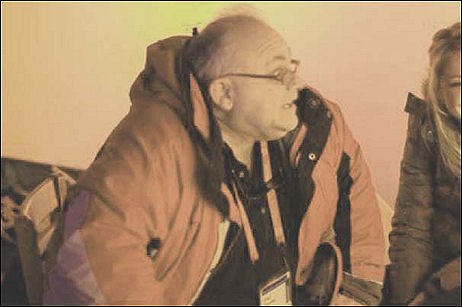
(l. to r.) Sandra Bullock, Pete Hammond, Roger Durling.

“I first saw The Blind Side on the WB lot on October 15th. This was roughly five weeks before opening, and there were about five people in the screening room. I called WB the next day and asked them afterwards if they knew what they had, that this was Bullock’s Erin Brockovich, and said she can get an Oscar nomination if they campaign it. They weren’t even planning to do that at this stage.

“I held off writing about it and predicting the Oscar nomination until Nov 4th — the first time I talked it up.

“The same day I participated in the first Gurus Of Gold on November 4th and was the only pundit predicting Bullock then. (Aside to Poland: If I hadn’t put her on there she wouldn’t have even made your Gurus list, David!)

“On November 23rd I wrote about it again after the opening weekend’s boxoffice report and put out a public plea for someone, ANYONE to join me on buzzmeter in predicting Bullock. Again I was still alone.”

Wells to Hammond: I might have joined you, Pete, if the brainiacs at Warner Bros. publicity had the horse sense to invite me to their early screenings, which of course in their stupendous and magnificent obstinacy they don’t.

“That article was used by Santa Barbara Film Festival chief Roger Durling in convincing Sandra’s reps to commit to a tribute and award at the SBIFF when a Best Actress nomination seemed still like a longshot. He first contacted them after the first article on November 4th. He hadn’t even seen the movie at that point.

“This coming Friday night I am hosting the SBIFF American Riviera award tribute to Sandra’s career at the 2200-seat Arlington. Roger told me it is the fastest-selling tribute in the 25-year history of the festival.”

Injustice to Fraser

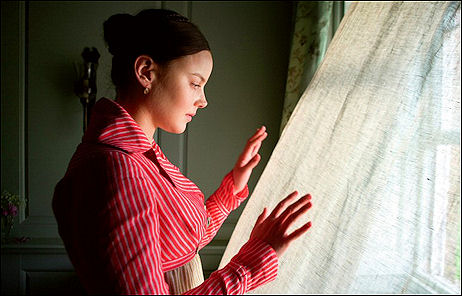
With the exception of a single Best Costume Design nomination for the work of Janet Patterson, Bright Star was shafted big-time this morning — up and down and around the town. Obviously few cared for the film as an emotional whole, and so all the participants were made to suffer slights. Director Jane Campion , star Abby Cornish and cinematographer Greig Fraser received no nominations. The latter’s contribution to Bright Star was perhaps the most award-worthy. Fraser’s perfectly measured, vermeer-lit photography was easily the equal of John Alcott‘s work on Barry Lyndon.