

Ivan Reitman will attempt a long reach across the generational divide in May when he begins filming a GenX/GenY romantic comedy called Friends With Benefits, based on a script by Elizabeth Meriwether (writer of the highly-touted, similar-sounding Fuckbuddies…is this the same script with a different title?). Natalie Portman and Ashton Kutcher will costar in the Paramount flick, which already has a locked-in early 2011 release date — January 7th. Variety calls this date “a lucrative frame for femme-driven comedies,” but a pre-slotted early January release amounts to a kind of statement of expectations about what the film is likely to be.
Runaways Hell Night
Distractions kept me from last night’s Runaways red-carpet photo op at the Sunshine Cinemas, so I went to the after-party at the Bowery hotel, hoping for a shot of Kristin Stewart and Dakota Fanning. It was a very nice gathering with tasty food, etc., but Stewart and Fanning decided to temporarily blow the party off by going somewhere else after the screening. (Young actors sometimes need to express disdain for publicity.) I knew they’d show up sooner or later but waiting around became interminable.
Falco Ink’s Janice Roland had graciously passed me into the event, but I was pretty much left to my own devices once I was in. Survival of the fittest, the scramble to survive, etc. There was the usual roped-off VIP area with two or three apes guarding the entrance. The party was filled with stylishly dressed, slightly desperate-looking people who had clearly attached great significance in their heads to being there. I began to feel badly about being there, and then really badly about it. I began telling myself that the people at this party were the worst people in the world. I was suddenly seized by a desire to talk to someone like Henry Fonda‘s Tom Joad character in The Grapes of Wrath.
Late in the game I chatted about the film with a hazel-eyed blonde who was sitting at the bar, and asked her at one point how she felt about Fanning’s performance as Cherie Currie. She said into my ear, “Do you mind if I don’t talk about that?” I said to her, “It’s okay — please don’t.” I gave her a look of slight contempt as I turned away and returned to the VIP area to wait with the other paps for Stewart/Fanning. It was a lot like standing around gate 225 at the Port Authority bus terminal.
After a while I just couldn’t stand it and left. I’m guessing that Stewart or Fanning or both eventually appeared, but it felt great when I finally left the party and hit the pavement and began walking north and breathing in the night air.
The only truly appealing part of the evening was speaking briefly to Apparition co-chief Bob Berney about everyone hoping to see Terrence Malick ‘s The Tree of Life at Cannes. Berney doesn’t expect the notoriously reclusive Malick to take part in any of the usual promotional exposures and appearances if the film plays there — no photo op gang-bang, no press conference attendance, no one-on-one press luncheon sit-downs, etc. Didn’t Malick go to Cannes in the ’70s for either Badlands or Days of Heaven?, I asked. Berney couldn’t remember but I think he did. I know that Malick won the festival’s Best Director prize in ’78 for Days of Heaven.
Garden State
One last dental journey to New Jersey this morning and I’m done. It’s not pleasant, it eats time and money, etc. But you can’t ignore this stuff. Attention must be paid. Which means a final catch-as-catch-can, battery-powered, filing-from-waiting-rooms-and-roadside rest stops column day.
White Rips Hoberman, Dart
After last week’s Armond White-vs.-Leslee-Dart kerfuffle over his not having been invited to see Noah Baumbach‘s Greenberg, everyone has been awaiting White”s Greenberg review with bated breath. Well, the piece is up — and guess what? White tosses off two or three observations, but he barely “reviews” the film at all.
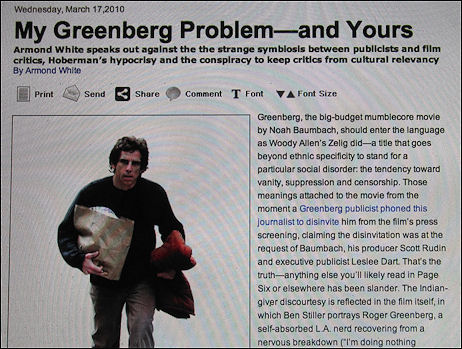
That’s because his ire and fire are mostly aimed at Village Voice critic Jim Hoberman, whom he regards as a small-minded lackey of the imperialist ruling circle of publicists and producers, and 42West publicist Leslee Dart, who kept White away from Greenberg screenings until last week’s brouhaha brought about a reversal.
The interesting thing is that White, a longtime Baumbach hater, almost gives Greenberg a backhanded compliment by calling it “a mite less obnoxious than Baumbauch’s other films.”
White otherwise devotes most of the 20 paragraphs in the article to vivisecting Hoberman for supplying photo-copy proof last Wednesday afternoon that White did in fact suggest in ’07 that his issues with Baumbach might been remedied by “retroactive abortion,” and for doing so for purely venal reasons. And to lambasting Dart, founder of 42West publicity, for being an enemy of free speech and a possible guest on an upcoming segment of the Glenn Beck Show. It goes on and on, and makes for vivid reading if nothing else.
My favorite part of the article notes that Greenberg was “co-conceived with Baumbach’s talented wife Jennifer Jason Leigh, and that in this respect the film continues Leigh’s filmography of masochistic females encountering sadistic males. It’s interesting to watch Greta Gerwig spar JJL-style with Stiller’s Baumbachian prick. I’ll probably be attacked for stating the obvious — that Greenberg seems to dramatize Leigh-Baumbach’s curious relationship — but that’s the film’s only point of interest.”
The last paragraph reads as follows: “This Greenberg problem has had the unexpected effect of unleashing Hoberman’s small-minded vanity. He has such enmity for me he’d rather embarrass his profession than defend it. From his inherited hipster perch at the Village Voice, Hoberman sets a corrupt agenda for the blogosphere’s wannabes. It seems not to matter to these backward children that Hoberman lied and distorted, creating his own WMD. He resents that I am a challenge to his authority; the Hobermanbots fear lively critical dialogue; they all want control. But aspiring critics and mainstreamers won’t make a worthwhile contribution to film culture until they learn to think (and read and see and feel) for themselves.
“Don’t get it twisted: This Greenberg squabble is not about me, it’s about the contempt that the Leslee Darts of this world show toward critics and that Hoberman displays to competition. If they can do this to me, they can do it to you.”
Here is Hoberman’s tit-for-tat response.
That Championship Season
Don Hahn and Peter Schneider‘s Waking Sleeping Beauty (Disney, 3.26) is a crisply entertaining, well-done, slightly fawning doc about how Walt Disney Co. honchos Michael Eisner and particularly Jeffrey Katzenberg led a team that made profound animation history for roughly a decade — from the time they took over the fairly moribund Disney studios in ’84 until Katzenberg’s resignation in ’94.
During this period Disney released the most successful string of animated feature hits ever seen from any studio before or since — The Great Mouse Detective (’86), Oliver and Company, Who Framed Roger Rabbitt (’88), The Little Mermaid (’89), The Rescuers Down Under (’90), Beauty and the Beast (’91), Aladdin (92), The Nightmare Before Xmas (’93), and The Lion King (’94).
The real hey-hey was closer to a seven year period — ’88 to ’95. In my book it all started with Roger Rabbitt in ’88 and more or less fanned out from there.
Pocahantas, released in ’95, was certainly a product of the Katzenberg regime and the attendant mindset. Toy Story, also released in ’95, was mainly a Pixar show but also rich with the double-tracking mentality that characterized the new-regime Disney classics — kid-friendly but also smart and clever enough to appeal to hip adults.
My two boys were born in ’88 and ’89, and my ex-wife and I were there as Los Angeles-residing parents all through this glory period. We lived it, paid for the tickets and toys and action figures, went to all the films (or rented them all and watched them repeatedly), sang “Under The Sea” with the kids, etc. And this movie brought it all back. A good feeling.
Hahn and Schneider’s doc thoroughly explains how the fortunes of Disney studios were basically in the crapper at the time Eisner and Katzenberg were brought in by Roy Disney. Box-office flops, pessimistic forecasts, etc. “The artists were polarized between newcomers hungry to innovate and old timers not yet ready to relinquish control,” etc.
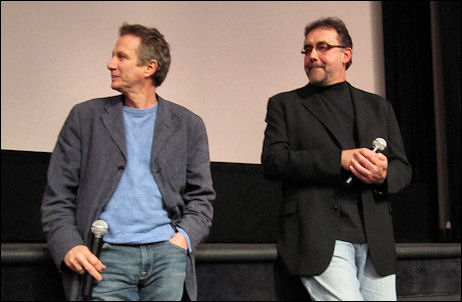
Waking Sleeping Beauty producer Peter Schneider (l.) and co-producer-director Don Hahn following Monday night’s screening of the film at the Museum of Modern Art.
As Alec Guiness‘s Prince Feisal puts it in Lawrence of Arabia, “What we need is a miracle.” And that’s pretty much what happened. The Eisner-Katzenberg run was the most productive, commercially bountiful and accolade-filled period in the annals of 20th Century animation.
Waking Sleeping Beauty was funded by and will be distributed in all media by Disney, but I don’t think it’s fair or accurate to brusquely dismiss it as “a work of corporate self-congratulation,” as Variety‘s Ron Nelson did after the big debut at last September’s Toronto Film Festival.
Disney’s winning streak didn’t just happen — it came about through hard work, heavy talent, bold thinking, creative friction, and particularly strong leadership. And this film does a better-than-decent job of sketching how it happened in nuts-and-bolts terms, and making you feel the emotional ups and downs (as well as the stress-outs and anxieties) that were part of the experience. That’s not a corporate thing — that’s blood, sweat and tears shed by real people.
That said, Waking Sleeping Beauty is a kind of family-friendly, PG-13 version of the saga. I believe that all of life is R-rated, no matter the region or subject or personalities involved, and now and then you can feel Hahn and Schenider stepping back from the more pointed or abrasive aspects of the tale. Both are big-time, Disney-employed veterans of the period being celebrated, and there’s a vested, sanded-down tonality to the film that probably wouldn’t have been there if a couple of renegade outsiders had made it.
There are two amusing anecdotes that everyone in the film business has heard and shared about the hard-driving ethos of the Eisner-Katzenberg era. One was a Katzenberg-alluding remark, allegedly passed along to certain Disney employees, that “if you don’t come to work on Saturday, don’t bother coming in on Sunday.” The other, of course, was the studio being nicknamed “Mouseschwitz.” These lines are funny — I don’t care what you say — and were based on what real people were feeling and sharing back then. And yet Hahn and Schneider don’t mention either one in the doc.
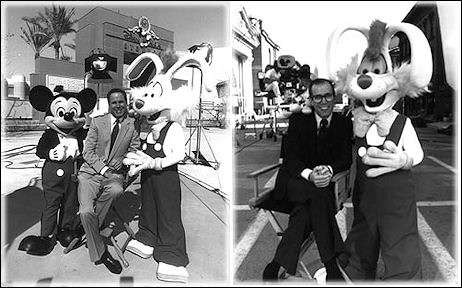
Michael Esiner (l.), Jeffrey Katzenberg (r.) early in their reign at Disney.
That’s deliberate myopia — i.e., looking to keep their relationship cool with Katzenberg (who probably resents the allusion to Nazi Germany and the Auschwitz concentration camp) or avoid a scuffle with their Disney benefactors. Hahn told me today these lines weren’t mentioned because they’re “well-trod material,” etc., but my son Jett, a Syracuse senior who knows a thing or two, had never heard “Mouseschwitz” and smirked when I mentioned it to him this morning.
It’s also slightly irksome that no one ever just states the obvious cultural currents. There always seemed to be something a little bland and WASPy about Hollywood’s animation community over the decades. To some extent Disney studios seemed to epitomize a certain white-picket-fence suburban culture (Walt Disney himself was from an Irish-Canadian family). But this string began to run out both creatively and business-wise, and it seems derelict not to mention that the Disney empire was saved by a couple of shrewd, scrappy, no-nonsense Jews.
My biggest beef is that Waking Sleeping Beauty doesn’t provide an epilogue — i.e., how the last fifteen years have unfolded in the animation arena and where all the Disney players went to and wound up. Hahn and Schneider don’t mention that Katzenberg co-founded DreamWorks and ran the animation division of that company, or anything about the powerful ascendancy of Pixar, or the ouster of Eisner by Roy Disney, etc.
Hahn told me earlier today that an epilogue was shot and considered, but they decided that the last fifteen years are “nothing you couldn’t find from looking on Wikipedia.” Baloney. Watching Waking puts you into the characters’ lives and heads and the whole animation culture, and you want to know what happened. Sorry, but it’s bad story-telling.
My favorite clip in the whole film is a shot of young Tim Burton working as an animator at Disney sometime in the early ’80s. He was 25 or so at the time, but he looked like he was 17 or 18. The clip got a big laugh.
Waking Sleeping Beauty will come out on DVD next fall, and will include about 85 minutes of bonus material.
Basketball Jazz
The idea of Obama not just spending time with this distracta, but knowing it well enough to riff about this and that team…amazing. That’s the point, I guess. The bigger the burden the more you want to hide away in the fantasy cave and feel like a 19 year-old.
Lounge Lizards
Several Paris metro stations have IKEA lounge furniture installed for general public comfort. The installations will remain until 3.24. It’s utterly impossible to envision this happening in the New York subway system. There would be vomit and urine stains all over the furniture in no time, not to mention discarded condoms and the odor of booze and beer, etc. Bums would take up permanent residence.
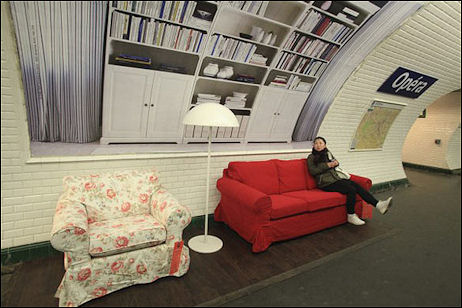
How, then, is this happening in Paris without apparent incident? The answer is that Paris, quite simply, is somehow better regulated and managed regarding its homeless underclass. Less crude and coarse than Manhattan — smoother, cleaner, silkier. How else to explain the IKEA experiment? Am I wrong about Manhattan subways and the skanky element they seem to attract or at least accomodate?

Maddow vs. Geithner
N.Y. Observer/Daily Transom’s Reid Pillifant notes that Treasury Secretary Timothy Geithner “continued his charm offensive” in a relatively long sit-down with MSNBC’s Rachel Maddow last night.
He spoke a lot about the “innocent victims” of the crisis, how he felt a deep “personal responsibility and obligation” to prevent another crisis, said bonuses made for a “crazy way to run a financial system,” and made it a point to reiterate that he has never actually worked at a bank — or even a hedge fund, for that matter.
But Geithner couldn’t bring himself to fall too far onto the sword, saying the Fed made some mistakes but was still “the strongest, the best, most able of those regulators, in the United States and around the world.”
“I think this is a just war,” he said of the administration’s push to pass a financial regulation bill. In case you couldn’t tell, the White House would very much like to get this done, and soon.
| The Daily Show With Jon Stewart | Mon – Thurs 11p / 10c | |||
| Home Crisis Investigation | ||||
|
||||
Diet-Coke 3D?
Obsessed With Film‘s Matt Holmes (a named inspired by Matt Helm?) wrote this morning that “a London-based SFX industry chum” has passed along post-production dirt about the state of Clash of the Titans (Warner Bros., 4.2), which has been undergoing a rushed, late-in-the-day 3D conversion.
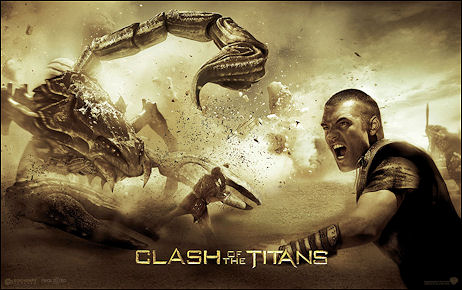
“Apparently they’ve had hundreds of Indian SFX sub-contractors working round the clock to 3D it,” Holmes reports.
First of all, this is the kind of 3D that Jim Cameron was making fun of at that Santa Barbara Film Festival party I attended last month. He was calling it “cardboard pop-up Christmas greeting-card 3D,” or words to that effect. So it’s a joke going in.
Secondly, if I was Jeff Robinov I’d be concerned about Indian guys with extremely polite manners and impenetrable accents and bad clothing finessing the 3D images of Sam Worthington and Liam Neeson, etc. “Hello, sir, can I help you?” I hate these guys for always opening the manual and telling me what it says. Not once have I dealt with a brilliant Indian tech-support guy who seems to think for himself (or herself). I don’t care if they’re working at call centers or FX houses — I feel I know those Mumbai guys very well. They’re cautious to a fault and committed to following the rules so they can feed their families. They’re not rocket scientists.
“The SFX teams that did the primary effects aren’t overly pleased [with what the Indian guys are doing],” Holmes’s friend is saying.
“Everyone knows and expects by now that Clash of the Titans will be the Diet Coke of 3D. This is common knowledge. Any movie that is shot in 2D and later post-converted into 3D is an inferior product and just won’t have the same effect on the eyeballs as films shot with 3-D camera’s.
“This message needs to be delivered to the masses who will be unsuspecting. They will see 3D and expect an Avatar-like experience every time they lay down their extra few quid/dollars but it’s just not going to happen with post-converted tinkering.”
Sunshine Cleaning
The Wrap‘s Sharon Waxman has written about the “bad blood” at Universal following the Green Zone debacle which may, she hears, result in a loss for the studio of $40 to $50 million. And it’s not just the fact that $130 million was spent on an Iraq movie. The marketing, she believes, was also to blame — i.e., “[it] sank like a stone and confused the hell out of me, for one.”
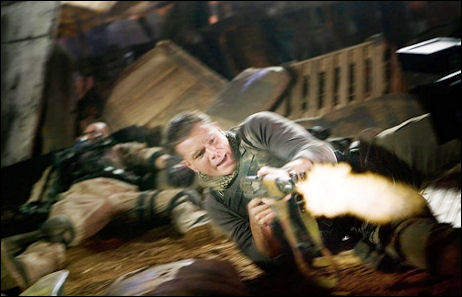
I wasn’t confused by the marketing. When Universal bumped Green Zone out of award season and into March 2010, the unmistakable message was that (a) they had a problem on their hands, and (b) they’d decided it would lose less if they could avoid Oscar-season ad pressures. That decision, in effect, was the marketing as far as I was concerned.
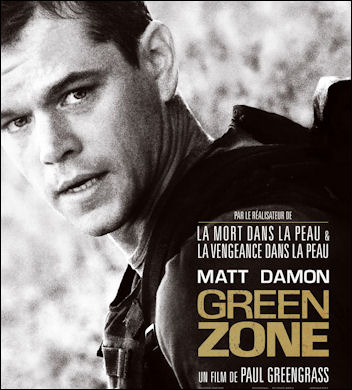
The trailer and one-sheet said the following: “Okay, here’s Matt Damon looking pensive and sweaty and Bourney…whatever. On one level it’s another shakey-cam type deal, but the monochrome poster image tells you it’s not a slam-banger — that it’s on the somber or conflicted side. It’s all in Matt’s facial expression. He’s going ‘I’m hot, I’m anxious and I’m running around, and I have a lot more running around to do before the film is over.’ So you know…it’s your call but we can’t even rouse ourselves into any state of excitement about this thing.”
I need some help with the math, though. Green Zone cost $130 million to make and you have to figure what…maybe $25 or $30 million to market? (I haven’t made any calls but I know Universal tried to keep costs down in this respect.) So you’re looking at a total outlay of $160 million, and the film has so far brought in less than $20 million theatrically in the US. Maybe the video will do decently and bring in…I don’t know what it will bring in. Nor do I have an intelligent estimate of future worldwide theatrical to pass along. But a projected loss of $40 to $50 million seems modest.
The message from Universal co-chiefs Adam Fogelson and Donna Langley — i.e., former Universal co-chiefs Marc Schmuger and David Linde did it — is a totally standard, completely justifiable duck-and-cover response.
It wasn’t our idea. We just tried to make the best of a bad situation. This sucker should have cost $40 or $50 million, all in. If Universal had any cojones it would have told Damon and Greengrass’s agents to shove their quotes up their asses. Iraq movies are Kavorkian injections. If you’re going to make one, you have to do it super-cheap. It shouldn’t cost any more than what Hurt Locker cost, if that. How did this elemental reality escape Schmuger and Linde’s attention? Beats us, but we didn’t start the fire, okay?
“You know, when they forced Khruschev out, he sat down and wrote two letters to his successor,” James Brolin‘s character said in Traffic. “He said, ‘When you get yourself into a situation you can’t get out of, open the first letter and you’ll be safe. When you get yourself into another situation you can’t get out of, open the second letter.’
“Well, soon enough, this guy found himself into a tight place, so he opened the first letter. Which said ‘Blame everything on me.’ So he blames the old man and it worked like a charm. Then he got himself into a second situation he couldn’t get out of, and he opened the second letter. It said, ‘Sit down and write two letters.'”
Hot Tub Kills
Anyone who puts down Hot Tub Time Machine (MGM/UA, 3.26) as…whatever, unfunny or not funny enough or insubstantial or that it’s only for 35-and-overs is at least somewhat clueless. Or dead inside. I just came out of a HTTM screening at the AMC 34th Street, and this ridiculous/gimme-a-break/hellzapoppin’/gross/outrageous/brilliant time-space-continuum comedy played like a friggin’ riot. Well, as a very clever and funny piece for the first two-thirds and then like a riot during the last third — how’s that?
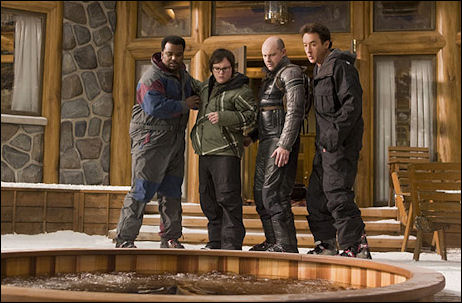
It’s Back to The Future with vomit and madness and Crispin Glover absurdity and nostalgic ’80s satire, and even a guy pretending to be Biff, that pudgy, obnoxious, one-expression dickhead in all three Back to the Future flicks. It’s Groundhog Day with black-guy semen splattered over its face. Well, not really semen but facial soap that looks like it. The “movies”, you know.
Hot Tub Time Machine is complete bullshit and sloppy as hell, but it takes you on an inventive, anarchic and clever-ass ride that makes you laugh, and then laugh more loudly, and then say to yourself, “Is this really happening? Is a straight guy really being forced to blow his straight friend in front of a crowd of hooting maniacs?”
The director is Steve Pink — heretofore to be recognized as the kind of sick madman that Hollywood youth comedies need and must have. The screenwriters are Josh Heald, Sean Anders and John Morris, working from a story by Heald.
God bless the sensibility of producer-star John Cusack for bringing this truly sick, in-and-out hilarious and philosophically reprehensible comedy to the big screen. Cusack is a hoot in this thing, as you might expect, but the real breakout is Rob Corddry, who plays the wild-card wildass in the group of four (Cusack, Corddry, Craig Robinson, Clark Duke ) who visit a broken down ski resort and travel back to their youth in the mid ’80s and…don’t ask.
It’s all too crazy and sick to recount, but it has a philosophical point, which is that your fate and your future are not set in stone, and that you only have to man up, throw the dice and change what you don’t like.
Everyone behind and in front of the camera was almost certainly on mescaline when it was written and made, and I know that I have to see it again soon, and at a theatre that doesn’t muffle the fucking sound like those ayeholes at the AMC 34th Street did tonight.
Will Hot Tub Time Machine make as much money as The Hangover? Maybe, maybe not…but I know one thing — this movie is smart and nuts and anarchic in a way that redefines the term. It’s my idea of what truly insane, throw-it-out-the-window, fuck-all smartass comedy should ideally be and feel like.
It’s better than The Hangover — funnier, sicker, more insane but also with a much trippier and crazier script. It looks like some grubby New Line comedy from 1992, but the pace is relentless and it gets funnier and funnier and funnier. Stupidly, okay, but accelerated with a seriously brainy bent.
The people saying that Hot Tub Time Machine was made especially for Gen-Xers and others who remember the ’80s are…okay, maybe half-right. But any age group should (and I think will) be able to recognize true batshit insanity when they see it.