Shudder At The Prospect

I don’t know what I was thinking. I wanted to be in Salt Lake City by the early afternoon, but the reality of getting three or four hours sleep at most and having to wake up with the stars still out has only just hit me. Tomorrow is the last day for all the stuff you always have to do before leaving. I’ll be wearing a niftier black cowboy hat than the one I wore last year. The flight will be miserable, of course, and I can only guess what the airline will be charging me for baggage.

Bullet Points

Apple’s iPad/iTablet will be announced on January 27th, but won’t be purchasable until March…is that right? Won’t their presentation seem a little anticlimactic, given all the informational hubbub so far?

An HE reader “used to sell a lot of Apple computers,” he claims, “so I know how their supply chain and marketing strategies have worked because they haven’t changed. I have no inside knowlege whatsoever, and have just been putting together the rumors like any other outsider.” But from all the sites and the consistencies and inconsistencies, here are his predictions:

1. What it is:

“A 10.1 inch multitouch screen that will act like the iPhone screen.

“It will have one button like the iPhone.

“It will have a video/still camera that’ll probably be 5 megapixels that will do video chat.

“It will be Wifi enabled.

“It will have 3g capability that you will have to pay a monthly charge for through the Itunes store.

“It won’t make calls (that would eat into iPhone market)

“It will run an operating system similar to the iPhone operating system, just expanded with options for filesaving like a Mac does.

“It will not run Snow Leopard or any other laptop/desktop Mac OS (which would eat into the laptop market).

“It will have the same iPod connector.

“It will have every major magazine or newspaper distributed as an application.

“There will be a new Ebook section on the Itunes site if they don’t go out and add an IBook site just to cater to the book business.

“It will have an aluminum backing similar to the current iPhone.

“It won’t have a battery you can replace (this is so that it will eventually DIE and you will have to replace it, like every iPod and iPhone).

“It will have the most gorgeous HD capable display you will see on anything out there.

There will most likely be three versions: Entry Level $599/ 32gb hdd, $699/64gb hdd, and a $899 with additional features and a larger HDD.

“The additional features will most likely be a mobile version of IWORK, Apple’s office suite that is the only thing they haven’t beaten Gates with.

“IWORK will be available as an application, but Microsoft Word will not obviously.

It will have a memory card reader slot, but no CD’s obviously.”

2. What it means for Apple::

“Apple has marketed itself as the primary consumer computing company. If there was a gap in their product offering, this is it.

“It makes them the first and last legitimate destination to purchase any book, magazine, newspaper — the key element being textbooks.

“Apple did it with music. They’re gaining momentum (slowly) with TV and film. But whatever momentum the TV and film had will be pedestrian to the explosion of consumption of print media through the iPad. Print media is already limited based on the form of the user interface. It will be cheaper and easier to consume, and the user experience will be better.

“This is a by-product, but Apple cares a lot about the environment. How much can they play up the fact that they are saving forests by enabling digital versions so people don’t have to print or recycle paper?

“The odds of them screwing up are astronomical. All they really have to do is get an iPhone and a Macbook Pro to have sex and you will have the most portable and most enjoyable content delivery system in the world.

3. What it means for us as a society:

“It gives a heart transplant to journalism as an industry and public service. People need reporting, and when the print media no longer has to pay for pulp and printing presses (which they are currently doing in addition to their current digital formats) they will have more money to compete for reporters who will improve the overall finished product. We all know about the death of newspapers from David Simon and The Wire.

“Whatever was holding back the idea of telecommuting isn’t anymore.

Any media you want will be available by a subscription service. NBC on demand? $5 per month. NYTimes? $5 per month. Whatever else you can think of.

“Just like the iPod became your entire CD collection, you will be able to carry around your entire DVD collection on a viewable form that exceeds or rivals your current viewing situation. If you have a top end 50” HDTV with a Blu-ray player that you watch in surround sound from 10 feet away, it will look the same on 10.1, deliver similar if not equal sound and resolution from 2.5 feet away.

“If it does and these things, and if it performs them in a simple, clean, straightforward way, there is no way that this doesn’t make Apple the one to beat in every major and minor media platform. I think future versions may include some form of Docking system that eventually replaces your cable box and blu-ray player. I don’t think they want a part of the console gaming industry now, but they already have the mobile gaming industry on its toes, but if they want the consoles they can take that too.

“The iPod is 10 years old. Ten years ago, people had CD collections and mobile CD players that were huge. When was the last time you saw one of those things? Ten years from now, its entirely possible that people will look at newspapers, magazines, textbooks, cd’s, dvd’s, cable boxes, stereos, paper notebooks, printed photographs, landline telephones (gone with the advent of the video chat and skype apps). And it will be entirely possible that Apple, while not owning exclusivity in any anti-trust capacity, will effectively own all of those industries. Every school kid could be required to have one in lieu of issuing textbooks.

“Since 1984, Apple has targeted two markets, education and personal consumers. They ignored business computing. What does this do to Microsoft, who is on the verge of another so-so version of Windows, a huge investment in an inferior tablet, and losing marketshare in their business based software? What happens if Apple wants to make a move into that world? With cost effective user-friendly workstations that work with everything you already have and improves it going forward? Whats stopping them?”

“Still Stunned”

The Envelope‘s Pete Hammond spoke last night to Avatar‘s James Cameron at the Fox after-party at Craft. His first question, naturally, was about Cameron’s surprise Golden Globe win over Kathryn Bigelow in the Best Director category.

“I am still stunned,” Cameron answered. “I was sure [Kathryn] was gonna win. I thought because it was the foreign press, they might appreciate our movie a little more, so best picture was a possibility, but not director.”

As for Avatar being $200 million shy of breaking Titanic‘s worldwide box-office record, Cameron said he “always knew one day someone would do it. And I knew I had to prepare myself to accept that fact. I just never knew it would be me, so yeah, I’m fine with it happening now!”

“Dreary, Lifeless”

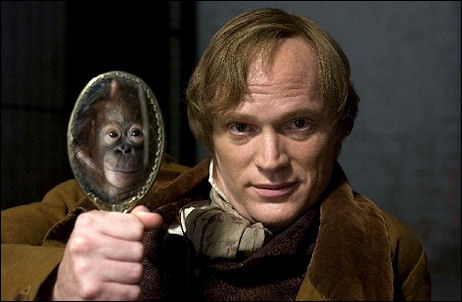
“I had to laugh after I saw Creation at the Toronto Film Festival last fall,” writes Marshall Fine, “because I’d read speculation in the press that the reason it was having trouble finding an American distributor was its controversial content.


Paul Bettany as Charles Darwin in Creation.

“As if this weak-tea, droopy-drawers drama had a scintilla of anything that might be mistaken for controversy squirreled somewhere within its overlong running time. Perhaps I dozed through that part.

“What most people were too polite to say was that Creation (1.22.10) is a colossal snooze, a drama allegedly about a hot-button topic — Darwin’s theory of evolution — that buries its most interesting material beneath a mountain of sudsy and dreary psychodrama that’s not all that dramatic.”

“In A Town Like This…”

An announcement about April Criterion releases says that Sidney Lumet‘s The Fugitive Kind (1960), an under-appreciated adaptation of Tennessee WilliamsOrpheus Descending starring Marlon Brando and Anna Magnani, will be among them. We’re talking a double-disc special edition with a high-definition digital transfer plus extras, including a documentary about the making of the film and an essay by David Thomson.

Brando’s Valentine Xaiver, a guitar-strumming drifter in a snakeskin jacket, was his second and last performance as a youngish moody type in a frankly sexual drama. (Val could’ve been the older, alienated-hipster brother of Stanley Kowalski — one who never wrote or kept in touch.) Brando returned to this kind of character in Last Tango in Paris, of course, but as a middle-aged man on a kind of spiritual downswirl.

Joanne Woodward costarred as a heavily mascara’ed wackjob. Victor Jory plays one of Williams’ standard-issue Southern sickos — a symbol of decrepitude and intolerance.

The Criterion email calls The Fugitive Kind a 1959 film. The IMDB says it opened on December 1, 1959 but Bosley Crowther‘s N.Y. Times review is dated April 15, 1960. It premiered in Los Angeles and sat around for four months before opening in New York?

“At the center of his drama, which grimly and relentlessly takes place in the sweaty and noxious climate of a backwash Louisiana town, there are two brave and enterprising people whose inevitably frustrating fate assumes, from the vibrance of their natures, the shape of tragedy,” Crowther wrote. “And because Marlon Brando and Anna Magnani play these two people brilliantly, The Fugitive Kind has a distinction and a sensitivity that are rare today in films.

“Credit, too, Sidney Lumet, who has directed this piercing account of loneliness and disappointment in a crass and tyrannical world. His plainly perceptive understanding of the deep-running skills of the two stars, his daring with faces in close-up and his out-right audacity in pacing his film at a morbid tempo that lets time drag and passions slowly shape are responsible for much of the insistence and the mesmeric quality that emerge.”

Honest Failure

HE reader Bobby Rivers has pointed out that during last night’s Martin Scorsese montage before he accepted his Golden Globe life achievement award there was no clip from New York, New York, even though the band played the film’s Kander & Ebb title tune as Scorsese walked to the stage.


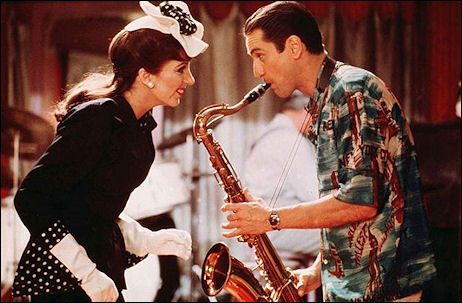
Liza Minelli, Robert De Niro in Martin Scorsese’s New York, New York.

The reason, of course, is that very few people feel much affection for New York, New York. I’ve never really liked it myself. (It has one electric scene — i.e., when Robert De Niro is physically thrown out of a club that Liza Minelli is performing in, and he kicks out several light bulbs adorning the entrance way as he’s manhandled out by the manager and a bouncer). But I know I’ve always liked Pauline Kael‘s line about New York, New York (one of the most infamous cocaine movies of all time) being “an honest failure.”

What other films can be described this way? Is dishonesty a reason why most films fail? Do audience sense some kind of lying going on and therefore reject them out of hand? Honest Failures is just one way of putting it. Respectable Failures, Honorable Failures, Commendable Failures…movie history books are full of them.

I’m not defining Honest Failures as films which have steadily risen in esteem in the years since their initial release (like Charles Laughton‘s Night of the Hunter, say), but as admirable, well-made films that are still a little under-regarded, and in some instances have almost been forgotten.

Stop It Right Now!

In the first post-Globes Oscar projection chart, And The Winner Is columnist Scott Feinberg has put James Cameron‘s name at the top of his list of Best Director Oscar-nominees (and with a little electric-green arrow next to his name) because he won the Golden Globe Best Director award last night. Stop that, Scott! And all the other giddy-golly Globe rebounders — cool your jets, please.


Kathryn Bigelow, James Cameron, Scott Feinberg

The Golden Globes are a bellwether of nothing except ethereal mood and easy-lay emotionality expressed by a group of pseudo-journalist whores for the most part, so chill down and take a breather and a sip of water.

Cameron may wind up winning the Best Director Oscar as a gesture of serious respect for the visionary craft that went into Avatar as well as an expression of community gratitude (i.e., the feeling that Avatar‘s tremendous worldwide success has given the industry a shot in the arm and changed the tentpole game with 3D). The Globe win reflected this feeling, I’m presuming. It was also about fellating a huge financial success. As Ricky Gervais inferred last night, money and glamour-power have always mattered a great deal to the HFPA membership.

The bottom line is that the voters and the voting that led to Cameron winning the Best Director Golden Globe are not widely or even marginally respected. In and of itself the Cameron award meant very little, and Feinberg knows better than to suggest that Cameron has some sort of headwind now. God, that little green arrow!

The Best Director Oscar is still Kathryn Bigelow‘s to have and to hold because (a) in a very real sense she accomplished as much with The Hurt Locker as Cameron did with Avatar, having singlehandedly and against tough odds created a high-throttle hammer-punch movie with its own sense of place and identity and its own special soul, only with much less money to throw around, and (b) because history and culture demand that a woman — who happens to be a formidable kick-ass director under any sun and by the standards of either gender — should win the Best Director Oscar this year, and in so doing become the first woman to be so honored in motion-picture history.

Enough with the kneejerk kowtowing to the current Big Cheese Alpha Male director of the moment…Bwana Bwana save us Bwana…thank you for bringing so much manna into our industry. Bigelow is the real Bwana — she is the embodiment of work-it, never-say-die, get-it-done and get-it-right despite the hardships. Every talented director who has had to push it to the limit and work 19-hour days without a net knows (or suspects) what Bigelow had to do to get where she is today, and how it must feel to be right on the precipice.

The visual-aural impression of Cameron’s name having been called out last night and his delivery of a gracious thank-you speech does, I admit, pass along a sense of superficial heat to Cameron/Avatar. But the opinions of 90-something foreign journalists (some of whom barely merit the name) who belong to a weird-ass exclusive club that wasn’t, at last glance, representing a wealth of world-class publications don’t mean squat.

As Sharon Waxman wrote two years ago, “Joining [the HFPA] is nearly impossible. Qualified foreign journalists from major media outlets need not apply and, anyway, they usually don’t. The group takes five new members a year at most, and any member can veto a candidate. With attrition from deceased members and those who failed to meet the work minimum, this year no more than 82 people will choose the winning movies and TV shows.” (That number stood at 95 last year, and is today presumably in the same ballpark.)

“Compare that to the Academy of Motion Picture Arts and Sciences, which has about 6,000 members,” Waxman concluded.

Indeed. And then tell Feinberg and Dave Karger and all the other ping-pong-ball prognosticators who’ve been predicting a Cameron Best Director win (Pete Hammond, Michael Musto, Ed Douglas) to settle down and use a little perspective.

Credit Where Due

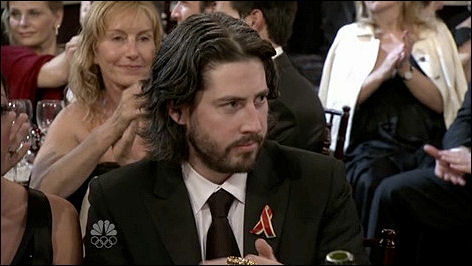
Two days ago (on 1.15 at 5:54 pm) L.A. Times/”24 Frames” columnist Steven Zeitchek posted the clearest explanation I’ve read about the apparent Up In The Air acrimony between Jason Reitman and Sheldon Turner. Reitman seemed to radiate a certain coolness toward Turner when they took the stage tonight to accept the Golden Globe award for screenwriting.


DVR capture of Jason Reitman after the announcement of Avatar‘s Best Picture win at the Golden Globes.

Well, That Happened!

Unable as I’ve always been to separate my feelings from my pulse-readings, I wasn’t very accurate with my Golden Globe predictions. Correct calls: Avatar for Best Picture, Sandra Bullock for Best Actress in a Drama, Jeff Bridges for Best Actor in a Drama, Meryl Streep for Best Actress in a Comedy/Musical, Mo’Nique for Best Supporting Actress, and Christoph Waltz for Best Supporting Actor.

I got everything else wrong. But everyone got Best Director wrong. It had been signed, sealed and all but delivered for Kathryn Bigelow — I mean, everyone with a shred of focus and perspective had decided this would happen — and then the HFPA, whores at the core, gave it to James Cameron because of the eye-popping grandiosity of Avatar‘s vision and box-office.

Nutters

My guess is that Robert Downey, Jr. has just won the Golden Globe for Best Actor in a Comedy/Music award because he’s sharp and funny and well-liked for his amusing way of riffing on the truth. Because the idea that he gave the best performance in this realm is a joke. He got through Sherlock Holmes with a slightly wiggy deadpan attitude…fine. But hardly the stuff of tribute. Any rational body would have given the award to Michael Stuhlbarg or Matt Damon. “Art in the blood is likely to take the strangest forms,” Downey said. “The Hollywood Foreign Press is a strange bunch.”

Second Mindblower

No one with an understanding of anything would suggest that The Hangover is a better, more valuable film than (500) Days of Summer. Nobody would even dare to compare the two in conversation. And yet the HFPA has just given The Hangover its Best Comedy or Musical award. “Wow…we didn’t expect this,” said director Todd Phillips.