

This scene from Spike Lee‘s The 25th Hour is one of the greatest looking-in-the-mirror soliloquies of all time, right up there with Robert Downey‘s in James Toback‘s Two Girls and a Guy and Kevin Spacey‘s in Casino Jack. Here’s a transcript on Chuck Palahniuk‘s site.
Hot Muslim Lingerie
I feel the ghost of Radley Metzger in this German-produced Liaison Dangereuse ad aimed at corrupting Muslim values by portraying traditional Middle-Eastern women as smokin’ hot mamas under their head veils (a.k.a. “niqabs.”) I was also thinking of the Catherine Deneueve-Susan Sarandon sex scene in Tony Scott‘s The Hunger. Terrorist reprisal countdown in Berlin….three, two, one.
Sexiness for everyone from Glow Berlin on Vimeo.
Murphy on Jaymes
Producer Don Murphy has written an affectionate obit about manager Cathryn Jaymes on his site, and in so doing has dinged Quentin Tarantino, with whom he has a well-documented history (including fistifcuffs at Ago in the late ’90s). He doesn’t refer to former partner Jane Hamsher with much affection either. Here‘s the piece:
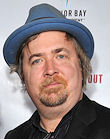

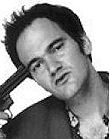

(l. to r.) Don Murphy, Cathryn Jaymes, Quentin Tarantino, Jane Hamsher
“I met Cathryn way the hell back in 1992. She was managing my friend Quentin Tarantino and my friend Roger Avary. She was nice. Almost too nice. I would forever tease her for being so nice. She had good taste and passion. She would fight hard for her clients, sometimes even when they weren’t all that talented. Because she was nice and because you therefore couldn’t be sure what to believe, she was a hard bird to figure out. This was Hollywood after all.
“In 1993 Quentin decided to betray our friendship. It’s a long boring story that doesn’t belong here, but he sold me and my ex-partner the rights to Natural Born Killers, acting friendly to our face, while stabbing us in the back. It was really nasty and just plain wrong. During this whole process, at considerable risk to herself, Cathryn helped us navigate the waters behind the scenes. She never once betrayed her client. She would never do that. But she knew what was right and what was wrong. She stuck up for us and was a better friend than her client and made sure we ended up okay. I’ll never forget her kindness as long as I live.
“Cathryn could be tiring, but that was because she cared passionately about what she believed in. She had a wit, a sense of fun, and what more can I say, she was just freaking nice. She was often disrespected because she was this eccentric, small lady, but she never let it stop her. She believed in people.
“And I was there, also, when she finally got dumped by the ‘successful’ Tarantino and she was destroyed by it. Here was somebody who lived on her couch and was nurtured by her and gradually attained his dreams, and then took a giant shit on her. Nice. In Sharon Waxman‘s Wrap article it is pointed out that she never recovered. She didn’t.
“When my former partner wrote “Killer Instinct,” her book about Natural Born Killers, it was important to me that Cathryn read it to make sure the details were right, and also to make sure she was comfortable with how her support of us was portrayed. She took her time, was very helpful and fastidious, and when she came back with her notes my then-partner Jane Hamsher lost it on her, I guess this was because she didn’t want to make changes. There are many reasons why our partnership ended soon after that book, but her treatment of Cathryn was a major factor.
“Over the last ten years or so Cathryn and I didn’t interact often enough. She kind of cut back on managing. It appears she was sick. And she focused on actors more than writers. I would see her at events. I think I last saw her at a special CAA screening that Oliver Stone had two years ago. She was always friendly, supportive and cordial. There is no one I have met in this business in 16 years who I can say the same about.
“Death always sucks. But it sucks more when it happens to somebody who was really just a sweet human being. Godspeed, Cathryn. You wanted to be remembered as someone who was fair. You were all that and more.”
Sad Death of Nice Lady
I should have linked right away to Sharon Waxman‘s 1.7.09 report on the sad passing of Cathryn James, the ex-manager of Quentin Tarantino. I spoke to James three or four times in the mid ’90s about her Tarantino history, and I remember that she was intellligent and frank and, as far as I could tell, a nice person (if a bit frail).
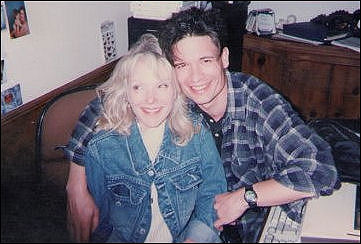
Cathryn Jaymes, former client-friend Craig Hamman in photo copied from The Wrap.
Waxman’s piece recounts the story of how Tarantino dropped Jaymes as his manager after his career began to take off. She took it extremely hard, and it may be true, as Waxman suggests, that her health suffered as a result. “Although many knew that Tarantino fired Jaymes abruptly on the brink of his greatest success with Pulp Fiction (a story I recount in “Rebels on the Backlot”), few knew that she contracted virulent breast cancer in the year or so after her brutal separation from the director.
“She chose to have a radical mastectomy but slowly bowed out of the business. I know that Cathryn believed, and it didn’t take much to convince me, that what she considered a shocking betrayal by Tarantino contributed to her illness.”
What Tarantino did was cruel, but stuff like this happens. All is fair in love and war and talent management, and anyone will tell you that kind and decent people sometimes take it in the neck in this town. Hollywood is filled with electric eels, and sometimes your Boy Scout (or Girl Scout) merit badge won’t get your client where he/she needs to go. Watch Kirk Douglas fuck Barry Sullivan in The Bad and the Beautiful — not pretty and in fact pretty cold, but the heat in the Hollywood kitchen makes people sweat 24/7. The more money, power and glory there is to be had, the worse people behave. Especially those who aren’t terribly nice people to begin with.
But I don’t think that even a fragment of a case has been made that Quentin Tarantino hurt or weakened Cathryn Jaymes to such an extent that her body wasn’t strong enough to fight off breast cancer. Are all illnesses psychological? They seem to be in some cases, but people get sick for all kinds of reasons, and it’s really not fair to draw linkage between a hurtful but common practice (i.e., manager-shucking) and a person’s illness or passing. If a person psychologically gives up — if they don’t have the fight to keep moving despite hurtful setbacks — that is their decision alone.
Still, it’s not helpful to be thought of as a prick. I don’t know how this episode will play among Academy members (who know, after all, how this town works politically and how some have clawed and back-bitten their way to the top), but I can’t see how the recent articles about Jaymes by Waxman and Don Murphy aren’t at least a slight problem as far as Tarantino’s Best Director chances are concerned.
Come and See
Earlier today I posted a flattering Sean Penn quote about The Hurt Locker. He called it one of the all-time great war films, comparable only to Elem Klimov‘s Come and See, a1985 Russian film, and Hal Ashby‘s Coming Home (1978). In response to this a director friend wrote the following:
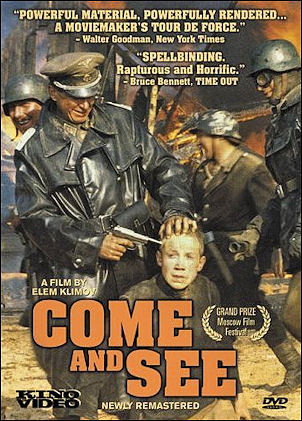
“I don’t know if it’s fair to categorize Coming Home as a war film,” he began, “but Elam Klimov‘s Come and See most certainly is. Furthermore Penn’s assertion that it’s one of the greatest of that genre is precise and fair. In fact, I would go as far as to say that the final hour of the film, much of it a second-by-second depiction of an atrocity in a Belarusian village, may be the finest filmmaking in the history of the art.
“Anybody who has devoted any study to Operation Barbarossa and is aware of the behavior both of the Einsatzgruppen and the partisans who fought them will tell you that it is about an accurate a depiction of these events as is possible. The ending of the film is magical. The title of this film (it was once called Kill Hitler) comes from the Book of Revelations, and the film has interesting Christian undertones throughout. Bizarre, since the film was the product of an atheist regime.
“Have you seen it? If not, you should hang your head in shame. It is mandatory viewing for anybody calling themselves a film scholar of any kind.”
No, I haven’t seen it. I will soon enough. I obviously have Penn to thank.
Wee Man
Peter Jackson doesn’t look small sitting next to Quentin Tarantino (who’s big but not huge) and Kathryn Bigelow — he looks like a Hobbitt. He looks so small it almost seems like a visual effect. And yet he doesn’t seem that runty in the shots in which he’s framed alongside James Cameron and Jason Reitman. (Lee Daniels is at Reitman’s left.)
Here’s part two and part three of this hot-shot director discussion produced by the Hollywood Reporter.
No Exit: Nick Nolte
I’d like to see Tom Thurman‘s Nick Nolte: No Exit because I’ve always enjoyed Nolte’s brutish charm. I don’t care for this trailer, frankly — I hate it when actors joke about other actors in a too-chummy way, trying for light banter as they go along — but Nolte is one of the great madmen. I’ve been told that a disc of Thurman’s doc is arriving via snail mail
My admiration of Nolte began with his legendary performance as “Samurai Ray” Hicks in Who’ll Stop The Rain. Except the only available DVD of Karel Reisz ‘s film looks awful in parts. It’s nearly unwatchable for the first ten or twelve minutes.
Fast Break
So now four Sundance 2010 films will be quickly available on VOD following the festival’s end. Linas Philips‘ Bass Ackwards, which New Video and Zipline Entertainment will offer on multiple platforms starting on 2.1.10, was the first to be announced. Today IFC’s Sundance Selects revealed three more VOD quickies — Michael Winterbottom and Mat Whitecross‘s Shock Doctrine, Benny Safdie and Josh Safdie‘s Daddy Longlegs (formerly known as Go Get Some Rosemary), and Daniel Grau‘s Les 7 Jours du Talion (7 Days).
Longlegs, a character-driven drama about becoming an adult, and 7 Days, a torture-revenge piece, will debut on VOD on Friday,1.22, after they first screen at Sundance. I don’t know when Shock is being VOD’ed but you’d have to figure sooner rather thanb later.
Penn Springs
At a recent Palm Springs Film Festival gathering Hurt Locker producer-screenwriter Mark Boal introduced Sean Penn to The Wrap‘s Steve Pond, and they were off to the races. Boal’s film, said Penn, “is one of the three greatest war pictures ever made,” the other two being Come and See and Coming Home. (What about Paths of Glory and A Walk in the Sun?)
“It’s not an anti-war film, it’s not right or left…it doesn’t take sides,” said Penn. “It’s real life, executed skillfully and powerfully. It trusts that real life is incredibly dramatic, and it says to you, there are times when it might be the right thing to support war – but know that war hurts. The Hurt Locker hurts.
“It’s dealing with a territory where I spent time I am an envious person, and I wanted to criticize it. But I couldn’t, because it gets it right.”
Daniels Nominated for DGA Award?
The Directors Guild of America has blown off three directors who delivered two superb films — An Education‘s Lone Scherfig and A Serious Man‘s Joel and Ethan Coen — while nominating the director of a clearly divisive and problematic film — Precious helmer Lee Daniels — in large part (let’s be honest) because boomer-aged liberals in the DGA needed to put the west-of-Fairfax white-guilt factor to bed.
Are you going to stand there and look me in the eye and tell me Precious was a better directed film than An Education or A Serious Man? Don’t even reply because we know the answer and I don’t want to hear any bullshit equivocations.
I’m not totally dismissing Precious — it’s a moving, semi-decent film in portions — but I would strenuously argue that Tom Ford‘s A Single Man is a much more moving and accomplished work, and is surely more of a carefully finessed film from a visual-aesthetic viewpoint. A Single Man is Vanity Fair-level and Precious is Star magazine. Those red-carpet fantasy sequences with Gabby? I want to vomit.
The Daniels nomination is a political celebration of mediocrity by way of racial point-spreading. Nominate Daniels and you’re good to go. Don’t nominate Daniels and the word might get around that you’re a bit of a closet racist. Why risk it?
DGA members also nominated Kathryn Bigelow for The Hurt Locker, James Cameron for Avatar, Jason Reitman for Up in the Air and Quentin Tarantino for Inglourious Basterds for its top feature award.
Absence of Cool
Four days ago the smoking-in-movies issue returned for the 37th time. It started with Stanton A. Glantz, director of the Center for Tobacco Control Research and Education, bitch-slapping Avatar for Sigourney Weaver‘s character being a chronic smoker. Then New York‘s David Edelstein suggested that movies with cigarette smoking should get an automatic R rating. Then David Poland said “what?” And then Movieline‘s Stu Van Airsdale jumped in.
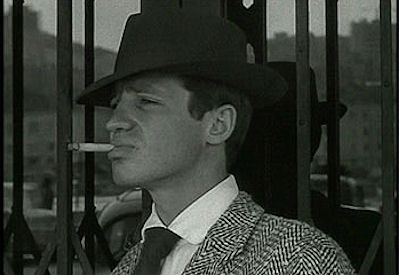
Jean Paul Belmondo in Breathless
I’ve said this so many times it’s coming out of my ears. People should be free to do anything they want of a self-destructive nature — cigarettes, booze, compulsive eating, coke, heroin — as long as theykeep it to themselves. And actors should be free to do anything they want that will make a performance connect. But smoking has lost its coolness, and actors who lean on it repeatedly or compulsively are boring, and I’m starting to say “fuck ’em” when they pull one out and strike a match.
Here’s how I put it two and a half years ago:
“The only people I know in real life who smoke are (a) young and courting a kind of contrarian identity, (b) older with vaguely self-destructive attitudes, and in some cases beset by addiction problems, (c) serious party people with unmistakable self-destructive compulsions and tendencies, and (d) life’s chronic losers — riffraff, low-lifes, bums, scuzzballs. Cigarette smoking used to be extremely cool but no longer, and that goes for actors in movies too.
“All the above associations seem to kick in every time sometime lights up in a film, and it’s gotten so that I don’t want to watch characters in movies smoke at all. Unless it’s a period film or unless they look extremely cool doing it (a la Robert Mitchum in Out of the Past or Jean Paul Belmondo in Breathless), but very few actors have that ability.
“I smoked for years and years but I don’t any more, and I don’t like the way cigarettes smell unless I’m in Europe. (It’s different over there). Smoking isn’t outright suicide but it’s the next thing to it, and every time someone lights up in a movie it half-pisses me off and makes me think negatively about the film in general, especially if this or that actor smokes all through the movie and looks and acts like a lowlife.
“Criminals in movies are always smoking because of (b), (c) and (d), but I think it’s way too easy for an actor to use smoking as a piece of business. It’s tedious and repellent. It makes me want to see the actor get shot or at least beaten up.
“I think the sun has really set on the sexiness of smoking in movies, and I’m starting to think that actors who light up all the time in front of the camera are second-raters.”
Six Thousand Films
NY Times DVD/Bluray columnist Dave Kehr recently lamented the winnowing process by which thousands of obscure films have been shelved and forgotten because studios “felt that more obscure films wouldn’t be profitable enough to justify striking new prints and preparing new digital transfers.
“As a result huge swaths of our film heritage have vanished. After 10 years of DVD the studios seem to have concluded that all the films that will make money in home video have already been released; that number is a very small percentage of their output. Turner Classic Movies online says that of the 162,984 films listed in its database (based on the authoritative AFI Catalog), only 5,980 (3.67 percent) are available on home video.”
If you’d asked me to spitball the percentage of films on DVD compared to the total amount made, I would have said maybe 10% to 15%. But less than 4%?
We all suspect that the majority of titles that haven’t made it to DVD are marginal junk, but it’s a near-certainty that at least 5% of the unseen are worth seeing/renting/owning. Many are listed on the left side of Hollywood Elsewhere, in the lower-left mustard-colored section. The list of DVD Unreleased has been compiled and maintained over the last year or so by Moises Chiullan.
The films include Saint Joan (Otto Preminger, 1957), Macabre (William Castle, 1958), The Fiend Who Walked the West (G. Douglas, 1958), Five Gates to Hell (Clavell, 1959), Key Witness (Phil Karlson, 1960), Summer and Smoke (Peter Glenville, 1961), The Chapman Report (George Cukor,1962), Bachelor Flat (Tashlin, 1962 –on Hulu], The L Shaped Room (Forbes, 1963), The Chalk Garden (Ronald Neame, 1964), A Thousand Clowns (Coe, 1965), You’re a Big Boy Now (Coppola, 1966), The Whisperers (Forbes, 1967), Dark of the Sun (Jack Cardiff, 1968), Skidoo (Preminger, 1968), Last Summer (Frank Perry, 1969), The Comic (Carl Reiner, 1969); The Revolutionary (Williams, 1970), The Landlord (Hal Ashby, 1970), Diary of a Mad Housewife (Frank Perry, 1970), Tropic of Cancer (Strick, 1970), I Never Sang for My Father (Cates, 1970), Pretty Maids All In A Row (Roger Vadim, 1971), Sometimes a Great Notion (Paul Newman, 1971), Marriage of a Young Stockbroker (Turman, 1971), ‘Doc’ (Perry, 1971), The Music Lovers (Russell, 1971), Savage Messiah (Russell, ’72 or ’73), Drive, He Said (Jack Nicholson, 1971), The Steagle (Sylbert, 1971), The Last Movie (Hopper, 1971), Made For Each Other (Bean, 1971), The Day the Clown Cried (Jerry Lewis, 1972), Hickey & Boggs (Culp, 1972), The Carey Treatment (Edwards, 1972), Play It As It Lays (Perry, 1972), Pete ‘n’ Tillie (Ritt, 1972), Slither (Zieff, 1973), Love and Pain and the Whole Damn Thing (Pakula, 1973), Man on a Swing (Perry, 1974) and so on.