
To Hell With Holmes

Guy Ritchie‘s hyperbolic Sherlock Holmes isn’t a movie — it’s a franchise,” writes New Yorker critic David Denby. “Or, at least, a would-be franchise. Arthur Conan Doyle‘s material has been grabbed by its velvet collar and thrown into twenty-first-century media culture. Such a turn was inevitable. The subdued charm of Conan Doyle’s hansom cabs, enveloping fogs and courteous manners, in which the facade of gentility is broken up so delightfully by devilish conspiracies, is not of our age.”
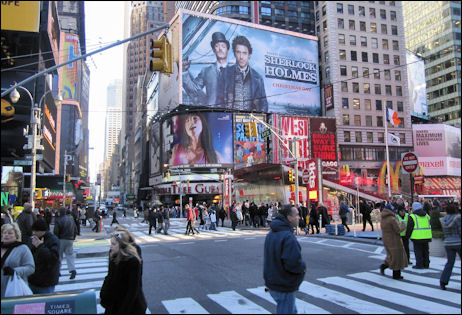
In other words, ladies and gentleman: Sherlock Holmes: The Coarsening and Degradation of Civilization As Your Fathers and Grandfathers Once Knew It.

“In Ritchie’s version, the facade doesn’t even exist: his London is rubbled and mucky, with beggars underfoot, and fouled by half-finished industrial monstrosities. Ritchie’s visual style, aided by the cinematographer Philippe Rousselot, is graphic-novel Victoriana: there are steampunk interiors — ironworks and infernal machines with a retrofuturistic look — and dim laboratories in which everything looks rank. The movie is grimly overproduced and exhausting, an irritating, preposterous, but fitfully enjoyable work, in which every element has been inflated.”
More Avatar Uptick

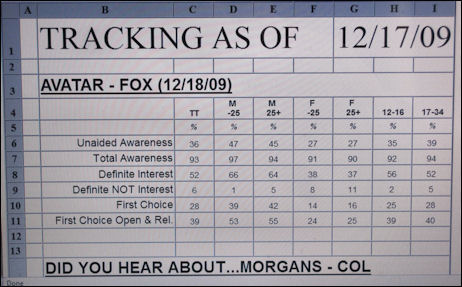
Avatar‘s tracking numbers have strongly surged. Total awareness is at 93, definite interest is at 52, first choice is at 28 and first-choice-and-release is at 39. Under-25 females who were counted on 12.10 as definitely not interested at 18 have sunk down to 8, which obviously means that negatives have dropped across the board.

After lamenting earlier this month that Avatar‘s most recent first-choice tracking seemed to have stalled out at 16, I suggested that a 30 first choice just prior to opening day seemed necessary to match box-office expectations. On December 10th I noted that Avatar’s across-the-board first choice has risen from 16 to 20 — good news. And now it’s nearly at 30, which is roughly the same or a tad higher than the first-choice figure for New Moon just before opening day.

Does this mean that previous expectations that Avatar would open somewhere between the high 60s and low 70s are perhaps moot? A box-office analyst I spoke to a few days ago said “if people are expecting Avatar to open to $100 million, their expectations are wildly unrealistic. It doesn’t need to open to anywhere near that, and Fox isn’t expecting it to.” I’m thinking that a Sunday-night figure in the mid to upper 70s might not be unrealistic.

Eye Plays Tricks?

Eagle-eyed Avatar fans might want to take note of possible differences between the IMAX 3-D version and the regular 3-D versions. Netherlands-based HE reader Jonathan Spuij claims he’s seen “both the IMAX 3D cut and the regular digital 3D version of Avatar and I noticed two small changes in scenes.” Or at least he thinks he did.

“First, when the super-tree gets destroyed, the IMAX cut shows the clansmen trying to fly off their banshees from the top of the falling tree,” he writes. “I didn’t notice this shot in the regular version.

“And second, there’s a shot in the trailer of Sam Worthington sitting by his Avatar-machine in the lab in his wheelchair. The little scene preceded the final video recording in the IMAX version but was cut from the regular version.” Wait…I don’t get what he’s saying here exactly.

Spuij finishes his letter with “is there more or am I just imagining things?” Is he?

SAG Nommie Nod

I have to return a rental car in New Jersey and then bus back into Manhattan for a Serious Man luncheon at the Monkey Bar starting at 12:30 pm, so I haven’t time to get into the just-announced SAG Award nominations.

It’s the same old gruel anyway with Up In The Air, Precious and Inglourious Basterds taking three nominations each. Mark my words — five years from now the people standing by Precious will be like Peter denying three times that he knew Yeshua of Nazareth. Who, me…Precious…what?

Shock and Awe

L.A. Times critic Kenneth Turan‘s comparison of James Cameron‘s Avatar to The Jazz Singer will have a profound impact on the Best Picture race, I suspect. Among those over-50 Academy members who listen to and occasionally follow his lead, I mean.

The instant I read his review I began to think that if the ABTHL crowd (i.e., anything but The Hurt Locker) decides that they can’t fully embrace Up In The Air because of its admirable refusal to go all warm and huggy during the final ten minutes, they might just throw their support behind Avatar as a tribute to Cameron’s boldly visionary historical-leap-forward. We’re clearly looking at a three-picture race right now. Only an Oscar-handicapping ostrich would deny that Avatar is now a major contender for Best Picture.

“Think of Avatar as The Jazz Singer of 3-D filmmaking,” Turan begins. “Think of it as the most expensive and accomplished Saturday matinee movie ever made. Think of it as the ultimate James Cameron production.

“Whatever way you choose to look at it, Avatar‘s shock and awe demand to be seen. You’ve never experienced anything like it, and neither has anyone else.

“Say what you like about writer-director Cameron — and take it from me, people have — he has always been a visionary in terms of film technology, as his pioneering computer-generated effects in The Abyss and Terminator 2: Judgment Day testify. He is not a director you want to underestimate, and with Avatar‘s story of futurist adventures on a moon called Pandora, he restores a sense of wonder to the moviegoing experience that has been missing for far too long.

“An extraordinary act of visual imagination, Avatar is not the first of the new generation of 3-D films, just as Jazz Singer was not the first time people had spoken on screen. But like the Al Jolson vehicle, it’s the one that’s going to energize audiences about the full potential of this medium.

“That’s because to see Avatar is to feel like you understand filmmaking in three dimensions for the first time. In Cameron’s hands, 3-D is not the forced gimmick it’s often been, but a way to create an alternate reality and insert us so completely and seamlessly into it that we feel like we’ve actually been there, not watched it on a screen. If taking pleasure in spectacle and adventure is one of the reasons you go to the movies, this is something you won’t want to miss.”

Got To Be Cool

This Melena Ryzik Carpetbagger piece about the security guys who handled the Manhattan premiere and after-party for It’s Complicated is sharp and briskly paced. But a major point is side-stepped. Security goons are solid and disciplined and nicely dressed, but they don’t know who anyone is and they don’t want to know. They refuse to be street smart. This is why they’re called goons or apes — because they insist on fulfilling the definition of these terms.

If you’ve been invited by a publicist handling an event and have a series of e-mails on your iPhone to prove it, the goons will refuse to even look at them. They don’t want to know anything. They will only acknowledge what the list tells them, or what their superior (who also doesn’t want to know anything) tells them. They refuse to be cool. No occasional stabs at being cosmopolitan or perceptive or amiable, even.

And they refuse to have “spotters” on their team, which is to say people who are familiar with the crowd and have a certain awareness of who’s who in the New York social-media world. At the It’s Complicated party I watched a tall African-American goon refuse to talk to or even look at Peggy Siegal, who’d been hired to handle key celebrity invites for that event, as she tried to reason with him. A few minutes later I heard another goon say, “Who’s Peggy Siegal?”

Now, that’s not just being uninformed — that’s a kind of arrogance. That’s analogous to handling security for Yankee Stadium and saying “who’s Joe Girardi?” Why have a team of know-nothings handle your security? Why not hire guys who at least try to be cool and cognizant from time to time?

That’s why if I was in the movie-premiere security business, I would call my company Very Cool Goons or Smart Ape Security or something along those lines.

(Ryzik’s video piece was very professionally produced by Jenny Woodward — cheers.)

“What A Show!”

James Cameron‘s Avatar “is the most beautiful film I’ve seen in years,” says New Yorker critic David Denby in the 1.4.10 issue. “Amid the hoopla over the new power of 3-D as a narrative form, and the excitement about the complicated mix of digital animation and live action that made the movie possible, no one should ignore how lovely Avatar looks, how luscious yet freewheeling, bounteous yet strange.

“As Cameron surges through the picture plane, brushing past tree branches, coursing alongside foaming-mouthed creatures, we may be overcome by an uncanny sense of emerging, becoming, transcending — a sustained mood of elation produced by vaulting into space. Working with a crew of thousands, Cameron has reimagined nature: the movie is set on Pandora, a distant moon with thick forests, alpine chasms, and such fantastic oddities as wooded mountains hanging in the sky. The geographical center of the movie is a giant willow tree where a tribal clan, the Na’vi, worships the connections among all living things — a dubious-sounding mystical concept that the movie manages to make exciting.

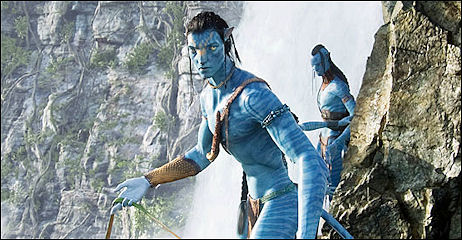
“In Titanic, Cameron turned people blue as they died in icy waters, but this time blue is the color of vibrant health: the Na’vi are a translucent pale blue, with powerful, long-waisted bodies, flat noses, and wide-set eyes. In their easy command of nature, they are meant to evoke aboriginal people everywhere. They have spiritual powers and, despite their elementary weapons — bows and arrows — real powers, too.

“From each one’s head emerges a long braid ending in tendrils that are alive with nerves. When the Na’vi plug their braids into similar neural cords that hang from the heads of crested, horselike animals and giant birds, they achieve zahelu, which is not, apparently, as pleasurable as sex, but somewhat more useful — the Na’vi’s thoughts govern the animals’ behavior.

“Cameron believes in hooking up: this world is as much a vertical experience as a horizontal one, and the many parts of it cohere and flow together. The movie is a blissful fantasy of a completely organic life.”

Sheep Mystique

“Group votes of any kind tend to cancel out radical options on either side in favor of the middle,” says Spoutblog‘s Karina Longworth in a 12.16 Vanity Fair.com piece.

“If you are not surprised that neither Ron Paul nor Ralph Nader has ever been elected president, you should be equally unimpressed by the fact that The Hurt Locker and Up in the Air have taken the bulk of this year’s pre-Oscar honors. Though the two films have their own unique virtues (and failings), neither is daring enough to truly piss anybody off. More often than not, consensus victories go not to the best or most innovative films, but to the films that pretty much everyone is pretty much okay with.”

The article is titled “Why Do All the Awards Honor the Same Movies?” I understand after reading Longworth’s piece why radical options will never be supported by majorities, but the question about why there’s such uniformity among critics groups has been explored and answered, I feel, by myself, while Longworth barely addresses it.

Movies Need This

“I’m so jaded I even initially regarded James Cameron‘s mindblower as a perfect Forgotten Decade capstone — nothing more than one rich man’s $300 million intellectual exercise with some silly blue aliens. But then Avatar actually blew my mind. It’s in fact a turning point: Cameron took the decade off, let the technology catch up with him, and then usurped its power by making something hot and light and utterly permanent. The self-proclaimed King of the World reclaimed art from the kingmakers.” — from a 12.16 Esquire.com article by Movieline‘s Stu VanAirsdale, called “Why Avatar Really Can Change Movies Forver.”

Reitman at 21

I briefly spoke with Up In The Air director-writer Jason Reitman today at 21, where a Peggy Siegal luncheon was held to celebrate the film. I told him I’ve watched the Up In The Air four or five times, and that my favorite part is the last ten minutes. And yet some folks have told me the finale didn’t warm them up the way they wanted. Reitman smiled, shrugged and said, “That’s not my job!” Good for him. My sentiments exactly.

It took Jett and I four and a half hours to drive from Syracuse to Manhattan this morning, including a 25-minute breakfast. That’s too damn long. I don’t like driving way the hell up to that academic gulag, that Siberia in the snow. I do it, of course, because it’s Jett’s home for now but God, what an environment.

Money That Matters

“The cancer that has often afflicted Academy Award thinking is the equation that a film deserving of being chosen Best Picture can’t, in fact, be chosen if it hasn’t made a pretty good amount of dough.” This is the portion of my quote for a story about The Hurt Locker‘s Best Picture chances that Boxoffice.com’s Phil Contrino didn’t use in his 12.15 story.

No criticism intended for Phil — I just like like the use of the words “cancer,” “dough” and “Academy Award” in the same sentence.

The Hurt Locker has received an overwhelming amount of critical support over the last couple of days,” his story begins. “The high-tension flick has won Best Picture from the New York Film Critics Circle, the Los Angeles Film Critics Association, the Boston Society of Film Critics and the San Francisco Film Critics Circle. It also received Best Picture nominations from the Golden Globes and the Broadcast Film Critics Association.

“As a result, it looks as though The Hurt Locker‘s chances of winning the Best Picture Oscar have improved exponentially.

“Yet the most coveted prize in the movie business has never gone to a film that failed to achieve success at the box office. Unfortunately, The Hurt Locker grossed only $12.7 million during its domestic theatrical run.

Crash is this decade’s lowest grossing Best Picture winner with $54.6 million. Technically, Annie Hall has the lowest domestic gross of any Best Picture winner since 1970 with $38.3 million in 1977, but that equals around $124 million when adjusted for inflation.

“Does this mean that The Hurt Locker can’t possibly win the big prize?”