Begging, Jumping

Every year I complain about those godawful cookie-cutter scenes in which the hero of a film jumps head-first off an incredibly high building or cliff. The same exact bit has turned up in many if not most of Hollywood’s high-budget action-fantasy-thrillers over the last 20-odd years. As far as I can recall the big-jump syndrome began with Tim Burton‘s Batman. This is a YouTube clip reel, of course.

In any case I just noticed that an “oooh, wow” cliff jump is also in Avatar, and something inside me collapsed when this hit me. My intestines dislodged and did a big splat. Why, I’m wondering, don’t the makers of these event films ever say to themselves, “Jeez, here we are doing another building-jump or cliff-jump scene. This must be the 64th or 65th since Batman…I forget. Some kind in my office has shown me a list. Shouldn’t we try something else? Audiences are going to get sick of this eventually.”

Amazing Mystery of Anvil

So how did Sacha Gervasi‘s Anvil! The Story of Anvil manage to win two IDA Documentary Awards — i.e., best feature-length doc and best music documentary — last night while not even making the Academy’s feature-doc shortlist? How could there be such a huge disconnect from between the Academy’s documentary committee and the IDA? Especially with Anvil‘s recent nomination for a Best Doc Spirit award?

Is it that the IDA and the Spirit committees are younger, hipper, less stodgy? Except Anvil! is about balding heavy-metal musicians in their 50s afraid of losing their mojo. The film is about struggle, rebirth, redemption. It’s primarily a heart movie. The ending is pure Hollywood. How old and blinkered and plugged up do you have to be to consider Anvil too hip for the room? 85?

Anvil producer Rebecca Yeldham told me this morning that “one of our most amazing screenings was up at the San Francisco Jewish Film Festival where the median age was 55. And when it ended we got a rousing standing ovation from an audience of upper middle-class Jews. It’s really a movie for everyone. Hopefully people will open their minds [after last night’s win].”

If exuding a proverbial heart element was a key requirement for a potential Best Picture Oscar nominee, Anvil would be right up there among the potential ten. But I can’t advocate this as I believe in Canadians staying in Canada and Mexicans staying in Mexico. I would nonetheless break ranks and cheer if Anvil was to suddenly gain traction as Best Picture hopeful, unlikely as this may sound.

Yeldham (who wouldn’t mind a Best Picture nomination either) claimed not to know the procedural particulars about why Anvil would score with the IDA and the Spirits but not the Academy. You’d think that the folks serving on the three committees for these groups would be cut from the same cloth, faith, DNA. It doesn’t make basic sense.

I’d understand if Anvil was short-listed and/or nominated by the Academy but didn’t win — stuff happens, get over it. But to not even be short-listed?

“Lush With Its Own Life”

This Josh Horowitz/MTV discussion with Avatar director James Cameron and costars Sam Worthington and Zoe Saldana went live two days ago. I don’t like questions that include the words “how did you deal with that pressure”? I’ve heard that question 973 times over the last 15 or 20 years. It reminds me that expectation pressure is constant — the biggest headache/nightmare in the world — and that repeatedly mentioning this is tedious and infuriating. The only way to cope with fear is to fly over it with inspiration.

$387 Million, No More

Okay, forget that 11.8 N.Y. Times/Michael Cieply estimate about Avatar costing its backers close to $500 million. (A little over $300 million to make, over $150 million to market, something like that.) The budget for Avatar, a Fox spokesperson has “bluntly” told The Wrap‘s Dominic Patten, “is $237 million, with $150 million for promotion, end of story.”

Patten writes that “presuming Fox’s $387 million compounded figure is accurate, the film should have no problem getting into the black. A $400 million score at the worldwide box office — not a stretch by any means for a film of this caliber — will provide a revenue base that, when combined with home video sales, TV and other licensing, should add up to a profit. Global home-video revenues for films of comparable budgets range from $314 million for The Dark Knight to $133 million for the critically panned Spider-Man 3.”

Today’s Roundup

A Gold Derby Best Picture chart posted today showed that Up In The Air stll leads, but also that The Hurt Locker has now overtaken Precious for the #2 position. The contributors oin this chart (which doesn’t represent the whole team) are Rope of Silicon‘s Brad Brevet , Coming Soon‘s Edward Douglas, And The Winner Is columnist Scott Feinberg, WEN Network’s Kevin Lewin, The Wrap‘s Steve Pond and myself.

Gold Derby papa-bear Tom O’Neil says “there’s no love for It’s Complicated or District 9, but Julie & Julia, A Single Man and The Station Agent” — O’Neil-speak for The Last Station — “have been cited after being snubbed in the previous rundown.”

Greed Saliva

I’ve been looking around for the right Sundance Film Festival rental over the past week or so. I tried the Star Hotel, of course, but they wouldn’t even return my call. I mean, that cowboy hat/residual scent riff I ran last year almost certainly broadened awareness of that humble establishment among hundreds if not thousands of film industry people, and they can’t be polite when I call about a room?

Anyway, I’ve been calling around and checking Craig’s List and the prices I’m hearing and reading about are very pre-Great Recession. Park City condo and home owners, in short, are being their usual grubby-mitt selves and in denial of the economic climate all over this country right now. They don’t seem to understand what’s going on in the independent film business these days. It’s been cratering for several months and is but a fraction of what it was last year at this time. Last year it was a pumpkin; right now it’s a walnut. And yet everyone in Park City is charging the usual double-or-even-triple gouge rates.

Attending Sundance is tax deductible and all, but you’d think that some renters would be saying to themselves, “Well, I guess things aren’t as flush this year as they have been in years past” and adjust their rents accordingly. But nope.

Franco Hospital Art

“Performance art is all about context,” writes Howl star and forthcoming General Hospital costar James Franco in a new Wall Street Journal article. It’s called “A Star, a Soap and the Meaning of Art: Why An Appearance on General Hospital Qualifies as Performance Art.”

“If you bake some bread in a museum space it becomes art, but if you do it at home you’re a baker. Likewise, when I wear green makeup and fly across a rooftop in Spider-Man 3, I’m working as an actor, but were I to do the same thing on the subway platform, a host of possibilities would open up. Playing the Green Goblin in the subway would no longer be about creating the illusion that I am flying. It would be about inserting myself in a familiar space in such a way that it becomes stranger than fiction, along the lines of what I’m doing on General Hospital.”

Nine

Nine is what it is — a musical based on a stage musical based on 8 1/2, a 1963 Federico Fellini classic about a brilliant Fellini-like director who can’t decide what his next film will be about. It’s also a kind of sleek-elite Euro mood piece about 1960s Italy and sunglasses, hot women and cool coastal villages and…you know, artistic ennui and weltschmerz and all that aromatic razmatzz. It’s not about “story” as a kind of Italian glide-along atmosphere — a lather of mood and attitude and locale and Euro-coolness.
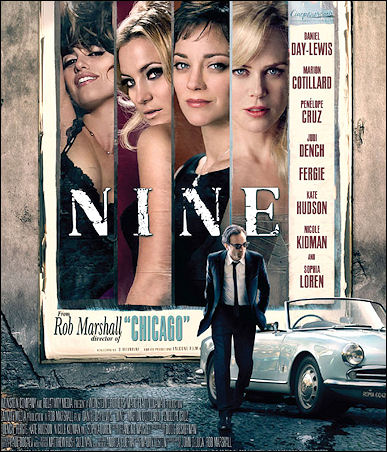
It’s not, in other words, the kind of musical that people who liked Chicago for the recognizably greedy, middle-American characters are necessarily going to relate to. It lacks…refutes, really, what is commonly regarded as the common touch. It’s about the kind of movie-making people whose every word and gesture expresses the fact that they are removed from (and are most likely disdainful of) the American experience. People who would rather take a bullet in the head than be fat or poorly dressed or visit Venice during tourist season.

So given all this history and expectation — it’s a locked-down thing without any wiggle or improv room — it really isn’t too bad. I mean, it’s Nine…whaddaya want?

It’s certainly not painful to sit through. I guess I could amp up the enthusiasm and say that I had a moderately okay time with it, although I didn’t care at all — at all — for director Rob Marshall‘s decision to shoot most of the musical numbers on the same London sound stage, over and over and over. I saw it with a lady who lives for Broadway musicals and she wasn’t over the moon about it, so there’s that too.

The actresses are all pretty good, and yes, Marion Cotillard has the strongest role as the wronged wife. (The fact that she sings two songs compared to everyone else having one tells us that Marshall sees her as the deepest and most compelling character).

And I loved watching Daniel Day Lewis slink around in this thing, his posture and composure in a constantly glum or downish angle. He’s such an intense actor and so deeply sunk into his Guido character, and without anything to do except smoke cigarette after cigarette without coughing, and wear those great looking black suits and drive that cool little light-blue sports car around. And I love the sound of his voice — it’s like an oboe or a bassoon.

Given the likelihood that the women who’ve enjoyed The Blind Side and are currently very keen to see It’s Complicated are going to feel a little bit cool towards Nine (everyone had to know this going in — it doesn’t have much of a heart and the music is only so-so) it’s actually kind of ballsy that Harvey Weinstein pushed it through and got it made. I respect that. It’s not a musical for mall people. It’s really a musical for big-city gay guys, except I know a couple who’ve seen it and aren’t huge fans so go figure.

I can’t move myself to write any more today. It was hard enough banging this out. Maybe a little more tomorrow.

Nine Embargo Dumped

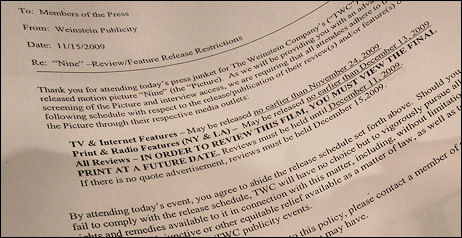
Before sitting down to see Rob Marshall‘s Nine in mid November I signed a Weinstein Co. agreement that said (a) I would see the final print at a future date (which I’ve since been invited to see, with the first screenings beginning yesterday) and consider only that version when reviewing, and that (b) I wouldn’t post anything until 12.11 or 12.15, depending on whether or not a quote-ad agreement deal would be in effect.

And then out of the effin’ blue MCN’s David Poland suddenly posted a brutal pan late last night, and then came Variety‘s Todd McCarthy with his soft positive review and Hollywood Reporter‘s Kirk Honeycutt with another pan, and then In Contention‘s Kris Tapley said this morning that he agreed with 99% of what Poland had said, etc. And there were no e-mails or texts from anyone at Weinstein saying it’s okay to run a review. The dam just broke.

What happened? Did Poland go because he was told the trades were going? Why did the trades decide to go? All I know is, nobody tells me jack. I’m just sitting here at the desk, slamming and plugging away, writing this and thinking about that, etc. I mean, I have a reaction or two as well. Except I don’t feel like struggling with a long review right now. It’s nearly 4 pm on a Friday afternoon…fuck me. Okay, I’ll write something but not too long.