Franco Hospital Art

“Performance art is all about context,” writes Howl star and forthcoming General Hospital costar James Franco in a new Wall Street Journal article. It’s called “A Star, a Soap and the Meaning of Art: Why An Appearance on General Hospital Qualifies as Performance Art.”

“If you bake some bread in a museum space it becomes art, but if you do it at home you’re a baker. Likewise, when I wear green makeup and fly across a rooftop in Spider-Man 3, I’m working as an actor, but were I to do the same thing on the subway platform, a host of possibilities would open up. Playing the Green Goblin in the subway would no longer be about creating the illusion that I am flying. It would be about inserting myself in a familiar space in such a way that it becomes stranger than fiction, along the lines of what I’m doing on General Hospital.”

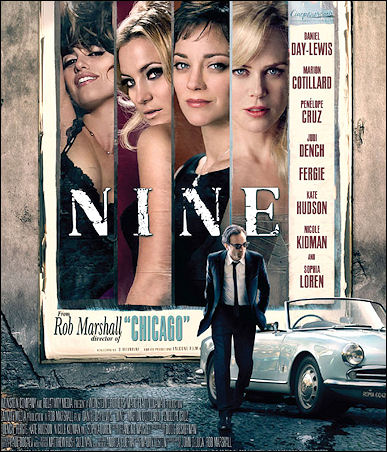
Nine

Nine is what it is — a musical based on a stage musical based on 8 1/2, a 1963 Federico Fellini classic about a brilliant Fellini-like director who can’t decide what his next film will be about. It’s also a kind of sleek-elite Euro mood piece about 1960s Italy and sunglasses, hot women and cool coastal villages and…you know, artistic ennui and weltschmerz and all that aromatic razmatzz. It’s not about “story” as a kind of Italian glide-along atmosphere — a lather of mood and attitude and locale and Euro-coolness.

It’s not, in other words, the kind of musical that people who liked Chicago for the recognizably greedy, middle-American characters are necessarily going to relate to. It lacks…refutes, really, what is commonly regarded as the common touch. It’s about the kind of movie-making people whose every word and gesture expresses the fact that they are removed from (and are most likely disdainful of) the American experience. People who would rather take a bullet in the head than be fat or poorly dressed or visit Venice during tourist season.

So given all this history and expectation — it’s a locked-down thing without any wiggle or improv room — it really isn’t too bad. I mean, it’s Nine…whaddaya want?

It’s certainly not painful to sit through. I guess I could amp up the enthusiasm and say that I had a moderately okay time with it, although I didn’t care at all — at all — for director Rob Marshall‘s decision to shoot most of the musical numbers on the same London sound stage, over and over and over. I saw it with a lady who lives for Broadway musicals and she wasn’t over the moon about it, so there’s that too.

The actresses are all pretty good, and yes, Marion Cotillard has the strongest role as the wronged wife. (The fact that she sings two songs compared to everyone else having one tells us that Marshall sees her as the deepest and most compelling character).

And I loved watching Daniel Day Lewis slink around in this thing, his posture and composure in a constantly glum or downish angle. He’s such an intense actor and so deeply sunk into his Guido character, and without anything to do except smoke cigarette after cigarette without coughing, and wear those great looking black suits and drive that cool little light-blue sports car around. And I love the sound of his voice — it’s like an oboe or a bassoon.

Given the likelihood that the women who’ve enjoyed The Blind Side and are currently very keen to see It’s Complicated are going to feel a little bit cool towards Nine (everyone had to know this going in — it doesn’t have much of a heart and the music is only so-so) it’s actually kind of ballsy that Harvey Weinstein pushed it through and got it made. I respect that. It’s not a musical for mall people. It’s really a musical for big-city gay guys, except I know a couple who’ve seen it and aren’t huge fans so go figure.

I can’t move myself to write any more today. It was hard enough banging this out. Maybe a little more tomorrow.

Nine Embargo Dumped

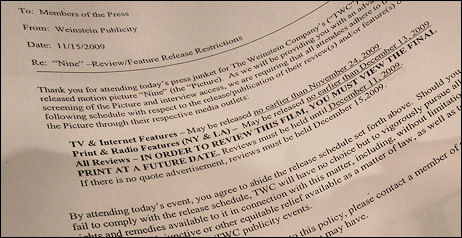
Before sitting down to see Rob Marshall‘s Nine in mid November I signed a Weinstein Co. agreement that said (a) I would see the final print at a future date (which I’ve since been invited to see, with the first screenings beginning yesterday) and consider only that version when reviewing, and that (b) I wouldn’t post anything until 12.11 or 12.15, depending on whether or not a quote-ad agreement deal would be in effect.

And then out of the effin’ blue MCN’s David Poland suddenly posted a brutal pan late last night, and then came Variety‘s Todd McCarthy with his soft positive review and Hollywood Reporter‘s Kirk Honeycutt with another pan, and then In Contention‘s Kris Tapley said this morning that he agreed with 99% of what Poland had said, etc. And there were no e-mails or texts from anyone at Weinstein saying it’s okay to run a review. The dam just broke.

What happened? Did Poland go because he was told the trades were going? Why did the trades decide to go? All I know is, nobody tells me jack. I’m just sitting here at the desk, slamming and plugging away, writing this and thinking about that, etc. I mean, I have a reaction or two as well. Except I don’t feel like struggling with a long review right now. It’s nearly 4 pm on a Friday afternoon…fuck me. Okay, I’ll write something but not too long.

Pass and Fail

The Hollywood Reporter‘s Kirk Honeycutt has huffed and puffed and unequivocally panned Rob Marshall‘s Nine (Weinstein Co., 12.18). And Variety‘s Todd McCarthy, playing it cooler and more circumspect. has given it a friendly and approving pat on the back.
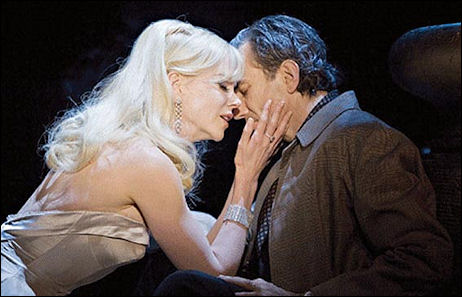

Nicole Kidman, Daniel Day Lewis in Rob Marshall’s Nine.

And yet between the lines you can sense an absence of serious gushing pleasure in McCarthy’s reactions. The ultimate effect is that his review doesn’t really counter-balance Honeycutt’s, which is much more impassioned. What Nine needs now is a champion — an advocate to ride in on a white horse with wings (like the TriStar horse) and write something about Nine that’s not just knowing and supportive but operatic. An orgasm review that gets high off its own juices…anyone?

“The Nine disappointments are many,” grumbles Honeycutt, “from a starry cast the film ill uses to flat musical numbers that never fully integrate into the dramatic story. The only easy prediction is that Nine is not going to revive the slumbering musical film genre. Box-office looks problematic too, but moviegoers are going to be enticed by that cast, and the Weinstein brothers certainly know how to promote a movie. So modest returns are the most optimistic possibility.

Federico Fellini‘s 1963 masterpiece takes you inside a man’s head. Since he happens to be a movie director, those daydreams and recollections are visually striking but, more to the point, you sense, through the nightmares of an artist blocked from his own creativity, everything that is going on inside this man. In Nine, written by Michael Tolkin and the late Anthony Minghella, you get a tired filmmaker with too many women in his life and not enough movie ideas.

Daniel Day-Lewis plays Guido and, to his credit, it’s not Marcello Mastroianni‘s Guido but a new character, more burnt-out than blocked and increasingly sickened by his womanizing. He’s an incredibly sexy man and performs all the right moves. The problem is he keeps doing those moves over and over so you experience not so much artistic angst but a guy trying to sober up from a two-week binge. Sporting a scruffy beard and running a hand through long hair only goes so far.
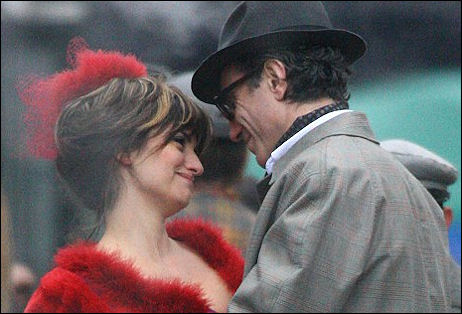

Penelope Cruz, Daniel Day Lewis.

“With Nine you never get inside the protagonist’s head. You just can’t decide whether his problem is too many women or too many musical numbers breaking out for no reason.”

McCarthy finds not just reason but rhyme. “Cutting between black-and-white and color in the musical numbers and, like Fellini’s film, constantly on the move as Guido is buffeted about with scarcely a moment to breathe, much less write a script, Nine takes the the matter of directile dysfunction seriously without being pretentious about it,” he writes.

Michael Tolkin and Anthony Minghella‘s script “notably finds a way to honor 8 1/2 while enabling one to put it to the side of one’s mind, and in illuminating Guido’s folly while still taking seriously his relationships with women.

“Instead of making Guido entirely self-absorbed and self-serious, Day-Lewis at once places the viewer firmly in the palm of his hand and then in his pocket by emphasizing the character’s humorous awareness of his position in life. He puts on a grand show at a press conference, although one journalist, noting that Guido’s last two films flopped, pierces the armor of jokiness by asking, ‘Have you run out of things to say?'”

Which instantly recalls a Randy Newman lyric from a few years ago: “I got nothin’ left to say / “I’m gonna say it anyway.”

Snappy Comebacks

Moving Image Source’s Matt Zoller Seitz has delivered Part 2 of his Clint Eastwood study, called “Kingdom of the Blind, Part 2.” Narrated this time as well as subtitled.

“Eastwood’s wisecracking angel of death persona is so familiar — and so beloved by audiences — that when he seriously critiques it, as he did in Unforgiven, it doesn’t always register,” says Seitz. “People see Eastwood in a cowboy hat and think ‘entertainment.’ This writer saw the film three times in theaters. Two of those times the audience cheered Munny’s vengeance — the most horrific rampage in a studio movie since Taxi Driver — as if it were Terminator 2.

“Is Eastwood an exploitation filmmaker with aspirations to importance, or an artist who uses violent action to entice viewers into experiencing his films’ more complex aspects? Is he making art, or just entertainment with personality?

“Such distinctions may be a dead end; Eastwood would surely never draw them. And in any event, the actor-director isn’t just aware of his inconsistencies and mysteries, he foregrounds them in his films. The most intriguing aspect of Eastwood’s career is Eastwood himself.”

In Your Eyes

In the view of New Yorker critic Anthony Lane, “the tension between the bleak and the blithe” in Up In The Air “is sustained by director-writer Jason Reitman to the end. Airports are the seedbed for all that is most alien, angering, and atomized in our twenty-first-century days, and there are times, in this film, when George Clooney‘s eyes appear to glaze and say, Come die with me.”

Avatar Needs Hugs

In the Old Hollywood days a major studio that had spent big-time on an epic-level film (Gone With The Wind, Duel in the Sun, Ben-Hur, Around The World in 80 Days, Cleopatra, etc.) would almost automatically be assured of a few below-the-line Oscar nominations. The producers and studio chiefs also knew that the town would at least try to find it in its heart to bestow a Best Picture nomination unless, you know, the big film they’d made was embarassingly bad. And sometimes they’d wangle a Best Picture nomination even if it sucked (i.e., Dr. Doolittle).

In so doing the community would basically say to the producers and the studios behind these behemoths, “You guys have stuck your necks out and hired hundreds of people, and now we’re going to try and give you as much semi-legitimate Oscar hoopla as we can, which will presumably help you out at the box-office.”

I don’t know if old-time community standards are still in effect but in a fair and just world shouldn’t Avatar get Best Picture nominated for the simple fact that it’s a big-gamble movie that has cost $300 million? In a compassionate world shouldn’t the community rally round and do as much as it can to help out poor 20th Century Fox and Tom Rothman and James Cameron and all the other guys whose members are on the chopping block…no? Presuming it doesn’t blow chunks, of course, and I strongly doubt that it will. If you had green-lighted Avatar wouldn’t you feel gratified and comforted if the town voted to support you and yours with a Best Picture nomination? Isn’t a community supposed to take care of its own?

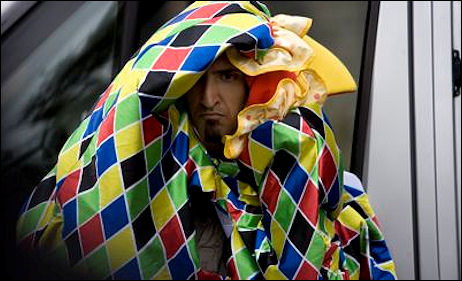
“Jihadi Comedy”

Chris Morris‘s Four Lions, a comedy about suicide bombers, is set to screen in Sundance 2010. Morris and In The Loop creator Armando Iannucci used to be allied or partnered in some comedic fashion. So figure that Four Lions is 2010’s In The Loop, or…you know, something in an Islamic-doofus vein.

In preparation Morris reportedly spoke to” terrorism experts, imams, police, secret services and hundreds of Muslims.” A statement from Warp Films says that the film “understands how terrorism relates to testosterone. It understands jihadis as human beings. And it understands human beings as innately ridiculous.”