Valance Again

In tribute to tonight’s BAM screening of John Ford‘s The Man Who Shot Liberty Valance (as part of the New York Film Critics Circle 1962 series), the New Yorker‘s Richard Brody has assembled a video piece and written a few words, among them a declaration that it’s “both the most romantic of Westerns and the greatest American political movie.

“The Western is intrinsically the most political movie genre, because, like Plato’s ‘Republic,; it is concerned with the founding of cities, and because it depicts the various abstract functions of government as direct, physical actions. It’s also an inherently romantic genre, because of its connection with the nation’s founding mythology. (One of the strengths of Ford’s movie is its depiction of the actual grassroots practical politicking in the Western territories.)

“The movie’s most famous line, of course, is that of a newspaperman: ‘This is the West, sir. When the legend becomes fact, print the legend.’ Ford prints it — and prints the facts behind it — and makes a movie about the moral burden of a life lived in the name of a myth and the ethical implications of direct action. Implicitly, the subject of the film is also that of a nation founded in this way. In his next Western, Cheyenne Autumn, from 1964, Ford takes on another overlooked Western reality: that of the Native Americans and their relations with the United States government.

“But the movie is also romantic in another, intimate way — it’s a great love story and a painful triangle, involving the tenderfoot lawyer (James Stewart), his gunslinger friend (John Wayne), and the woman they both love (Vera Miles). The tale’s epic span — it’s framed as a flashback to distant youth — stretches that love story over a vast arc of experience and renders it immeasurably poignant.

“As it draws to a close, there’s hardly a dry eye in the house — at least, in our house.”

I wrote about 15 months ago that I didn’t like The Man Who Shot Liberty Valance “as much as I should because of the TV sound stage vibe, the hamminess of the acting, the fact that John Wayne and Jimmy Stewart are at least 15 years too old for their parts, etc.”
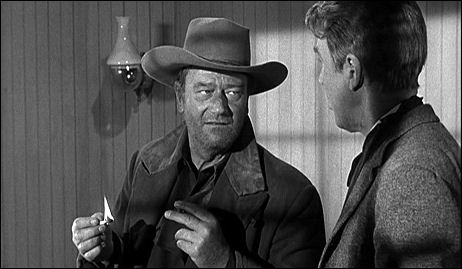

John Wayne, James Stewart

I also wrote the following in July 2007: “You can talk about this film for hours and never run out of new things to discover or re-review. I’ve seen Liberty Valance many, many times on the tube, and I absolutely love the transfer on the most recent DVD. It’s basically an old man’s movie — an elegy for bygone times and regrettably false legends. There’s also no denying it’s one of Ford’s very best — his saddest and most personal film ever, and worthy of the highest respect.

“But the older I’ve gotten (and I’ve said this before), the more trouble I’ve had with Ford’s sentimental cornball streak. His affection for actorly colorfulness among his supporting players seems to get worse every time I re-watch one of his films. Andy Devine‘s performance in Liberty Valance as a cowardly, squealy-voiced sheriff is, for me, 90% torture . (His one good scene is in the very beginning when he takes Vera Miles out to visit Wayne’s burned-down ranch.) Edmond O’Brien‘s alcoholic newspaper editor is a problem performance also. The movie is littered with them.

“As Newsweek critic Malcom Jones observed in March 2006, Ford’s movies “are a little antique, a little prim.”

“The irony, of course, is that despite the irritating aspects, The Man Who Shot LIberty Valance becomes a greater and greater film with each re-viewing. Some- thing majestic and touching and compassionate seems to come out in greater and greater relief. Genius-level films always gain over the years, but to my surprise I was almost moved to tears last night — and this stagey monochrome oater has never quite melted me before. Go figure.”
Abbie Hottie

I sat down late yesterday with Bright Star‘s Abbie Cornish, whom I found quite personable, steady, friendly and straight-shooting. And a serious knockout, of course. She’ll most likely land a Best Actress nomination for her performance as Fanny Brawne. I mean, does anyone see this not happening? There’s never a second in which she isn’t fully submerged in that character and Bright Star‘s milieu (i.e., early 1800s London) and the intense romantic stakes. By any standard it’s a fairly serious sink-in.

I forgot Cornish was playing this somewhat limited and yet finally impassioned woman. She just “was” and I went with that. I didn’t experience the usual hesitation during the first few minutes of her performance. It was a fast sell and a deep dive.

Cornish has a kind of a chubby-cheeks going on in Bright Star (which seems a bit accentuated by her dark hair being constantly worn in a bun), which is why I noted that she seemed as if she could take her lover, John Keats (Ben Whishaw), in a wrestling match but that’s neither here nor there. She’s now her naturally blonde self and seemingly in prime athletic shape for her role as “Sweetpea” in the currently filming Sucker Punch, now being directed by Zack Snyder in Vancouver. Warner Bros. will release it in 2011.

My interview is in two parts — part 1 above, part 2 below.

Liquidity

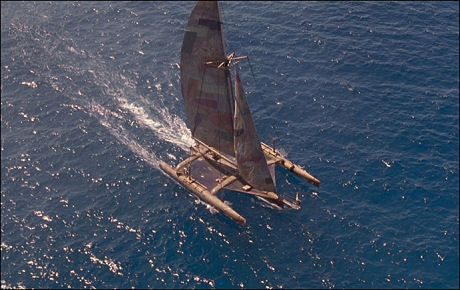
A Blu-ray of Kevin ReynoldsWaterworld came out last Tuesday. It’s been 14 years since it opened and I’ve never seen it twice. I honestly don’t know if I’d even watch a free screener, much less rent or buy it. The more I think back on it the more nothing it seems — an over-produced high-concept thing that nobody really wanted to see to begin with.


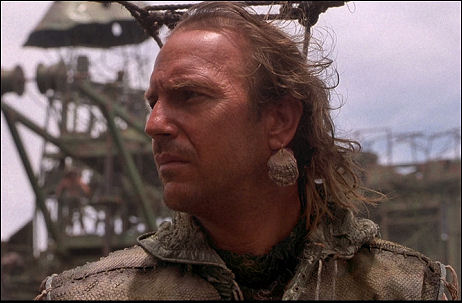
Kevin Costner in Waterworld.

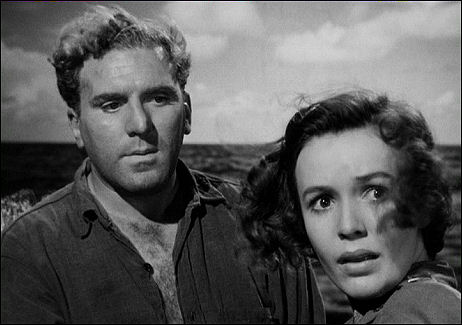
Lifeboat.

The story is hugely disappointing, particularly the windup over last 20 or so minutes. The only things that have lingered from my first-and-only viewing are (a) that device that converted urine to fresh drinking water, (b) Dennis Hopper‘s ridiculous one-eyed bad guy, and (c) Jeanne Tripplehorn‘s performance, which had gravity and sincerity.

I remember being shocked when I realized that the first of the two dps (I forget if it was Scott Fuller followed by Dean Semler or vice versa) had decided to shoot it in 1.85 rather than 2.39 Scope. The dominant idea had to be about visually conveying how overwhelming and absolute the sight of a world cover by water would be, and yet they decided not to use a Scope image? I read somewhere that the producers were afraid that widescreen footage of a constantly bobbing-around milieu would make audiences sick, but that strikes me as ridiculous.

I’ve written this before, but I’ve always felt a much stronger sense of the raging energy and fearsomeness of the ocean from Alfred Hitchcock‘s Lifeboat (1943), which was shot in an indoor studio tank with wind and rain machines and whatnot.


Kevin Costner, Jeanne Tripplehorn in Waterworld.

Blue Crash

Almost every time I drive back to Los Angeles from Santa Barbara, I stop at this location and just stare for five minutes or so. Everyone needs an atmospheric submission moment from time to time. Coastlines are like non-denominational churches, providing comfort to all seekers, even the lowest of the low. Even the Hispanic Party Elephant from North Bergen could savor this.

Kooza

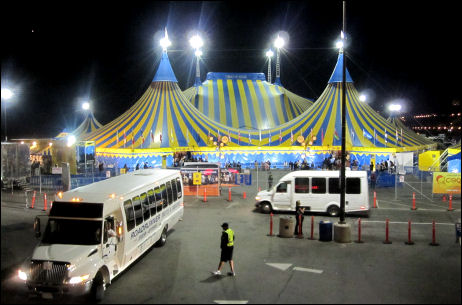
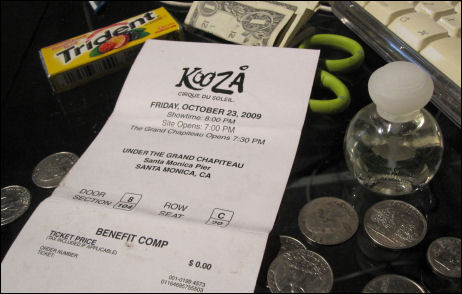
I was graciously guested last night into Kooza, the latest Cirque de Soleil spectacular that is nothing short of brilliant. It’s ballet, slapstick, harmony, transcendence, gymnastics, derring-do, poetry, wonder and thrills. The show runs just short of three hours with a 30-minute intermission. I spilled half of an 18 oz. can of Beck’s on my right pant leg and it didn’t faze me a bit. The Santa Monica engagement began on 10.17. Upcoming engagements are scheduled for Irvine, San Diego, Portland, Seattle and Vancouver.


Cirque de Soleil tent adjacent to Santa Monica pier — Friday, 10.23.09, 7:25 pm

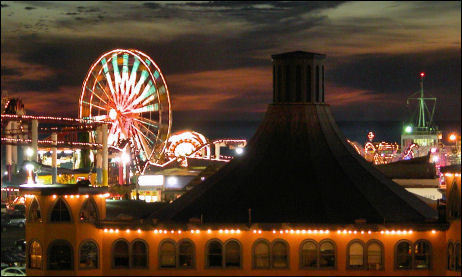
Friday, 10.23, 11:05 pm

Opportunities Abound

In the view of Entertainment Weekly critic Owen Gleiberman, Joel and Ethan Coen “should seriously consider making a gloriously skewed pop musical.

“I’m more convinced of that than ever having seen the spectacular use they make of the Jefferson Airplane song ‘Somebody to Love’ in A Serious Man,” he eexplains. “This is one of those pop-music epiphanies worthy of Tarantino, Scorsese, or Paul Thomas Anderson — and the strange thing is, it’s just there, so unlikely yet so sublime, sitting right in the middle of the Coens’ highly personalized movie about a nebbishy Jewish family trying to make its way in Middle America in 1967.

A Serious Man opens with an old Yiddish parable (a fake, it turns out — the Coens just made it up), in which a kvetching couple in what looks like a 19th century Eastern European village invite an old man into their home who may or may not be a dybbuk (i.e., a malevolent spirit). This prologue introduces the movie’s grand theme — which is not, as many critics have said, an update of the Book of Job. Rather, the theme is a question: When bad things happen, are they the actions of God, or are they the result of people anxiously overreacting to what God does?

“At this point the screen goes dark, and we see what looks like a golden ring, which is the outline of a mysterious tunnel that we’re suddenly whooshing through. The whole audience is traveling — through space? time? — with nothing to guide it but a familiar, gathering sound. It’s the thrashing ’60s beat and desperate, do-or-die romantic ferocity of Grace Slick, exhorting her listeners to find ;somebody to love’ in a world where that may be the only salvation left.

“So what, exactly, is a vintage Jefferson Airplane anthem doing in this movie? In A Serious Man, the Coens use ‘Somebody to Love’ in two fascinating and resonant ways.

“When we first come out of that tunnel, we’re staring at a hard white piece of plastic — it’s a close-up of an earpiece, plugged into the head of 12-year-old Danny (Aaron Wolff), who is listening to ‘Somebody to Love’ on his transistor radio in Hebrew school. What’s more than a bit trippy is that as the camera travels down that earpiece wire, it seems to be completing the journey out of the tunnel. In what is basically a realistic drama, the Coens present the leap from the peasant shtetl to the tract-house anonymity of Midwestern America as an act of science fiction.

“It’s as if the Jews of the old world weren’t just being transplanted — they were getting beamed up. The movie uses ‘Somebody to Love’ as the sensuous electric pulse of the society they were now joining. And yet…it’s science fiction because, in some part of their hearts, they’re still in the shtetl. They’re in two worlds at once.

“Late in the film, the song comes back — this time as high comedy. Danny has just completed his bar mitzvah (while stoned out of his gourd), and as a reward he gets an audience with the community’s chief rabbi, an ancient, wizened wizard of a Talmudic scholar who sits in his room like a Yiddishe mafioso, surrounded by musty texts and eerie things in bottles. The inaccessibility of the rabbi has been a joke throughout the film (Danny’s father, who could use some guidance, can’t begin to get a meeting), and so our curiosity about what he’ll finally say has reached the boiling point.

“Slowly, in his thick accent, the old man begins to speak, mouthing what sounds like it could only be a centuries-old Jewish proverb: ‘Ven da truth is found…to be lies. And all da joy…vithin you dies.’ Yes, it’s the lyrics of ‘Somebody to Love.’ Except that the rabbi, instead of voicing the song’s next line (‘Don’t you want somebody to love?’), substitutes his own, more existential version. He asks: ‘What then?'”

The Deadness

Everyone had heard or suspected that Mira Nair‘s Amelia would be bad, but I was nonetheless stunned by the boredom and general flatness that leapt — seethed? — out of every scene and frame. Ron Bass and Anna Hamilton Phelan‘s script is amazingly drippy and mundane. The roteness of Nair’s direction is suffocating. This is probably the last American-funded directing gig she’ll have in a long time. Put her in movie jail and throw away the key.


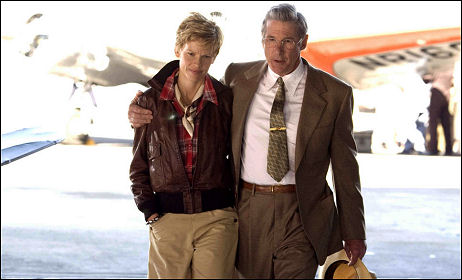
Hilaryu Swank, Richard Gere in Mira Nair’s Amelia.

Call it a mildly agreeable time-waster if you want, but if you truly enjoy Amelia or even express a degree of genuine enthusiasm — “Not too bad! Nice aerial photography!” — there’s really something wrong with you. With your taste buds, I mean. Amelia is a film diseased and poisoned and deadened with schmaltz. It’s a major embarassment all around.

Hilary Swank‘s performance as the legendary aviator is mildly okay in itself (it’s mostly about her white teeth) but she’s trapped in a lethally dull film so she goes down with the ship regardless. Richard Gere‘s George Palmer Putnam — the suave money guy who married Earhart — is also mildly acceptable. Ewan McGregor‘s Gene Vidal, an aviation instructor and would-be infidel, reminds you McGregor has a nose for crap and opportunities for career deflation.

How did Fox Searchlight, an operation synonymous with smart classy films and clever, aggressive marketing campaigns, get saddled with this thing?

I heard mild moanings coming from a critic sitting behind me at last Monday’s screening on 55th Street, and I heard at least two throat-clearings from other critics sitting nearby.

The Envelope‘s Pete Hammond recently wrote that “in some ways Amelia is reminiscent of Out Of Africa, which has the same combination of sweep, adventure and romance this film incorporates.” Be careful, Pete! The ghost of Sydney Pollack has read that line and is now on the haunt, looking for you.

Hammond also claimed that “if this were 40, or even 20 years ago, Nair’s meticulously mounted effort would be deemed a front-runner for awards and a certain thing at the box office.” No, it wouldn’t. Dramatic mediocrity has been a recognizable thing for centuries, and no self-respecting Oscar handicapper in the late ’60s or late ’80s would have given Amelia a shot at anything, even out of politeness.

The Hollywood Reporter‘s Ray Bennett, who damaged his cred when he raved last year about Mamma Mia, recently claimed that Amelia “ranks with recent real-life portrayals of Ray Charles by Jamie Foxx and Truman Capote by Philip Seymour Hoffman and could be similarly awards-bound.”

Bennett added that “the classically structured bio will appeal to grown-ups, history buffs and lovers of aeronautics, but in showing how the flier was one of the most lauded celebrities of her time, it also might appeal to youngsters.” The mind reels!

Soupy Sails

The once-legendary Soupy Sales, an immensely likable josher, has died at age 83. This video reminds that the best part of the New York-area Soupy Sales Show (also called Lunch with Soupy Sales) was the offscreen laughter from the crew. Sales’ career peak happened during a live engagement at the Paramount theatre during the 1965 Easter holiday. I’d love to find a YouTube of Frank Sinatra‘s visit to Sales’ show the same year.,

Comfort of Friends

Here’s a tip-of-the-hat to whomever makes the in-flight video programming decisions for Continental Airlines. All airlines program contemporary crap (i.e., Land of the Lost, Transformers 2) but very few include classic films. I’m just saying it was enormously comforting to watch John Ford‘s The Grapes of Wrath and Howard HawksBringing Up Baby during Wednesday’s JFK-to-LAX flight. It mitigated an otherwise close-to-hellish experience (i.e., stuck in a cramped seat on a seemingly interminable flight).

Holbrook In The Game

Dogwood Entertainment and Freestyle Releasing have pacted on a limited theatrical release of Scott TeemsThat Evening Sun, which reputedly boasts an award-level performance by Hal Holbrook. Pic will open in New York on 11.6 and in LA on 11.20. Holbrook will reportedly make appear at each theater on the film’s opening nights in New York and Los Angeles.

Variety‘s Joe Leydon has called it “an exceptionally fine example of regional indie filmmaking [that] deserves savvy handling by a venturesome distrib to maximize its potential to attract auds and win prizes. Pic’s major selling point is Holbrook’s career-highlight star turn as an irascible octogenarian farmer who will not go gentle into that good night. But this deliberately paced, richly atmospheric drama also boasts first-rate work by a splendid supporting cast and impressive production values that would pass muster in a much pricier production.”