What Happened Was

In 1997, or some five or six years after the flop of Curly Sue and his retreat from Hollywood, the late John Hughes shared his concerns about the malignant effects of the film industry upon family and friends with female pen pal Alison Byrne Fields.

“John told me about why he left Hollywood just a few years earlier,” Fields writes in an 8.6 blog post called “Sincerely, John Hughes.” “He was terrified of the impact it was having on his sons. He was scared it was going to cause them to lose perspective on what was important and what happiness meant. And he told me a sad story about how, a big reason behind his decision to give it all up was that ‘they’ (Hollywood) had ‘killed‘ his friend, John Candy, by greedily working him too hard.”

In other words, Candy’s death at age 43 from a heart attack and cardiac arrythmia wasn’t, in Hughes’ opinion, primarily due to his being severely overweight and having been a smoker most of his life. In fact, Hughes believed that Candy might well have survived if Hollywood hadn’t maliciously forced him to constantly perform as the star of various movies, for which he was presumably well paid.

That’s interesting. I never knew that. But this is what genius-level auteurs do — they create their own worlds by investing in them whole-hog.

Candy’s Wikipedia biography — obviously suspect in the wake of Hughes’ just-revealed opinion — claims that the extremely bulky actor “had been making a significant effort to improve his health in the last year of his life, [having] recently quit smoking” and making progress at losing weight. “His family had a history of heart disease, and he had been warned by doctors several times before to reduce his weight, but Candy had trouble doing so.”
It’s Complicated, You Bet

Just about every Nancy Meyers movie involving a female lead of a certain age begins with Meyers saying to herself, “Wouldn’t it be wonderfully satisfying and exciting if…?” The romantic fantasy in It’s Complicated (Universal, 12.25) is that after a foxy older divorced woman (Meryl Streep) begins seeing an attractive new guy (Steve Martin) her re-married, somewhat girthy ex-husband (Alec Baldwin) gets the hots for her and starts cheating on his younger wife (Lake Bell) as they begin an extra-marital affair.

I don’t buy this any more than I bought the basic plot of Meyers’ Something’s Got To Give (Jack Nicholson‘s randy music executive falling for Diane Keaton‘s affluent screenwriter as she’s courted by Keanu Reeves‘ young physician). In real life a guy like Baldwin would cheat on his new 30- something wife with another young ‘un. The point is that Meyers’ films are always about comfort — i.e., about upper-middle-class affluence (i.e., shiny copper pots hanging in the kitchen), attractive lighting, bright chatter, and an attractive older female lead getting to express how strong and soulful she is in the third act.

I sometimes have a mildly good time at Meyers’ films. I know I’m going to enjoy Streep and Baldwin’s performance in this latest one — Streep especially. (The trailer suggests that Martin’s character has been made overly congenial and agreeable — i.e., no edge.) I just wish that the stories and characters that Meyers invents would be more palatable.

And I wonder how the idea of Baldwin-as-a-romantic-lead is going to go down. I love his manic wit but over the last 12 to 15 years Baldwin has been packing on the pounds and playing nothing but rascals and hyper madmen. He’s a great personality but there’s no peace in him, certainly not on-screen. Women of whatever age rarely see a guy of this type as a great catch. They might run around for a bit with a Baldwin-type guy, but when it comes to longterm scenarios they seem to prefer mild-mannered smileys who provide shelter and comfort — i.e., oak trees + a day at the beach.

Twitter Fail

Today’s Twitter silence, the result of a virus attack that lasted at least six or seven hours if not longer, probably caused tens if not hundreds of thousands of Twitter addicts great separation anxiety…at first. Then, I’ll wager, they began to get used to the idea. Perhaps some of them actually did something with their off time — took a long walk, talked with someone they’d been meaning to talk to but never had, thought, daydreamed, went to a hardware store, etc.

A day after the 1994 L.A. earthquake (the fairly big one that happened at 4:30 or 5 in the morning) I was asked by my Entertainment Weekly editors to get Hollywood stars to talk about how they’d dealt with the rock ‘n’ roll. So I called Warren Beatty and asked for a quote or two. Beatty wouldn’t talk about the broken glass in his mountaintop Mulholland Drive home, but he said that the quake may have been a good thing by keeping people from doing their usual-usual. EW used the following quote: “It gave us cause for the pause we should all be taking anyway.”

“Big Baby”: Hughes Revisited

Originally posted on HE in March of last year (you can’t find it online otherwise):

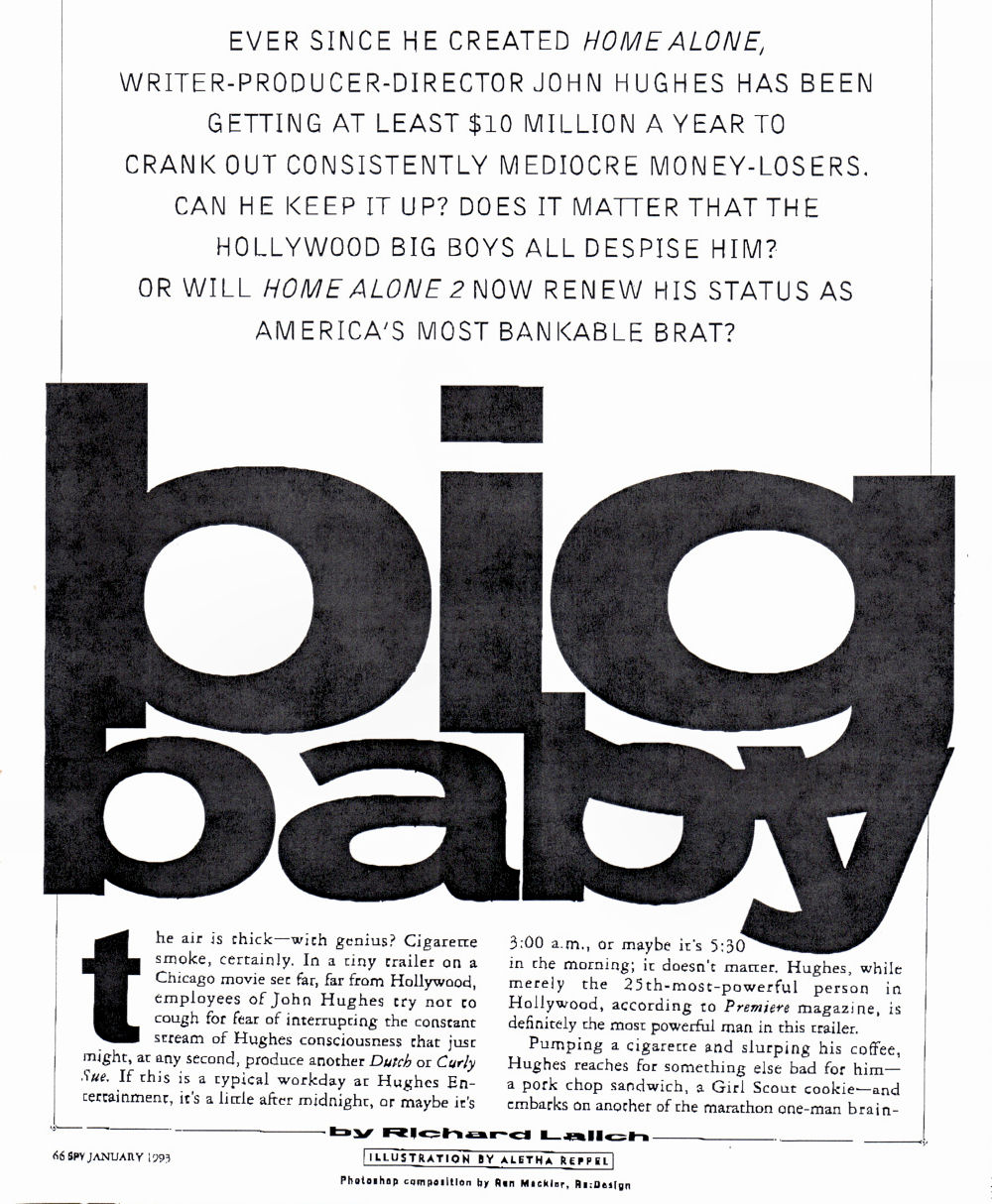
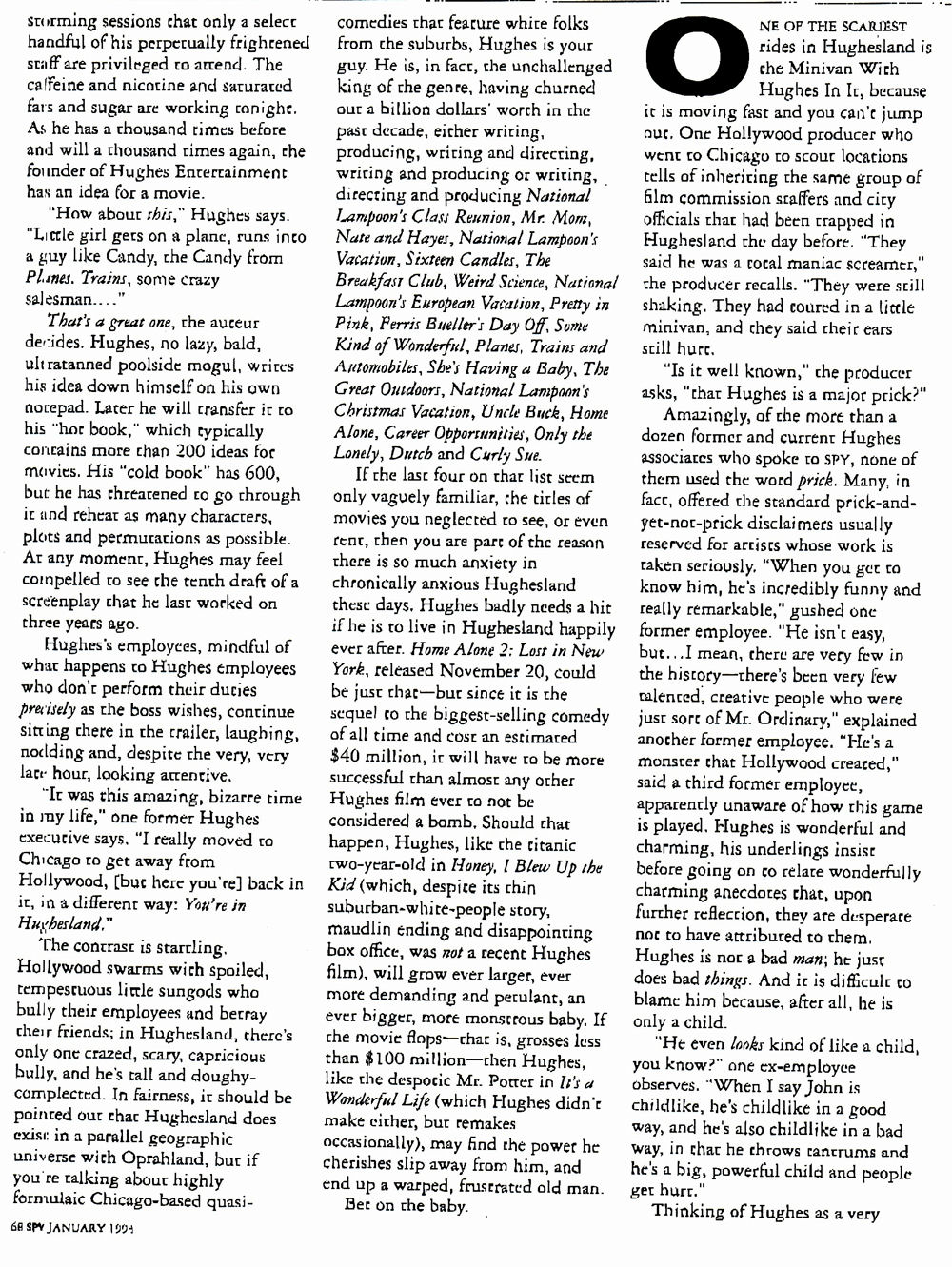
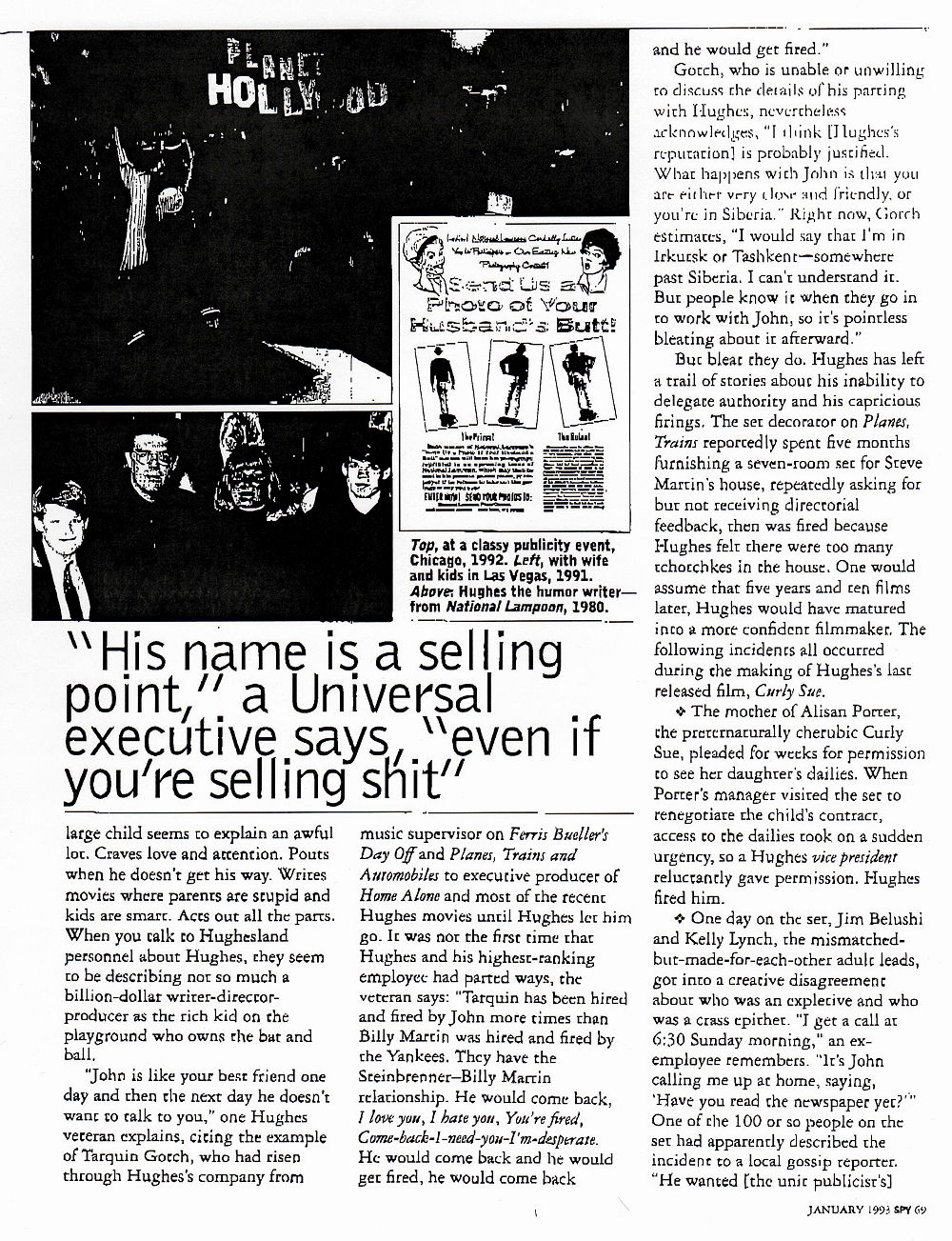
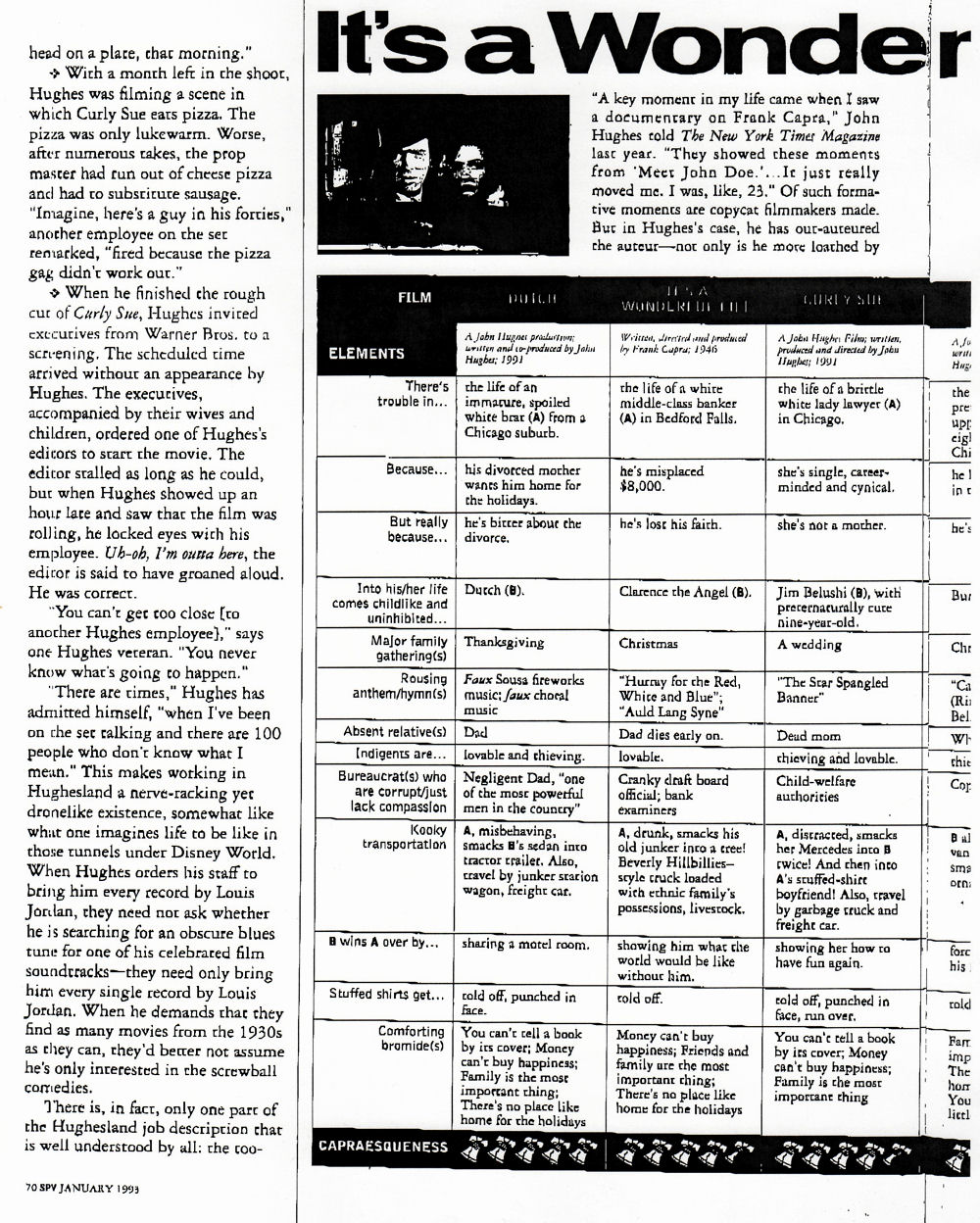
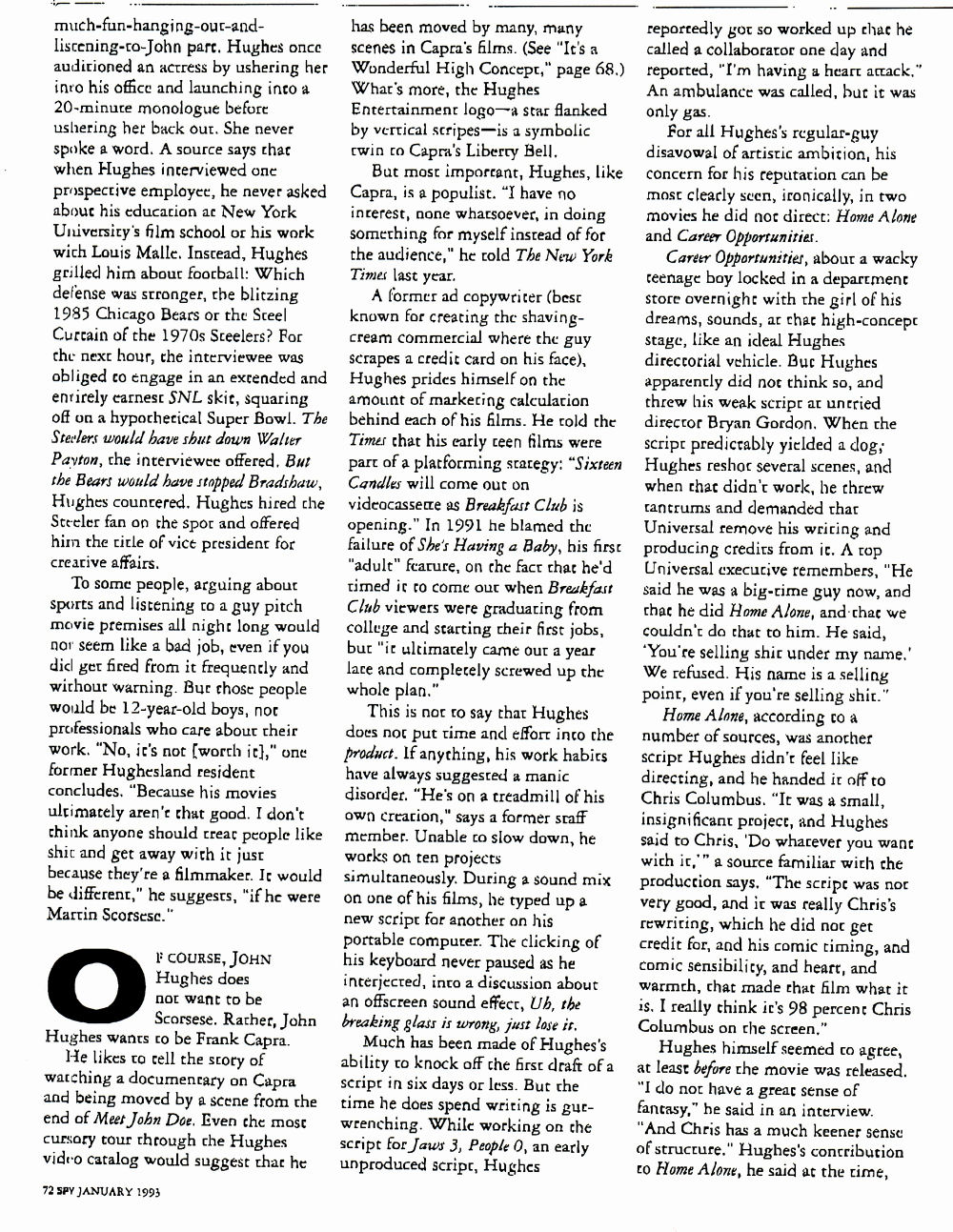
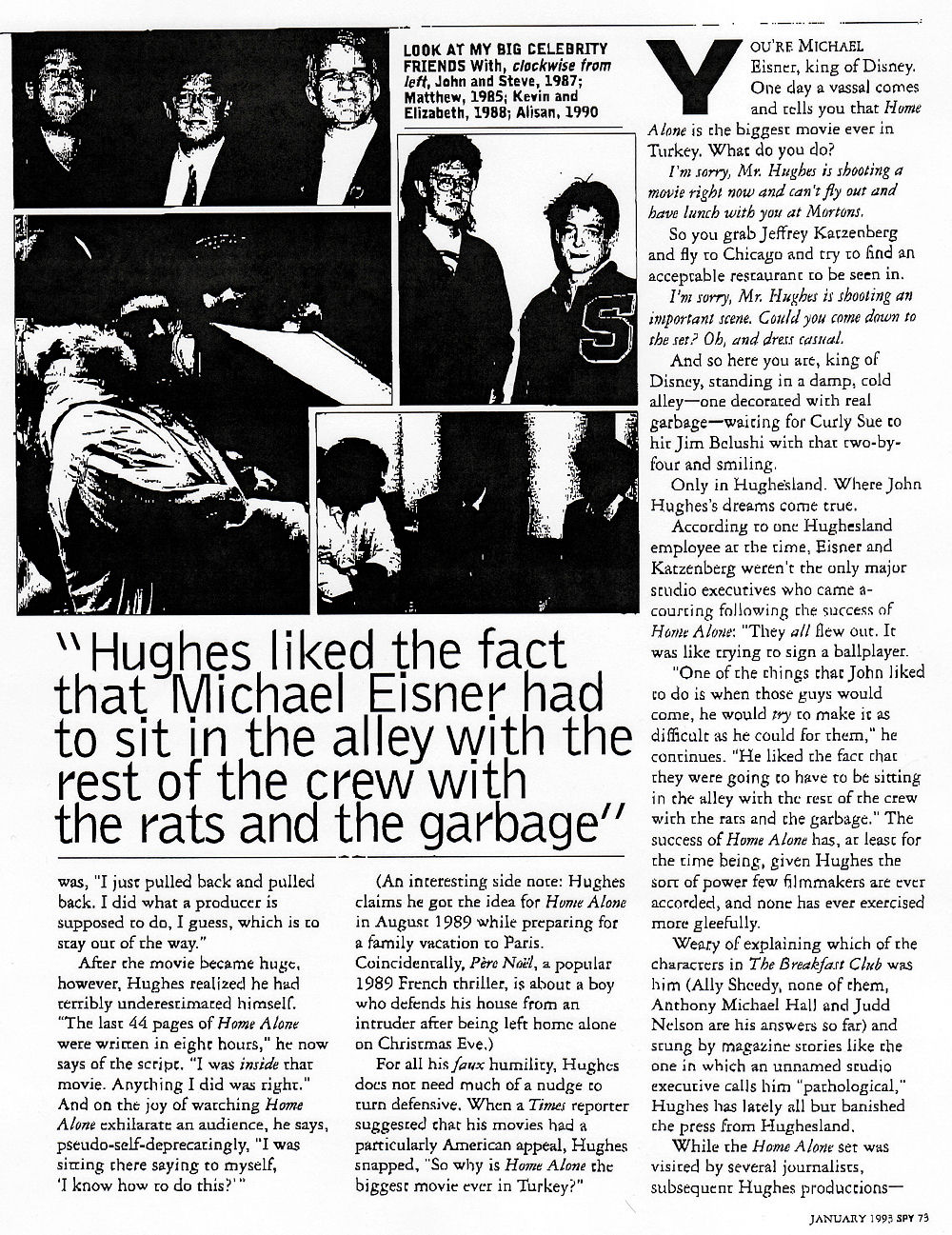
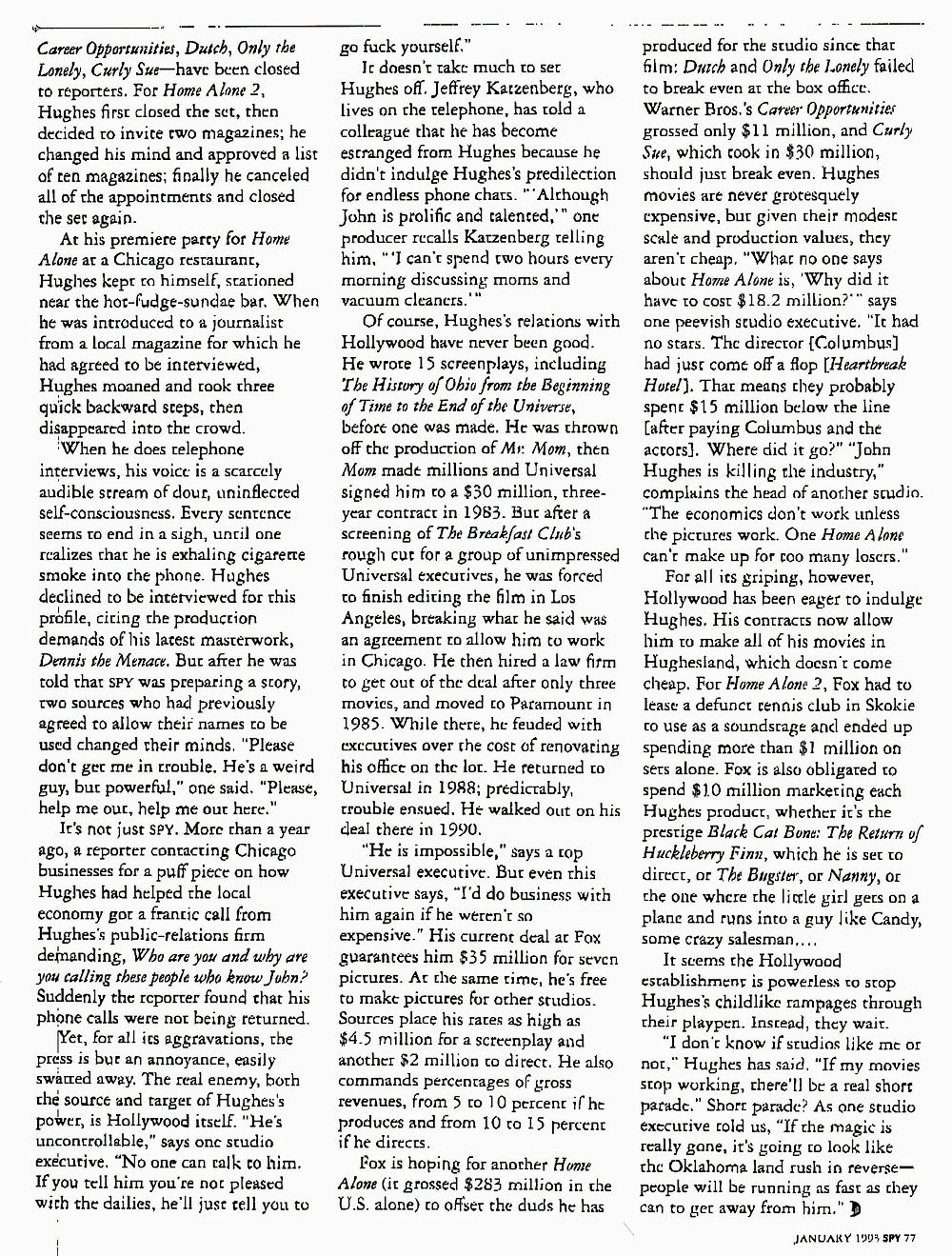
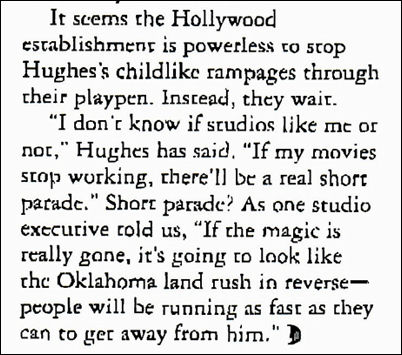
“A friend has faxed me the pages of that John Hughes/”Big Baby” article that I mentioned the other day, the one that trashed him — despite Hughes being at the time the 25th most powerful person in Hollywood, according to the the then-thriving Premiere magazine — for being “one crazed, scary, capricious bully.” It turns out it was a January 1993 Spy magazine piece by Richard Lallich.

So here it is: page #1, page #2, page #3, page #4, page #5, page #6, page #7 and page #8.

“Apologies for the quality, but these are scans of faxed pages. At least they’re legible. The type may seem small at first but just double-click and zoom in.”

John Hughes, 59, Is Dead

’80s comedy dynamo John Hughes, who allegedly “didn’t take care of himself” and “had bad eating habits, like that of a child,” according to a guy in the Hollywood comedy community, died on a Manhattan street this morning. Of a heart attack. My source heard Hughes may have been with his family when it happened, but he’s not at all sure and has heard otherwise. I love/loved one Hughes film in his whole canon — Planes, Trains and Automobiles.

Road Splat

Apart from 28 Days Later and a few others, many if not most zombie movies since Dawn of the Dead have either been seen as dry comedies or comedy-flecked, tongue-in-cheek horror romps. Ruben Fleischer‘s Zombieland (Sony/Columbia, 10.9), working from a script by Rhett Reese and Paul Wernic, is obviously pushing in the direction of overt genre comedy. Jesse Eisenberg, Woody Harrelson and, in a cameo, Bill Murray playing “one of the infected.”

Dead Reckoning

The final day-before-Friday, cross-your-fingers and hold-your-breath G.I Joe numbers are as follows: 19% Unaided Awareness, 90% Total Awareness, 45% Definite Interest, 9% Not Interested, 19% First Choice and 30% “First Choice & Rel.”…whatever that last stat means. I still don’t see a weekend haul that will go much higher than the high $20s or low $30s. If I’m wrong, please explain how.

New Game for Scott/Phillips

A film critic from a major east-coast city wrote this morning about new potential pressures that may be visited upon N.Y. Times critic A.O. Scott in his new capacity as costar (along with Chicago Tribune critic Michael Phillips) of At The Movies. “Remember the old days when almost every movie ad had a ‘two thumbs…way up’ quote from Gene Siskel and Roger Ebert?,” he wrote. He meant that Siskel/Ebert didn’t start out as black-or-white, yes-or-no, positively-inclined thumb critics, but they seemed to lean in that direction after their show took off. “I’m saying this because TV audiences don’t like people who are perceived as ‘negative’ or ‘mean’ or ‘elitist,'” my critic pal said. “i don’t want to be part of this discussion, but i’d like to hear what you and your readers might have to say.”

Dollars and Cents

“We intend to charge for all our news websites,” New Corp. honcho Rupert Murdoch has officially said in so many words, adding his belief that “if we are successful, we will be followed by other media.” Murdoch owns the New York Post and Wall Street Journal as well as the London Times and Sun newspapers in England.

So what kind of weekly or monthly fees will average news junkies like myself have to pay in order to stay high and informed once all the major news providers start charging? What will it come to in order to read the major print outlets that can’t cut it unless they start charging? In the ’90s a typical Manhattan news hound used to buy the four NYC dailies plus the Voice and the N.Y. Observer and New York magazine and whatever else. Which came to $35 per week and $140 per month…something like that.

What would the estimated cost be in today’s economy? I’m afraid that once all the big news orgs jump on the Murdoch bandwagon that it may come to something like…I don’t know, $250 or $300 a month? More?