

Brief descriptions of the 10 Greatest Sci-Fi Films Never Made — Vincent Ward‘s Alien 3, Wolfgang Petersen, Andrew Kevin Walker and JJ Abrams‘ Superman vs. Batman, Steven Spielberg‘s Night Skies, Edgar Rice Burroughs‘ John Carter of Mars, Phil Kaufman‘s Star Trek: Planet of the Titans, Arthur C. Clarke‘s Childhood’s End, Alfred Bester‘s The Stars My Destination, Alejandro Jodorowsky‘s Dune, Ridley Scott‘s I Am Legend and The Outer Limits — comprise a forthcoming (7.15) Times Online article.
“Closely Run Gamble”
A vivid and well-written Woodstock recollection from Martin Scorsese, excerpted from a foreword to Mike Evans and Paul Kingsbury’s “Woodstock: Three Days That Rocked the World,” appeared in last Sunday’s Times Online. “I was to be one of the Woodstock film’s editors,” Scorsese writes. But he doesn’t mention what I was told a few weeks ago by Woodstock director Michael Wadleigh, which is that Scorsese was let go from the editing team when the operation moved from New York to Los Angeles.
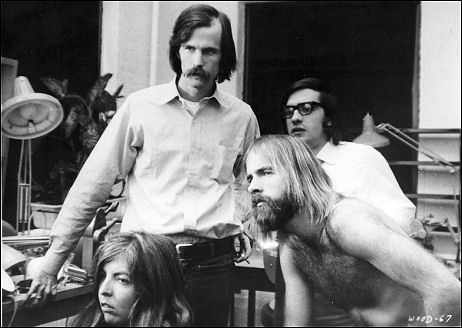
(l. to r.) Woodstock post-production team Thelma Schoonmaker, a guy I’m having trouble identifying (sorry) Michael Wadleigh, Martin Scorsese.
“Department of Law”
“Todd and me are in our cool fishing bibs. Piper’s helping out on the boat. It’s an amazing day that shows how our Creator favored my beloved Alaska, gatekeeper of the continent, and makes a great shot for all the network reporters up here to milk. This progresses me away from my image as some kind of flaky ‘rogue diva’ and back to my image as a tough huntin’ and fishin’ gal.
“But Andrea Mitchell makes such a darn big deal about how I’m quitting in the middle of my term.
“‘You’re not listening to me!’ I snap.
“She says maybe I didn’t want to go back to the nitty-gritty of Alaska politics after the bright lights of the national campaign.
“‘The nitty-gritty, like, you mean, the fish slime and the dirt under the fingernails and stuff that’s me?’ I said. Awesome response, huh?!!” — from “Sarah’s Secret Diary,” a Maureen Dowd column appearing in today’s (7.8) N.Y. Times.
Sighting
As I walked last night along West 3rd Street (on the southern end of Washington Square) I walked by a young woman wearing a “McCain for President” T-shirt. A blonde, of course, with a Lynn Cheney cut. Maybe 20 or 21, walking her dog, buying an ice-cream cone. “Hey Jett…a Republican,” I whispered to my son, gesturing discreetly. This town is full of eccentrics and that’s what I love about it, but to walk through the West Village proclaiming your allegiance to John McCain…?
Got It?
“All right, sure. I wasn’t expecting the moment with the little girl. Nobody was. And it got me, okay? I’m human like anyone else and it got me. But it’s over now, see? Let it go. Some of us didn’t like some of what we saw and heard, and enough is enough.”
Latest Upgrade
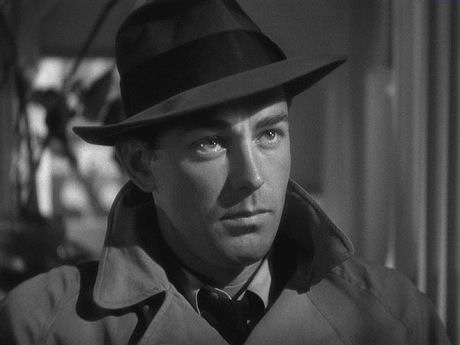
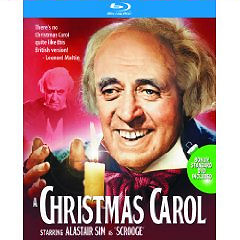
Would you spring for a Bluray of a 1951 British black-and-white film that was professionally produced but never intended to be a Gregg Toland-level visual masterpiece? I’m planning to in this instance. Brian Desmond Hurst‘s A Christmas Carol, the only version worth owning or watching, has never looked all that radiant, although the most recent standard DVD was fairly decent. A “new state-of-the-art high-def film transfer from the original 35mm negatives” is promised with “digitally restored picture and sound.”
Staples Metaphor
“Close call here. They ended ‘We are the World’ before I could jimmy open my gun closet and blow my brains out.” — Twitter message from N.Y. Times media columnist David Carr, a.k.a., ‘the Bagger.” Update: Carr’s Tweet was actually a re-Tweet — he was passing along an original thought from one Roland Hedley.
Big Fan
I missed Robert Siegel‘s Big Fan when it played Sundance ’09 and haven’t seen it since. It’ll screen here next week, I gather. First Independent Pictures will start a gradual indie rollout in NYC on August 28.
Bigger Is Better
A.O. Scott‘s inspired video essays always look smallish and slightly degraded on the Times site, but they look significantly improved at a width of 560 pixels on YouTube. (Just search with “NY Times critics’ picks A.O. Scott”.) This essay on John Ford‘s Fort Apache is one of the better ones, particularly for the parallels Scott raises between Ford’s U.S.cavalry vs. native Americans conflict and current U.S. military adventures in Iraq and Afghanistan.
Blue Pill
At the currently-rolling Michael Jackson tribute, Stevie Wonder recently said the following: “I know we all feel that we needed Michael with us, but God must have felt that he needed him a lot more.” Oh, surely. And a tearful Brooke Shields has just spoken of the Little Prince whom “we need to look up” to now that he’s sitting on high. The denial is pathetic and it’s all so Vegas. But I’d be concealing if I didn’t admit that some of the tributes have moved me. Some, not all.
Strength and Recovery Guys
I attended a Barnes and Noble discussion early last evening with Night of the Gun author David Carr (a.k.a., “the Bagger“) and Beautiful Struggle author Ta-Nehisi Coates.
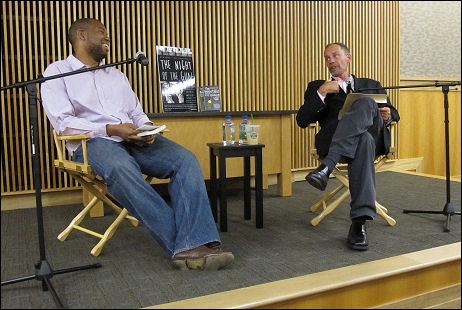
(l.) Beautiful Struggle author Ta-Nehisi Coates, (r.) Night of the Gun author David Carr at Barnes and Noble on East 86th Street — Monday, 7.6., 7:25 pm.
Here’s an mp4 (or rather, what used to be an mp4 before YouTube’s processor turned it into video ghoulash) of Carr reading a passage from his book about his father — a blunt, blustery, tough-love type.
I’m sorry for not having read Beautiful Struggle. It’s a growing-up-with-a-tough-dad story — growing up in a tough Baltimore neighborhood, the constant push-and-pull of temptations and admonitions, and his father being “steeped in race consciousness and willing to go to any lengths — including beatings — to keep his sons on the right path.”
Coates’ remarks last night told me he’s a frank and intelligent man of good and generous spirit. I’ll take the evidence of what I heard him read (on top of Carr’s praise) as a reliable indicator that his book is worth reading.
I reviewed Night of the Gun almost exactly a year ago (on 7.19).
“I love Carr’s voice,” I wrote, calling it “at once flip and candid and yet elegant and wise. But the book is also a gripping, dead honest and well-reported confessional. And at the same time — no mean feat — dryly entertaining.
“Night of the Gun is one of those ‘I did this and whoa…I’m not dead!’ books, but of a much higher calibre. Much. Carr is a man of immense steel balls to have written this, and particularly to have gone back into the damp muddy tunnels of the past and fact-checked everything for three years. He did some 60 interviews with the witnesses and participants. He pored over the depressing documents (arrest reports, medical sheets) that all drug-users accumulate sooner or later. It must have revived nightmares. But Carr went and did it and bravely wrote this book, and did a bang-up job of it. Hat off, head bowed.”