A day or two ago I was inquiring about my iPhone 15 at the local Apple store. It was only a couple of minutes after opening, and there were maybe nine or ten store reps in their royal-blue T-shirts, all looking at me and ready to help.
You never know in advance if the person you’re about to speak to is a tip-top brainiac. Most of them are reasonably bright and always generous in spirit but they rarely know everything, and more often than not they’ll pass along information that they “think” is probably correct, often adding “let me check…hold on.” And that’s fine.
But I knew I’d lucked out when I began talking to a 20something store rep with a knitted skull cap. First of all guys who wear skull caps tend to be ultra-focused in a nerdball way. But I knew this dude was a genius because he pointedly didn’t make eye contact. Right away I said to myself “that’s an Asperger’s thing…this guy is Albert Einstein-y.”
And he pretty much was, as it turned out. Not once did this guy even glance in the direction of my pupils. The whole time he was looking at the tabletop or the belt on my jeans or the fringe tip of my wool scarf. And he was fucking brilliant. It was hugely pleasurable to converse with him.
The vast majority of people in customer service focus on smiling and nicey-nice-ing and emotional caressings, and that’s fine. But when a slightly dysfunctional Genius Bar-type guy comes along, I smile inside and say a little prayer of thanks.
I can’t abide people who repeatedly say “uhm” in the middle of long explanations or statements or descriptions.
Once they start doing this I immediately stop listening to the substance of what they’re saying and start waiting for their next “uhm.” I don’t want to hear it but at the same time I do.
When the next “uhm” comes along I roll my eyes and let out a slight cough. The more they say “uhm” the stronger my telepathic message: “Stop doing this…say what you need to say without saying ‘uhm’….you’re killing me and yourself in the bargain…dear God, stop it.”
And then they say it again.
“Uhm” is a filler word — a word that signifies (a) you’re a clod and (b) you’re mulling over and preparing your next phrase or sentence.
Okay, I’ll occasionally use “uhhh” as a pause word, but I decided decades ago to never, ever say “uhm.” Or “like” — only idiots say “like” all the time.
I also say “basically” from time to time, but I never say it like a Millennial or Zoomer — “bayziggly.”
Lincoln’s Gettysburg address: “Uhm…four score and seven years ago our fathers…uhm…our fathers brought forth on this continent…uhm…a new nation, conceived in Liberty, and dedicated to the proposition that…uhm, all men are created equal.”
The Minghella was set in 1958 (i.e., two years before the release of Rene Clement‘s Purple Noon). The Zallian newbie is set in “the ’60s,” according to the Wiki page.
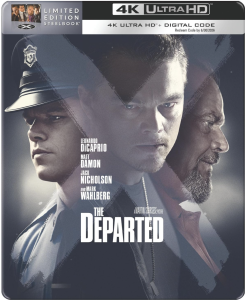
Martin Scorsese‘s The Departed is now close to 18 years old. Ranking ahead on the Scorsese hot list are Goodfellas, Mean Streets, Taxi Driver, Raging Bull, The Wolf of Wall Street and The Last Temptation of Christ.
So The Departed ranks seventh, and that ain’t hay.
And I’ll repeat my argument with two Jack Nicholson/”Frank Costello” lines. One, Costello describing Rome as a place with “nicer wops” but “no pizza.” I’ve visited Rome five or six times and pizza joints are everywhere. And two, repeating that cliche about Chinese laundry guys saying “no tickee, no laundry.” Except the line is “no tickee, no washee.”
I was looking at this Gone With The Wind overture clip, and I found myself curiously melting down over Max Steiner‘s music. Because it’s gentle and sad and lamenting, and because it conveys a sentimental longing for things — customs, attitudes, climates, cultural atmospheres — that are gone and never to return.
I’ve written five or six times that GWTW is not a film about slavery or the antebellum South or even, really, the Civil War. If it was just a Civil War epic or a Southern plantation drama or a marital misery piece it would have faded many decades ago.
It’s basically a parable about hard times and terrible deprivations, and most people (apart from the terminal wokeys) understand that today. It’s about (a) a struggle to survive under ghastly conditions and (b) about how those with brass and gumption often get through the rough patches better than those who embrace goodness and generosity and playing by the rules.
Yes, David O. Selznick‘s 1939 film is an icky and offensive thing here and there, but (I’ve said this also a few times) you can’t throw out the second half of part one…the shelling of Atlanta, the struggle, the crowd scenes, the panic, the burning of Atlanta, the anguish, the soldiers groaning and moaning, Scarlett’s drooling horse collapsing from exhaustion, the moonlight breaking through as she approaches Tara, the radish scene plus Ernest Haller‘s cinematography…you just can’t throw all that out.
Obviously the film’s unfortunate racial attitudes, which were lamentably par for the course 85 years ago, are now socially obsolete. And I wouldn’t argue with anyone who feels that portions of it are too distasteful to celebrate, but it just doesn’t seem right to lock all of that richness inside some ignoble closet and say “no more, forget about it, put it out of your minds.”
Legendary filmmaking is legendary filmmaking, and Steiner’s music is just too affecting, too transporting.
Steiner’s greatest scores: King Kong, The Informer, Slim, Jezebel, Gone with the Wind, Sergeant York, Casablanca, Since You Went Away, The Big Sleep, Key Largo, The Treasure of the Sierra Madre, White Heat.
There are three things that a film has to do in order to qualify for eternal blue-ribbon, Mount Olympus status and the simultaneous allegiance of Joe and Jane Popcorn along with your elitist, dweeb-level, ivory-tower elites.
One, it has to deliver the plain, honest truth (or undercurrent of truth) about a given world or situation — along with a little entertainment value, okay, but without undue exaggeration, no shallow exploitation, not too much sugar or vinegar, and no blatant bullshit of any kind. (This requirement in itself leaves out at least 80% of commercial cinema.)
Two, it has to persuade audiences to emotionally invest in it — to trust what it’s doing and where it seems to be going.
Three and most importantly, it has to put you into a kind of alternate-reality mescaline dream state…a place that you want to stay in and never leave, or at least make you want to return to frequently — a realm that feels so inviting or stylistically transporting that you want to live in it, even if it seems a bit dangerous.
Yes, of course — all movies are dream states in a way. The better ones always lead to a certain primal feeling of alteration or discovery (the film has taken you to an entirely new but seemingly straightforward place) or emotional comfort and reassurance. But the ones that hit the jackpot are the ones that tell you what this or that slice of life on planet earth (or life aboard an intergalactic space cruiser) is basically like …how it really is…the full, honest, non-delusional truth of things.
Which of the 2024 Best Picture nominees did you want to literally move into and live in, or at least visit for a few weeks?
I hated the claustrophobic world of Oppenheimer…university classrooms, government inquisition rooms, meeting rooms, Los Alamos residential shacks. If a magical bearded wizard came up to me last summer and said “I can fix it so you can literally time-travel back to J. Robert Oppenheimer’s world…back to 1930s England, 1940s bomb-blast Los Alamos and 1950s paranoid America….would you like to go?”….I would scrunch my face up and say to that fucking wizard “are you fucking kidding me?”
I was mildly intrigued by the Oklahoma world of Killers of the Flower Moon during my first viewing, but the second viewing was hell…I was stuck in that godawful fucking world, watching and listening to those 1920s roadsters chugging along those muddy streets…those awful damp ditches where the bodies were dumped…studying Leonardo DiCaprio‘s dumbfuck facial expressions, stuck with Lily Gladstone‘s dreary, Native American passivity and Robert De Niro‘s pinched expressions and midwestern drawl…hate it, hate it…escape!
I loved visiting the trippy, furious-jumping, sound-stage world of Poor Things. but I didn’t want to actually live in it. Because it’s skewed and unreal and more than a bit arch — no offense.
I’m too much of an average, well-educated, moderate-minded white dude to want to live in the satirical, male-despising, super-feminized world of Barbie….sorry.
I felt completely comfortable with the 1970 realm of The Holdovers. If that same wizard offered me a chance to time-trip back to ’70, I would go if I could journey there as a young lad with twenty grand in my wallet…cool. I would love that.
The realm of American Fiction is a wise and intelligent one…my kind of place except all the whiteys are woke moron suck-ups. Not my cave, bruh.
I loved certain aspects of the dream-world of Maestro, but I hated the casual cruelties forced upon poor Carey Mulligan.
Past Lives was an under-energized drag, and it always will be — I would never want to hang with those three dull people.
Anatomy of a Fall? No thanks. I now associate Grenoble with stifling vibes and constipation
Would I want to live in the nicely tended home in The Zone of Interest, right next to the walls of Auschwitz? I need to answer this?
I will forgive a film for not being an inviting place to hang in or visit if it’s being relentlessly honest about itself and the world it’s depicting. But the best kind of film tells the truth and offers an extra-cool hang in terms of environment, style, vibes.
There is no bullshit and nothing but truth in The Bicycle Thief (notice that I didn’t call it The Bicycle Thieves), North by Northwest, East of Eden, Mean Streets, Repo Man, Election, The Hospital, Treasure of the Sierra Madre, David Fincher‘s Mindhunter series, Gunga Din, Some Like It Hot, Two Women, La Strada, Zero Dark Thirty, Vertigo, Fellini Satyricon, Manchester By The Sea, Paths of Glory, Vertigo, Nomadland, Only Angels Have Wings, Collateral and 12 Years A Slave.
I’ve never had a great longing to experience India. Overpopulated, too much poverty, boring topography, guys shitting on the street, etc. But ever since catching Wes Anderson‘s The Darjeeling Limited (’07) I’ve wanted to travel across India on a nice, not-too-swanky, middle-class sleeper train…bunk beds in a cabin, superb Indian food in the dining car, hours of meditation time while staring at the countryside.
My only long-ass, third-world train ride happened 11 years ago in Vietnam, and I don’t mind saying it felt like dreary hell.
[Posted in mid-November 2013] Yesterday was a long one. A road journey from Hoi An to Quang Ngai and the My Lai Massacre Museum, and then a slow, rickety train ride from Quang Ngai to Nha Trang. We left Hoi An at 7:30 am and arrived in Nha Trang at 11 pm last night.
I wanted to visit the My Lai massacre museum near Quang Ngai so we drove down early yesterday morning — a two-hour trek with all the rain and the traffic and road construction. I was told it would take another 11 or 12 hours to drive to Nha Trang so we bought train tickets from Quang Ngai to Nha Trang, which would take about eight hours, I was told. It took ten.
Our down-at-the-heels, less-than-fully-hygienic train left at 1 pm and chugged along at a moderate pace for 400 kilometers, stopping for 10 or 12 minutes at each station. It was hellish, in a sense, but I didn’t want to be encased in a luxurious tourist cocoon. I wanted to feel and smell and taste the real Vietnam like an average local. Well, I got that.
Given the widespread loathing and the massive flop rejection of Madame Web, Dakota Johnson naturally has to distance herself from it (“who, me?) and more or less throw the carcass under the bus. Hence her chat with Bustle‘s Charlotte Owen (3.5.24):
“[Making Madame Web] was definitely an experience for me. I had never done anything like it before. I probably will never do anything like it again, because I don’t make sense in that world.” [Translation: ‘Nobody believed I was supergirl material….I look too passive or spacey or something.”]
“And I know that now. But sometimes in this industry, you sign on to something, and it’s one thing and then as you’re making it, it becomes a completely different thing, and you’re like, ‘Wait, what?’ But it was a real learning experience, and of course it’s not nice to be a part of something that’s ripped to shreds, but I can’t say that I don’t understand.
“It’s so hard to get movies made, and in these big movies that get made — and it’s even starting to happen with the little ones, which is what’s really freaking me out — decisions are being made by committees, and art does not do well when it’s made by committee. Films are made by a filmmaker and a team of artists around them. You cannot make art based on numbers and algorithms.
“My feeling has been for a long time that audiences are extremely smart, and executives have started to believe that they’re not. Audiences will always be able to sniff out bullshit. Even if films start to be made with AI, humans aren’t going to fucking want to see those.”
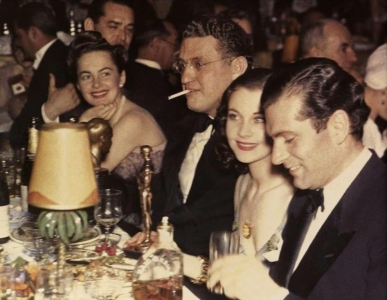
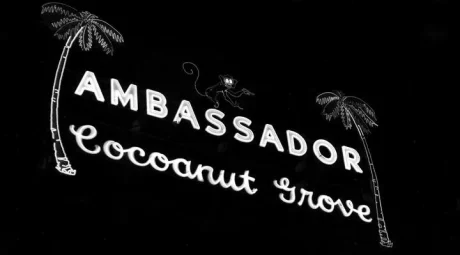
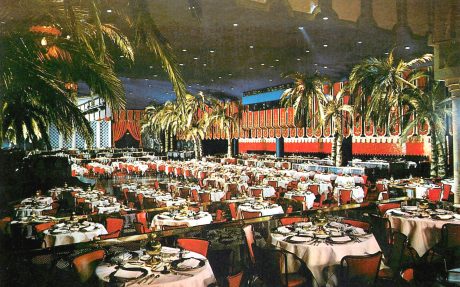
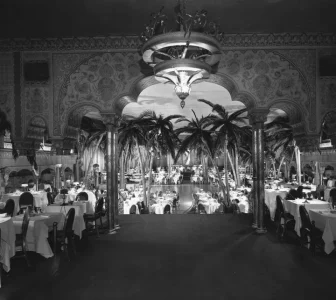
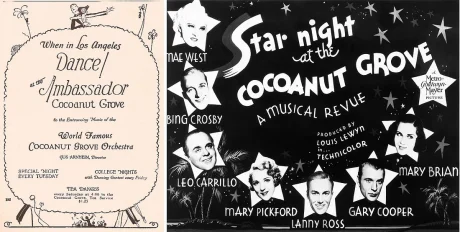
A Gone With The Wind quartet (Olivia De Havilland, David O. Selznick, Vivien Leigh, Laurence Olivier) during the 12th Academy Awards ceremony, held on the evening of Thursday, 2.29.40 (why a Thursday?) at the Ambassador Hotel’s CocoanutGrove.
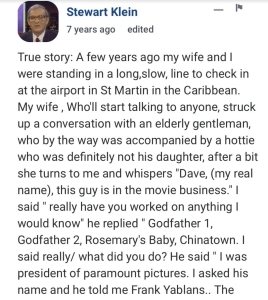
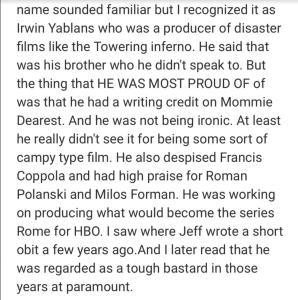
Passed along seven years ago by HE commenter “Stewart Klein“:
Posted on 11.27.14: Producer and former Paramount Pictures president Frank Yablans, who presided over that studio during its early-to-middle”70s golden period (The Godfather, Serpico, Paper Moon, Chinatown, The Godfather, Part II, Murder on the Orient Express) and then served as vice-chairman and COO of MGM/United Artists under Kirk Kerkorian, died earlier today at age 79.
Unlike his slightly older, still-living brother Irwin, a producer of second-tier “product” who was Billy Carter to Frank’s Jimmy Carter, the younger Yablans believed in class and quality. Alas, like almost every other producer, his record was hit-and-miss.
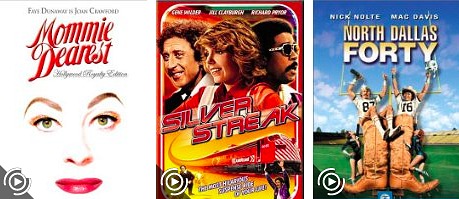
Frank produced Silver Streak (good comedy), The Other Side of Midnight (glitzy garbage), The Fury (second-tier DePalma), The Star Chamber (Peter Hyams crap) and Congo (crap).
Yablans also produced and co-penned screenplays for North Dallas Forty (a very good football film) and Mommie Dearest (classic, hilarious, over-the-top kitsch).
HE commenter Bobby Peru has attempted a takedown of Frank Perry‘s Mommie Dearest, calling it a “florid embrassment” that uses “cheap, tacky artifice to generate cartoonish shocks” and “unintentional comedy.”
That’s been the prevailing rant against this film for decades, and it’s just as wrong today as it was 35 years ago. I explained what it actually is as concisely as I knew how.
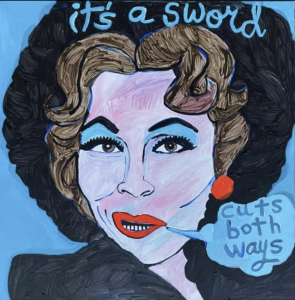
“Mommie Dearest is maudlin soap-opera realism,” I replied, “overbaked but winkingly so, everyone in on the joke and yet taking it ‘seriously,’ and at the same time a melodrama that’s occasionally intensified and heightened to the level of Kabuki theatre.
“The comedy is not ‘unintentional,’ but at the same time it’s not really a ‘comedy’ — it’s a kind of hyper-realism with a campy edge.”
“If director Frank Perry had modulated Dunaway’s performance, some of the great lines — ‘No wire hangers EVER!,’ ‘Don’t fuck with me, fellas!’ — wouldn’t have worked so well. Those lines are the stuff of Hollywood legend, right up there with Bette Davis saying “what a dump!” and Vivien Leigh saying “I’ll never by hungry again.”
Peru: “This post is quite amusing for a number of reasons, but I concur Dunaway is a legend for her finite run of the above mentioned films, which will go down in film history. However, to call Mommie Dearest ‘that great Frank Perry film’ is, at the least, oxymoronic, and at most a wild, almost unbelievable overstatement, especially coming from a ‘film Catholic’ like you, Jeff; the Movie Godz do not approve. Even Dunaway knows what a POS that florid embarrassment is; after years of rudely dismissing any journalist who would dare to even breathe the title, she finally discussed recently and blamed Perry for ruining her career by not working to ‘direct’ her performance, thereby leaving it unmodulated and Dunaway herself twisting in the wind (as if great, Oscar-winning actors can’t self-direct at least to a modicum).
“The movie is camp junk for a reason — because it is cheap, tacky artifice with one agenda, which is to generate cartoonish shocks. This has not stopped me and millions from enjoying it as such, but ‘great’ it most certainly is not unless you are referring to unintentional comedy.
“As for Dunaway herself, the Crawford turn bolstered by decades of diva behavior (my friend is her neighbor and has told many a story) well past her glory years has also contributed to why her career went to the toilet; too many grandiose notions about herself and a history of making lives difficult onset. I’ve heard first-hand stories of her dismissing acting students while auditing classes (‘They’re staring at me’) to parading up and down the aisle of a coach flight — get this — reading a script aloud. She is a major nut, great as she was.”