Attaboy Best Picture Noms

Variety‘s Tim Gray just reported that the Academy will nominate ten Best Picture nominees, which devalues the meaning, of course. Why didn’t the Academy decide to nominate 15 films for Best Picture?This way, five more films will get the box-office benefit, but not really.

Enemies Deal

In response to my calling Public Enemies “the most captivating, beautifully composed and freshly conceived gangster movie since Bonnie and Clyde,” an HE reader has written that this sounds like a “transparent attempt to get in some advertising blurb.” No, it isn’t that. Another reader has expressed doubt if it’s “more captivating, beautifully composed and freshly conceived than Goodfellas.” Yes, it is that.

Let me explain.

Gangster-movie-wise, Bonnie and Clyde introduced some major new concepts in 1967. It simultaneously delivered a mid ’60s youth-culture, up-the-establishment attitude while using quaint 1930s period trappings and details (with the exception of Warren Beatty‘s modified Rodeo Drive haircut) and occasional art-movie flourishes. It brought the French New Wave, in a sense, to Depression-era Texas, Louisiana, Oklahoma, etc.

Public Enemies is similarly out there with a radical use of razor-sharp, high-def digital widescreen photography (this is going to be one hell of a Bluray) that totally says “not the early 1930s!” and “55-inch LCD screens at Best Buy!” and at the same time says “actually, this is the real early 1930s without the rat-a-tat-tat Pennies From Heaven squawkbox atmosphere and embroidery and Jimmy Cagney-Paul Muni personalities that you’ve been conditioned to expect.”

Add to this the use of shadowy and sometimes just plain dark and inky Gordon Willis-y compositions from cinematographer Dante Spinotti and deliberately muttered dialogue (half of which I personally couldn’t hear, which was totally cool because I was so taken in by the “all” of it).

The combined effect allows audiences to see and experience the early 1930s in a way that is simultaneously “right now” and “back then.”

It’s simultaneously an art-movie that says “fuck the rubes if they can’t take a joke,” a shoot-em-up bank robbery gutpuncher and hell-raiser, a moving and deliciously off-the-ground romantic love story between Johnny Depp‘s John Dillinger and Marion Cotillard‘s Billie Frechette as well as a heavy bromance between Mann and Dillinger.

It really is a fresh package-and-a-half. Plus it’s so “elevated” and so unconcerned with dumb-shit Transformer taste buds that it’s some kind of bold and beautiful.

Due respect to Martin Scorsese but Goodfellas wasn’t as fresh and “whoa” as this. It more or less just spritzed up and recycled the ethnically authentic Mean Streets goombah neighborhood culture and applied it to a rise-and-fall of northeastern mob culture arc from the ’50s to the ’80s with a lot of cinematic pizazz and that great narration from Ray Liotta and all those great performances from Pesci, Sorvino and that Harry Nillson music and so on.

Goodfellas, to sum up, was very cool and electric but Public Enemies is more exciting in a Bonnie and Clyde sense. That’s what I was trying to say, and have now said.

Stoops to Conquer

Carey Mulligan, radiant star of Lone Scherfig‘s An Education and an almost-certain Best Actress contender once the games begin, makes a brief appearance in Michael Mann‘s Public Enemies (in a platinum blonde Jean Harlow wig), and appropriately showed up at last night’s after-party. She wouldn’t tell me how her recently announced role in Wall Street 2 will be contoured (sworn to secrecy, etc.) except that she doesn’t play a guilt-tripper. An Education (here‘s my Sundance review again) will play both Telluride and Toronto.


Tuesday, 6.23, 11:05 pm.

Cool Night Air

Coming out of the Westwood Village right after Wednesday evening’s premiere screening of Michael Mann‘s Public Enemies, and in fact just as the closing credits had finished and the curtain had come down. A group of Iraq rebellion solidarity demonstrators positioned themselves across the street, and just as I zoomed in the Canon Elph SD 780 IS decided to lose focus. Go figure.

Enemies Forever

Michael Mann‘s Public Enemies, which premiered last night in Westwood, is glorious and levitational — the most captivating, beautifully composed and freshly conceived gangster movie since Bonnie and Clyde. It’s an art film first, a Mann head-and-heart trip second, a classic machine-gun action pulverizer third, and a conventional popcorn movie fourth. The schmucks will go “meh” and the people who are hip enough to understand what this movie is doing/has done will retire to tens of thousands of nearby cafes and talk it over for at least a couple of hours.


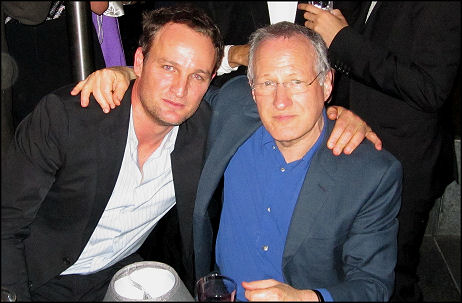
Public Enemies director and cowriter Michael Mann (r.), costar Jason Clarke (l.) at after-party at the Hammer Museum. Compare the eyes, noses, jawlines, foreheads — they could be father and son

Tuesday, 6.23, 11:05 pm.

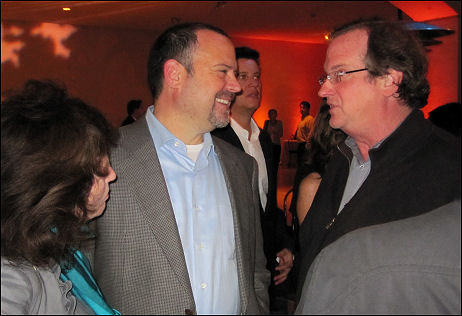
(l. to r.) Beyond The Box’s Paula Silver, Universal co-president Marc Schmuger, Pete Hammond at Public Enemies after-party

The Public Enemies after-party was perfect — excellent people, great Wolfgang Puck food (mac-and-cheese with lobster) and wonderfully fragrant air coming in from the open rooftop. It’s 2 am and I need to crash. I need to return a car and catch a 10:30 am plane so that’s it. I land in NYC around 7:45 pm — another dead-to-the-world confinement day on a United Airlines jet-slash-bamboo cage.

The Anti-Lumenick

Michael Mann‘s Public Enemies “marks an exciting return to muscular, patient storytelling for Mann,” writes In Contention‘s Kris Tapley. “After dubious stabs at commercial appeal in Collateral and Miami Vice — films that certainly have followers and admittedly plumb thematic depths no other filmmaker would have reached — the director has painted his most resonant character study since 1995’s Heat.

Public Enemies “fits seamlessly into a line of filmmaking Mann has generated to represent, as F.X. Feeney has called it, ‘a profound, interactive, philosophical history of the United States.’ Collateral and em>Miami Vice served as stylistic, muscle-flexing diversions, but here the director seems more thoughtful in his approach to character and structure. As with Ali, he doesn’t succumb to the lures of the biopic. He tells a story, directly, and without qualification or ornamentation. The film is classic Mann.”

$14 Million?

An absurd-sounding story by The Wrap‘s Sharon Waxman and Amy Kaufman appeared early this afternoon, claiming that Nikki Finke was paid $14 million for Deadline Hollywood Daily. If this turns out to be real (or even two-thirds or one-half real), the person who approved the deal would have to be called an idiot.

If I was a prospective buyer I would think twice about paying Finke $1.4 million for her site. If Finke ever leaves her house (I’ve heard she rarely does this) and gets hit by a car like Shelley Winters in Lolita, DHD would be worth absolutely nothing — zilch.

Waxman/Kaufman have written that a knowledgeable source said the $14 million “would be paid out over several years” and that “normally such deals are tied to traffic or to revenue projections…nonetheless, it is an exceedingly high price for a relatively small website.”

Almost Rickety

I was reading Kris Tapley‘s nicely written Batman nostalgia piece and happened to click on the attached YouTube clip of the opening credits. And it was like….whoa! Take away the dark minicam footage (i.e., squirreling through the shadowy caverns of the Batman crest) and the titles alone seem so primitive, so austere — almost like the main titles for a King Vidor or Sam Wood film of the 1940s. You would never see such plain-looking credits on a big-budget comic-book superhero film today.

Humping Robodog

Transformers: Revenge of the Fallen is a horrible experience of unbearable length, briefly punctuated by three or four amusing moments,” writes Roger Ebert in a just-posted review. “One of these involves a dog-like robot humping the leg of the heroine. Such are the meager joys. If you want to save yourself the ticket price, go into the kitchen, cue up a male choir singing the music of hell, and get a kid to start banging pots and pans together. Then close your eyes and use your imagination.

“The plot is incomprehensible. The dialog of the Autobots, Deceptibots and Otherbots is meaningless word flap. Their accents are Brooklynese, British and hip-hop, as befits a race from the distant stars. Their appearance looks like junkyard throw-up. They are dumb as a rock. They share the film with human characters who are much more interesting, and that is very faint praise indeed.

“The human actors are in a witless sitcom part of the time, and lot of the rest of their time is spent running in slo-mo away from explosions, although — hello! — you can’t outrun an explosion. They also make speeches like this one by John Turturro: ‘Oh, no! The machine is buried in the pyramid! If they turn it on, it will destroy the sun! Not on my watch!’

“The humans, including lots of U.S. troops, shoot at the Transformers a lot, although never in the history of science fiction has an alien been harmed by gunfire.

“The battle scenes are bewildering. A Bot makes no visual sense anyway, but two or three tangled up together create an incomprehensible confusion. I find it amusing that creatures that can unfold out of a Camaro and stand four stories high do most of their fighting with…fists. Like I say, dumber than a box of staples.”

Already Figured This

“Arguably, one reason why the film industry has encouraged and promoted the concept of director’s cuts…is that it enables a film’s owner to sell the same product to the same customer twice — or even, in a few special cases, three or four times. Presumably, if you recut somebody’s film, the damage isn’t serious because it can always be ‘restored’ on DVD. The basic mythology appears to be that every film has two versions, a correct one and an incorrect one. But in fact this isn’t quite true.

“A better paraphrase of the mythology would be, more paradoxically, that every film has at least two versions — a correct one and a more correct one, to be succeeded in turn by further upgrades.” — from a 6.23 Slate piece by Jonathan Rosenbaum‘s called “Death by a Thousand Director’s Cuts — How DVD marketing is rewriting the history of film.”

Holding Pattern

The Bruno screening I spoke of yesterday came off as scheduled at 4 pm at Mann’s Chinese. 20% critics, 80% hoi polloi. It’s all cool and fine but no reviews or riffs until July 6th.