Curbside


While I love the spirit of film festival van screenings, I would never sit down and watch a film this way. A trailer, perhaps, but never a feature.

Long Run Foreseen

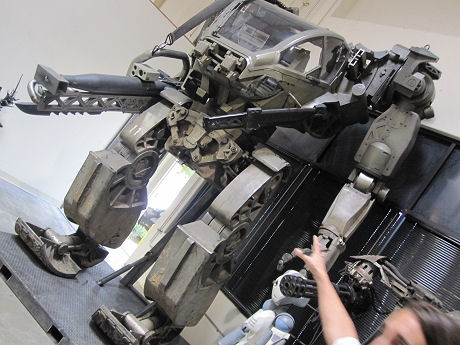
“How hot is James Cameron‘s Avatar?,” asks N.Y. Times reporter Michael Cieply. “Hot enough that Imax so far has not lined up any other Hollywood movies for its ultra-big screen theaters between Fox’s release of Mr. Cameron’s 3-D science fiction thriller on Dec. 18 and the arrival of Tim Burton‘s Alice in Wonderland on March 5.

“Things could change. But the Imax people are mulling whether the several hundred large screens by then expected to be up and running with commercial films (as opposed to the museum-type fare) will be needed for almost three months to satisfy demand for Mr. Cameron’s first feature film since Titanic.”

“Bubblegum Sidedish”

“No matter how much extreme contextualization and heavily stylized techniques Quentin Tarantino [uses] in Inglorious Basterds, it feels like a bubblegum sidedish to the heavy dinner plate of his career,” says Indiewire‘s Eric Kohn.

“Despite a World War II setting, Inglorious Basterds mainly feels like an homage to crime and thriller movies, using Nazis as cardboard villains in a facile manner akin to the Indiana Jones franchise.

“As the story [builds] into an espionage drama, Tarantino churns out the most conventional accomplishment of his career, Jackie Brown included. Sure, you can tear apart the layers of references to countless genres from multiple eras, but not with the same relish allowed by Kill Bill or Pulp Fiction, where reading into the text and digging its natural flow were not mutually exclusive.

“That’s hardly the case here. To watch Basterds without considering Tarantino’s implementation of enyclopedic movie knowledge makes it into a breezy, insignificant experience. Basterds is a talk-fest. Anyone familiar with the Tarantino touch will testify that the director likes to make his characters talk and talk and talk — and sometimes so that it ends up absorbing the spotlight. In Basterds we see the worst side-effects of this tendency.”

Well Said

Here’s that riff from Quentin Tarantino this morning about why the Cannes Film Festival is so important and exciting. “One of the things I love about Cannes is [that] during this time on the Rivera, cinema matters — it’s important,” he said. “And even when people boo [and whatnot], it’s out of passion. It’s not just these images glazing over you — it matters, it means something.

“And all of the world’s film press from the planet earth — America, England, Iceland, Greenland…they’re all here. Bam, at once. Everyone here at the exact same time. They argue and they jostle and do this and do that, and it’s like the cat is out of the bag for the entire planet earth. And I’m down with that. I am not an American filmmaker — I make movies for the planet earth, and Cannes is the place [for that to happen].”

Basterds Encounter


Brad Pitt signing autographs or shaking hands or something in the vein outside the Salle de Presse following this morning Inglourious Basterds press conference.

Inglourious Basterds costar Diane Kruger (l.), director-writer Quentin Tarantino — 5.20, 11:42 am.

French actress Melanie Laurent, who gives one of the film’s two standout perfs as Jewish refugee who inherits a Parisian movie theatre. (The other is given by Christoph Waltz as the brilliantly evil Col. Hans Landa.)

Costars Michael Fassbender, Eli Roth, Brad Pitt

Whole Lotta Talkin’

Here’s the opening of this morning’s Inglorious Basterds press conference, following this morning’s 8:30 am screening. And here’s an mp3 of most of what was said. About 13 or 14 minutes in director-writer Quentin Tarantino delivered a great riff on what the Cannes Film Festival so special. I’ll try and find and isolate and run it as a stand-alone. As for the film…

It’s not great. It’s a fairly engaging Quentin chit-chat personality film in World War II dress-up. It’s arch and very confidently rendered from QT’s end, but it’s basically talk, talk, talk . Tension surfaces in a couple of scenes (especially the first — an interrogation of a French farmer by a German officer looking for hidden Jews) but overall story tension is fairly low. A couple of shootouts occur but there’s no real action in the Michael Mann sense of the term except for the finale. No characters are subjected to tests of characters by having to make hard choices and stand up for what they believe, and nobody pours their heart out. What they do is yap their asses off. Cleverly and enjoyably at times, yes, but brisk repartee does not a solid movie make.

The theme, I suppose is the penetrating and transformative power of film. The secondary theme is a Jewish revenge fantasy against the Nazis. (Costar Eli Roth called it “kosher porn” in this sense.) No emotional currents, no sense of realism and no characters you’re allowed to really and truly enjoy and care about. That said, the two best performances are given by Christoph Waltz as Col. Hans Landa — a great malicious Nazi — and Melanie Laurent as Shoshanna Dreyfus, a French farm girl who escapes Landa’s grasp and winds up running a Parisian cinema.

Inglourious Basterds is probably too talky to lure the knuckle-draggers. The chat really does seem to weigh things down in the middle section. It’s an arch exercise in World War II genre filmmaking, a kind of filmic valentine for people who love film and film culture, and a put-on about World War II movies.

Trims To Come?

“The version of Inglorious Basterds that bows in Cannes is unlikely to match the one that Universal and the Weinstein Co. roll out at a multiplex near you,” the Hollywood Reporter‘s Scott Roxborough wrote today. “Wednesday’s screening clocks in at 2 hours and 40 minutes — reassuringly long for cast members worried about ending up as cutting-room dross — but a programming challenge for distributors. So Basterds in Cannes could resemble a test screening, with a leaner, perhaps meaner cut going up in August.”

Broken Embraces

Pedro World is a perfect haven, a warm cave filled with invention, brilliance, constant emotional intrigue, suspense, and exactitude. It’s a place to hang, a place of assurance that always mesmerizes and delights and makes you feel well taken care of, like you’re staying in some $2000-a-night hotel in some tranquil valley.

I’m not saying that the pleasures of the films by Pedro Almodovar are better because they’re less gnarly or challenging or easy-to-figure than the creations of Park Chan-Wook, Andrea Arnold, Gaspar Noe or Jacques Audiard. I’m saying that Almodovar is a master director-shaman who always knows exactly what he’s doing and how to work it…and I mean precisely. So much so that even his not-quite-great films, like Broken Embraces, are still exquisite gourmet meals.

Which is why earlier today I said that Broken Dreams is “easily the most fully realized, thematically satisfying, self-assured and purely entertaining film of the festival so far. Not as fully emotional as Almodovar’s best films, but on a very high station in the second tier. Way in front of anything I’ve seen so far.”

Partly a romantric noir, partly a tragedy about playing around, largely about creative creation and holding to a vision and putting things right in the end, the story spans some 16 years (set in ’08, flashing back to ’92 and ’94). It focused on a film director (Luis Homar) who’s lost the love of his life (Penelope Cruz) as well as his eyesight to a jealous lover, and how after much revelation achieves a kind of satisfaction in the end. I’ll say no more except that it’s a profound and enriching finish all around.

What’s not quite 100% about it? The who-did-what, what’s-happening-next? and what-really-happened-14-years-ago? element seems to slightly dilute or compromise the emotionality.

But the pleasures of simply appreciating the craft in Broken Embraces aren’t messed with in the slightest. The way Almodovar’s multi-layered and multi-toned story is so expertly written (by himself), performed by Cruz and Homar and everyone on down, woven together by editor Jose Salcedo and shot by Rodrigo Prieto, etc. I didn’t want it to end. It just won’t stop caressing and knocking you out. I could easily watch it again right now.

I could catch at the Salle du Soixentieme tomorrow, for instance, but I won’t since Wednesday is my final festival day with Inglourious Basterds starting things off at 8:30 am and finishing with Michael Haneke‘s The White Ribbon and Sam Raimi‘s Drag Me To Hell. Plus the usual filing and running around and packing.

Dillinger Sartre

In an article about Public Enemies (Universal, 7.1) by the San Francisco Chronicle‘s Ruthe Stein, director Michael Mann says that while gangster John Dillinger (Johnny Depp) and his gang “could plan robberies in a very meticulous fashion, they couldn’t plan next month. They had no concept of the probability that if they kept robbing banks, eventually they would get caught.

“‘They had no plan for the future,’ Mann tells her. ‘They were living for the moment…there was a “disconnect between cause and effect. If you trusted the wrong person and got shot, it wasn’t because of an error of judgment. It just happened.”

“The expressions ‘a bullet with your name on it’ and ‘when your time is up’ were popular in the 1930s,” Stein notes, “and reflect a sense of things being out of your control.”

Never, it seems, in the history of ill-gotten gains has a criminal ever realized that they’re in it for the short haul, and if they were smart they’d sock their loot away in Central America or Bern or the Cayman Islands and carefully plan for the moment when they’d pack their bags and go on the lam. Tony Soprano never got this and look what happened.

Street Action

I ran into this “manif” (i.e., a political parade) just after emerging from the Olympia plex on rue d’Antibes where I’d just seen Angela IsmailosGreat Directors — a concise and well-shot personal tribute doc about Bernardo Bertolucci, Agnes Varda, Stephen Frears, Todd Haynes, David Lynch, Catherine Breillat, Richard Linklater, Ken Loach and John Sayles. It’s a warm reassuring bath of a film, but it’s also about Ismailos’ golden blonde hair — a steady presence from start to finish.