On The Road


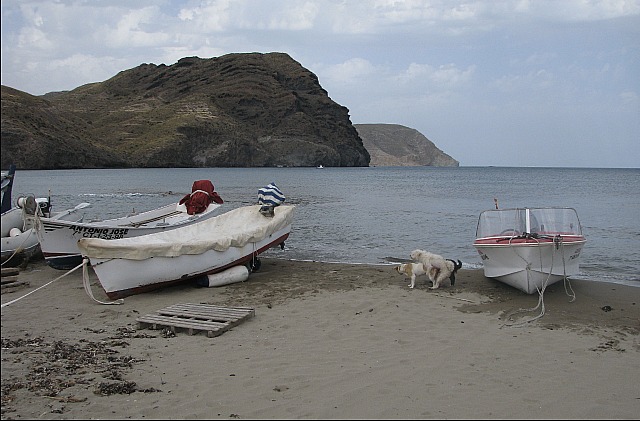
On hill overlooking Las Negras — Saturday, 5.23, 8:40 pm.

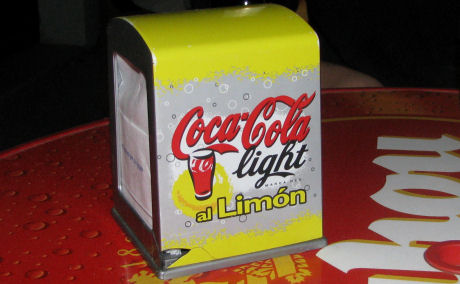
314th reason why European culture is better than U.S. culture: they still sell Coke Limon over here. Americans shunned my all-time favorite soft drink after a year or so of market sampling. They go for Dr. Pepper, beer, Sprite, Coke Zero, Fanta but not the greatest tasting Coca Cola hybrid of all time.

Grief, Dinos…Say Again?

A guy with relatively close proximity to Terrence Malick‘s Tree of Life has confimed what is common knowledge in some circles but has never been rock-solid confirmed, which is that, yes, there is a dinosaur sequence. “Apparently the depth of the father’s (Brad Pitt) grief when [reason conveyed but omitted here] is so great that the film goes back to the beginning of time and charts evolution…I guess this includes dinosaurs,” the Cannes guy says.

He also says the film is definitely “coming out in ’09. The IMAX stuff takes up around 40 minutes and they are currently raising the money.”

Need That Schwing

I feel less negatively about Sam MendesAway We Go (Focus Features, 6.25) than Variety ‘s Dennis Harvey, who yesterday called it “a digression into loose, anecdotal Amerindie-style terrain” for Mendes and an “oddly sour, unappealing road-trip scenario” costarring John Krasinski and Maya Rudolph.

I found it okay, not bad, mildly diverting, somewhat engaging, etc. I know — damnation with faint praise, right? I was going to wait until later in the month but Harvey forced it.

Krasinki and Randolph play a pair of intelligent, vaguely likable, moderately appealing 30something couple with definable brains and souls. But as actors they exemplify, I think, what you don’t want to do when you’re casting your leads. The bottom line is that they’re both supporting players without any leads to play with or against. This is obvious from the trailer. They just don’t have that special chemistry-slash-empathy factor that leading actor types always seem to radiate.

“Penned by first-time scribes, alt-lit favorites and real-life spouses Dave Eggers and Vendela Vida,” Harvey notes, “pic will likely find some defenders, particularly among the authors’ fans. Still, its theatrical career launching June 5 looks to be short with ancillary prospects modest.”

South of Aqaba

Las Negras, a small village on the coast of Andalucia in southeastern Spain, is in the dry area of the Cabo de Gata (Cape of the Cats). It’s located about 20 or so kilometres south of Playa Agorobico, which was the area that David Lean used to stage the attack on Aqaba in Lawrence of Arabia, requiring the construction of a semblance of the Moorish-themed town as it existed in 1917 or thereabouts. Alas, the coastal headland has been spoiled by an illegally built hotel which has been threatened with demolition.

Noe’s Death Trip

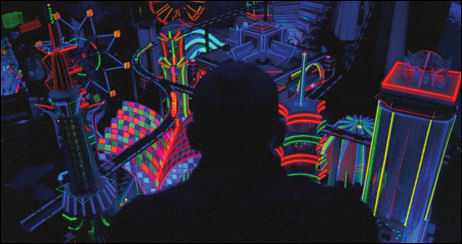
“I know what it’s like to be dead” is one of John Lennon‘s more famous lyrical lines. Now, with his Cannes-screened Enter The Void, director Gaspar Noe has also laid claim to having an imaginative knowledge of the after-realm, which might be summarized as “I know what it’s like to be dead and reborn.”

And it’s fascinating, to hear it from Moving Pictures magazine’s Eric Kohn. The problem, however, is that “no movie in recent memory [has] simultaneously outstayed its welcome and felt so fresh in nearly every scene.

“In a rare film accomplishment, No√©’s Enter the Void inspires feelings of awe, disgust, contemplation and annoyance — sometimes all at once,” he observes.

“The movie begins from the perspective of a young, American drug dealer named Oscar (Nathaniel Brown), who lives in Tokyo with his sister (Paz de la Huerta). The camera adopts his perspective, jutting to black as it mimics his blinks and even muffling his voice to make it sound like the viewers are inside his head.

“The downbeat stoner gets high and heads out to a bar with a friend. Along the way, they have a cosmic discussion about the Tibetan Book of the Dead, sounding like a couple of aimless druggies with little connection to reality. But their discussion ends up having highly profound implications. Soon, the dealer is dead, lying in a pool of his own blood in the bathroom of the bar. And yet the camera maintains his perspective, and that’s when things start to get really far out.

“Oscar’s viewpoint drifts out of his body to explore his surrounding environment, where he witnesses the fallout of his demise.

“His sister, an erotic dancer whose seedy lifestyle caused Oscar to become a drug addict in the first place, veers into depression. Meanwhile, Oscar starts to think back on his childhood before flashing back to modern times, witnessing some nifty-looking colors and ultimately getting reborn as the spawn of his sister and best friend. Trust me, spoilers are important when recommending No√©’s movie. It’s worth seeing simply for its intense application of one gimmick the whole time, but you need to know that it does end after a while — after two hours and 30 minutes, actually.

Borrowing from the aesthetics of Cloverfield, first-person shooters and the extreme long-take style of Mike FiggisTimecode, Noe’s audacious work begs for big-screen treatment, a patient audience and a willingness to give the director a certain amount of leeway. In concept, it’s just plain dumb. In execution, it’s somewhat pretentious and far too ambitious. In the right frame of mind, however, Enter the Void offers a wholly original twist on the role of spectatorship in storytelling. Love it or hate it, the movie succeeds as a radical experiment in film form.

“When the flashbacks begin (and the movie adopts a third-person view), Noe settles into a relatively basic pattern, jumping back and forth from Oscar’s memories to his perspective in the present. Then, right when you expect the director to wrap things up, it gets even nuttier. We are given the privilege — if it can be described in that manner — of witnessing Oscar’s re-conception as it happens, including a shot from inside his sister’s womb as a penis enters her and shares the seed that will bring him back to the world. It’s like Look Who’s Talking gone NC-17 and avant-garde.

“Beyond its unique construction, Enter the Void also functions as a dedicated provocation. With loads of graphic sex and even an onscreen abortion, the movie led many in its Cannes audiences to suggest that it ups Lars von Trier‘s Antichrist as the most controversial entry at the festival. Maybe, but it’s the core idea of the production — death as the ultimate drug trip — that ought to take the spotlight.”

Prophet + Sony Classics

Jacques Audiard‘s A Prophet, my most lamented miss of the Cannes Film Festival (due to oversleeping), has been acquired for U.S., Latin American and Australian distribution by Sony Pictures Classics. Variety’s Sharon Swart reported early this morning that “multiple distribs had been interested in the film but several reported that sales company Celluloid Dreams had attached a steep price tag for the U.S. rights.” Audiard made it in my book with The Beat That My Heart Skipped, an ’05 remake of James Toback’s Fingers.

Malick’s Tree in ’09?

In a story about a Spanish distrib buy of Terrence Malick‘s Tree of Life, Screen Daily‘s Chris Evans reported yesterday that “the film is due for release in the U.S. later this year.” No quotes support this alleged intention so it’s probably best to hold off until a solid confirm comes in. The story describes Malick’s film as being about “a man who struggles to come to terms with a childhood torn apart by sickness, suffering and death.” What about the dinosaurs? (Thanks to The Playlist for the shout-out.)

Let ‘Em Out

A few things were bugging me during the Cannes Film Festival but I didn’t want to vent for fear of muddying the waters (as well as not wanting to sound overly pissy). But now that I’m out of it and wandering around Spain I’m figuring what the hell. I was irritated on an almost daily basis by the following:

(a) People doing the “mall meander” along the Croisette. That’s a Fran Leibowitz term that refers to New York tourists walking much too slowly and forcing purposeful striders like myself to walk around them. These people walk along like they’re they’re half-asleep in their bathrobes at 3 am, shuffling into the kitchen to get a glass of milk.

(b) People who don’t sit as much as collapse-flop into seats directly in front of you, like four-year-olds falling backwards onto a bed of pillows, and in so doing banging your kneecaps. A good portion of these same people also tend to rock in their seat like 185-pound hyper poodles. (“This is fun…like a rocking chair!”) They seem unable to just sit in their seat like a statue or a bean bag or someone like myself might. Then again Wednesday night at the Michael Haneke/ White Ribbon screening my knee pushed slightly against the seat of a guy in front of me, and he gave me a dirty look. Fuck him too.

(c) Older men who wear shorts and sandals. I don’t want to even glance at their white legs and funny-looking digits. Show some self-respect and wear long pants and loafers, for Chrissake.

(d) Older short guys who huff and puff as they take take three or four minutes to place their small suitcases in the overhead rack on a train. (Okay, this isn’t a Cannes peeve — it’s a train-from-Narbonne-to-Barcelona one.)

Parnassus Phffft

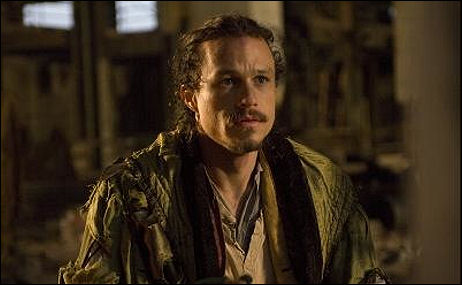
If someone had asked me to write an imaginary-exercise review of Terry Gilliam‘s The Imaginariam of Dr. Parnassus, which was obviously thrown into serious jeopardy 16 months ago by the death of its star, Heath Ledger, I might have started with a lead that reads something like this, having heard what I’ve heard and presuming the worst:

“Marred by shoddy special effects and half-formed fantastical conceits, Gilliam’s film has the feeling of a comic fantasia desperately seeking to find its rhythm. Nearly abandoned after the sudden death of leading man Heath Ledger prior to completing production in January of last year, the final result reflects the frantic cobbling together of missing pieces.”

This, in fact, is what Indiewire‘s Eric Kohn has posted from Cannes about two hours ago.

“Ledger’s posthumous status haunts his scenes, as it does in the moments in which various actors replace him. Compounding that problem, the cartoonish CGI and inconsistent storytelling yield a seriously disjointed experience. Still, Parnassus deserves to be seen, probed and evaluated as an interesting misfire in Gilliam’s delectably quizzical canon.”

Which begs the question, when was Gilliam’s last straight-shooting, no-excuses, on-target film? The Brothers Grimm? The Fisher King? Time Bandits? My most positive Gilliam association, frankly, isn’t one of his films but Lost in La Mancha, that doc about the collapse of his Don Quixote film.

On The Fly


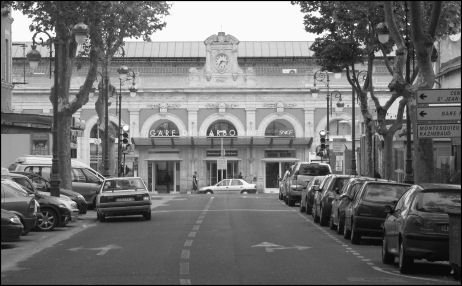
Gare de Narbonne — Friday, 5.22.09, 7:35 am.

Pretty much all the French-language women’s fashion mags have been radically reduced in size. There’s no way to get a sense of scale from this photo, of course, but they’re a little bit bigger than the old TV Guide from way back when, or the old Reader’s Digest, which half-mattered as a publication about eight or ten years ago.

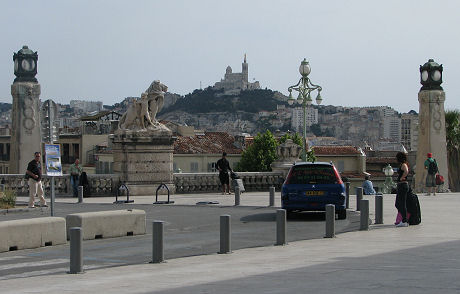
Looking southeast from the Gare de Marseilles — Thursday, 5.21.09.