Inspired by Jokeyphone I tried to find my all-time favorite joke — the one that some call “kiki” about two anthropologists captured by cannibals in New Guinea, etc.? — but I couldn’t find it anywhere. If anyone has seen this on YouTube under some other name, please advise. You know which one I mean….? Anthropologost #2, having seen what happened to his friend when he chose “kiki” says, “I’m not a brave man so I’ll choose death.” And the chief goes, “Very well, death…but first, kiki!”
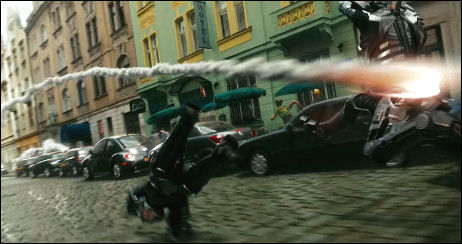
The bottom line, of course, is that all the attention given yesterday to the problems of G.I. Joe: The Rise of Cobra (Paramount, 8,7) will turn out to be a blessing in disguise. The film is what it is and there are millions who will pay to see it no matter what, but among the fence-sitters two things are incontestable: (a) barring an unimagined catastrophe of some kind the worst is over in terms of bad buzz, and (b) the film’s rep has nowhere to go but up.
Once the sneak previews and media screenings start in July it’s entirely possible that the G.I. Joe word will be “wow, surprise…a lot less awful than I expected!” If G.I. Joe had accumulated nothing but positive buzz going into August it would have to meet those expectations, God forbid. Now the pressure is off. If it turns to be even half-tolerable the word will reflect that in a mostly positive way — “doesn’t suck that badly!,” “harmless!” “I got through it and finished my popcorn!” and so on.
Paramount owes guys like myself a debt of gratitude. Seriously — they’re better off for it. And they have eight weeks to put across the old counterspin — a snap.
In today’s N.Y. TimesA.O. Scottmakes a good point about The Taking of Pelham 1 2 3, which is that the “stubborn, earthbound fact of the subways serves as an anchor” for director Tony Scott. “The gritty physicality of subway cars and tunnels balances the director’s signature flights into G.P.S. and Google Earth-inspired bird’s-eye moviemaking, constraining his indulgences much as it limits the options of both the criminals and the civic authorities in the movie.
The Taking of Pelham 1 2 3 “is neither too raw nor too nostalgic,” addsEntertainment Weekly‘s Lisa Schwarzbaum. “And in the hands of director Tony Scott, it’s relevant but not too distressing, something that doesn’t shy away from jolting violence but is also, you know, fun. It’s an open-hydrant whoooosh of an action thriller.”
Two days ago Forbes‘ Dorothy Pomerantzreported that Harrison Ford earned $65 million dollars between June ’08 and this month, mostly or entirely through his Indiana Jones and the Kingdom of the Crystal Skull profit percentage deal. That awful film has grossed $786 million worldwide.
Sixty five friggin’ million for donning the old fedora, holding his nose and starring in a megapic that (a) made him look like much more like a corporate go-alonger than a studly movie star, (b) all but ruined the viability of the Indiana Jones franchise and (c) cemented George Lucas‘s reputation as a legendary spoiler and degrader of potentially wow films.
The second biggest 6.08 to 6.09 earner was Adam Sandler, who made $55 million off fees and whatnot stemming from You Don’t Mess With the Zohan and Bedtime Stories. Will Smith came in third with a lousy $50 million for his work on Hancock and Seven Organs for Seven People…Jesus God.
The universally loathed and despised Eddie Murphy came in fourth via his earnings the mediocre Meet Dave. In fifth place was the dedicated workhorse Nicolas Cage.
Earnings estimates were based on talks with “agents, managers, producers and lawyers to determine what the stars earned as upfront pay on movies [stars] are currently shooting, as well as backend pay earned after a movie hit the theaters.” Forbes also tabulated “any money actors might have earned from doing ads for things like beer, banks and coffee.”
Tom Hanks came in sixth with $35 million followed by Tom Cruise ($30 million, 7th place), Jim Carrey ($28 million, 8th place), Brad Pitt (a lousy $28 million? With all those kids and all that travel?), and Johnny Depp ($27 million, 10th place).
The elite bottom-feeders are George Clooney ($25 million), Russell Crowe ($20 million…lifestyle cutbacks!), Robert Downey Jr. ($20 million, 13th place), Denzel Washington ($20 million), Vince Vaughn ($14 million), Ben Stiller ($14 million, second mortgage), Seth Rogen ($12 million, enough for starter home and nice second-hand Taurus), Matt Damon ($11 million…what’s he doing?), Christian Bale ($10 million, 19th place), and Will Ferrell ($10 million).
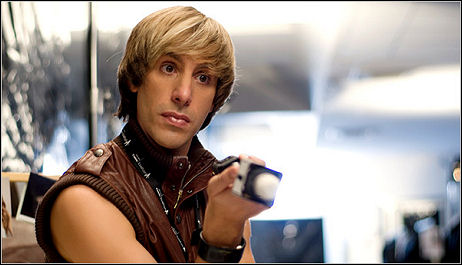
There’s a small but stunning “whoa!” in Brooks Barnes‘ 6.14 N.Y. Times piece about how Bruno simultaneously mocks and elbow-nudges homophobia. Universal, the film’s distributor, “won’t discuss the filmmaking process,” he writes, “but the studio insists that the vast majority of the people who appear with Sacha Baron Cohenhad no idea they were being filmed for a Hollywood movie.”
This is the article‘s big whopping obiter dicta — the words in passing that suggest there’s no limit to average people’s ability to keep their brains from noticing or absorbing anything that doesn’t naturally reside in their own private intellectual and emotional gulags. To delicately rephrase, after Borat you really needed to be a complete cultural hillbilly not to be aware that Cohen would be out and about last year filming Bruno in a blonde wig.
I’m mentioning this because it suggests, obviously, that the core element in Bruno, like in Borat, is a relentless expression of disdain for Middle American zombie culture.
“In mercilessly exploiting the discomfort created when straight men are ambushed by aggressive gayness, Bruno happens to (surprise!) expose homophobia,” writes Barnes. “Gay groups are reacting with deeply mixed emotions, heightened by the recent triumphs (Iowa) and losses (California) in efforts to legalize gay marriage. Is the film then vulgar, inappropriate and harmful? Or bold, timely and necessary? All of the above?
“Ultimately the tension surrounding Bruno boils down to the worry that certain viewers won’t understand that the joke is on them and will leave the multiplex with their homophobia validated.
“‘Some people in our community may like this movie, but many are not going to be okay with it,’ said Rashad Robinson, senior director of media programs for the Gay and Lesbian Alliance Against Defamation. ‘Sacha Baron Cohen’s well-meaning attempt at satire is problematic in many places and outright offensive in others.’
“Holding the opposite view are people like Aaron Hickland, the editor of Out magazine, who said he plans to put Mr. Baron Cohen on the August cover. ‘The movie does something hugely important, which is showing that people’s attitudes can turn on a dime when they realize you’re gay,’ Mr. Hickland said. ‘The multiplex crowd wouldn’t normally sit down for a two-hour lecture on homophobia, but that’s exactly what’s going to happen. I’m excited about that.’
“Bruno is not a lecture, at least not overtly. Like Borat: Cultural Learnings of America for Make Benefit Glorious Nation of Kazakhstan, the 2006 smash that starred Mr. Baron Cohen as an anti-Semitic Kazakh journalist, Bruno is first and foremost a raunchy comedy featuring a not-so-bright guy who embraces sexism, racism and stereotypes as he happily goes about his business. Borat and Bruno are both familiar to fans of Da Ali G Show, Mr. Baron Cohen’s satirical talk show, which first ran in Britain in 2000 and began appearing on HBO in 2003.
“Yet Bruno is also intended as a statement about what it is like to be a member of a minority in America in 2009. Mr. Baron Cohen’s malaprop-loaded antics are fictional, but the hate they can elicit from the people he encounters is ostensibly real. (The same was true of Borat, which some human rights groups also greeted with hostility; Abraham H. Foxman of the Anti-Defamation League said at the time that audiences ‘may not always be sophisticated enough to get the joke’).”
“Some figures in the conservative media have refused to go along with the big hate — people like Fox’s Shepard Smith and Catherine Herridge, who debunked the attacks on that Homeland Security report two months ago. But this doesn’t change the broad picture, which is that supposedly respectable news organizations and political figures are giving aid and comfort to dangerous extremism.
“What will the consequences be? Nobody knows, of course, although the analysts at Homeland Security fretted that things may turn out even worse than in the 1990s — that thanks, in part, to the election of an African-American president, “the threat posed by lone wolves and small terrorist cells is more pronounced than in past years.
“And that’s a threat to take seriously. Yes, the worst terrorist attack in our history was perpetrated by a foreign conspiracy. But the second worst, the Oklahoma City bombing, was perpetrated by an all-American lunatic. Politicians and media organizations wind up such people at their, and our, peril.” — from Paul Krugman‘s 6.12 N.Y. Times column (which went online last night).
Conservative columnist and opportunist S.E. Cupp, a contributor to Politico and the Washington Post, tells Sean Hannity that President Obama is to blame for David Letterman‘s Sarah Palin routine the night before last. “I’m not saying this to be inflammatory,” she said, “[but] I blame Barack Obama…he allowed his surrogates to talk this way.”
“Allowed”? Marching in absolute uniform lockstep is a right-wing thing. Liberals wake up in the morning and decide what they’re going to say and do on their own. They don’t take orders or sing to the media from pre-prepared hymns.
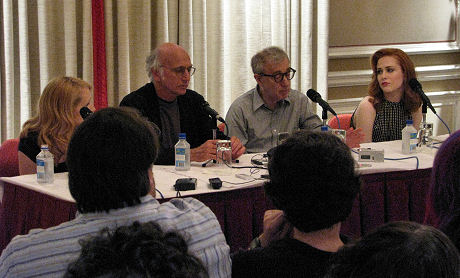
The Whatever Works team — director-writer Woody Allen, costars Larry David, Evan Rachel Wood and Patricia Clarkson — held a press conference early this afternoon at the Hotel Regency. Here’s an mp3 of the whole thing. A good thing, several laughs, time well spent.
Allen, typically candid and clever and self-deprecating, got the biggest laughs. David amused here and there but was mainly plain-spoken. Clarkson got off a few good ones. Wood looked very uptown and older than her 22 years with reddish swept-back hair — Suzie Parker circa 1958.
I asked a slightly off-center question about how much of the humor and dialogue felt misanthropic when I first saw Whatever Works a few weeks ago, particularly in the way Allen views folks from the hinterlands, but that two recent political murders by right-wing loonies had made the film seems less misanthropic on a certain level. Woody got a good laugh when he answered that he’s “against murders,” but then he went with the thought and riffed a bit about what a horrific and threatening place the world seems to be on a daily basis.
“Think of that one scene in Hannah and Her Sisters when Max Von Sydow, playing a cynical painter, rails against money-mad Christian preachers, and then multiply it 100 times and then make it a bit meaner,” I said in my 4.22 review, trying to sum up the film.
“But what the characters say and finally do in Whatever Works isn’t cause for anyone’s misanthropy. The story is about people changing and adapting and going with the flow, and it ends on a gracious and generous note.”
(I. to r.) Patricia Clarkson, Larry David, Woody Allen, Evan Rachel Wood — Thursday, 6.11, 2:10 pm.
In a piece that alludes to areas of discomfort in the gay community about Sacha Baron Cohen‘s Bruno (Universal 7.10), Matt Drudgewrites that the N.Y. TimesBrooks Barnes “is planning to go thousands of words on the societal implications of it all.”
I’ve been told that story about Stephen Sommers‘ removal from G.I. Joe: The Rise of Cobra (Paramount 8.7) isn’t far from the truth and at least deserves a read. It comes from a guy named “End Times.” He posted the account last night on Don Murphy’s site. [Note: story was removed yesterday morning.]
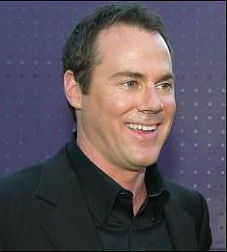
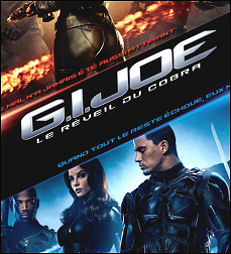
G.I. Joe director Stephen Sommers; French poster art
My source says Sommers “was given total freedom but he melted down and has made the biggest bomb in many a moon. Paramount production chief Brad Weston is looking to bail and work for Peter Chernin with Star Trek as his coda because G.I. Joe will decimate the Paramount team and lead to many, many scapegoats.”
“After a test screening [of G.I. Joe: The Rise of Cobra] in which the film got the lowest test score ever from an audience in the history of Paramount, the executive who pushed for the movie — Brad Weston — had Stephen Sommers, the superhack director of the film, fired. Removed. Locked out of the editing room.” Wells comment: How does this guy know what Paramount’s test-scoring history is? Does he have all the stats? If so, how did he get them?
“Stuart Baird, a renowned fixer editor, was brought it to try to see if G.I. Joe could be made releasable. Meanwhile producer Lorenzo di Bonaventura, whose turkey Imagine That (also championed by Weston) explodes this weekend as the new bomb in theatres, was told his services were no longer needed on the film either.” Wells comment: Someone needs to call around and verify and round this out.
“Sommers was then forced by his William Morris agents to pretend that he was working on Tarzan over at Warner Brothers, doing design work, even though that film doesn’t even have a good script yet. When word of the firing started to be whispered about in Hollywood, Sommers was summoned back to the editing room but merely to save appearances. Baird is still re-editing the movie with studio input.
“Hasbro CEO Brian Goldner, who turned down other offers from the property to go with the script that was rushed out in eight weeks by Stuart Beattie (i.e., because of the writer’s strike), is frantic that the Sommers-created debacle will destroy the brand and is now distancing himself from the pending catastophe.
“None of this needed to happen. The problem is that someone did not know the mythology. Lorenzo di Bonaventura was in charge of the film and never contradicted Sommers on anything. Lorenzo, so you know, was previously a senior Warners honcho and had GI Joe under option there (not as a producer) for seven years and he refused to greenlight the film, stating that because he grew up in Italy he had no knowledge of it.
“If you google enough, at one point you will see he wanted the film to be about an action hero named Mann (Action Man…got it) and he clearly had no clue what the GI Joe world really was.
“And the hapless hack Sommers? Where did he come from? The confused Jon Fogelman at William Morris, who signed Hasbro away from CAA, had to find a director in a hurry for his new clients and gave [Paramount] the only guy who he repped who would do it. A sad end to what could have been a great franchise. Acceleration suits indeed.”
Update: Movieline‘s Kyle Buchananposted a followup a few hours ago, the gist saying that “sources” have told him that Sommers is still on the film.
So I got in touch with my guy and here’s what he said: “The bottom line is that you don’t read stuff like this about a film that’s working. The bad buzz around G.I. Joe has been swirling around for a long time. The studio knows it’s a bomb and is trying to mitigate the disaster.
“Sommers’ complete autonomy got them into this mess, but he doesn’t have it anymore. He was petulant and demanding throughout the production and got his way at every turn, until now. This isn’t about his final cut nor anyone’s respective ‘vision’ as they’re now mightily endeavoring to get a version of this film together that’s releasable and can get the biggest opening possible.
“One person at Paramount said it’s the weakest major release since Escape From L.A. Any hopes for a new tentpole are completely gone.”