Here’s the initial Synecdoche, New York review I posted on the morning of 5.26.08 (which read as 5.25.08 by the Los Angeles clock):
There’s no way around saying that Charlie Kaufman, the director-writer of Synecdoche, New York, is a gloom-head. A brilliant and, in his past screenplays, hilarious one (by the standards of dryly perverse humor), but a gloom-head all the same. Who, for now, has put aside his sense of humor. The problem with his film, which I loved in portions, understood the point of and was intrigued and somewhat amused by in the early rounds, is the damn moroseness of it.
And the title is impossible. I would actually say commercially suicidal. I finally learned how to pronounce the damn thing — Syn-ECK-duh-kee — but if the folks who wind up distributing believe that average moviegoers are going to do anything but run in the opposite direction when this puppy opens, they’d best think again. Titles should always convey something that your average dumbass can understand — this one doesn’t. And they sure as shit can’t be tongue-twisters on top of this.
I nonetheless said to myself during the first 50 minutes or so, “This is my kind of deal.” Okay, maybe into the first hour. Smart-guy material, wise and witty, at times almost elevating, at times surreal, performances that strike the chords just so.
But it began to wear me down. I could feel my interest ebbing. This had something (okay, a lot) to do with the archness and obsessiveness of the characters caught up in various fickle head trips and never saying “uncle.” I didn’t hate what was going on — it’s an imaginative Alice in Wonderland-type thing — but I found myself wishing nonetheless that all these dithering neurotics (Caden especially) would get over themselves and…I don’t know, go rob a bank or move to rural China or something. The story tension in Synecdoche, New York is zilch.
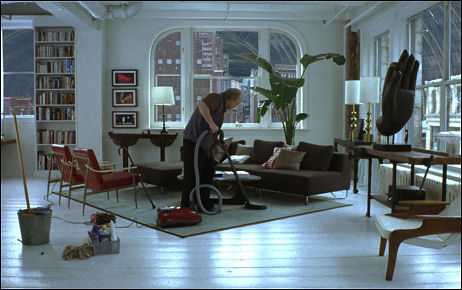
And later with the shots of pink urine and bloody stools sitting in the toilet. I don’t care how lame this makes me sound, but I’ll put up with no more than one human waste shot in a film. Here there are three.
Kaufman doesn’t do “comedies,” per se, but he should have (and could have, if he were so inclined) made it all funnier. And a bit shorter. In the realm of, say, 110 minutes rather than the 124-minute version shown in Cannes.
This might sound like a thoughtless suggestion for a film that follows its characters for a good 30 or more years, staying with them into old age and serious decreptitude. I only know that for all the rich ideas and fully worked-out totality of it, for me it started to drag big-time.
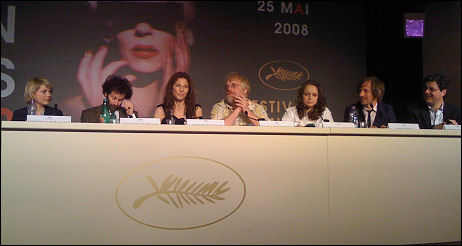
Kaufman said at the post-screening press conference that he began writing it in response to feelings of oncoming decay and death. That’s what 49 year-old gloom-heads do, I guess. They’re most likely looking at another 35 to 40 years of life, if not more, but they feel threatened about the depletion of the organism and the curtain coming down.
The shorthand buzz before Friday’s screening was “quality material, tough sit.” I was intrigued and semi-into what it was doing, but I didn’t and couldn’t submit like Kaufman wanted me to. That said, it’s certainly worth a tumble. Only two hours and four minutes of your time, and a promise of at least some satisfaction.
I was especially wowed by a sermon scene that happens sometime in the last third. It’s just some young bearded clerical letting go with the gospel according to Kaufman (we live in a gloomy, fearful universe), but the way it was written and performed made me feel alive and re-engaged.
After the press conference I asked Kaufman and producer Anthony Bregman if I could be sent a copy of this speech to give HE readers a taste of what’s really good and special about the film. Kaufman passed me along to Bregman, who said, “Do you have a card?” No, I’m cardless, I said, but you can easily send me the dialogue through the website. I knew then and there I’d never hear from him. If anyone has a copy of the script, please get in touch.
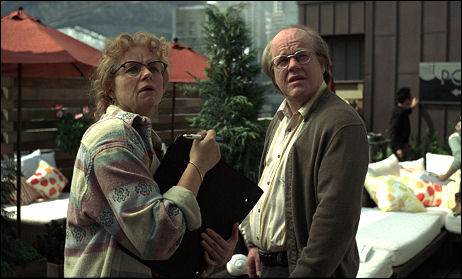
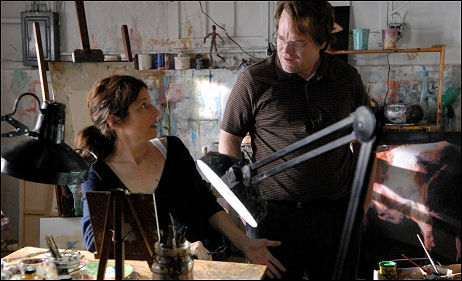
Caden (Phillip Seymour Hoffman) is a 40ish upstate New York theatre director who’s married to Adele (Catherine Keener), a successful miniaturist painter. They have a very cute little daughter (Sadie Goldstein) named Olive, who doesn’t slightly resemble either of them. Naturally.
As the story begins, Caden is becoming more and more alarmed at signs that serious diseases (or intimations of same) may be shortening his life. His marriage seems like a typical union — relatively stable, shuffling along, both parties depressed, he with a girlfriend (Samantha Morton‘s Hazel) on the side. But Adele can’t hack his gloominess. She flies Olive to a Berlin gallery showing with her friend Maria (Jennifer Jason Leigh) and never returns.
Caden soon after is handed a genius grant, and decides to stage a massive atmospheric theatre piece inside a super-hanger-sized structure that houses a scaled-down replica of Manhattan. The subject is Caden’s own life. He casts actors to play himself and all the people closest to him. So by the halfway mark there’s a duplicate Caden (played by Tommy Noonan), a duplicate Hazel (Emily Morton), a duplicate Lucy (an actress character initially played by Michelle Williams) and so on.
Caden rehearses and rewrites for years on end, but the piece is never performed for the public. They wouldn’t get what’s going on anyway, right? Keep things hermetic. Process is all. But there I was watching it, realizing after a time that there was no escape from the hangar, and wishing more and more that something else would happen. A visitor who isn’t in the play upsetting the apple cart, say. Or a 747 crashing into the hangar and blowing it all to hell.
And yet I was never exactly bored. In a way it’s a riff on Federico Fellini‘s 8 and 1/2. It’s been 45 years since that landmark film. Isn’t it good for our collective moviegoing soul to wade through such films now and then? Then why am I mostly pissing on a film made by a guy whom I’ve enjoyed and admired for many years? Because I’ve always gotten a sardonic kick from Kaufman’s screenplays, and this one took me into the Realm of the Bright but Dispiriting Bummer.
In his Synecdoche, New York review, Cinematical’s James Rocchi wrote that “there are some dreams where we awake perfectly clear as to how the pieces and parts of our nighttime vision matches up to our waking life, and there are other dreams where we simply blink, and dismiss them as nothing but crazy talk; Synecdoche, New York is more like the latter kind of dream, and that hurts the film. Its ideas are so fecund and fertile and promiscuously perverse that we’re often left with a movie too slippery to grasp with the mind and too clever to claim with the heart.”
That says it pretty well, I think.
I asked a few journalists at last Friday’s Sony Pictures Classics luncheon which film they’d rather distribute if they had to choose one or the other — Synecdoche, New York or Steven Soderbergh‘s 260-minute Che. The latter, they all said. That’s saying something.