To Be Or Not To Be

Charlie Kaufman‘s Synecdoche, New York opens limited today. But before getting into my own complex, semi-enthused, slightly tortured feelings about this undeniably interesting, densely layered film, let me quote one of the greatest opening paragraphs of a N.Y. Times film review that I’ve ever read, written by Manohla Dargis and concerning, naturally, the matter at hand:
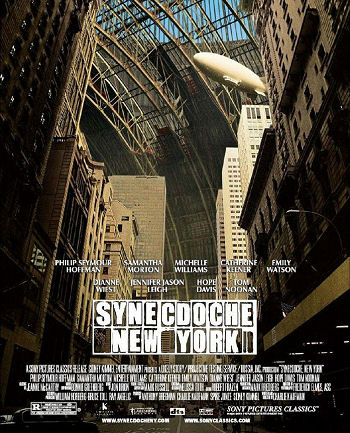
“To say that Charlie Kaufman’s Synecdoche, New York is one of the best films of the year or even one closest to my heart is such a pathetic response to its soaring ambition that I might as well pack it in right now. That at least would be an appropriate response to a film about failure, about the struggle to make your mark in a world filled with people who are more gifted, beautiful, glamorous and desirable than the rest of us — we who are crippled by narcissistic inadequacy, yes, of course, but also by real horror, by zits, flab and the cancer that we know (we know!) is eating away at us and leaving us no choice but to lie down and die.”
That, ladies and germs, is what writing can be, needs to be, should be, and damn well ought to be at times. Perhaps even often.
But back to my own reaction, which I posted on the morning of Tuesday, 5.26, or four days after I saw it in Cannes, sitting in a sixth-floor studio apartment in the Montparnasse section of Paris. It was a partly…okay, 60% negative response, but I didn’t intend to come down on the film in a scolding way, given that I enjoyed and even relished it in many respects.
To illustrate this point, here are three graphs (composed of this and that sentence rescrambled for maximum effect) from the original review:

Untitled from Hollywood Elsewhere on Vimeo
“I loved it in portions, understood the point of it, and was intrigued and somewhat amused by in the early rounds. An imaginative Alice in Wonderland-type thing, it has rich ideas and a certain fully worked-out totality. It is clearly smart-guy material, wise and witty, at times almost elevating, at times surreal, and with performances that strike the chords just so.
“I was especially wowed by a sermon scene that happens sometime in the last third. It’s just some young bearded clerical letting go with the gospel according to Kaufman (we live in a gloomy, fearful universe), but the way it was written and performed made me feel alive and re-engaged. It encapsulates what’s really good and special about the film.
“I was never exactly bored. In a way it’s a riff on Federico Fellini‘s 8 and 1/2. It’s been 45 years since that landmark film. Isn’t it good for our collective moviegoing soul to wade through such films now and then?”
I’m basically saying I feel badly about having slammed it, given that I admire Kaufman and feel roused by Synecdoche‘s ambition. But I need to disagree with a claim made in Dargis’s final graph, to wit:
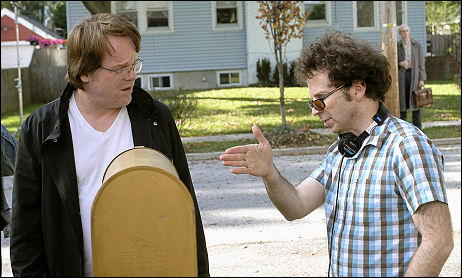
“Despite its slippery way with time and space and narrative and Mr. Kaufman’s controlled grasp of the medium, Synecdoche, New York is as much a cry from the heart as it is an assertion of creative consciousness. It’s extravagantly conceptual but also tethered to the here and now, which is why, for all its flights of fancy, worlds within worlds and agonies upon agonies, it comes down hard for living in the world with real, breathing, embracing bodies pressed against other bodies. To be here now, alive in the world as it is rather than as we imagine it to be, seems a terribly simple idea, yet it’s also the only idea worth the fuss, the anxiety of influence and all the messy rest, a lesson hard won for Caden. Life is a dream, but only for sleepers.”
Synecoche, New York did not strike me as “coming down hard for living in the world with real, breathing, embracing bodies pressed against other bodies.” It struck me as coming down hard for the beautiful obstinacy of Charlie Kaufman’s vision, which is basically that life is a flower, a miracle and a banquet all in one, but that we’re all nonetheless fucked and heading for the grave.
Kaufman has said again and again that this movie is about fear of death and decrepitude. In a Salon interview with Andrew O’Hehir up today, he says it thusly:
“I think as you get older you start to — I’ve always been preoccupied with issues of dying and illness. All that stuff is not new for me, but it does become more a part of my life as I get older and watch people I know die and get sick. It’s a real thing and it’s a universal thing. No matter where you are in your life, it dictates your decisions.
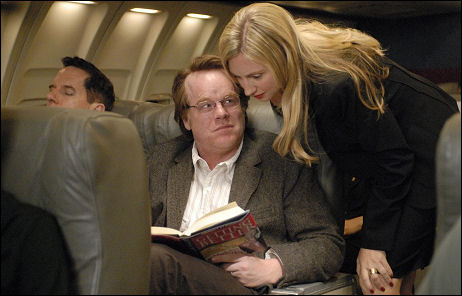

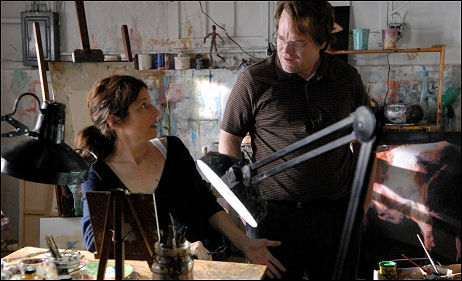
Hoffman, Hope Davis

“I know that as a very young child, I was afraid of death. Many children become aware of the notion of death early and it can be a very troubling thing. We’re all in this continuum: I’m this age now, and if I live long enough I’ll be that age. I was 20 once, I was 10, I was 4. People who are 20 now will be 50 one day. They don’t know that! They know it in the abstract, but they don’t know it. I’d like them to know it, because I think it gives you compassion.”
All that is well and good, but does this sound like a guy who in the final analysis believes in and swears by the primal simplicity and transcendence of bodies and souls hungrily entwined?
Way Back When

Here’s the initial Synecdoche, New York review I posted on the morning of 5.26.08 (which read as 5.25.08 by the Los Angeles clock):

There’s no way around saying that Charlie Kaufman, the director-writer of Synecdoche, New York, is a gloom-head. A brilliant and, in his past screenplays, hilarious one (by the standards of dryly perverse humor), but a gloom-head all the same. Who, for now, has put aside his sense of humor. The problem with his film, which I loved in portions, understood the point of and was intrigued and somewhat amused by in the early rounds, is the damn moroseness of it.
And the title is impossible. I would actually say commercially suicidal. I finally learned how to pronounce the damn thing — Syn-ECK-duh-kee — but if the folks who wind up distributing believe that average moviegoers are going to do anything but run in the opposite direction when this puppy opens, they’d best think again. Titles should always convey something that your average dumbass can understand — this one doesn’t. And they sure as shit can’t be tongue-twisters on top of this.
I nonetheless said to myself during the first 50 minutes or so, “This is my kind of deal.” Okay, maybe into the first hour. Smart-guy material, wise and witty, at times almost elevating, at times surreal, performances that strike the chords just so.
But it began to wear me down. I could feel my interest ebbing. This had something (okay, a lot) to do with the archness and obsessiveness of the characters caught up in various fickle head trips and never saying “uncle.” I didn’t hate what was going on — it’s an imaginative Alice in Wonderland-type thing — but I found myself wishing nonetheless that all these dithering neurotics (Caden especially) would get over themselves and…I don’t know, go rob a bank or move to rural China or something. The story tension in Synecdoche, New York is zilch.

And later with the shots of pink urine and bloody stools sitting in the toilet. I don’t care how lame this makes me sound, but I’ll put up with no more than one human waste shot in a film. Here there are three.
Kaufman doesn’t do “comedies,” per se, but he should have (and could have, if he were so inclined) made it all funnier. And a bit shorter. In the realm of, say, 110 minutes rather than the 124-minute version shown in Cannes.
This might sound like a thoughtless suggestion for a film that follows its characters for a good 30 or more years, staying with them into old age and serious decreptitude. I only know that for all the rich ideas and fully worked-out totality of it, for me it started to drag big-time.
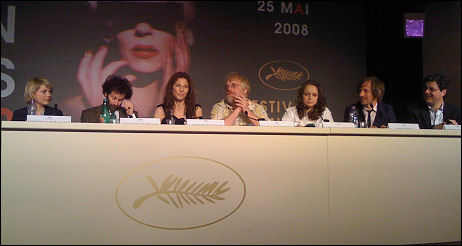
Kaufman said at the post-screening press conference that he began writing it in response to feelings of oncoming decay and death. That’s what 49 year-old gloom-heads do, I guess. They’re most likely looking at another 35 to 40 years of life, if not more, but they feel threatened about the depletion of the organism and the curtain coming down.
The shorthand buzz before Friday’s screening was “quality material, tough sit.” I was intrigued and semi-into what it was doing, but I didn’t and couldn’t submit like Kaufman wanted me to. That said, it’s certainly worth a tumble. Only two hours and four minutes of your time, and a promise of at least some satisfaction.
I was especially wowed by a sermon scene that happens sometime in the last third. It’s just some young bearded clerical letting go with the gospel according to Kaufman (we live in a gloomy, fearful universe), but the way it was written and performed made me feel alive and re-engaged.
After the press conference I asked Kaufman and producer Anthony Bregman if I could be sent a copy of this speech to give HE readers a taste of what’s really good and special about the film. Kaufman passed me along to Bregman, who said, “Do you have a card?” No, I’m cardless, I said, but you can easily send me the dialogue through the website. I knew then and there I’d never hear from him. If anyone has a copy of the script, please get in touch.

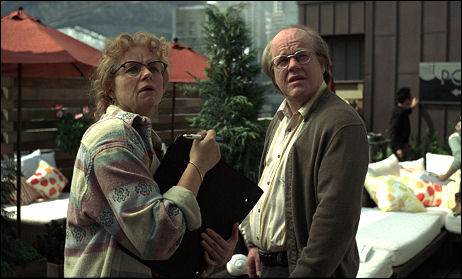
Caden (Phillip Seymour Hoffman) is a 40ish upstate New York theatre director who’s married to Adele (Catherine Keener), a successful miniaturist painter. They have a very cute little daughter (Sadie Goldstein) named Olive, who doesn’t slightly resemble either of them. Naturally.
As the story begins, Caden is becoming more and more alarmed at signs that serious diseases (or intimations of same) may be shortening his life. His marriage seems like a typical union — relatively stable, shuffling along, both parties depressed, he with a girlfriend (Samantha Morton‘s Hazel) on the side. But Adele can’t hack his gloominess. She flies Olive to a Berlin gallery showing with her friend Maria (Jennifer Jason Leigh) and never returns.
Caden soon after is handed a genius grant, and decides to stage a massive atmospheric theatre piece inside a super-hanger-sized structure that houses a scaled-down replica of Manhattan. The subject is Caden’s own life. He casts actors to play himself and all the people closest to him. So by the halfway mark there’s a duplicate Caden (played by Tommy Noonan), a duplicate Hazel (Emily Morton), a duplicate Lucy (an actress character initially played by Michelle Williams) and so on.
Caden rehearses and rewrites for years on end, but the piece is never performed for the public. They wouldn’t get what’s going on anyway, right? Keep things hermetic. Process is all. But there I was watching it, realizing after a time that there was no escape from the hangar, and wishing more and more that something else would happen. A visitor who isn’t in the play upsetting the apple cart, say. Or a 747 crashing into the hangar and blowing it all to hell.

And yet I was never exactly bored. In a way it’s a riff on Federico Fellini‘s 8 and 1/2. It’s been 45 years since that landmark film. Isn’t it good for our collective moviegoing soul to wade through such films now and then? Then why am I mostly pissing on a film made by a guy whom I’ve enjoyed and admired for many years? Because I’ve always gotten a sardonic kick from Kaufman’s screenplays, and this one took me into the Realm of the Bright but Dispiriting Bummer.
In his Synecdoche, New York review, Cinematical’s James Rocchi wrote that “there are some dreams where we awake perfectly clear as to how the pieces and parts of our nighttime vision matches up to our waking life, and there are other dreams where we simply blink, and dismiss them as nothing but crazy talk; Synecdoche, New York is more like the latter kind of dream, and that hurts the film. Its ideas are so fecund and fertile and promiscuously perverse that we’re often left with a movie too slippery to grasp with the mind and too clever to claim with the heart.”
That says it pretty well, I think.
I asked a few journalists at last Friday’s Sony Pictures Classics luncheon which film they’d rather distribute if they had to choose one or the other — Synecdoche, New York or Steven Soderbergh‘s 260-minute Che. The latter, they all said. That’s saying something.

Not An Onion Parody

Variety‘s Michael Fleming and Elsa Keslassy are reporting with apparent seriousness that Steven Soderbergh intends to direct a $30 million 3-D rock musical about Cleopatra with Catherine Zeta-Jones in the title role and Hugh Jackman as Marc Antony.
Financing and distribution deals are being shopped “over the next two weeks” by producers Greg Jacobs and Casey Silver. (Some kind of drop-dead, do-or-die window of opportunity?) The music has been written by the defunct indie rock band Guided by Voices (formed in ’83, disbanded in ’04), and the script is by James Greer, a former bass player for the band and an author.
It seems a bit much, no? Domestic Bollywood, emotionally excessive, flirting with ick. Maybe that’s the “point.” The gaudier and more Technicolor 3-D lurid in a take-no-prisoners sense, the better.

A Bit Sad

I’ve always loved the political term “dead cat bounce” — i.e., a poll bounce that happens once, slightly, and then goes nowhere. It’s one of the minor regret issues of my life that I’ve never had a chance to use it in a sentence in this column or in anything else I’ve written. Not in a way that felt right. You can’t just plop a term into a sentence. It has to happen of its own volition.

Nothing Definitive

Patrick Goldstein posted a belief/suspicion two days ago that “the days of Focus Features are numbered.” For what it’s worth, I’ve been told by a reliable fellow that this simply isn’t true. Now and for the foreseeable future, he meant.
Goldstein suspects that “Universal will probably say, for now, that it’s committed to Focus’ survival. That’s because the company is about to launch Milk, its big end-of-the-year Oscar movie, whose campaign would be undermined if Focus looked like a lame duck. Expect Universal to wait until next spring, after Oscar season is over, before quietly announcing layoffs, signaling that Focus, like Paramount Vantage before it, will remain a label, but without its own marketing and distribution.”

Face It

I’ve come to the bitter conclusion that I’m better off with fake plants than live ones. Because I can’t seem to bring myself to care for the live ones in the right way. Too much water, not enough water or watered too infrequently, not enough light, too much light. I’ve lost count of the number of plants that have died slow terrible deaths in my home. The word has gone out among all the plants in all the plant shops in Los Angeles. If that Wells guy buys you and takes you home, it’s like going to the gas chamber.

Hot Frosty Blondes

In Janet Maslin‘s 10.22 N.Y. Times review of Spellbound by Beauty: Alfred Hitchcock and His Leading Ladies (Harmony, 10.28), she paraphrases author Donald Spoto‘s view that “no understanding of the director’s career can be complete without the dark side, and that great art need not correspond with saintly behavior.

“And [Spoto] suggests that this book be read as ‘a cautionary tale of what can go wrong in any life.’ After all, ‘it is the story of a man so unhappy, so full of self-loathing, so lonely and friendless, that his satisfactions came as much from asserting power as from spinning fantasies and acquiring wealth.’ By the time Hitchcock imploded with Tippi Hedren [during the making of The Birds and Marnie], the craving for such power had stifled the creative vitality of his work.”
It’s absolutely true that Hitchcock’s downslide began right after The Birds (’63) and stayed in a downswirl mode until the end, despite the view in some quarters that he resurged with 1972’s Frenzy. (Has anyone watched this film lately? It’s brave and adventurous with two or three standout sequences, but at the same time much of it is tedious and meandering and seriously lacking in story tension. And certain portions of Anthony Shaffer‘s dialogue are dreadful.)
What Spoto’s book seems to be saying, going by Maslin’s assessment (and I would say this is true in most walks of life), is that if you’re living a life afflicted by sexual or emotional repression sooner or later it’s going to negatively affect your productivity or creativity. This was Hitchcock, all right. By all indications he had no sex life at all for decades. According to Spoto nothing happened with his wife Alma except for one incident. (Good God!) So he poured all his sensual appetites into power, wealth, travel, good food, etc. And quietly lusting after his actresses in differing ways