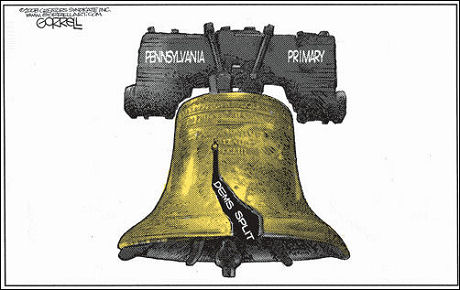
The time has come for Barack Obama to throw Reverend Jeremiah Wright under the bus and walk away and wash his hands. Wright is an arrogant egotist and — I’m sorry but it’s true — a major asshole who doesn’t give a damn about Obama’s presidential candidacy. If he did he would never have succumbed to the ego stroke of a Bill Moyers Journal interview and said what he said, which is that — in Wright’s own words! — Obama is a politician who feels or believes one thing and says another.
“He’s a politician, I am a pastor,” Wright tells Moyers. “We speak to two different audiences. He said what he had to say as a politician, I say what I have to say as a pastor. [We’re speaking to] two different worlds. I do what I do, he does what politicians do. What happened in Philadelphia [referring to Obama’s great speech], he had to respond to the soundbites, and he responded as a politician.”
This it. The man is incorrigible. A menace. Obama has to slap him down and cut him off cold and say so. If he doesn’t do this within 24 to 48 hours, he’s in real trouble. He can’t pussyfoot around. Do this or die. Cut all ties. Renounce. This is a personal betrayal. A friend who supports Obama told me an hour ago, “If he doesn’t do this, he doesn’t deserve to win.” I wouldn’t go that far, but sometimes being hard and strong is the only thing that will do.
Urman Rules
Mark Urman has been named president of ThinkFilm, replacing the recently departed Jeff Sackman. (What’s the story behind this, I wonder? There’s always a story.) A co-founder of the company, Urman had been chief of theatrical distribution since the company’s launch in September of 2001. Urman will continue to work out of the company’s New York City offices, which is the new ground zero. Congratulations to a very bright and shrewd fellow.
Del Toro Will Hobbit
The totally expected deal for Guillermo del Toro to direct The Hobbit in two parts has been signed, sealed and delivered. It’ll be a New Line-MGM joint production that will eat up four years of Del Toro’s life. Obviously a good gig, obviously an excellent choice, and congratulations to a beautiful human being on a very fine score.
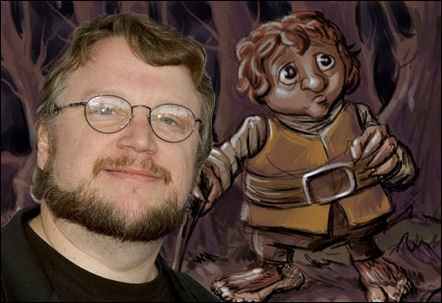
But if you ask me there’s a downside to this deal. It means that Del Toro, a truly gifted director with the power to be a 21st Century Luis Bunuel or better, won’t be making any adult-market, real-world-grappling, artistic-growth movies in the vein of Pan’s Labyrinth and The Devil’s Backbone for a long, lonnng time. He’ll be Hobbit-ing until at least 2012 and probably into 2013.
Del Toro’s will be moving to New Zealand for the next four years to work with Peter Jackson — arrghhh! — and his Wingnut and WETA production teams. The two films will be directed back to back, with the sequel which will deal with the 60-year period between The Hobbit and The Fellowship of the Ring, the first of the Lord of the Rings trilogy.
Decisiveness
Because four guys working for Quantum of Solace, the currently rolling James Bond film, suffered three accidents over a five-day period — the Aston Martin accident last Saturday, another car accident on Monday, and a third one yesterday involving a near-fatality — the producers have shut down production?
Why — to wait for the curse to lift? To give the producers time to bring in a Catholic exorcist? Either the drivers were drinking, they don’t know how to drive, or it’s just bad luck. If guys are getting into car accidents and you want to “do” something about it, doesn’t it make sense to go to the guy who hired them and cut him loose? Fire this person and at least you’ve “done” something …even it it doesn’t seem to make much sense. But you don’t shut down the shoot.
This reminds me an incident during my tenure as manager of the Carnegie Hall Cinema in ’78. My boss was the late Sid Geffen, known affectionately in New York exhibition circles as an eccentric fellow. One day the ticket-seller, a pretty woman in her 20s, was held up while sitting inside the street-level booth. Terrified, she passed whatever money she had to the thief, slipping it through the slot. Two days later the same thief came back and robbed her again. Sid’s response was to fire the ticket-seller. He figured she was either a jinx or in on the deal. Either way Sid has “done” something about the problem. The person who replaced the girl, by the way, never got hit.
This reminds me of another Sid Geffen employee-relations story. Sid was a gifted b.s. artist who liked to use high-falutin’ blah-blah to mask his basic agenda. One day he called an employee into his office and said, “I’ve come to realize that I’m holding you back…I’m standing in your way…I’m keeping you from the progress you need to make in your life.” The guy listened for three or four minutes and said, “So Sid…you’re firing me, right?” Geffen was adamant. “No,” he said, “I’m graduating you!”
Open and Shut
Deception isn’t very good and will probably tank ($5 million give or take) when it opens this weekend, but 20th Century Fox is releasing it anyway it was produced by and costars Hugh Jackman, with whom the studio has a good relationship with a future (X-Men Origins: Wolverine, Australia). This, in a sentence, is the gist of John Horn’s 4.24 L.A. TImes story about this unfortunate (for audiences) dynamic.
One Out of Four
I’m commenting on this 4.24 New York “Vulture” piece about “Which Superhero Movie Will Suck?” because the art they created for it looks cool and I wanted a reason to re-size and re-post. Otherwise I would have ignored the post altogether. Nobody has any reason to believe that Ironman, The Dark Knight or Hellboy 2 are going to be problematic. At all. Not a whiff. A 75% dead story.
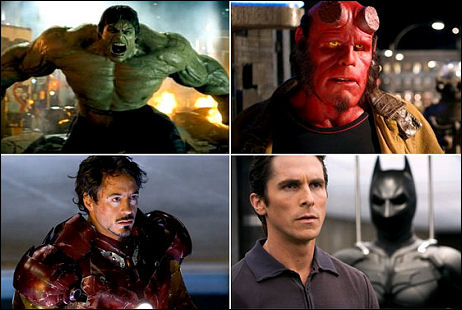
The word on Ironman so far has been strong, and there’s no reason to even intuit that Chris Nolan and Guillermo del Toro might not deliver in their usual rich-feast, intense undercurrent way. Only The Incredible Hulk has, according to general buzz, a semblance of Cecil B. DemIlle-like storm clouds swirling above. But nice collage!
Nice Shrug
Except for the cartoonish, over-the-top CG, I don’t have a problem with this Hancock tailer. So I don’t get the disdain and skepticism voiced yesterday by the New York “Vulture” guys. As long as the story is tight and the other basics (acting, dialogue, character, attitude) are nicely finessed, there’s a place (even in my sometimes sour universe) for good, empty, rambunctious fun by way of Will Smith, Charlize Theron and director Peter Berg.
Hancock (Sony) opens on 7.2.08 — a nice long holiday weekend, and a good empty fit. It could, as EW has predicted, become the summer’s third highest-grossing film, and perhaps even the second-highest, as I’m wondering for some reason about the legs of Prince Caspian. The only problem I’m sensing…. naah, leave it alone. Okay, I’ll mention it — the TV credits of the two screenwriters, Vincent Ngo and Vince Gilligan, are less than encouraging.
Back To This
This spirited exchange between Vanity Fair Daily‘s Elizabeth Hurlbut and MCN’s David Poland about repeated schlong exposures in Judd Apatow movies — and particularly Jason Segel’s trifecta in Forgetting Sarah Marshall — is the most thoughtful and fully-considered exploration I’ve read anywhere.
HE regulars are sick of my posts about Segel’s physicality, but I may as well remind everyone that there’s a reason why Terry Southern sometimes used the term “gross animal member.” Wang shots are tolerable, depending, as always, on the how and why. My problem with Segel’s Marshall displays arose because I was simultaneously forced to contemplate his Michelle Pfeiffer-sized man-boobs. A double whammy.
Repulsion
For Republicans out to smear Barack Obama, no tactic is too low or slimey, as Floyd Brown‘s new Willie Horton ad attests. Brown created the original Horton ad that was credited with being one of the two big things that sank Michael Dukakis‘s candidacy in 1988. (The other was the video of Dukakis riding in that army tank wearing a Rocky-the-squirrel helmet.)
Return of Skolimowski
Jerzy Skolimowski‘s Four Nights With Anna will have its world premiere in Cannes as the opening film of the 40th Directors’ Fortnight showcase, according to Variety‘s John Hopewell.
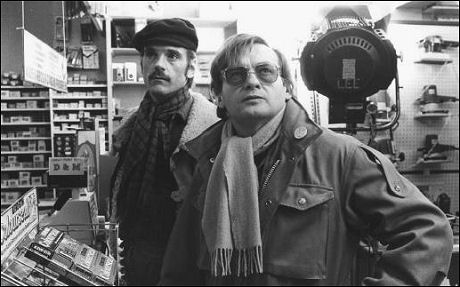
Oddly (or perhaps not so), the IMDB doesn’t even list Anna on Skolimowski’s page (although it does list an ’08 project called America, a period drama written by Eyes Wide Shut‘s Frederic Raphael that’s based on a Susan Sontag work).
The Polish-born Skolimowski will turn 70 on May 5th. I will always revere his direction of Deep End (’71), The Shout (’78) and particularly Moonlighting (’82), which I saw at the New York Film Festival in September 1982. For me the world is divided into two camps — those who immediately think of Bruce Willis and Cybil Shepherd when they hear Moonlighting, and those who think of Skolimowksi and Jeremy Irons. At best, we’re talking about a 98% to 2% split.
Everyone regarded Skolimowski as a world-class helmer back in the day. (Not that he’s less admired now.) I was honored to interview him at the Algonquin Hotel just prior to Moonlighting‘s commercial debut. Things slowed down for him in the ’90s, but he’s been acting in recent years in films such as Eastern Promises, Before Night Falls, L.A. Without a Map and Mars Attacks!
Four Nights With Anna, which costars Polish actors Kinga Preis and Artur Steranko, is described as “a tale of amour fou, chronicling one man’s voyeuristic relationship with a woman as it evolves over four days.” That’s Skolimowski, all right — always the sensualist.
The full Directors’ Fortnight’s program will be announced Friday. Vareity’s speculation about the lineup includes Hunger, about IRA hunger striker Bobby Sands from British helmer Steve McQueen; and Francesco Munzi‘s Il resto della notte, an immigration phobia drama set in Italy’s wealthy northeast region.
Other titles being talked up are Acne, from Uruguay’s Federico Veiroz; Tony Manero from Chile’s Pablo Larrain (about “a serial killer obsessed with John Travolta’s Saturday Night Fever character), Argentine dierctor Lisandro Alonso’s Liverpool, Catalan Albert Serra’s El cant dels ocells, Radu Muntean’s Boogie and Claire Simon‘s Les Bureaux de Dieu, described as a “potentially polemical” French abortion doc.
Can Speed Racer Be Saved?
The marketing team for Speed Racer (Warner Bros. 5.9) is facing an ironic challenge. It’s basically “a kid’s movie,” as a critic friend recently confided, but the tracking, according to Fantasy Moguls’ Steve Mason, says the biggest interest levels so far are with the over-25 crowd who grew up on the animated versions in various media.

There is therefore “every reason for Warner Bros to be concerned” about the Wachowski Brothers latest, Mason writes. Total awareness is at 77%, but un-aided awareness is sitting at a mere 5% and definite interest is only at 29% — certainly an issue of concern. As Mason points out, even 20th Century Fox’s What Happens in Vegas, another 5.9 opener that feels to me like a whatever thing, is doing better on this score.
Kids never show up on tracking very strongly, of course, but Speed Racer is a very costly event picture that’s kicking off the summer season. It needs to generate a lot more interest among younger males over the next two weeks or the crestfall factor will be huge.
I for one am fascinated by the visual textures in this thing and therefore consider it a must-see, but I don’t count very much in the big scheme. The target audience is going to pay to see this thing or not based on the ads and trailers alone…or not.