“American Gangster” extras

For the most part, the extra 18 or 19 minutes of footage in the American Gangster Extended Cut DVD (out Tuesday) feeds right into the whole with a sense of absolute harmony. We all know what it feels like when a film has had lumps added to its stocking with “flavor” or directorial “darlings.” This is not one of those cases. This is more like the extended Bugsy or Aliens. I would have been that much happier with American Gangster if these extras had been in from the get-go.
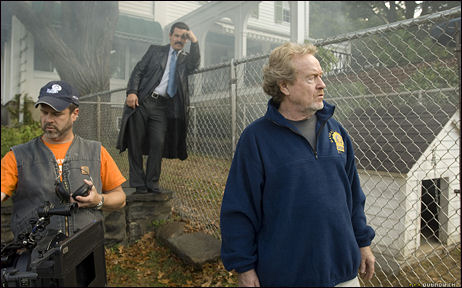

Josh Brolin (center), Ridley Scott (r.) during preparation of American Gangster‘s dog-shooting scene

The two biggest stand-outs are a “Bumpy on the beach” scene (a flashback to Denzel Washington and Clarence Williams III talking about supply and demand and the middle man out at Coney Island) and a follow/chase scene with Richie Roberts/Russell Crowe tailing a member of Frank Lucas’s gang who’s “carrying.”
One of the additional scenes seems gratuitous, but only a wee bit. I’m speaking of an extended finale after Washington gets out of prison and finds Crowe saying “welcome back” and taking him on a walk through the new Harlem. I enjoyed a line that Washington says about a trio of young hip-hoppers (“I guess you can only be young and dumb once” or something similar) that’s taken verbatim from Lucas in Marc Jacobson‘s “Return of Superfly” article. But the ending in the theatrical version is tighter, cleaner, preferred.
Disc 2, however, has an omitted alternate beginning that’s far superior to the one used in the theatrical version. Instead of a short nighttime scene with Washington setting a guy on fire and then shooting him as Williams looks on, the alternate is a blue-tinted, dialogue-free prologue in a diner (or a bar) that shows Washington walking in the front door and plugging a guy who’s just sitting there and tapping the seat of a chair with with a pair of drumsticks. The spooky, dreamlike aura gets you right off the top. I can’t imagine why Scott decided to use the other scene instead. Scott uses the last portion of this sequence at the tail-end of the extended version, after the closing credits.
Barkley Blurts

Former basketball star, NBA commentator and Barack Obama supporter Charles Barkley ripped into “fake [Republican] Christians” on CNN this morning for their judgmental views about gays and other groups and beliefs deemed to be in defiance of Christian values. No argument here — intolerant religious purists are cut from the same cloth the world over, be they American or Middle Eastern — but Barkley is probably going to get a “chill out and shut up” phone call from an Obama campaign official, saying “don’t rattle the Obamacans!”

“Wild Things” clip?

I don’t know how to respond to this alleged clip from Spike Jonze‘s Where The Wild Things Are, which won’t be out until 2009 (according to the IMDB).
Could it be legit? If so, I’m 90% committed to running the other way when this film comes out. A live action piece with bipeds in big animal costumes voiced by name actors (Forest Whitaker, Catherine Keener, Paul Dano, James Gandolfini, Catherine O’Hara, Lauren Ambrose)?
The clip shows a guy in a big Cheshire Cat costume talking to a kid in a white animal outfit, and then asking to be hit in the stomach with a stick. (I thought it was going to be a Harry Houdini scene with the kid hitting the cat when he’s not ready, but no.) Jonze is a respected, very sharp, avant garde-meets-commercial director but c’mon….this?
Co-produced by Legendary Pictures, Playtone and Warner Bros. and co-written by Jonze and Dave Eggers, Where The Wild Things Are is an adaptation of Maurice Sendak‘s classic children’s bok.

Rec Show Harry rant

A Rec Show rant from Ray about a recent piece by AICN’s Harry Knowles that indicates (in Ray’s view) that Harry was an HD-DVD supporter because he received free Toshiba/HD-DVD booty (including four HD-DVD players) and had only one Blu-ray player. Fairness requires a statement that Ray’s case doesn’t seem conclusive. (To me.) But I’m amused by the colorful prose in the opening graph that mentions Harry’s grandmother.

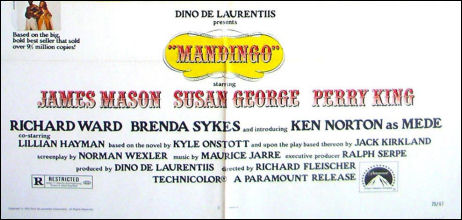
“Mandingo” revisited

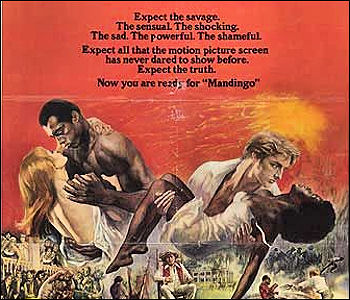
I saw Richard Fleischer‘s Mandingo with a couple of friends at one of the New York repertory cinemas (probably the Carnegie Hall or the Bleecker) in the late ’70s. Unavailable on DVD in this country, it’s a piece of rank steamy pulp about a slave (Ken Norton), slave-owners (James Mason, Perry King) and inter-racial shtupping (Susan George being a significant participant).

Mandingo had originally opened in ’75, but by the time I saw it the cool-cat revisionist attitude had settled in. It wasn’t a hoot as much as a howl — one of the most appalling sexual soap-operas ever made, but also a knowing wallow. It was a cinefile’s version of mud wrestling or Tijuana donkey sex made extra-laughable by cheap social criticism. The stamp of “produced by Dino de Laurentiis” made it all the more delicious.
I don’t remember laughing or even smirking. (Although one of my friends did.) I don’t remember it being a turn-on, even. I’ve repressed most of the experience (the mind flushes this stuff out as a kind of survival mechanism), but I do remember the repulsion. I’ve seen my share of exploitation films, but my lingering impression was of a film that truly stunk from the head and the groin.
I was young at the time, however, and I didn’t have the perspective to appreciate Mandingo‘s undercurrents. To hear it from N.Y. Times resident film-dweeb Dave Kehr, Mandingo, to be screened this coming Saturday as part of a mini-Fleischer retrospective at the annual Film Comment Selects series at Lincoln Center, is Fleischer’s “last great crime film” as well as “a thinly veiled Holocaust [parable].”
Kehr’s auteurist-revisionist view is a classic case of “believing is seeing.” Ignore the experience of the film and whatever primal reactions you may have had to it. Consider instead the director’s thematic tradition, and focus on the high-minded intent that hangs suspended above the swamp.

“When Mandingo was released, many critics erupted with rage over its aggressively tasteless portrayal of the slave-owning South,” Kehr begins, “which seems in retrospect both a desired and appropriate response. More than a portrait of social decadence, Mandingo is Fleischer’s last great crime film, in which the role of the faceless killer is played by an entire social system.
“For the French critic Jacques Lourcelles, one of Fleischer’s most articulate admirers, the recurring theme of his work is society slipping into decadence. Fleischer’s most provocative film on this theme is the still potent Mandingo from 1975 (Feb. 23, Walter Reade Theater), an anti-Gone with the Wind that treats the pre-Civil War South as a swamp of degradation for white masters and black slaves alike.
“Rattling around a tumble-down Tara of peeling plaster and near-empty rooms, James Mason (Captain Nemo in Fleischer’s children’s classic 20,000 Leagues Under the Sea) presides over a human breeding farm. He is as occupied with finding a suitable stud for his prize female slave as with finding a bride who will give his lame son (Perry King) the male heir he requires.
“The treatment of humans as so much chattel, to be bought, sold and cruelly abused regardless of their social position, makes Mandingo a thinly veiled Holocaust film that spares none of its protagonists. More than a portrait of social decadence, Mandingo is Fleischer’s last great crime film, in which the role of the faceless killer is played by an entire social system.”
DVD Availabilty Update: Pete Hammond reports he bought a DVD of Mandingo and Drum at Ameoba two years ago. The DVD distributor is Blaxfilm, he says.
Hammond says that copies are available on E-Bay.

Gallumphing Sevigny

In a piece about Chloe Sevigny‘s personally designed clothing line on view at Manhattan’s Opening Ceremony, the Guardian‘s Ryan Gilbey writes that while “the 33-year-old Sevigny is tall and slender in tight, dark jeans, black boots and baggy leather jacket, she walks with a slight galumphing awkwardness, planting her feet purposefully as she goes.

“Her face is long and elegantly pointed, offset by a formidable jaw on which you could crack open a bottle of beer. Her droopy-lidded eyes can lend her a docile vagueness, which came in handy during an early run of movies set in the white-trash hinterland (Gummo, Boys Don’t Cry, Julien Donkey-Boy), in which she played characters for whom a move to the arse end of nowhere would have represented unimaginable social promotion.”

Best Films of ’08

“Will there be a good movie this year?,” Time‘s Richard Corliss asked yesterday. “Do we have to wait till November for Hollywood to unveil the niche prestige items that it saves for Oscar consideration? Is every movie till then doomed to be aimed at the all-important 8-year-old-girl-to-14-year- old-boy demographic?
The Best Films of 2008…hands down, take ’em home, in this order: 4 Months, 3 Weeks and 2 Days, In Bruges, The Band’s Visit, Cassandra’s Dream (second-tier Woody Allen, but not at all bad with a superb Colin Farrell weak-loser performance) and — I know this sounds like a stretch — Sylvester Stallone‘s Rambo, which is one of the most stupidly exhilarating wastes of time I’ve ever paid good money to sit through.

Surprise Moments

In a 2.17 N.Y. Times piece about some especially memorable Oscar moments, Anita Gates‘ list of big surprises somehow omits Roman Polanski‘s winning the Best Director Oscar for The Pianist in ’03. That was stunning. I’ll never forget it as long as I live.
Gates recalls (1) Pollock‘s Marcia Gay Harden winning over the favored Kate Hudson for her performance in Almost Famous, (2) L.A. Confidential‘s Kim Basinger beating Titanic‘s Gloria Stuart for Best Supporting Actress, (3) Linda Hunt‘s winning the same prize for her acting in The Year of Living Dangerously, (4) The Goodbye Girl‘s Richard Dreyfuss taking the Best Actor Oscar from Equus nominee Richard Burton, (5) West Side Story‘s Rita Moreno “beating out grandes dames Lotte Lenya, Fay Bainter, Una Merkel and Judy Garland” in ’62, and (6) Cecil B. DeMille‘s The Greatest Show on Earth taking the Best Picture honor from High Noon and The Quiet Man.

Numbers

The four-day total for Jumper is projected to be roughly $28,557,000. Step Up will make about $22,846,000, The Spiderwick Chronicles will earn $20,400,000, and Fool’s Gold will take down $16,410,000, give or take.

Times Square marquees

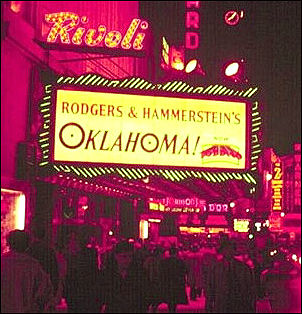
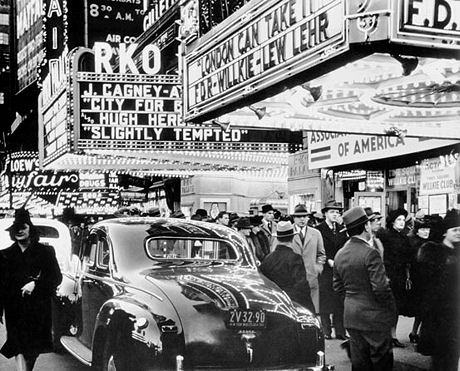
I’m a fool for photos of Times Square marquees from the ’20s onward. Color, black-and-white…anything that looks sharp and clean and well-framed. I’ve heard about a coffee-table book devoted to such photos, but if anyone knows of any websites with a good assortment or even a site with a single decent shot of any of big marquees announcing any classic film (the Astor showing On The Waterfront, King Kong at the Radio City Music Hall or the Roxy…anything like that), please inform. All I’ve been able to find so far are inky dupes like the one below.

Here’s one passed along by Edward: