Weekend numbers

It was going to be neck-and-neck between Fred Claus and American Gangster with both in the mid 20s…wrong. Claus is going to come in third with $19,463,000, and will probably end up in the $50 million range, at best, which makes it a shortfall in relation to production costs. A stumbler, a groaner…an occasion for long faces.

And they’re going to get longer next weekend. Mr. Magorium’s Emporium will be strong family-trade competition starting next weekend (11.16), and then Enchanted opens on 11.21, not to mention the Claus word-of-mouth effect. (It’s not very funny –critics despise it.) Exhibition has only two more weekends of business anyway. The over-30s start to disappear after Thanksgiving and don’t return until just before Xmas. So the big weekend box-office story is the death of Claus.

Jerry Seinfeld‘s Bee Movie has held decently and will be the weekend’s #1 film with $25,22,000 by Sunday night, give or take. American Gangster, off about 46% from last weekend, will be #2 with a little more than $25 million. Robert Redford‘s Lions for Lambs will end up with $6,667,000 — $3000 a theatre in 2200 situations.

No Country for Old Men‘s limited opening (28 theatres) will wind up with a little more that $29,000 a print, which is spectacular. Every last seat was apparently sold at every Arclight show yesterday except for the final late-night one.
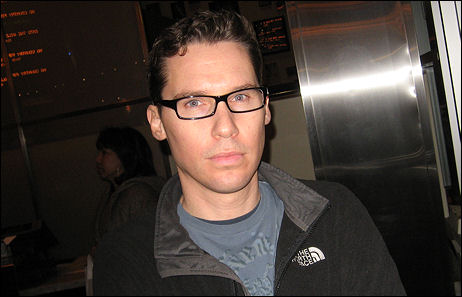
Bryan Singer at the Arclight


Valkyrie director Bryan Singer, having arrived here from Berlin only a day or two ago, in Hollywood Arclight lobby — 11.9.07, 11:35 pm. He said he’s been editing all through the Valkyrie shoot, and should have a full rough assembly within a couple of weeks. I told him I like the just-released trailer. We talked about the episode when Valkyrie was briefly denied permission to shoot at the historic Blenderblock building; Singer said he’d picked out a replacement location, but once permission was granted and they were shooting at Blenderblock he began to feel relieved they hadn’t been forced to shoot elsewhere. I’ve known Singer since ’95 — he doesn’t look a day older.

Landis, Rickles at tthe Arclight


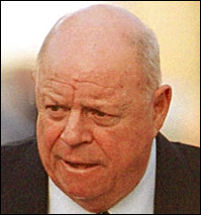
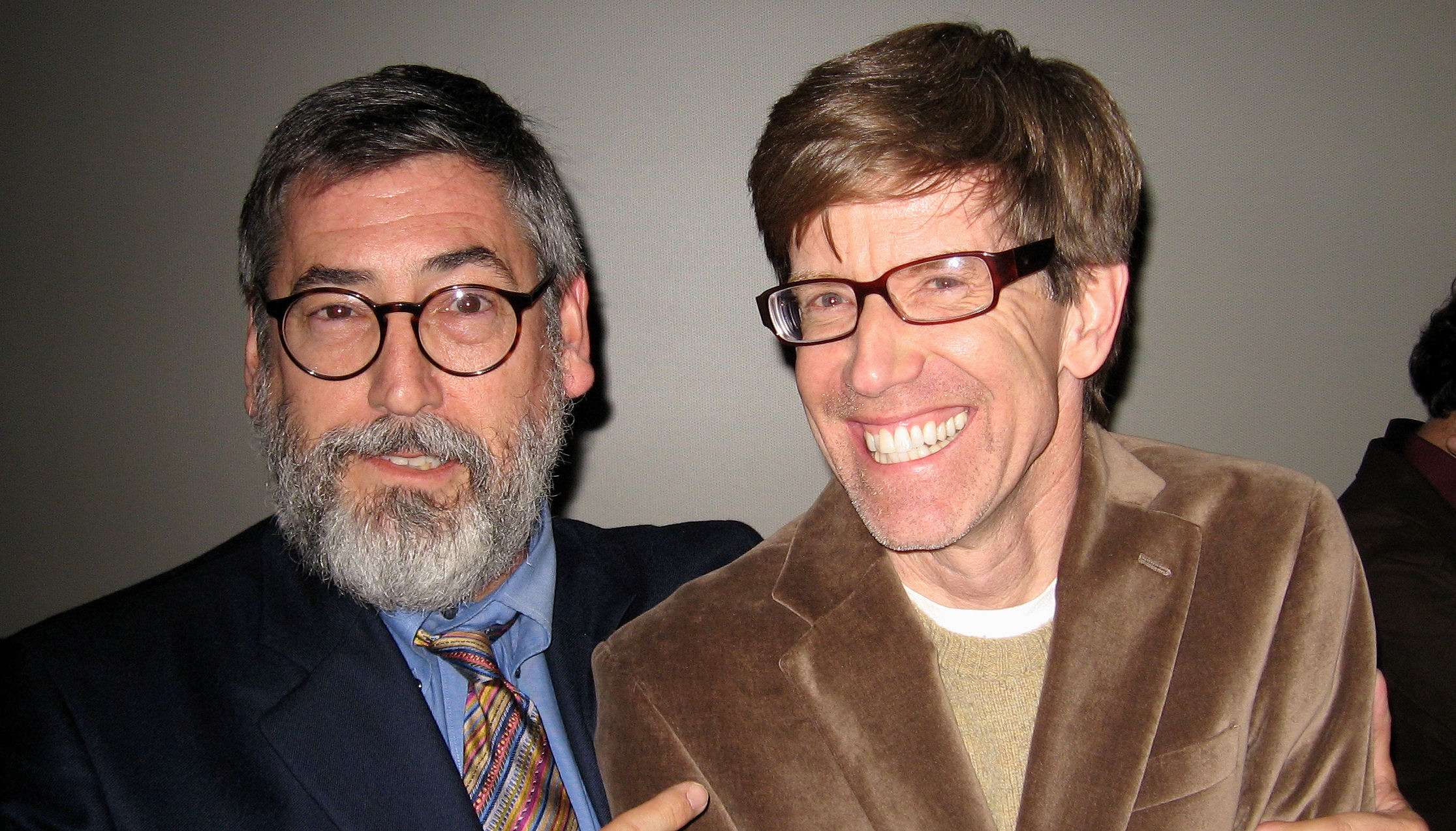
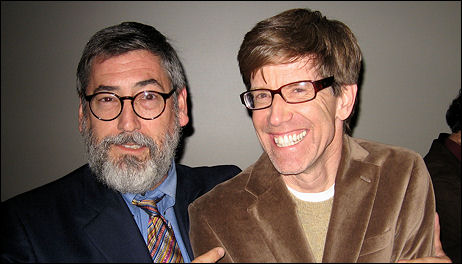
Director John Landis and friend following Friday night’s screening of Mr. Warmth, a snazzy, hilarious portrait of legendary insult comic Don Rickles, at Hollywood’s Arclight plex — 11.9.07, 11:25 pm. The 81 year-old Rickles took a bow before the screening, but was gone when the lights came up.

Remding people about “Zodiac”

It’s not a stretch, not a reach, and pretty much incontestable that David Fincher‘s Zodiac is one of the five best films of 2007. I don’t mind reminding people of this obvious fact. It’s a blazingly original, perfectly made, deeply haunting landmark film that’s not only about an obsessive search for an elusive serial killer, but has the genius to embody its own theme by being obsessive itself — an amazing synchronicity that echoes back and forth into infinity.

Ten years from now most of the films being talked up for Best Picture will on the tip of people’s tongues or flat-out forgotten, but Zodiac will be just as vivid in people’s minds as Heat is today. Naturally, of course, no one’s saying anything about it right now. I think it’s an affront to the Movie Gods that you have to rattle cages to get people to say, “Oh, yeah….Zodiac. Right. Came out last March. Great film.”

And you guys call yourselves film worshippers? Devout movie catholics? And you can’t be bothered to pay tribute to an indisputable classic — one of the greatest investigative procedurals-slash-art movies ever made?

Paramount seems to believe in Zodiac‘s Oscar potential. The Envelope‘s Pete Hammond reported yesterday that the studio “spent around $300,000 on trade ads on 10.24, including two glossy double gate-folds that added up to 8 pages of rave quotes in Variety.”

Paramount “has also sent director’s cut DVDs to hundreds of awards voters and taste-makers in addition to the film’s regular ‘For Your Consideration’ DVD to Academy members,” Hammond adds.

Rissient & Rickles

Here I am late as usual in posting stuff, but Todd McCarthy‘s Pierre Rissient: Man of Cinema — an affectionate tribute to one of the craftiest and most unapologetically fierce-minded cineastes in motion picture history — is playing at the AFI Film Fest three hours from now (at 6:30 pm). Then comes John LandisMr. Warmth, a “pretty great” documentary about Don Rickles. On top of which these guys could be separated-at-birth twins. A fairly spirited double bill with in-between time for some fast food.

“Lions for Lambs” review

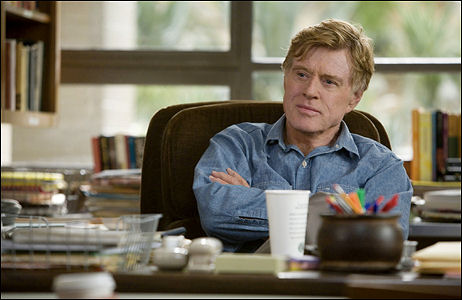
I’ve been trying to get it up for a Lions for Lambs review for several days now, and it just wouldn’t happen. The truth is that I don’t like three second-tier things about Robert Redford‘s new film — the photography, the Aghanistan mountain-range combat sequence, and the use of generic title cards — and I was trying to articulate what I feel about the first-tier aspects so as not to seem trivial. But sometimes the trivial things aren’t trivial but proverbial “blades of grass.”

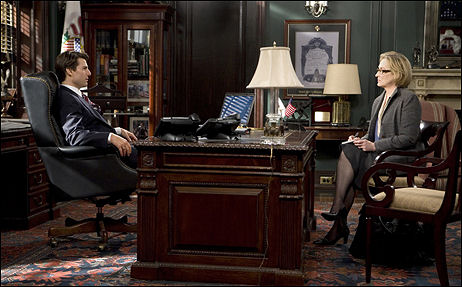
The truth is that I admire Redford’s audacity in having made such a starkly didactic film. You can’t not call it ballsy, although it’s hard not to call Lions for Lambs generally underwhelming. This is a film, after all, that is shorn of tension and visual fluidity in the service of educational “talk”. It is marginally involving, but never once alarming. much less gripping. Everyone had to know that the chances of such a film dropping dead on its opening weekend were pretty high, even with Redford, Tom Cruise and Meryl Streep topping the cast.

BEWARE: A PLOT SPOILER AWAITS FOUR GRAPHS HENCE.

The subject, as Redford’s college professor character puts it, is that “Rome is burning.” For 88 minutes the film cuts back and forth between three illustrations of this situation. One, journalists not rigorously questioning the right-wing propaganda about the manifest destiny that is driving the war on terrorism. Two, college kids not giving a shit about the enveloping tragedy of that conflict. And three, the certainty that soldiers trying to fight it out in Afghanistan are going to die in order to validate some vague neocon dream of victory.

I certainly don’t disagree with what it’s saying, and I didn’t hate watching it. But I was irritated by three things.

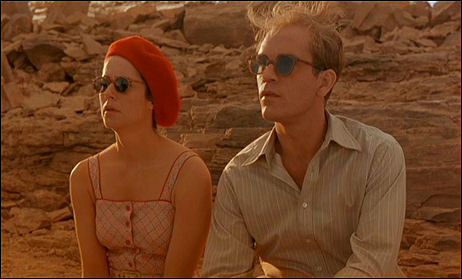
One, Philippe Rousselot‘s photography is so flat, drab and lacking in visual intrigue during the scene between Redford and Andrew Garfield that it borders on irritating. It’s so lacking in invention that it becomes hard to concentrate on what’s being said. If I were Redford I would have either made Lions for Lambs super-attractive by shooting it the way Vittorio Storaro shot Reds or The Sheltering Sky (which would obviously remove the visual irritation factor, which would allow the viewer to pay closer attention) or I would have taken the super-raw, no-frills approach that Oleg Mutu chose for 4 Months, 3 Weeks & 2 Days.


The Sheltering Sky

Two (and here comes the SLIGHT SPOILER! ), it’s hard to believe that a solder could fall from a helicopter onto rocky, snow-covered terrain on top of a mountain and just get slightly banged up. (Production designer Anton Furst killed himself by jumping off the top of a five-story parking structure.) It’s harder to believe that the fallen soldier’s best friend in the chopper, having seen him tumble out, would simply jump out of the chopper himself and hope for the best. The only way we could buy this would be if Redford showed us that the chopper is hovering, say, 20 or 30 feet above the mountain peak, but he doesn’t. On top of which enemy Afghan soldiers are shown approaching the position of these two soldiers from less than a hundred feet away, and for no discernable reason they take an awfully long time — a good half-hour — to attack.

Three, white titles explaining anything are bad enough, but there is no reason to call the university where Redford’s professor teaches a generic “California university” — it matters to absolutely no one if the school is in California or Rhode Island or Oregon or Wisconsin. And we certainly don’t care if we know the name of Redford’s character. It sounds like a small-ass thing to gripe about, but the second those titles flashed on-screen I tuned out and stayed that way for two or three minutes…until tuning out again because of Rousselot’s photography. Why create road blocks that do nothing except get in the way?

All that said, here’s a rave review from the New York Press‘s Armond White.

Lumenick’s “No Country” review

When a truly exceptional film comes along, it sometimes inspires critics to do their best writing. N.Y. Post critic Lou Lumenick is expected to keep his prose plain, unadorned and borough- friendly, which means he can’t do an A.O. Scott, an Armond White or a Lisa Schwarzbaum. But his No Country for Old Men review has exceptional conviction and a pure-of-heart quality.

NCFOM “is the first movie I’ve seen in a very long while that deserves to be called a masterpiece,” he begins. “It’s such a stunning achievement in storytelling that, when the DVD comes out, I’d wager you could even turn off the sound and hardly miss a thing. This really isn’t a movie to watch on DVD, though.

“You need as big a screen as possible to savor Roger Deakins‘ sweeping cinematography, which is as integral to the movie’s triumph as the edge-of-the-seat direction by Joel and Ethan Coen, or a trio of unforgettable performances by Javier Bardem, Josh Brolin and Tommy Lee Jones.

“Adapting (and, if you ask me, surpassing) a 2005 novel by Cormac McCarthy into their best-ever movie and their first Best Picture contender since Fargo, the Coens deliver a classic, neo-noir Western of innocence lost set in 1980 Texas.

“Jones, who gets top billing but has notably less screen time than his co-stars, has never been better or a more commanding presence. Just watch when he pours himself a glass of milk from a bottle that Chigurh has left out after visiting Llewelyn’s house.

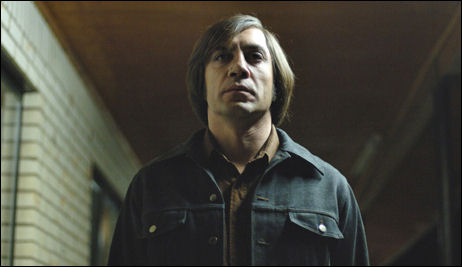
“Bardem delivers by far his most effective English-language performance as the enigmatic, deep-voiced Anton Chigurh, who plays with potential victims in memorable ways (notably a sequence at a gas station).

“The breakthrough here is Brolin, whose Llewelyn starts out as a greedy comic bumbler not unlike William H. Macy‘s Jerry Lundegaard in Fargo, but turns into a character worthy of a Greek tragedy.” Another Greek reference!

“Even in one of Hollywood’s best seasons in years, No Country for Old Menworks as high art and a rousing genre entertainment.”

That said, this passage from Armond White’s review is especially strong: “This is the Coens’ first crime movie since they began to master the medium, and the way No Country morphs from noir into contemporary-western moral struggle makes it deeper, funnier and even stranger than Fargo, their 1996 hit.

“You know what national cataclysm happened since then, so it should be no surprise that the Coens have made a crime movie that seems quietly aghast at the likelihood of death and menace occurring on American soil. Unlike American Gangster‘s sensationalized crap, this is a crime movie/western exercise that contemporizes the miasma of a world at war.”

Schwarzenegger feels their pain

“The studio executives are not going to suffer. The union leaders are not going to suffer. The writers on strike are not going to suffer. These are people that have money. The electricians, the grips [and] the set designers are the people suffering because they will not get paid now and they are out of work.” — California Governor Arnold Schwarzenegger as quoted by KFSN-TV. Schwarzenegger has said “he will get involved in contract talks if asked.”

Jones’ passivity is Greek

“One of the subversive conceits of No Country for Old Men is that for all the experience and skill” tucked under the belt of Tommy Lee Jones‘ Sherill Bell, “he is more of a passive character than an active one, functioning as a kind of Greek chorus who comments on and contextualizes the action rather than being at the heart of it.” Thank you, Kenneth Turan, for specifically agreeing with HE on this point.

Early “No Country” figures

Today’s east coast and midwest attendance figures for No Country for Old Men are in, and it’s looking very strong. Joel and Ethan Coen‘s masterpiece is playing in 28 situations with a minimum expectation of $25,000 a print, although the Miramax release could end up with a per-screen average above $30 thousand, which will translate to $700,000 for the weekend.