

The Broadcast Film Critics Association and VH1 have pooled forces, and part of the deal is a VH1 show called “Critics Choice: Best Movies of 2007” which kicked off last Saturday night and will be repeated throughout the month and into January, leading up to the Broadcast Critics Association’s Critics Choice Awards on 1.7.07. The next airings: 12.19 at 8 pm, 12.20 at 11 am, 12.23 at 10 pm and 12.28 at 9 am. Pete Hammond handles some if not most of the on-air schpiel.
“Campfire” scene from “There Will Be Blood”
“Our church is called the Church of the World…[and] we’re told in the book not to discuss our faith with strangers, even ones that have been so nice and helpful.” — Daniel Day Lewis in a campfire scene from There Will Be Blood that’s not in the finished film. (But is viewable here.)
Lane on “Sweeney Todd”
“For all the wild swipes of Sweeney’s razor, spattering red on the lens, was there not more threat, and mystery, in the sight of Johnny Depp as Edward Scissorhands — the lost soul who could kill at will but never did?” — from Anthony Lane‘s Sweeney Todd review in the 12.24 New Yorker.
Shouldn’t Lane be tapping out a blog of some kind? Is there a major-league film critic who writes less frequently? No one’s saying that volume rules above all, but reading appetites have become much more voracious over the least five years or so and you just can’t loll around and and bang out two or three elegantly-phrased reviews per month and call it sufficient. Because it isn’t. Not any more.
Klopfer swtiches to Obama
With things slowing down this week in Boston as they heat up for Barack Obama in Iowa, it’s worth considering the words of former Hillary Clinton supporter and precinct captain Susan Klopfer as she explains her change of heart.
Kenny on Nichols
I can’t suppress a couple of responses to Glenn Kenny‘s L.A. Times profile of Charlie Wilson’s War director Mike Nichols, which ran yesterday.
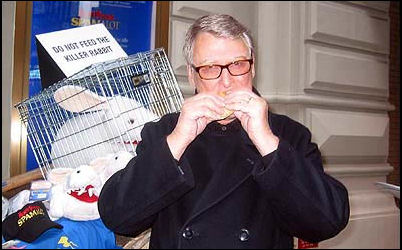
Kenny cautions that “one shouldn’t underestimate the Nichols touch” in having made War into a potentially popular “sand” movie, despite Americans having said “no way” to every ’07 film with the slightest whiff of any Middle Eastern elements. Maybe Charlie Wilson’s War will be the exception — it’s certainly entertaining enough. But nobody has a “touch” to have and to hold. Artists are touched by inspiration like lightning — it passes through them, and they are nothing more than lucky conduits when this happens.
The exceptional, long-lasting artists are those with a knack for keeping themselves open to inspiration, or who at least know how to position or trick themselves into the right state of mind so that lightning comes their way more often than not. The fact that creative lightning touched Nichols repeatedly from the days of his Nichols & May routines in the early ’60s until the end of his Phase One career caused by the total crash-and-burn reception to The Fortune, or that he got a version of it back in his Phase Two career with Biloxi Blues, Heartburn, Silkwood, The Birdcage, Primary Colors, Closer and Angels Over America is no indication, much less an assurance, that the lightning was still with him when he shot and edited Charlie Wilson’s War.
Kenny mentions a profile piece by the New Yorker‘s John Lahr in which Nichols “described the waning inspiration that struck him in the years after his steep ascent” and that “he also reveals that in the ’80s he struggled with a Halcion dependency that induced a breakdown.” But Kenny doesn’t acknowledge the extreme unusualness of Nichols’ career in that his Phase One brushstrokes — his signature style as a filmmaker from The Graduate to The Fortune — had totally disappeared when he returned to filmmaking in ’83 with Silkwood. He had literally abandoned his muse of the ’60s and early ’70s and become an entirely different (one could say less distinctive and more accomodating) man.
The late Richard Sylbert, the fabled production designer who worked for Nichols on Who’s Afraid of Virginia Wolff, The Graduate, Carnal Knowledge, The Day of the Dolphin and The Fortune and obviously saw it all first-hand, explained this directorial-personality-change arc a few years ago over a lunch at Swingers.
Americans are stupid
The fact that more people saw Alvin and The Chipmunks last weekend than will likely see No Country for Old Men in its entire release (as pointed out yesterday by “BNick”) is, I agree, depressing. But if my kids were four or five I’d have probably popped for tickets last weekend along with everyone else.
Question is, how many viewers over the age of 12 saw it for their own reasons?
This, possibly, is where this month-old YouTube essay comes in. One dispute with the guy who wrote and taped it: I believe in ghosts. I think it is ignorant and illogical not to. I have felt the presence of swirling spirits all my life.
Ledger’s Joker
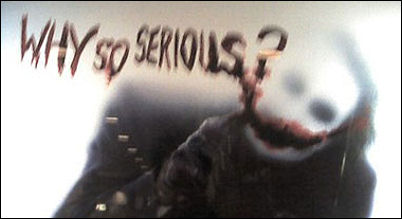
Heath Ledger was, of course, obliged to make his Joker look more street-loony and smeared-up than Jack Nicholson‘s green-haired goblin, and make him stagger and prance and lunge around in an even more wackazoid fashion. Ledger has definitely created a Joker that owes nothing to either Nicholson or Cesar Romero. This is certainly indicated by a new high-deffy Dark Knight trailer. It’s almost stunning to realize that Nicholson’s Joker made his big-screen debut 18 and 1/2 years ago.
Dergarabedian tops himself
HE reader Joe Branham has just pointed out an especially insipid quote from Media By Numbers president Paul Dergarabedian in a just-posted CNN story about the $76.5 million earned this weekend by I Am Legend, which ranks as the largest December opening ever and a “personal best” for star Will Smith. “It’s no wonder Will Smith feels so lonely,” Degarabedian remarked. “Everyone else on earth is in the movie theater.” He sometimes makes me want to scratch the paint off walls with my fingernails, this guy. I’ve been coping with this for years.
Huckabee and Norris
“When Chuck Norris does a push-up, he’s actually pushing the earth down.” — Republican presidential hopeful Mike Huckabee in a recently-released spot with the star of Invasion U.S.A.
“Once” coming to DVD
“It’s unique but gently lulling. It’s about struggle and want and uncertainty, but with a kind of easy Dublin glide-along attitude that makes it all go down easy. It’s all about spirit, songs and smiles, lots of guitar strumming, a sprinkling of hurt and sadness and disappointment and — this is atypical — no sex, and not even a Claude Lelouch-style kiss-and-hug at the finale. But it works at the end — it feels whole, together, self-levitated.”
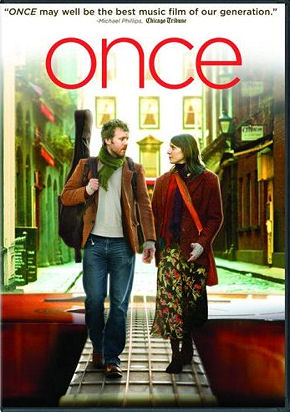
I wrote this 11 months ago about seeing Once at the ’07 Sundance Film Festival, and on Tuesday it’s finally out on DVD. Everyone’s read and heard enough about this amazing little film by now, but this 11.26 review by DVD Talk‘s Preston Jones is a better-written appraisal than anything I’ve read in months.
“Once is as electrifying as I’d hoped it would be, a tour-de-force synthesis of original music, almost instinctual acting and a keen eye for the often unpleasant realities of love. Not to damn with faint praise, but Once is one of the best films of 2007 and almost certainly, one of the best films of this decade.
“Once isn’t a showy Hollywood vehicle, dolled up with lavish sets and opulent costumes; rather, it’s nearly a film from the Cassavetes school, outfitted with an absorbing, fantastic soundtrack — a stark look at the formative stages of an artist’s career and the sacrifices that are necessary in order to take that crucial next step.
“Most astonishingly, you feel none of this weight — Carney keeps the plot flowing smoothly, leaving much of the exposition to his actors’ expressive visages — Once glides along, delivering a bittersweet coda to this tale of unrequited love, one final high-wire trick in a movie that will leave you teary-eyed and breathless at its dexterity. An astonishing, unforgettable masterpiece.”
“Wilson” issue raised again
I’ve gotten into this deballed Charlie Wilson’s War story twice now — on 11.29 and 12.13 — but now N.Y. Times writer Richard Berke has jumped in with what reads like a well-reported story along the same lines.
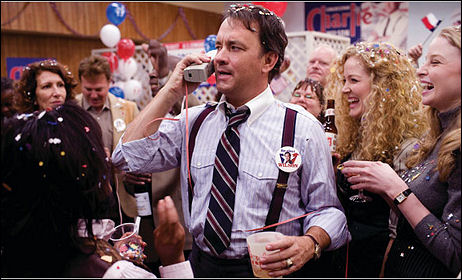
“The Charlie Wilson on the screen is more honorable and less reckless than the real one,” he writes. “Left on the cutting-room floor was a scene of Wilson in a drunk-driving accident. And the movie doesn’t depict some of the book’s wackier moments. There is no mention of Wilson’s dispute with the Pentagon after he sought to bring Annelise (Sweetums) Ilschenko, a former Miss U.S.A.- World, on a Defense Intelligence Agency plane in Pakistan. And though a memorable belly-dancing scene remains, it ignores the part where the dancer brandishes a sword at the Egyptian defense minister, taking aim at his groin.
“Even Wilson, who at 74 underwent hear-transplant surgery in September, emerging from quarantine for the first time to attend the premiere on Monday night in Los Angeles, said, “They were kind to me.”