“Gone Baby Gone”

I had a few problems with the first half of Gone Baby Gone when I first saw it three or four weeks ago. On top of which I was so whipped I had trouble keeping my eyes open. On top of which I had to be somewhere so I bailed at the one-hour mark, intending to catch it again in a more rested state. I saw it again last week and this time wide awake and right to the end, and it was a whole different deal.
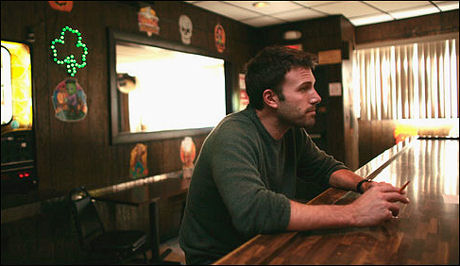

Ben Affleck

I still have beefs, but the ending is quite strong — deliciously disturbing, I’d say — and in my book that’s almost the whole ball game.

For the finale alone, Gone Baby Gone is a first-rate drama. It’s also a formidable Boston crime film. The atmosphere is genuine, if not quite in the rich-underworld vein of Peter YatesThe Friends of Eddie Coyle. It’s a morally complex film that leaves you teetering on a seesaw with a shot of irony that doesn’t wash out, and in fact stays with you for days.

Ben Affleck has done a better-than-decent job in his maiden directing effort, and with the acclaim this film is already getting he’ll have gone a long way to erasing memories of his career-destroying relationship with Jennifer Lopez. He’s scored as a director, he can still work as an actor (as far as that goes) and he can kick ass any day he wants as a political commentator or candidate, even. He’s totally fine.

The best kind of endings build to a climax and drive their thematic point home clear and true. But a Gone Baby Gone-type ending — one that pulls you in conflicting ways with equal force, and both seeming like the “right” course — is nothing to snort at. It’s not quite up to the legendary ending of Eric von Stroheim‘s Greed, but it’s aiming at the same archery target. (And it hits it.) And if you ask me it packs a slightly stronger punch than the finale of Clint Eastwood‘s Mystic River.
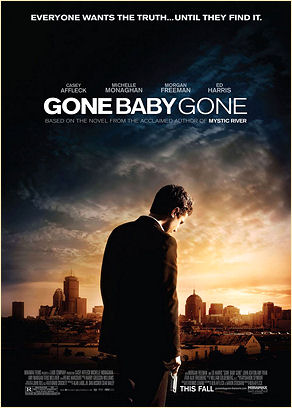
Eastwood’s ’03 film shares two things with Gone Baby Gone. Both are based on Dennis Lahane novels, and both are about decent working-class Dorchester folks who’ve pretty much given up on the law and have decided to apply their own solution or justice when it comes to the fate of their children.

I’m not going to spill anything specific, but Gone Baby Gone is basically about a search for a 4-year-old Dorchester girl — the daughter of an empty, emotionally unstable floozie and coke addict (Amy Ryan) — who’s apparently been kidnapped, and a long search for the truth about what why she was taken, who took her and why.

The main problem, for me, is that Patrick Kenzie and Angie Gennaro, the neigh- borhood private detectives who are called in on the case, are played by Casey Affleck and Michelle Monaghan.

Their performances (especially Affleck’s) are solid, but there’s no buying a couple of actors who look like they’re in their mid to late 20s as case-hardened pros. Sorry, but I need to see people in their mid to late 30s (and looking it) playing these parts. (Affleck and Monaghan were 31 and 30 when they shot the film.) The movie tries to diffuse the issue by having a couple of characters say “how old are you?” to Affleck, but young is young.
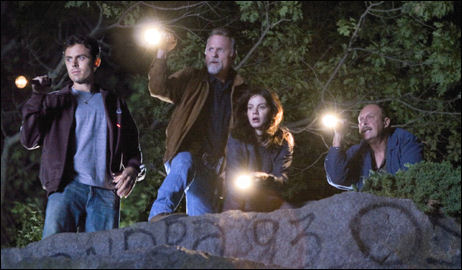

(l. to r.) Affleck, Harris, Monaghan, Ashton

Plus there’s a difference between a whodunit being “complex” and verging into “what the fuck?” territory. Maybe I’m just not smart enough (I got a few As but mostly Bs in high school), but I was having trouble following some of the twists and turns. There’s a scene at a rock quarry that doesn’t make a lot of sense. (I’ve seen it twice and I still don’t know what happened.) My head was spinning during parts of the third act. Maybe Ben Affleck should have aped Clint’s Mystic River pace, or otherwise made it a little easier for dummies like myself to keep up.

Amy Madigan plays the aunt of the four-year-old who hires Kenzie and Gennaro. Morgan Freeman plays a police captain and Ed Harris and John Ashton are detectives involved in the case. Titus Welliver plays Madigan’s husband. Nobo- dy’s interest or agenda is quite what it seems at first, but then crime whodunits are always peeling away at the onion.

I say again that a movie that ends this well deserves an audience. For all the irritants, Gone Baby Gone needs to be seen and thought about afterwards. It’s unusual for a crime drama to leave you with this much moral aftermath. And all the hubbub about Casey Affleck’s performance is warranted. He acts and sounds like a real Boston slouch-around, and he almost overcomes the too-young issue because of it. Between this and his arresting turn in The Assassination of Jesse James by the Coward Robert Ford, ’07 has been quite the year for him. Cheers.
Smoldering Slabs of Man-Meat

Everyone enjoyed Manohla Dargis‘s Elizabeth: The Golden Age review than ran two days ago, but a big-city critic had this comment: “Do you think a male critic could have gotten away with that many references to female legs crossed, bosoms heaving and bodies quaking? What might the female equivalent of ‘smoldering slab of man meat‘ be, and could you publish it in the New York Times? A male scribe would have been called a perv and worse, methinks. The double standard lives!”

Finke’s Robinov column & “Last Samurai”

Nikki Finke‘s latest Jeff Robinov bashing states that the Warner Bros. production president will receive a promotion in early ’08 that will “finally end his nightmare of running in place behind Warner Bros Entertainment Inc President and COO Alan Horn, ” largely because, as one source confides, Robinov is a slavish corporate toady “in complete submission to quarterly reports and bottom line [thinking].” Shocker!

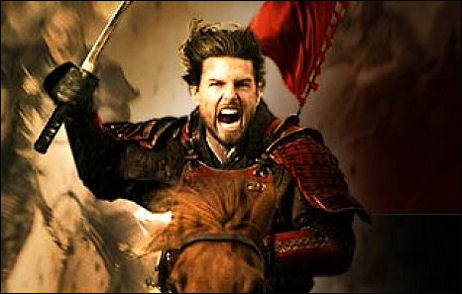
The thing that made my eyes pop is Finke’s astonishing claim that Horn “frequently says The Last Samurai [is] one of his favorite movies of all time.” That explains a lot, if true. What does it say about a company that can’t be bothered to properly promote across-the-country openings of The Assassination of Jesse James, easily one of the year’s finest films, and at the same time has a top-dog CEO who not only admires an unquestionably mediocre Ed Zwick film but regards it as one of his all-time favorites?

Even if Finke has it wrong about the “frequently” and the “of all time” parts (can this really be so? how could any presumably sophisticated Hollywood executive not only be of this opinion but state it repeatedly?), this Last Samurai anecdote will hang around Horn’s neck for years to come. It seems to be like a case of obiter dicta — words in passing — giving the game away. It’s one thing to say you admire a second-rate film or find parts of it extraordinary, but to put it at the top of your personal all-time list is something else.

Real Ghost video

This is lame, cheesy, sophmoric. I admit that. But being in a pre-Halloween mood (or something), I clicked on this real ghost video (from www.szworld.net) this morning, and suddenly I wasn’t bored or suffering from the Sunday blahs. Sometimes a low-rent quickie video delivers a certain thing that’s beyond the grasp of narrative.

Landis and “Mr. Warmth”

An IFC News video clip of John Landis during his recent N.Y. Film Festival press conference for Mr. Warmth: The Don Rickles Project, which several L.A. journos would love to see sometime soon. “Not a comedian but a performance artist….and the judge laughed.” The public NYFF screening is (or was) today.

“Beowulf” has a PG-13?

Does anyone find the MPAA’s decision to give Robert ZemeckisBeowulf (Paramount, 11.16) a PG-13 rating a little puzzling, or at the very least inconsistent? Lots of intense (one could say orgiastic) violence and a haunting use of frontal female nudity (a digitally reconstituted Angelina Jolie) would normally result in an R.

As reader David Adams wrote this morning, “Judging from the red-band trailer they either sliced it up to get the rating (only to return the footage for the ‘Special Edition Director’s Cut DVD’) or someone at Paramount sent the MPAA the biggest fruit basket ever made.”

“2001” in IMAX?

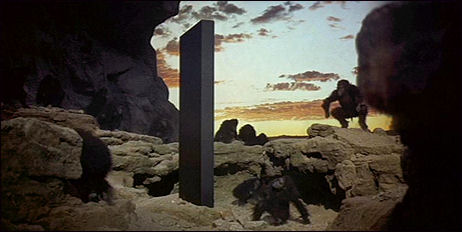
A San Francisco guy named Bob Bowman recently wrote the following to Roger Ebert: “Wouldn’t it be great if someone were to commemorate the 40th anniversary of the release of 2001: A Space Odyssey next year by striking new prints and showing the movie on IMAX screens across the country? What a fantastic experience that would be!” Ebert said that the idea “seems almost inevitable. And remember that the film was shot in 70mm, so it would look even better.”

I would do backflips over this. And Ebert is right — the process by which 35 mm films are transferred to IMAX has gotten pretty good, so a 70mm transfer would look even better. The precise 40th anniversary will be on 4.3.88 — less than seven months away. If this is being planned they’ve almost certainly already begun the work. I wrote a couple of p.r. people this morning to see if they know anything. Does anyone?

A new 2001 DVD is coming out a week and three days from now. A first-graph line in Ebert’s 1968 review sums it up nicely: “The fascinating thing about this film is that it fails on the human level but succeeds magnificently on a cosmic scale.”

“War” in December

The first Academy screenings for Charlie Wilson’s War (Universal, 12.25) have been scheduled for Monday, 12.3 — one in New York, one in Los Angeles. This plus director Mike Nichols‘ tendency to finesse his films until the very last minute (like a lot of directors) plus his statement at last night’s American Cinematheque tribute to Julia Roberts that he’s still tooling around with it indicates no media screenings until after Thanksgiving.

Aaron Sorkin‘s War script loses its energy a little bit in the final third. It’s best in the first and second acts. The ending is okay — thoughtful, echo-y, a “hmmm” quality — but it’s not gangbusters. Endings aren’t everything, but they matter.

“Sleuth” comparison

The numbers guys are saying the new Sleuth is already dead (it opened in 9 theatres this weekend and will only average about $4000 a print). Question is, does having seen the ’72 original — directed by Joseph L. Mankiewicz, Michael Caine and Laurence Olivier starring — improve or diminish the current version (Kenneth Branagh directing a Harold Pinter adaptation)? Worth a looksee. Joe Leydon is alerting the world to an airing of the oldie tomorrow night.

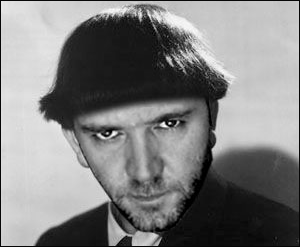
Russell crowe as Moe

It hit me last weekend (along with several thousand others) that the failure of The Heartbreak Kid could mean that the Farrelly brothers are finished. It seems as if they are right now — yes, I’ll admit that, the curtain has come down. But they can get it right back if they make that Three Stooges movie they’ve been talking about for three or four years now, and I mean with Russell Crowe as Moe. I don’t care if he’s told them “no” a hundred times. He’s the only guy for that part. No one else.

It’s true that the Farrelly’s moment of perfect cultural synchronicity — a four-year stretch that began with Dumb and Dumber and ended with There’s Something About Mary — has passed, and that Judd Apatow has taken the king of comedy crown away from them. (Mary was nine years ago…the train has moved on.) It all comes down to the Stooges. Make it right (which hinges upon casting it right) and all is forgiven. And they can do it. I know they can.

Dean scream movie

The killing of Howard Dean‘s Presidential primary campaign was a deliberate media hit job. News producers played that “yeeahhhhh!” video clip (pulled from Dean’s speech to followers after his third-place showing in the 2004 Iowa caucus) hundreds and hundreds of times over the next two or three days until Dean had been turned into a complete clown, a punchline, a living Wilhelm scream.

And now Leonardo DiCaprio wants to portray Dean in a film version of a play called Farragut North, written by former Dean staffer Beau Willimon about “a novice but inspired campaign staffer who works for an unorthodox presidential candidate. George Clooney would direct and produced the film for Warner Bros.

The most interesting story, for me, wouldn’t be about the experience of a Dean campaign worker, but about how and why the “yeaahh!” clip was seized upon and exploited by the media in order to destroy Dean. He might have lost the nomination to John Kerry in the long run, but the clip killed him. It was one of those amazing media moments in which a political movement was assassinated so that a few hundred TV stations could broadcast a cheap laugh and maybe boost ratings. It was a defining triumph of media mediocrity.

Here are two of the best YouTube “yeaaaah!” clips I could find — clip #1 and clip #2.

Weekend numbers

Yesterday Variety‘s Ben Fritz and Dave McNary reported that Elizabeth: The Golden Age, Michael Clayton, Tyler Perry’s Why Did I Get Married? and We Own the Night “are expected to gross in the low- to mid-teens” in a kind of even-steven fashion, and I said I’d been told that Why Did I Get Married? would do “$20 million-plus, and that the others will come in at $10 to $12 million lowball, and $12 to $14 million at best.” That’s more or less what’s happened. My estimate, I mean, and not Variety‘s.

There’s too much product out there and product kills product, but despite the glut Why Did I Get Married? — far and away the weekend’s #1 film — will end up with $22,151,000 by Sunday night, give or take.

The Game Plan will be second with $11,226,000 — almost exactly half of Perry’s earnings. James Gray’s We Own The Night will come in third with $10,948,000 — a little over $4000 a print and going nowhere. The fourth-place Michael Clayton is probably doing well in the uptown regions, but the rurals are giving it the bum’s rush — a projected $9,893,000, under $4000 a print, dying in Middle America.

The Heartbreak Kid is down 50% for a projected $7,064,000 and a fifth-place showing.

Elizabeth: The Golden Age has gone down to the sea in ships. It will take in $6,383,000 — 2000 theatres, $3200 a print. The women and older couples read the reviews and said “later.” Cate Blanchett‘s Ziggy Stardust has slipped beneath the waves and been embraced by Bill Nighy‘s Davy Jones. “You are one of us now,” he says as he looks into her eyes and her soul. “Tug on my facial squid tentacles and join us in eternal damnation.”

The Kingdom will come in seventh with $4,467,000. Across The Universe is eighth with $3,921,000 and $4100 a print. I don;t care about the ninth- and tenth-place finishers. Sleuth opened in 9 theatres and only made $4000 a print…disaster. Control , the best of them all, has been playing in one theatre in the Village and will take in $28,000.