

This five-minute Cloverfield clip is nothing new. I say enough with the tease clips. The movie opens in four and a half weeks — it’s time to start showing it. It just hit me that Cloverfield (Paramount, 1.18.08) would actually be a work of genius if they never show the beast. Let the 9.11 metaphor speak for itself and just go with the panic…the sounds, screams, explosions, etc. It could be phenomenal on this level.
“Legened” riff
Several I Am Legend video clips, available on Yahoo.com, present the case better than any review: the dozens upon dozens of images of an evacuated and wasted Manhattan, overgrown with weeds and tall grass and populated with wild deer and the occasional lion and littered with rotting cars and buses, are worth the price of admission in themselves.
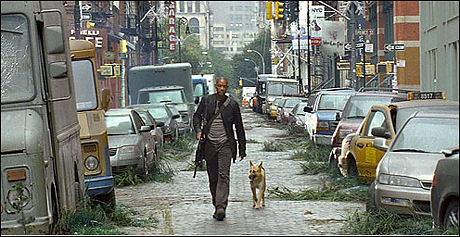
I’m a fool for CG fakery when it’s this good, and each and every shot of post- apocalyptic desolation in this film — the pastoral still-life stuff, I mean — is as good as it gets these days. I believed it. I was there. Hats off to production designers David Lazan and Naomi Shohan, art directors William Ladd Skinner and Patricia Woodbridge and the various CG supervisors from Sony Picture Imageworks, New Deal Studios and CIS Hollywood.
In this respect I Am Legend is very nearly the equal of Alfonso Cuaron‘s Children of Men, and that’s saying something.
It’s too bad that the biological movement stuff — especially the CG “deer” and the nocturnal ghouls — aren’t up to snuff. In fact, forget the ghouls entirely. They’re cartoon dreadful. One look at these fiends and you’re out of the movie and thinking about checking your e-mails. It’s hard to tell who did what, but the bad guys in this respect, apparently, are senior character animators Tom Bruno Jr. and Stephen A. Buckley.
Why didn’t director Francis Lawrence just hire a first-rate ghoul makeup team and go the Tom Savini route? The person responsible for the CG ghouls — the person who said “don’t hire actors” — is an idiot. He doesn’t understand the Werner Herzog rule that movies are worthless if they encourage you to be cynical about what you see. Anyone who knows anything about visual effects is going to mutter “bad CG” when the Legend ghouls appear. They aren’t in the least bit scary because they’re not in the least bit convincing.
CG animals are also a big problem these days. The only poor aspect of Beowulf were the CG horses. You can tell from the first Legend clip that the deer are way too hard-drivey. They move too fast, can’t really “see” them, don’t seem biological.
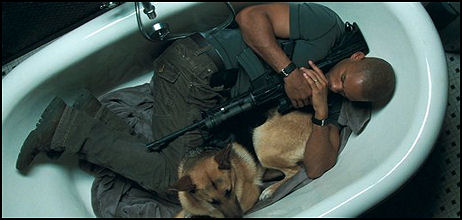
The live human aspect of I Am Legend — the “story” about scientist Will Smith and his dog (a German shepherd) roaming around Manhattan as he tries to solve the mutant problem from his home-base laboratory — isn’t a huge problem. I found it slightly better than passable. It doesn’t go off the rails until the final act, and Smith seems much less concerned than usual about the audience loving him this time. He’s just “there” and working it — focused on survival, not being stupid, dug in, unaffected.
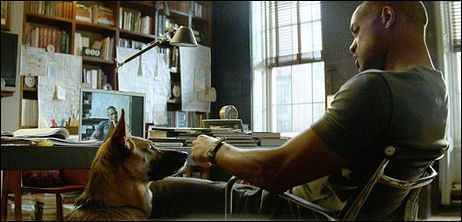
His character, Dr. Robert Neville, is too rich for a guy who once worked for the government, but movies like this are always absurdly indifferent to monetary realities. Before Manhattan was evacuated due to a lethal virus (a lot like the one that ravaged England in 28 Days Later) Smith and his wife and daughter lived in a Washington Square townhouse that only guys with Sultan of Brunei-type incomes would be able to begin to afford in real life. On top of which Smith mentions a second home (“the farm”)…what is this?
The only other thing that irritated me is a last-act element which I’ll get yelled at for discussing, so forget it. Suffice that the most touching scene in the film is a death scene in which Smith’s character does a kind of Jack Kervorkian thing.
It appears that Smith, who’s only 39, is starting to go seriously gray. His closeups in this film show he’s got a major salt-and-pepper thing going on. He was a young- looking guy only three or four years ago. Now he looks like a buff 49 year-old.
Blizzard burger
This latest Boston blizzard video, taken about 90 minutes ago, is the best yet because the snowflakes are illuminated by streetlights…important visual distinction!

London Film Critics are the shit
Now this is a Best Picture lineup I can totally live with! All hail the London Film Critics for coming up with a list that makes more sense than any I’ve seen this month — No Country For Old Men, The Assassination of Jesse James by the Coward Robert Ford, There Will Be Blood, Zodiac and The Bourne Ultimatum.
Director of the Year noms are for Florian Henckel von Donnersmarck (The Lives of Others), Paul Thomas Anderson (There Will Be Blood ), Joel and Ethan Coen (No Country For Old Men), David Fincher (Zodiac) and Cristian Mungui (4 Months, 3 Weeks & 2 Days)
The Attenborough Award for British Film of the Year nominees are Once, Control, Atonement, Russian Penis Movie and This Is England.
The British Actor of the Year nominees are Sam Riley (Control), James McAvoy (Atonement), Christian Bale (3:10 to Yuma), Jim Broadbent (And When Did You Last See Your Father) and Jonny Lee Miller (The Flying Scotsman).
It just goes on and on like that…great. I couldn’t find the original website or link so I had to link to MCN’s page.
Apted to DGA membership
A 12.13 e-mail sent to Directors Guild members by DGA president Michael Apted has conveyed frustration with the WGA strike and a feeling that fresh DGA attitudes in separate negotiations are what’s needed at this stage: “We have been waiting and watching [the WGA strike situation] for months. But now, with no end to the current impasse in sight, we find ourselves having to ask the hard question: is it now our turn to sit across from the AMPTP?
“We believe the answer to that question lies in one simple truth. We cannot abdicate our responsibility to all of you, the DGA membership. You expect us to fight for you. We promised you we would do just that. We believe that the preparation and determination [that the] DGA traditionally brings to the table, combined with our fresh perspective, is what’s needed to get the job done.
“The issue is not between the DGA and the WGA. Those who want to make that the fight will only strengthen our true adversaries. The real issue is how to ensure that we get the best and most equitable deal for DGA members.
“With this first and foremost in our minds, we have decided that the DGA must go forward with our own negotiations. In order to give the WGA and the AMPTP one last chance to get back to the table, we will not schedule our negotiations to begin until after the New Year, and then only if an appropriate basis for negotiations can be established.
“If it can, then the DGA will commence formal talks with the AMPTP in the hope that our bargaining strength and fresh perspective can help achieve a good and fair outcome for all concerned.”
Thai Sylvania lightbulbs
A great little Thai commercial for Sylvania lightbulbs. I don’t care that’s been sitting on YouTube for seven and a half months. Whoever thought it up is a fan of Terry Gilliam, Salvador Dali and Guillermo del Toro.
Snowed down in Brookline
The drive to Syracuse was abandoned 10 miles out of Boston on the Mass Pike. Total blizzard conditions, only the vaguest visibility beyond 200 yards, tens of trillions of snowflakes dropping each and every second, traffic moving 5 to 10 mph, some cars fishtailing and spinning out. Big snowstorms means big spectacle and everything stops or slows to a crawl — all systems are suddenly on hold and everyone’s on a kind of vacation. It took me almost two hours to make it back to Brookline…a great adventure!

Somewhere in Brookline — Thursday, 12.13.07, 2:15 pm
Here’s a 51-second video taken on the way back to town on the Mass Pike, and here’s a 35-second video taken on Aspinwall Street in Brookline. It’s a shame that my Canon A540 isn’t good enough to capture the snowflakes. They’re the whole show. Without them snaps are just a gray haze and the old snow-blanket effect.



Off to Syracuse
I have to pick up a rental car and then drive five hours through a snowstorm to Syracuse, where Jett took his final exam this morning. Highway snowstorm photos will be posted later this evening.
Brolin blast
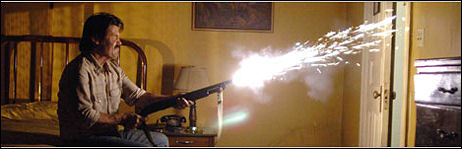
I love this No Country for Old Men photo, which I came across while reading a N.Y. Times story a few days ago. Why do juicy pics like these only emerge at the end of a campaign? I would have circulated this starting last fall.
Golden Globe noms
Here are HE’s reactions to some of the just-announced Golden Globe nominations:
Best Drama: American Gangster, Atonement, Eastern Promises, The Great Debaters, Michael Clayton, No Country for Old Men, There Will Be Blood. Response: What is that, seven nominations? Why not ten like the Broadcast Film Critics list? The HFPA’s belief that David Cronenberg‘s Russian penis movie is among the year’s best dramas while not even including Zodiac and The Assassination of Jesse James by the Coward Robert Ford is amusing, at the very least. History will judge their lack of vision and backbone accordingly.

Best Performance by an Actress in a Motion Picture — Drama: Cate Blanchett (Elizabeth: The Golden Age), Julie Christie (Away From Her), Jodie Foster (The Brave One), Angelina Jolie (A Mighty Heart), Keira Knightley (Atonement). Response: The Blanchett nomination is a joke. Conventional wisdom says it’s Christie’s to lose…and she could manage that if she doesn’t get out there and “work it” — which she’s said to be reluctant to do. The jackals and the wild dogs of Kenya can smell this attitude, and if they’re “smart” (in a vicious, dog-eat-dog, rules-of-the-game sense of the term), they’ll gang up and take her down. She’s definitely a vulnerable wildebeest.
Best Performance by an Actor in a Motion Picture — Drama: George Clooney Michael Clayton), Daniel Day-Lewis (There Will Be Blood), James McAvoy (Atonement), Viggo Mortensen (Eastern Promises), Denzel Washington (American Gangster). Response: They nominate Mortensen, Washington and Clooney but blow off HE faves Benicio del Toro and Sam Riley? I don’t care how repetitious I sound by bringing this up time and again, but this is a matter of breathtaking epic-scale denial. Del Toro and Riley gave landmark performances, and HFPA nominators are playing political suck-up games by nominating Clooney, Washington and Mortensen, all of whom (a) will look good on the red carpet but (b) gave very good but not quite award-level performances.
Best Motion Picture — Musical Or Comedy: Across The Universe, Charlie Wilson’s War, Hairspray, Juno, Sweeney Todd. Comment: The Across the Universe nomination is a sop and a joke. Arterial fire-hydrant issues aside, the winner really ought to be Sweeney Todd. If the blood kills it, Juno will gake the prize. Why isn’t Once nominated in this category? It’s easily superior in every respect to Across the Universe — more intimate, better acted, more honestly emotional, etc.
Best Performance by an Actress in a Motion Picture — Musical or Comedy: Amy Adams, Nikki Blonsky, Helena Bonham Carter, Marion Cotillard, Ellen Page. Comment: All sublime performances, but Cotillard deserves to win. Of course, she could very possibly lose because La Vie en Rose came out so long ago, blah blah. Picturehouse needs to bring Cotillard back to Los Angeles in early January and keep her there.
Best Supporting Actor: Casey Affleck, Javier Bardem, Philip Seymour Hoffman, John Travolta, Tom Wilkinson. Comment: Travolta is the weak sister in the group. Bardem will probably prevail, especially given his Spanish heritage and the HFPA’s presumed favoritism for foreign-reared contenders.
Best Supporting Actress: Cate Blanchett, Saoirse Ronan, Julia Roberts, Amy Ryan, Tilda Swinton. Comment: How formidable is the Ryan blitzkreig? Will the HFPA membership knuckle under and go along, or will they grow a pair and stand up for Blanchett or Swinton? Ronan is in there to round out the pack. The Roberts nomination is a case of the HFPA simply wanting her to attend the awards show.
Best Screenplay: Diablo Cody Juno), Joel Coen & Ethan Coen (No Country for Old Men), Christopher Hampton (Atonement), Ronald Harwood (The Diving Bell & the Butterfly), Aaron Sorkin (Charlie Wilson’s War). Comment: The Coens, of course, but it wouldn’t surprise me if Cody, who’s slightly better at working a room than Joel and Ethan, nabs it.
A friend just wrote to say that “the biggest disappointment in the Best Actor category is Tommy Lee Jones not getting any love for In The Valley of Elah.” Jones was superb in that film, yes, but I liked him even more in his somewhat quieter No Country supporting performance…and he was shut out there also.
Kubric, Cahill & projection standards
In keeping with the lousy-projection standards theme of my 12.5 and 12.6 postings, HE reader Grant McFadden has passed along comments by director Stanley Kubrick during a 1987 Rolling Stone interview with Tim Cahill. Commercial projection is perhaps a bit better today than it was 20 years ago (certainly if you factor in standards at theatres like L.A.’s Arclight), but generally speaking only that.
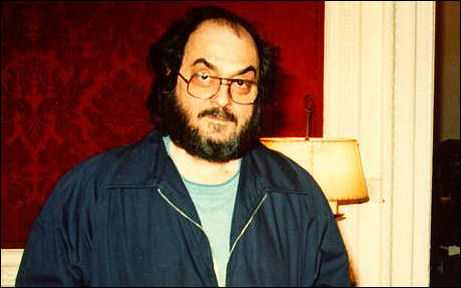
Here’s a portion of what Kubrick and Cahill said to each other on this subject:
Cahill: There’s a rumor that you actually wanted to approve the theaters that show Full Metal Jacket. Isn’t that an example of mindless anxiety?
Kubrick: “Some people are amazed that I worry about the theaters where the picture is being shown. They think that’s some form of demented anxiety. But Lucasfilms has a Theater Alignment Program. They went around and checked a lot of theaters and published the results in a [1985] report that virtually confirms all your worst suspicions. For instance, within one day, fifty percent of the prints are scratched. Something is usually broken. The amplifiers are no good, the sound is bad, the lights are uneven.”
Cahill: “Is that why so many films I’ve seen lately seem too dark? Why you don’t really see people in the shadows when clearly the director wants you to see them?”
Kubrick: “Well, theaters try to put in a screen that’s larger than the light source they paid for. If you buy a 2000-watt projector, it may give you a decent picture twenty feet wide. And let’s say that theater makes the picture forty feet wide by putting it in a wider-angle projector. In fact, then you’re getting 200 percent less light. It’s an inverse law of squares. But they want a bigger picture, so it’s dark.
“Many exhibitors are terribly guilty of ignoring minimum standards of picture quality. For instance, you now have theaters where all the reels are run [with a norizontal platter system]. And they never clean the aperture gate. You get one little piece of gritty dust in there, and every time the film runs, it gets bigger. After a couple of days, it starts to put a scratch on the film. The scratch goes from one end of the film to the other. You’ve seen it, I’m sure.”
Cahill: “That thing you see, it looks like a hair dangling down from the top of the frame, sort of wiggling there through the whole film?”
Kubrick: “That’s one manifestation, yeah. The Lucas report found that after fifteen days, most films should be junked. [The report says that after seventeen days, most films are damaged.] Now, is it an unreal concern if I want to make sure that on the press shows or on key city openings, everything in the theater is going to run smoothly? You just send someone to check the place out three or four days ahead of time. Make sure nothing’s broken. It’s really only a phone call or two, pressuring some people to fix things. I mean, is this a legitimate concern, or is this mindless anxiety?”
Diod Herring and DeDuerin deball “War”?
The day before flying to Boston (11.29) I wrote that while I was okay with Charlie Wilson’s War, I liked and admired Aaron Sorkin‘s 5.25.05 version of his Charlie Wilson’s War script somewhat more. I said it’s “obvious that the movie has been shaped in order to be less complex, much more upbeat and explicitly depoliticized, which to say scrubbed clean of all specific Al Qeada and 9.11 mentions.”

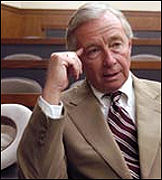
Houston socialite Joanne Herring, attorney Dick DeGuerin
It appears now that the Sorkin’s script may have been defanged and deballed due to legal pressure brought upon War producers by Joanne Herring, the right-wing Houston socialite and millionaire played by Julia Roberts in the film.
Yesterday’s Rush & Molloy column (12.12) in the N.Y. Daily News quotes Herring as saying she “practically choked” when she read Sorkin’s original screenplay,” which “ended with a shot of the Pentagon in flames, implying that Herring and Wilson (played by Tom Hanks) had abetted Osama bin Laden and his Al Qaeda crew.
“Can you ever predict a war?” Herring says to Rush-Molloy. “The shelf life of a Stinger missile is five years. There’s no weapon we got them that can be used today.” [HE note: This is a witless smokescreen rebuttal as neither the movie not Sorkin’s screenplay states or implies that weaponry purchased for the Afghan Muhjadeen in the ’80s was used against the U.S. later on.]
Herring showed the script to Wilson and “we wept and wailed and gnashed our teeth,” Herring says. “Then they brought in some legal muscle — Dick DeGuerin, the celebrated hot-shot Houston attorney who got an accused Houston murderer off and also defended U.S. Rep. Tom DeLay on conspiracy and money laundering charges. “DeGuerin got the attention of Universal and the producers,” the story says, [and] Herring, was thereafter “assured that the script would be changed.”
The column says that Herring flew to last Monday’s L.A. premiere “with Houston pals, who included former Secretary of State James Baker…[and] to everyone’s great relief, she and Wilson liked what they saw on the screen.”
That’s because all the movie says now, boiled down, is that despite the effective efforts of Wilson and Herring in arming the Muhjadeen and thereby helping to defeat the Russian invaders, the U.S. “fucked up the end game” in Afghanistan because no one nurtured political or cultural ties with key regional players and combatants in the war’s aftermath.
The film includes a scene in which Wilson’s committee declines to fund the construction of a school, at which point Hanks/Wilson talks about how “we always go into these countries to change things [and then] we always leave…but the ball keeps bouncing.”
Sorkin’s script is much tougher and more explicit in explaining the particular U.S. errors and oversights from the time of the Russian withdrawal to 9.11.01. As much as I like the final version of the film myself, I wish Universal and director Mike Nichols had sidestepped Herring and DeGuerin and been more faitthful to Sorkin’s original work, which is to say more faithful to the reality of what really happened over there.