

Not a huge surprise, but Sydney Pollack, Steven Soderbergh and Anthony Minghella were three good Godfathers on Michael Clayton, according to director-writer Tony Gilroy. “The advice all the way through the preproduction process is all ambassadorial and diplomatic: ‘Can you call this person for me?’ and ‘Have you ever worked with this costume designer before?’ and ‘I didn’t rehearse the film..is that a good idea?’ It’s all that kind of process stuff. To all of their credit, they gave to me what they would all want [as directors]. They gave me absolute autonomy. They gave me final cut. They protected me. They kept everything bad away from me. They created for me, on a small scale, the situation they all would want to have.”
Obama trailing in Iowa
I’ve been hanging onto the idea of Barack Obama reviving his candidacy by beating Hillary Clinton in the Iowa caucus. Now comes a Des Moines Register poll showing Clinton at 29%, John Edwards at 23% and Obama at 22%. The Iowa caucus isn’t until mid-January — three and a half months hence — and things could change, of course, but this is awful news.
“Heartbreak” sinks further
Those Heartbreak Kid numbers have gotten slightly worse. The Farrelly Brothers/Ben Stiller film did about $4,585,000 Friday and was projected yesterday to end up Sunday night with $14,434,000, which was less than the $15 to $16 million that was projected midday Friday and over $5 million less than the $20 million that handicappers were expecting a day or two earlier. This morning’s weekend projection, based on yesterday’s ticket sales, is a limp $13,756,000.
Access to the realm
Jonah Weiner‘s 9.27 Slate piece about what he believes to be unconscious racism on Wes Anderson‘s part (“Unbearable Whiteness”) is interesting reading, but what I liked the most was reading a line from Bottle Rocket — spoken by Luke Wilson‘s Anthony — that I’d forgotten.
“Anthony’s last girlfriend sent him into a psychological tailspin, we learn, when she made a bourgeois proposal,” Weiner explains. “Over at Elizabeth’s beach house,” Anthony says, “she asked me if I’d rather go water-skiing or lay out. And I realized that not only did I not want to answer that question but I never wanted to answer another water-sports question, or see any of these people again for the rest of my life.”
If you come from a well-tended family and you don’t have some kind of thought like this sometime in your teens or your 20s, you have no soul. Of course, sooner or later you grow out of this, and then down the road you start working your tail off — sometimes successfully and sometimes not — so you can make enough money to afford to be with people who ask each other on weekends if they’d like to water-ski or lay out. Not that you want to hang with them, but you want to be able to afford access to their realm.
Nicole Kidman should pack it in?
This is one of the meanest, most heartless pieces of analytical celebrity journalism I’ve ever read. I’ve never written anything this insensitive or pointless. You don’t pack it in if things aren’t working out. Maybe if you’re struggling or uncertain but not after you’ve already made it. What you do in a jam is redefine, rethink, reinvent. Quitting is completely out of the question. Anyone who suggests this is some kind of fiend.
Lim on two Joy Divison films
The most important thing in Dennis Lim‘s 10.7 N.Y. Times article about two Joy Division movies that the Weinstein Co. is distributing — Anton Corbijn‘s Control, a feature film, and Grant Gee‘s Joy Division, a documentary — is a line that sums up Corbijn’s film very neatly. It says that Control “largely resists the temptation to assign blame or explanations.”
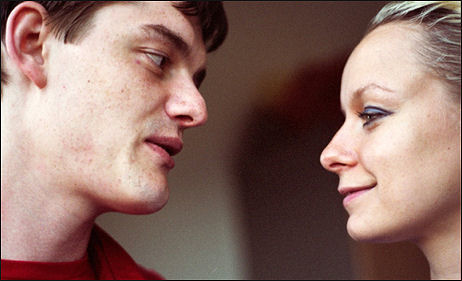
To me, that’s the all of it. In a very stark and disciplined way, Control is a “this happens, and then this happens” telling of a true-life story that does more than just relate events. Corbijn’s stripped-down, no-dramatic-emphasis approach (along with the film’s exquisite widescreen black-and-white photography) lends a certain bleak distinction, and this is what stays with you days and weeks after.
Changing, transforming
“Todd Haynes‘s Dylan film isn’t about Dylan. That’s what’s going to be so difficult for people to understand. That’s what’s going to make I’m Not There so trying for the really diehard Dylanists. That’s what might upset the non-Dylanists, who may find it hard to figure out why he bothered to make it at all. And that’s why it took Haynes so long to get it made.
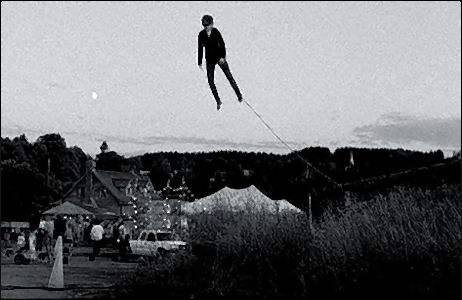
“Haynes was trying to make a Dylan film that is, instead, what Dylan is all about, as he sees it, which is changing, transforming, killing off one Dylan and moving to the next, shedding his artistic skin to stay alive.” — from Robert Sullivan‘s “This Is Not a Bob Dylan Movie,” an eight-page piece (onlline anyway) about I’m Not There in the 10.7.07 issue of Sunday N.Y. Times Magazine.
Recalling Benicio
There’s a good Chris Jones story about Benicio del Toro in the current Esquire that explains the genesis of a certain white T-shirt that the 40 year-old actor wears in Things We Lost in the Fire — a T-shirt with the words SAME SAME printed on the chest. Not just in a jogging scene (when you can read it plain as day) but in other scenes also — covertly, under shirts, jackets and overcoats, unseen but “there.”

“It became very important to him that Jerry” — Del Toro’s junkie character — “wear the T-shirt in Things We Lost in the Fire,” Jones writes. “It made perfect sense to Del Toro that this would be so.
“‘For me, it just, you know, said something about being levelheaded, not taking those ups and downs,'” Del Toro tells Jones. “‘I thought it said something about, you know, like, how to stay in that middle. Like, too happy would trigger him one way, too sad would trigger him another way, too much money would trigger him one way, not enough money would trigger him another way.’
“Except the film’s director, Susanne Bier, didn’t like the T-shirt,” Jones relates. “She didn’t get it. Maybe it was the language barrier; probably it was that Del Toro is flat-out hard to get. Either way, she resisted, and the Bull dug in his hooves, back and forth like that, until Bier finally relented, and today we see Jerry jogging in this curious T-shirt, spun out of some L.A. kid’s graffiti and a Vancouver souvenir shop.
“But that wasn’t the end of it. Del Toro’s known as Benny the Troublemaker not for nothing. There are other scenes, several of them, in which only he knows he’s wearing the T-shirt, a silent rebellion. He turned it inside out, wore it under blankets and bathrobes, even sneaked it onto a shelf in the background. For him, SAME SAME had become his mission. ‘Because at that point, I am that guy,’ he says. ‘I become the book.'”
All great actors are at least a little bit eccentric; some a little more so. One reason that Benicio del Toro is such a phenomenal actor is that he’s always considering the eccentric-weirdo whims that flash in his head (call them inspirations, sugges- tions, orders…whatever) and acting accordingly. All hard creative people receive messages from their inner well-of-wisdom all the time. Sometimes the messages are frivolous or unformed, but other times they tell you exactly what to do or say or the move you need to make.
I did some work on a Los Angeles magazine cover story in the summer of ’95 about the “New Noir” movie generation — guys like Bryan Singer, Don Murphy, Roger Avary, Benicio Del Toro and others who’d recently made films that had a film-noirish criminal edge.
Every big name who was featured in the piece met down at Smashbox Studios in Culver City, and the idea (hatched by editor Andy Olstein) was for everyone to hold a snub-nosed .38 or a .45 automatic and aim it at the camera. They were all okay with this except one — Del Toro.
He conveyed his opposition by motioning me over to a corner, or maybe an unoccupied room. (It happened 12 years ago; a couple of details are foggy.) He looked sad, grim. “I don’t want to do this thing with a gun,” he said. He didn’t like weapons, and he hated the cliche of aiming one at the camera. He wasn’t just disagreeing with the concept — the idea of posing with a gat seem to really disturb him deep down.
I could see that the idea was messing with his head, or perhaps with some core belief system…who knew?…so I figured what the hell. One guy not holding a gun wouldn’t be so bad, I reasoned, and it’ll probably add something to the layout. Uniformity is a mark of mediocrity, after all. So I told Del Toro not to sweat it, “this’ll be cool,” and went over to Olstein to break the news.

Gare du Nord
Olstein didn’t want to hear it. Everybody had to point a gun, he said. I should have worked harder to persuade Olstein that arguing with Del Toro was pointless, that it didn’t matter anyway, that it would give a certain distinction for one of the young Hollywood bucks to not hold a gun. But Olstein wouldn’t back off so I pussied out and went back to Del Toro to tell him Olstein was adamant. So was Del Toro. He’d dug in his heels and that was that.
Benicio went before the camera an hour or so later and refused to hold the gun, and Olstein finally caved.
The next time I ran into Del Toro along was at Gare du Nord in Paris on January 1st, 2000. He’d brought in the new millenium with some actress (I forget who) somewhere in the city, and was now waiting for a train to London where he was shooting Guy Ritchie‘s Snatch. We compared notes, talked a bit, shook hands and I walked off to rent a car. Cool coincidence, nothing more.
I’ve run into Benicio a few times since — at press junkets, a few parties, at the Mercer Hotel in Soho last year — but I’ve never quite forgotten that vulnerable but really complex look on his face — pained, worried, intractable — when he said what he said at Smashbox. Serious guy. Meant it. Formidable.
One other thing: Benicio’s junkie character is heavily into Lou Reed in Things We Lost in the Fire, and Reed’s “Sweet Jane” is heard twice in the film — early on and over the closing credits.
“Crossing Over” in ’07?
There’s some doubt in the air about whether the Weinstein Co. is going to give Wayne Kramer‘s Crossing Over, a Traffic-like drama about the immigration situation between Mexico and the U.S., a modest platform-type release in December. One of the reasons for uncertainty is that the Weinstein Co. recently mailed a list of ’07 films to Academy members, and Crossing Over wasn’t on it.
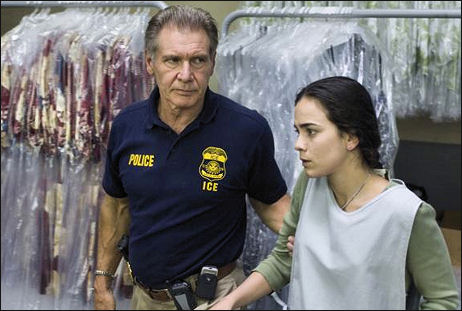
Kramer (The Cooler, Running Scared) directed and wrote with Harrison Ford, Cliff Curtis, Ashley Judd, Sean Penn, Ray Liotta, Alicia Braga, Alice Eve and Jim Sturgess topping the cast. My personal suspicion is that the Weinsteiners will mainly be pushing The Great Debaters (a Denzel Washington-inspires-the- students drama, based on a true story) along with I’m Not There and Control, but a person on the Crossing Over team believes nonetheless that some kind of limited opening will happen before 12.31.07.
“There’s a very strong possibility that we’ll platform in December (probably mid to late) and go wider in January,” he says. “A Crossing Over trailer should be coming out in the next couple of weeks, and Harvey [Weinstein] seems very supportive of the film. Anything can change, as it often does in this business, but the goal is to release in 2007, specifically because the immigration issue is white hot right now and the film is set in 2007 (in the week that the immigration bill failed in Congress).
“And Harrison Ford, by the way, gives one of the best performances of his career in our film. For all his fans who were disappointed that he didn’t participate in Traffic or Syriana, this one is for them. Also, Summer Bishil from Nothing is Private is a revelation, and look for good performances from Alice Eve and Jim Sturgess. And from Sean Penn, of course, who is incapable of delivering a false moment.”
Parallel stories
So there’s a mild story-telling phenomenon afoot these days: movies about two strong assertive alpha males who never meet during the course of the film until the very end, which a friend feels amounts to a kind of cheat. I think parallel-fate stories are interesting as hell, but I know what thsi guy means. You see two tough male leads on the poster and you figure, okay, these guys are going to mix it up on some level. And then they don’t.
The worst case, he feels, was War, the Jason Statham/Jet Li flick “that marketed itself as a big action movie pitting them, when in fact they were only screen together for about 10 minutes and fighting for about five.
“American Gangster is like that too, cutting back and forth between Russell Crowe and Denzel Washington and only putting them face to face at the very end.
“By its nature, The Departed was like that, too, where we never saw Matt Damon and Leonardo DiCaprio on screen together except for that chase sequence in Boston’s North End.
Reservation Road is another example, he feels. “Joaquin Pheonix and Mark Ruffalo meet a couple of times, but they only really come together at the end for that memorable scene.
“I realize that the film is assembled like the book (which has one chapter called ‘Ethan’ and the next called ‘Dwight’) but I wonder if this is something that’s being done to help with budget since you only need the big stars for half the scenes you would normally (i.e., 3 weeks rather than 6 weeks) with little overlap?”
“Can you think of any other movies recently or in the past that followed this trend?”
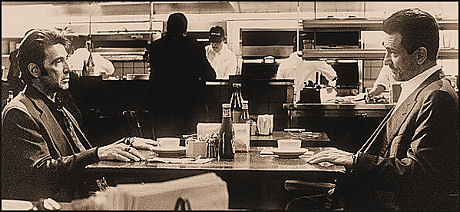
Yeah, but an excellent one — Michael Mann‘s Heat. Robert De Niro and Al Pacino spoke to each other in just one scene (i.e., the face-to-face over coffee at Kate Mantilini) but is was as good as mano e mano dialogue scenes get, and it was all the movie needed. Note: They also speak to each other in the final scene, of course, but barely. De Niro: “Told you I wasn’t going back [to jail].” Pacino: “Yeah.”
Pete Hammond reminded me that Sidney Poitier and Anne Bancroft never meet at all in a 1965 drama called A Slender Thread — about Poitier trying to talk Bancroft out of committing suicide. And of course, Claude Lelouch used parallel stories (i.e., the lovers never meeting until the end) in in at least two of films — And Now, Ladies and Gentleman and (as I recall) Another Man, Another Chance.
I can’t think of any others, although I’m sure they’re numerous.
Weekend numbers
The Heartbreak Kid was never tracking through the roof, but “it looked like $20 million” or something close to that. Nikki Finke reported late yesterday afternoon that this projection had been scaled back to $15 to $16 million, and now even that figure hasn’t been met. The Farrelly Brothers/Ben Stiller film did about $4,585,000 yesterday and is projected to earn $14,434,000.
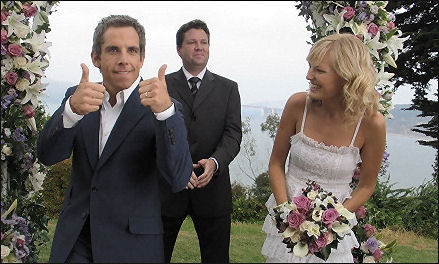
That’s a bit of a stunner. Obviously people detected something in the ads and trailers that turned them off to some degree, but what? Marital discord, betrayal, embarassment, humiliation….something. I suspected that the film’s mysogynist element might hurt business after a few days in theatres, but I didn’t see a first-weekend shortfall. The reviews were pretty bad (some were downright hateful), but this is a very funny film at times. Anyway, a big downer for Peter and Bobby Farrelly (remember those Something About Mary days when they were the kings of screen comedy and Judd Apatow wasn’t?) and not such a good thing either for Ben Stiller. It’s a tough world out there.
Good new for Michael Clayton, though. Tony Gilroy and George Clooney‘s corporate thriller opened in 15 theatres, pulled down about a little $12,000 per screen yesterday and is looking at a $44,000 average over three days and a cume of $688,000.
Wes Anderson‘s The Darjeeling Limited expanded to 19 locations and will have earned $29,000 a print by Sunday night.
The Kingdom will be #2 with $9,471,000, off 45% last weekend’s opener. It’s not going anywhere. What does Jamie Foxx‘s quote have to do with the price of rice? Nothing, but the Kingdom shortall will almost certainly be affected by this.
The fifth-place 3:10 to Yuma will end up with $3,190,000. The cume will be about $48,700,000 by Sunday night. It will obviously top $50 million before it’s done, which is pretty good for a so-so western.
Into The Wild expanded from 102 to 135 theatres, and will take in about $9000 a print for a $1.2 million weekend cume.
The Assassination of Jesse James expanded to 61 theatres and will pull in about $6700 a print for a cume of $409,000. It’s pretty much dead. I did everything I could to spread the word about Andrew Dominik‘s superb film, but if the dogs don’t want to eat the dog food you can’t stop them. (That’s a Samuel Goldwyn-ism mixed in with something else.) I pleaded with HE readers to drag their reluctant friends to this film, but very few obviously did. The moviegoers of this country are like unwashed junkies, walking around looking for quick-fix, feel-good movie highs. They don’t read reviews, they don’t care about ’70s movies, they have no depth or patience with anything, and too many of them actually enjoy hanging around Disneyland pod-people environments like the Grove, which are being replicated in every city and country around the globe. It’s pathetic, and on top of everything else it’s going to be Hilary Clinton vs. Rudy Giuliani in the Presidential race.
Hammond on hunkering down
It’s good to have Pete Hammond‘s Oscar- handicap column back in play, although it’s running on the Envelope this year instead of Hollywood Wiretap. His opening shot is that “a little game is being played” in order to keep the profiles of likely Oscar contenders low, or at least low-ish. As in Presidential politics, nobody wants to be seen as the front-runner too early.
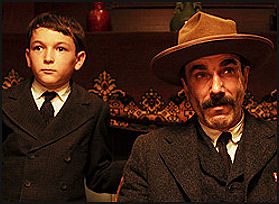
“Smart Academy consultants — battered by this year-round internet and mainstream media interest in the hunt for awards — are starting to act like CIA operatives, doing everything they can to prevent their prime contenders from peaking and burning out before they even open,” Hammond writes.
“One consultant, knowing this column was starting, pleaded with us not to anoint their holiday hopeful (an early front-runner) as an early front-runner. ‘If you mention the movie just don’t say we’re leading anything,’ the consultant begged.
“Another savvy campaigner, having just seen a preview of a late-December entry, waxed rhapsodic about the film’s attributes and called the film absolute perfection, a ‘real contender,’ but then warned us not to say a word. Your secret is safe here!”
A late December entry? Not much of a secret there — There Will Be Blood or The Bucket List or Charlie Wilson’s War, right? And who in their right mind would call a Rob Reiner film “a real contender” and “absolute perfection”?