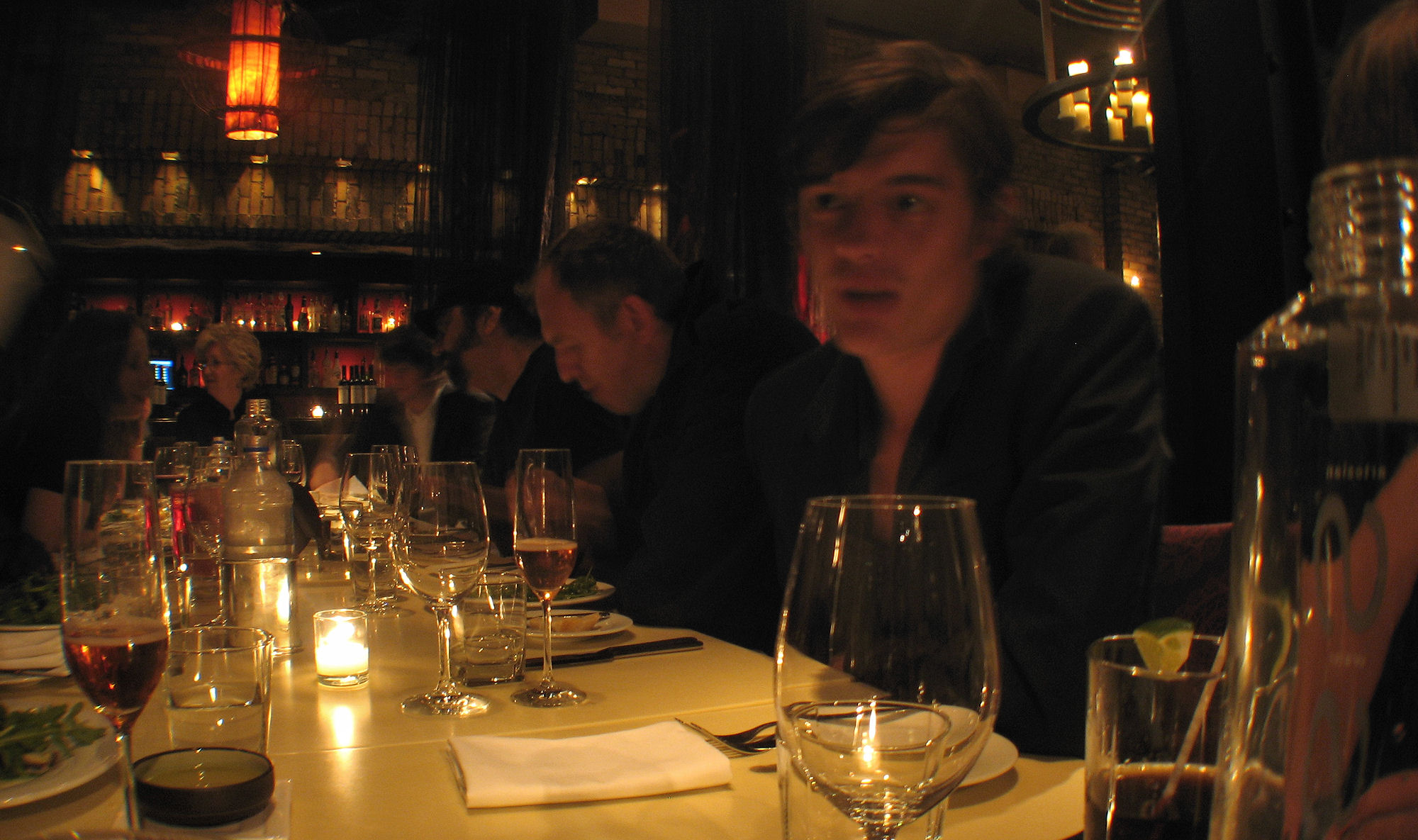
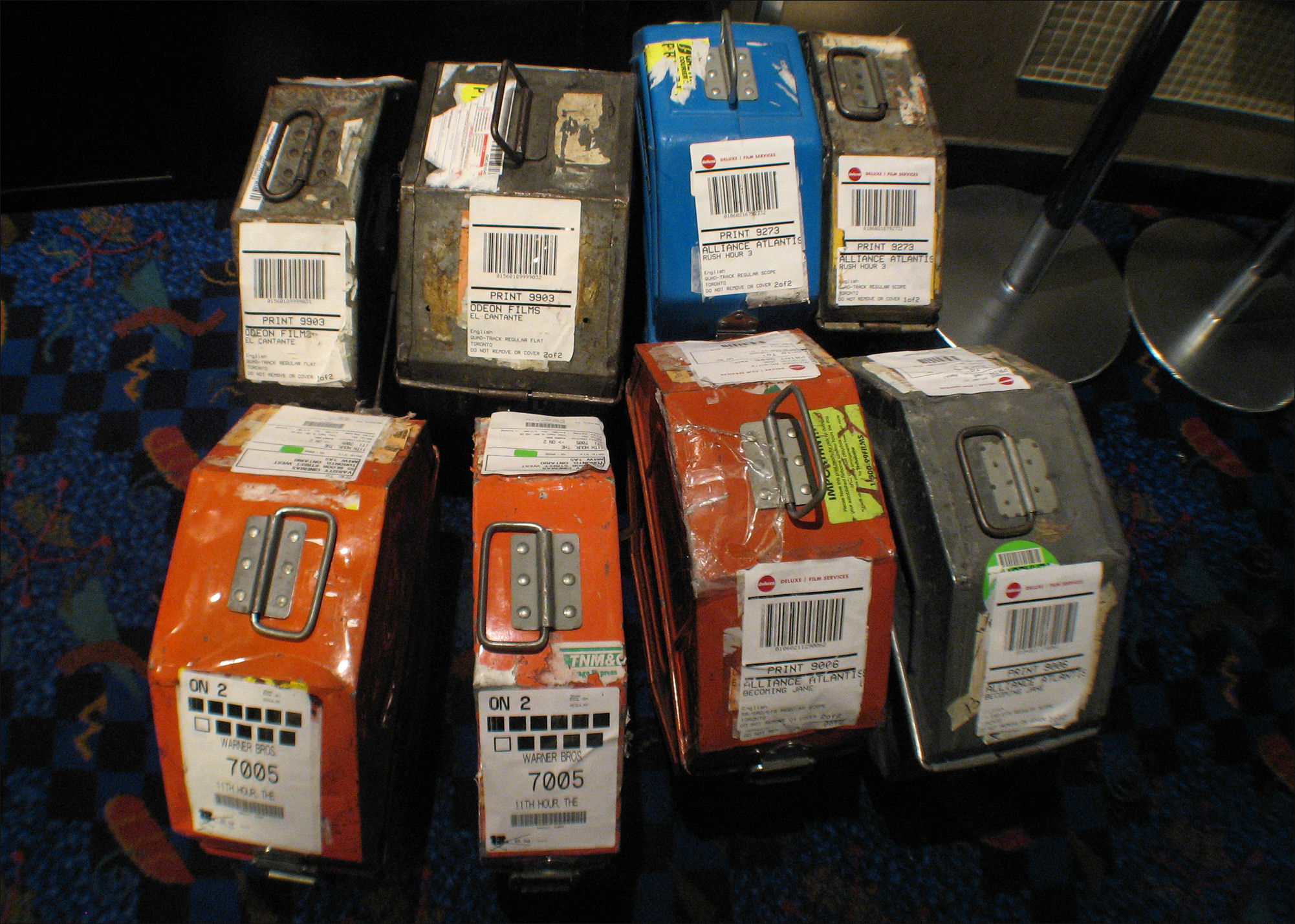
Nilsson doc stranded

At the ’06 Santa Barbara Film festival — sixteen and a half months ago — I ran my first piece about John Scheinfeld‘s Who is Harry Nilsson (and Why Is Everybody Talkin’ About Him?). I started out both liking it enormously and disliking it — I couldn’t get past the depressing aspects of a story about another ’60s-era rock musician self-destructing, but I was deeply moved by the music and the obvious love and care that Scheinfeld put into his film.

For whatever reason a distribution deal never happened. A logical suspect, Sony Pictures Classics, never bit despite Sony BMG owning the Nilsson catalogue, which would allow for an obvious cross-promotion potential.
And now with Scheinfeld’s doc about to have another screening at yet another film festival — a July 14th showing at Martin Lewis‘s Mods and Rockers festival at the American Cinematheque — its rep has become that of a proverbial wanderer, doomed to roam the seven seas without a port to call home.
I don’t know what the problematic particulars may be, but a film as good as this one deserves to be seen. It’s a profound insult to Nilsson, his legacy and his thousands of fans that the best this doc can hope for is some cruddy straight- to-video deal. The man was one of the greatest songwriter-singers of the ’60s and early ’70s — what’s the problem?
Obviously Nilsson never attained Beatles-level fame, and obviously Scheinfeld’s doc has a limited commercial potential. But for the film to fail to get any kind of deal whatsoever is absurd. Sounds like somebody’s being obstinate or unrealistic or both, and that other parties are asleep at the wheel.
Lewis suggested last week that one problem is the title. He thinks the doc should be called Everybody’s Talkin’. As soon as he said this I knew he was right. Are you listening, John?

Foster’s “Death Wish”

Neil Jordan‘s The Brave One (Warner Bros., 9.14), otherwise known as Jodie Foster-does-Death-Wish-slash-Ms. 45, is starting to be shown to select long-lead press with the idea of interviewing Foster before she leaves the U.S. later this month to start shooting her next film, Nim’s Island (20th Century Fox), in Queensland, Australia

A WB publicist told me this morning that The Brave One will play at the Toronto Film Festival a few days before it opens. An L.A. critic friend who’s seen it had some positive things to say about it last weekend, calling it very compelling, interesting, thumbs-uppy, etc.
The generic online synopsis: “New York radio host Erica Bain (Foster) has a life that she loves and a fiance she adores.” What…a guy? “All of it is taken from her when a brutal attack leaves Erica badly wounded and her fiance dead. Unable to move past the tragedy, Erica begins prowling the city streets at night to track down the men she holds responsible.”
Obviously the basic set-up is close to the one used in the cheesy but historic 1973 Michael Winner/Charles Bronson classic. Abel Ferrara‘s Ms. 45 (1981) is more of a feminist-rage, kill-all-male-predators movie, but the story kicks off because of a brutal assault upon a young girl.
“[Bain]’s dark pursuit of justice catches the public’s attention,” the synopsis continues, “and the city is riveted by her anonymous exploits.” Again — exactly like Death Wish. “But with the NYPD desperate to find the culprit and a dogged police detective (Terrence Howard) hot on her trail, she must decide whether her quest for revenge is truly the right path, or if she is becoming the very thing she is trying to stop.”
The most satisfying solution would be for Howard and his cop colleagues to huddle with Foster after she’s been wounded in a shootout and explain that they know she’s the renegade shooter, and that the best solution would be for her to move to another city. She does that, and it’s deftly implied in the final shot that she’ll soon be back in action.

No-work week

Some people are actually working today and tomorrow, but virtually everyone I know will be out of the office for five days straight starting on Wednesday. I wouldn’t drive anywhere during this 4th of July getaway period if you held a gun to my head. Okay, I might go hiking in Lone Pine, but no daytime driving. Holidays are hell. When the going gets easy, the tough sit down at their desks and catch up on their bookkeeping. Face it — it’s going to be a light week.

“Young@Heart” picked up

I was chatting with a Fox Searchlight publicist at last night’s LA Film Festival finale party outside the Wadsworth, and for a while the subject was Stephen Walker‘s sad/funny/soulful Young@Heart, that doc I wrote about last week about a Massachucetts-based octugenarian singing group performing various rock tunes.
I shared my view that Young@Heart is an almost-certain lock to win be nominated for a Best Feature Documentary Oscar, but apparently that’s a no-go due to the doc having played last year on British TV. Thanks to A.J. Schnack for pointing this out in a 6.30 posting on edendale.typepad.
I also told the Fox Searchlight publicist that I’d been told that an indie-level distributor had picked it up a few hours earlier for theatrical distribution. She smiled and expressed general interest but added nothing to the discussion. This morning Variety‘s Anne Thompson reported that Fox Searchlight is the company that made the deal.
I was told last night that Young@Heart will be released sometime between Labor Day and year’s end. In order to Oscar-qualify it would have to play for a week with twice-daily shows before the end of August, but again — last year’s British TV airing apparently disqualifies it.
The L.A. Film Festival award for best international feature, announced last night at the Wadsworth before a screening of Danny Boyle‘s Sunshine, went to Young@Heart. Focus Features has reportedly picked up the remake rights. I couldn’t find the trade story this morning, so I called Focus to see if they could help. That was two and a half hours ago.

Read more

Roth shocking & awe-ing

Last night I attended an LA Film Festival discussion called “Shock & Awe: New Wave Exploitation.” Moderated by F.X. Feeney, the panelists were directors Eli Roth (Hostel, Hostel Part II), Craig Brewer (Hustle & Flow, Black Snake Moan) and Jack Hill (the ’70s exploitation flicks Foxy Brown, Switchblade Sisters). I recorded the whole discussion — here it is.


Director Eli Roth following last night’s disucssion at Westwood’s Armand Hammer Museum — 6.30.07, 8:10 pm

The idea was mainly to size up the 35 year-old Roth, who’s recently been on the skillet for two reasons. One is his having been tarred as the leading purveyor of “torture porn” (a term coined two years ago by New York magazine critic David Edelstein) and particularly due to the loathing expressed over the fetishistic gruesomeness in Hostel Part II, particularly the scene in which a character played by Heather Matarazzo is hung upside down and knife-sliced to death. The other is the recent notion that torture porn is on the wane or starting to be “over” due to the underwhelming earnings generated by Hostel Part II.
I learned last night that Roth is a bright, sophisticated operator — he’s hard-core and full of fire. He knows himself, his movie history, his directors, how to shoot cheap, what he’s proudest of, etc. The key thing is does he want to keep on being “Eli Roth” or does he want to shift into a new gear in order to avoid being typed and confined within the walls of the horror/torture-porn dungeon? (You’ll hear me asking this right after Feeney opens the session up to questions.)
The talk went on for a little more than an hour. I came out of it feeling a lot more respect for Roth than I had going in. He’s much more talented and sophisticated that his films and subject matter suggest. I only hope he doesn’t end up like Tarantino — a B movie fetishist and wallower who refuses to do anything but recycle and reconfigure old-time exploitation movies he fell for in his teens and 20s.

“Valance” at the Wilder

Director Curtis Hanson hosted an L.A. Film Festival screening last night at the Armand Hammer Museum’s Billy Wilder theatre of John Ford‘s The Man Who Shot Liberty Valance. I slipped into the theatre right after the exploitation films panel around 8:30 and caught the last 25 or 30 minutes, and then I sat through the post-screening discussion between Hanson and L.A. Weekly critic Scott Foundas. Variety critic Robert Koehler was also in attendance.

The scratch-free 35mm print was from John Wayne‘s private collection, Hanson said. It looked great, although it didn’t seem to have that super-silvery sheen and needle-sharp focus that I’ve gotten off viewings of the Paramount Home Video DVD.
The Man Who Shot Liberty Valance was critically dismissed for the most part when it opened in April 1962. N.Y. Times critic Bosley Crowther called it “creaky” and declared it proof that “the western, ravaged by repetition and television, has begun to show signs of age…[a] basically honest, rugged and mature saga has been sapped of a great deal of effect by an obvious, overlong and garrulous anticlimax.”
It didn’t make very much money either, and the reasons weren’t hard to figure. Ford shot Valance in black and white, and most of it on a somewhat echo-y sound stage. It’s very talky for a western. James Stewart and John Wayne are both 20 years too old to be playing their parts. And it’s basically an old man’s movie — an elegy for bygone times and regrettably false legends.
But elite critics starting calling it an absolute classic about 30 years ago. Transformers fans will never, ever rent the DVD, but every serious film critic from Maine to San Diego will tell you it’s one of Ford’s very best — his saddest and most personal film ever, and worthy of the highest respect.

I don’t dispute this for a second. You can talk about this film for hours and never run out of new things to discover or re-review. I’ve seen Liberty Valance many, many times on the tube, and I absolutely love the transfer on the most recent DVD.
But the older I’ve gotten (and I’ve said this before), the more trouble I’ve had with Ford’s sentimental cornball streak. The man’s affection for actorly colorfulness among his supporting players seems to get worse every time I re-watch one of his films. Andy Devine‘s performance in Liberty Valance as a cowardly, squealy- voiced sheriff is, for me, 90% torture. (His one good scene is in the very beginning when he takes Vera Miles out to visit Wayne’s burned-down ranch.) Edmond O’Brien‘s alcoholic newspaper editor is a problem performance also. The movie is littered with them.
As Newsweek critic Malcom Jones observed in March 2006, Ford’s movies “are a little antique, a little prim.”
The irony, of course, is that despite the irritating aspects, The Man Who Shot LIberty Valance becomes a greater and greater film with each re-viewing. Some- thing majestic and touching and compassionate seems to come out in greater and greater relief. Genius-level films always gain over the years, but to my surprise I was almost moved to tears last night — and this stagey monochrome oater has never quite melted me before. Go figure.

Sunday morning verdict

Ratatouille is still way in front of Live Free or Die Hard, but it’s been inching down over the last three days while the Bruce Willis actioner has continued to inch up. Both are doing very well with the French rat movie almost $14 million in front of the Willis, but a friend says that at a Marina del Rey showing of Ratatouille yesterday 80% to 85% of the crowd was adult, indicating that this “very sophisticated” film is “not really getting the kids.”
Is this true in Baton Rouge and Jacksonville also? How about Portland? I plan on checking out at least one major theatre showing the Disney/Pixar film later today, but has anyone noticed any similar audience proportions?
Ratatouille‘s three-day estimate is now down to $46,315,000. Thursday’s tracking said it would take in around $50 million while numbers for Friday, 6.29 (reported yesterday morning) projected a weekend tally of $48,406,000.
It would appear that a certain percentage of not-very-worldly types whose idea of world-class, mouth-watering cuisine is a double hamburger with ketchup and fried onions are saying to themselves (and their kids in particular), “Do we really want to go to an animated haute cuisine movie? Maybe the Die Hard flick is more our speed even if it’s not supposed to be as good…Bruce is family, after all, and absorbing familiar emotional assurances from a coarse action flick seems like a safer, more comfortable bet.”
Live Free or Die Hard is now looking at a three-day total of $32,750,000 and a five-day cume of $47,779,000, having been handed a five-day projection of just shy of $40 million last Thursday and $45.8 million yesterday morning.

Rainer on Dreyfuss

I can’t find a stand-out money quote, but Peter Rainer‘s Bloomberg.com piece about Richard Dreyfuss is well phrased and fully felt. Four months from turning 60, Dreyfuss used to be an essential player who was sent all the best scripts early on. He deserves a lot better than what he’s getting today. I’m sure he was glad to be hired to play a loaded gay guy in The Poseidon Adventure, but it felt to me like a minor insult.

Creature Feature

For some unfathomable, better-left-unexplored reason I went to an L.A. Film Festival screening a few hours ago of a newly colorized version of 20 Million Miles to Earth (1957), which will come out on DVD on 7.31.07. I came out with the bitter knowledge that I’d just pissed away 90 minutes of my time on this planet because I liked the movie when I was a kid (i.e., when I had no taste) and because I was curious how good or bad this newly colorized verison might be.

The colorizing, personally supervised by stop-motion animator Ray Harryhausen, looks like an attempt to imitate over-saturated 1950s-style color and as such isn’t half bad, but of course all colorizing makeovers are bad regardless of the care and skill involved. (The upside is that the DVD will reportedly include the original black-and-white version in both 1.33 to and 1.85.)
The film itself gets more ludicrous each time I watch it. It’s hard to know where to begin because every single aspect of this film is amateurishly, sometimes comically “off” in one way or another. I can only surmise that the director, Nathan Juran, was some kind of shameless, talentless, low-budget monster-movie stooge.
Each and every line of Christopher Knopf and Robert Creighton Williams‘ dialogue is somewhere between painful and inept. Each and every actor (William Hopper, Joan Taylor, Frank Puglia, Tito Vuolo, et. al.) seems to doing parodies of clueless, stiff-necked 1950s-style line deliveries. The creature — an ugly green reptile with big whiskers and the arms and torso of a gay body builder down at Gold’s Gym– has no genitalia or waste-disposal orifices. Taylor’s character (i.e, “almost a doctor”) runs down a dirt road in Sicily to attend to an emergency situation wearing black high heels. An American child actor (Bart Braverman) pretends to be a Sicilian kid by imitating Robert Blake‘s Mexican lottery salesboy accent in The Treasure of the Sierra Madre.


William Hopper, Natalie Wood in Rebel Without a Cause

And one thing about the colorizing is plain stupid. Hopper, the son of columnist Hedda Hopper, had prematurely white-gray hair in the ’50s and never attempted to hide this. It’s unmistakably gray (mixed in with some black) in his performance as Natalie Wood’s pissy dad in Rebel Without a Cause, and yet the 20 Million Miles to Earth colorizing team decided to make his hair light-brown sandy. Not quite on the level of some technician’s decision in the mid ’90s to make Frank Sinatra‘s eyes brown in a colorized version of Suddenly! (1954), but pretty close.

No replacable battery?

Whoa, whoa…the iPhone doesn’t have a replacable battery? N.Y. Times “Talking Business ” columnist Joe Nocera was jerked awake by the following passage in David Pogue‘s early-bird review of the device, to wit: “Apple says the [iPhone] battery starts to lose capacity after 300 to 400 charges. Eventually, you’ll have to send the phone to Apple for battery replacement, much as you do now with an iPod, for a fee.”

“That couldn’t be, could it?,” the mind-boggled Nocera asks. “Did Apple really expect people to mail their iPhones to Apple HQ and wait for the company to return it with a new battery? It was bad enough that the company did that with the iPod — but a cellphone? Cellphones have become a critical part of daily life, something we can barely do without for an hour, much less days at a time. Surely, Mr. Jobs realized that.
“Didn’t he?
“When you do what I do for a living, this sort of question is usually pretty easy to clear up. You ring up a company spokesman, and get an answer. But at Apple, where according to Silicon Valley lore even the janitors have to sign nondisclosure agreements, there is no such thing as a straightforward answer. There is only spin.
“‘Apple will service every battery that needs to be replaced in an environmentally friendly matter,’ said Steve Dowling, an Apple spokesman. He went on: ‘With up to 8 hours of talk time, 6 hours of Internet use, 7 hours of video playback or 24 hours of audio playback and more than 10 days of standby time, iPhone’s battery life is longer than any other smartphone.’
“This response didn’t even attempt to answer the question I’d asked him, which was how Apple planned to service its batteries. But never mind. This is another Apple innovation: the robotic spokesman, who says only what he’s been programmed to say.
With Apple taking the position that the battery replacement issue was not something it needed to share with reporters — much less buyers of the iPhone — I went elsewhere in search of answers. I talked to design experts, battery wonks, technology geeks, and Mr. Mossberg of The Journal, the dean of technology reviewers.
“One thing I wanted to know was why Apple had made a cellphone without a removable battery in the first place; it seemed like such an extreme act of consumer unfriendliness. If the iPod was any guide, batteries were inevitably going to run down. With most cellphones, when the battery has problems, you take it to a store, buy a new battery, let the salesman pop it in, and start using it again. Why wasn’t Apple willing to do that?
“It is about assured obsolescence,” said Rob Enderle of the Enderle Group, a technology consulting firm. “That is why they don’t have a replaceable battery in the iPod. But the problem here is that the iPhone will run out of battery life before the two-year service contract runs out.”

Cruise, Germany, Singer

Two particular-interest quotes are contained in Michael Ceiply and Mark Landler‘s N.Y. Times piece (Saturday, 6.30) about the standoff/ contretemps between Tom Cruise and German military officials over their opposition to Cruise playing Col. Claus Schenk von Stauffenberg, the German Army officer who led a plot to kill Adolf Hitler in 1944, in Bryan Singer‘s soon-to-shoot Valkyrie.

Quote #1 is from German journalist Josef Joffe: “Stauffenberg for Germans is like Jefferson and Lincoln, motherhood, and apple pie all rolled into one. Germany is a country of established churches, and so Scientology is viewed as a cult and, worse, totalitarian and exploitative. A professing Scientologist in the role of Stauffenberg is like casting Judas as Jesus. It is secular blasphemy.”
Quote #2 is Singer saying “frankly, I was not aware of the issue of Scientology here in Germany.” What’s the point of saying this, even if it’s true? It makes Singer look clueless, which is he’s never been and never will be. Official German animus towards Scientology has been a fairly well-reported position for several years. Here’s a January 2002 BBC report stating that Cruise “has been lobbying officials in Germany over the country’s strong stance against Scientology.” It’s not credible of Singer or any purportedly aware industry person to claim ignorance of this issue, particularly one who’s about to make a film with Cruise in Germany.

Weekend numbers

Ratatouille, the weekend’s #1 film, is projected to tally $48,406,000, having earned $16,075,000 on Friday. Yes, that makes it the softest Pixar opening since 1988’s A Bug’s Life, but that’s to be expected with such a relatively exotic and sophisticated subject (the travails of a French rat who wants to be a chef). But it’s going to show legs once people see it and talk it up.
Live Free or Die Hard did a little over $10 million last night — figure $30.8 million for the weekend and a five-day cume of $45.8 milliion — hjgher than expected.
Evan Almighty will do $15,947, 000, which is a 49% drop from last weekend. It cost $200 million-plus and it’s not going to make $100 million at this rate. The likelihood is that it’ll come in closer to $80 or $85 million all in.
1408 will earn $11 million this weekend, down 40% from last weekend’s debut. Not bad
Fantastic Four: Rise of the Silver Surfer will end up with $8,188,000 — why do people keep going to this thing? Knocked Up will come in sixth with $7,450,000. Oceans 13 is seventh with a projected $5,995,000. Pirates 3 will be eighth with $4,775,000. Evening will be ninth with $3,918,000 and $4000 a print — not going anywhere.
Sicko is tenth with a projected $3,916,000, or .just under 9000 a print. I’m told that the Weinsteiners were looking for $6 or $7 million. They just need to build this thing and circulate the word.
The second week of A Mighty Heart will bring it about $1,607,000, off 55% La Vie en Rose is still doing pretty well with over $7 million now — good for subtitled film You Kill Me did about 156,000 last night.