

On one hand, the somewhat-New-Line-partial David Poland has called Michael Davis‘s Shoot ‘Em Up “grindhouse dim sum…unbelievably tasty and surprising and engaging stuff…a joyous plate of entertainment…a watchable enjoyable experience…good junk!” On the other, Variety‘s Peter Debruge is calling it “violent and vile in equal measure” as well as “shamelessly sordid” and “gonzo” in the vein of Running Scared, The Boondock Saints, Domino and Smokin’ Aces, and yet — important passage, this — “too stylistically audacious to dismiss outright.” I’d love to get into this myself, but the defining terms have obviously already been drawn. You either have a taste for low-brow vitality, or you don’t.
“Once” at the Landmark
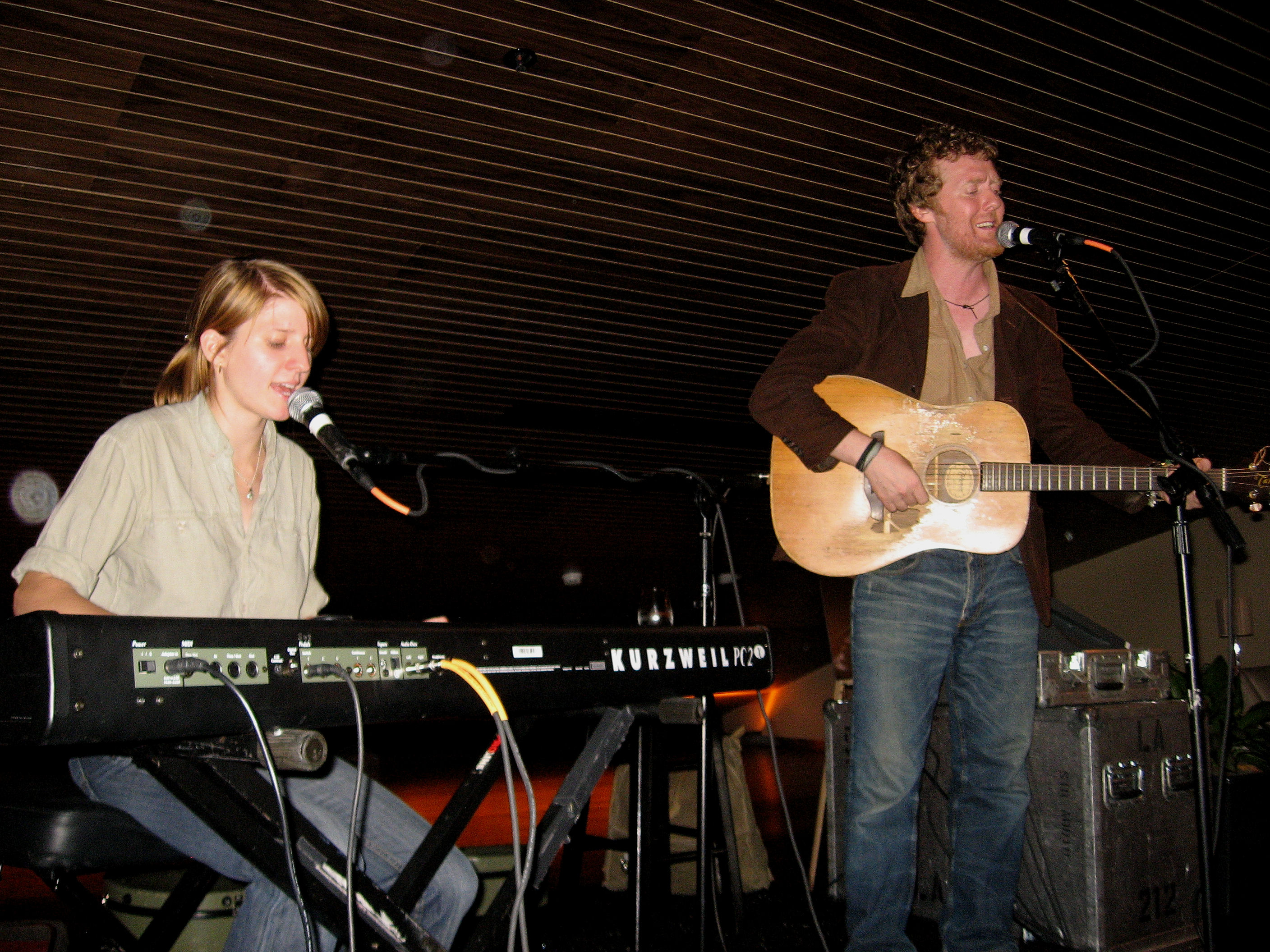
Fox Searchlight and Landmark Cinemas hosted an industry/journo shindig (screening, party, performance) last night for Once, which is right now receiving a fresh TV-ad push and personal-appearance promotion by costars Glen Hansard and Marketa Irglova. Here’s a slow-loading but better quality wav file of their performance of “Falling Slowly”, and here’s an mp3 file of “When Your Mind’s Made Up”.
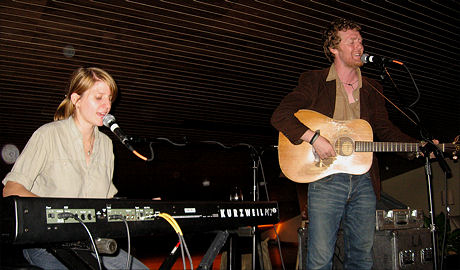
Once costars Marketa Irglova, Glen Hansard performing in the lounge/bar within West L.A.’s Landmark plex — Tuesday, 7.31.07, 9:25 pm
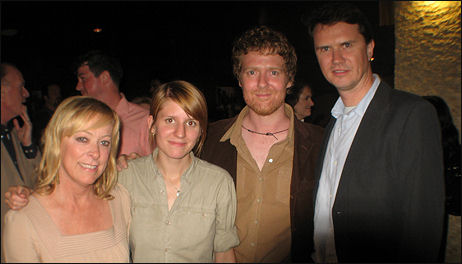
Fox Searchlight marketing president Nancy Utley, Marketa Irglova, Glen Hansard, Fox Searchlight prez Peter Rice at last night’s soiree.
Glen and Marketa are playing this evening at a sold-out show at the El Rey on Wilshire. They visited Jay Leno on Monday night; a visit with Carson Daly airs on Friday, 8.3. Hansard and The Frames are going to be touring with Bob Dylan in New Zealand and Australia throughout most of August. All that’s left to happen now is for the film to show up in more theatres so the live-wires who are still saying “Never heard of it!” will perhaps give this perfect little film a looksee.
Beowulf animation
The Envelope‘s Tom O’Neil wrote earlier today to ask for a quote about the Best Animated Feature race as it looks now. His piece just went up, but here’s my summation in my own words: Ratatouille is the front-runner but the matter of Beowulf‘s classification is far more interesting.
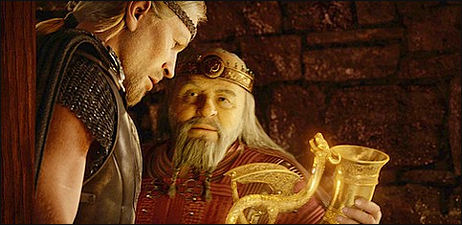
I’ve seen most of the 3D Beowulf product reel that played at Comic-Con, and the digital work has convinced me that it’s the most out-there and avant-garde-ish animated stuff I’ve seen in ages — far more so than Richard Linklater‘s Waking Life or A Scanner Darkly, and way in front of Robert Zemeckis‘s Polar Express.
Here’s how I wrote it…
“By far the best animated film of the year so far is Ratatouille — forget the Simpsons, forget Shrek the Third, and, given the indications so far, it’s hard to think of Jerry Seinfeld‘s Bee Movie as any kind of serious Ratatouille competitor. Look at the new one-sheet, listen to Seinfeld discussing it in Cannes….draw your own conclusions.
“Ratatouille rules because it says something that is true and generous that everyone recognizes as true (or wishes were true), which is that not anyone can be an artist but that art can come from anywhere. To an Academy person, this could be taken to mean that an electrician or a makeup artist or a bit player can write a screenplay or direct a film that everyone will love or which might even win awards. That is music to the Academy’s Unwashed Masses, and this is why Ratatouille has, at this stage, the clear lead. Apart from the fact that it’s one of the best and brightest animated films ever.
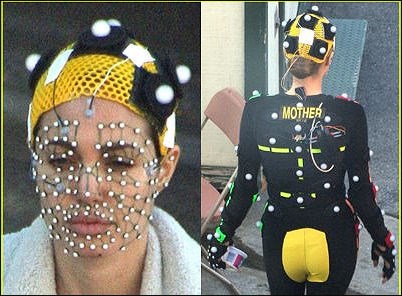
“But the most interesting animated film so far is Beowulf, which I saw a reel of footage from yesterday. Projected in 3D, it looked to me like the trippiest and most absorbing animated footage I’ve seen in ages, although it may not, according to the Academy’s “Rule Seven,” be an animated film. ‘May’, I say.
“Beowulf is a real eye-popper and clearly something other than the realm of animation. Each and every frame is ‘animated’ by any standard of digital recomposition, and yet the Academy seems to be saying that any film that begins with live-action performance and then uses digital animation to enhance or augment that performance (like, say, Linklater’s two above-named films) is not eligible. Again — this is not the final word.
“The animation in Beowulf, which isn’t “animation” at all, is definitely painterly, and at the same time it’s obviously not unvarnished reality. And yet it began at the core as live-action footage of the actors (Ray Winstone, Anthony Hopkins, Angelia Jolie, etc.) shot in a room full of sensors that captures their performance in a bare-bones, Samuel Beckett style at Culver Studios in early ’06.
“Rule Seven of the Academy rules regarding Best Animated Feature film say that a contender has to be “a motion picture of at least 70 minutes in running time, in which movement and characters’ performances are created using a frame-by-frame technique. In addition, a significant number of the major characters must be animated, and animation must figure in no less than 75 percent of the pictures running time.”
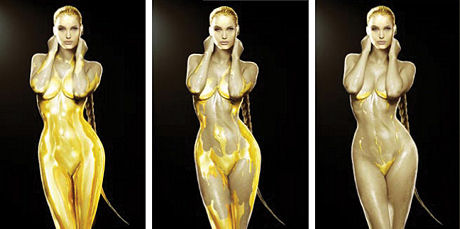
Beowulf screenwriter Roger Avary is calling the 3-D Beowulf “digitally-enhanced live action”. It’s also, in my view and without question, animation. It’s also mind-blowing. I loved it. I can’t wait to see the whole feature.
Beowulf, says Avary, is “enhanced live action” and as such is “closer to Ralph Bakshi‘s painting over cells, the rotoscoping of 2-D imagery, even though Beowulf is about the rotoscoping of 3-D imagery. The 3-D version will be the largest 3-D release of all time. It will be released also in Real-D, a new 3D process, and IMAX 3-D.
“More and more, the differences between animated and real-life action is starting to blur. The form is changing, and rather than limit actors with this technology, Zemeckis is actually trying to figure out a way that can broaden what an actor can do.. He want to make sure it’s about performance…this is the first time that the technology doesn’t get in the way…it’s technology allowing you to fall deeper in the performance.”
Voice of Jackson
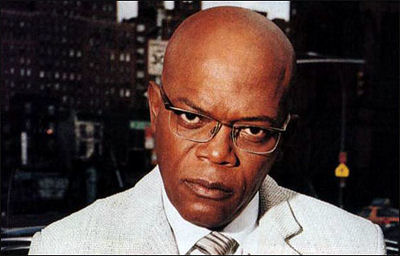
Sixteen minutes of Samuel L. Jackson talking about a few things — his role as “Champ,” a charismatic, grimy-ass derelict revealed to be a former champion boxer in Resurrecting The Champ and the real-life story behind it, the intriguing success of 1408 (in which he played a relatively small role), the respective failures of Black Snake Moan and Snakes on a Plane, and his refusal to name a favorite among the Presidential candidates because nobody’s saying anything,” or words to that effect. (Recorded at yesterday’s Resurrecting the Champ junket at the Four Seasons hotel.)
Obama’s situation
Three factual statements: (a) Hilary Clinton has more black supporters than Barack Obama, (b) the archetypal Barack Obama voter “is a 28 year-old white woman with a Masters degree,” as Tucker Carlson said on MSNBC a few minutes ago and (c) there’s a certain portion of the electorate who will never vote for Obama because he’s black. The last statement especially. We all know this deep down, and that the no-way-in-hell voters are not just old-school Jim Crow types with shotguns racks in their pickup trucks. But no one will ever address it, least of all the Obama campaign.
Podhoretz vs. Bergman
Ingmar Bergman “stopped making motion pictures in 1982, though he wrote and directed several small films for television,” writes N.Y. Post columnist John Podorhetz. “And the truth is, he quit just in time. His day had passed. After decades of declaring modern life worthless and offering only suicide as a way out of the nightmarish tangle of human existence, Bergman had nothing more to say.”

Podhoretz also says that “the critics who described Bergman as the greatest of film artists were people embarrassed by the movies. They didn’t admire the medium. They were offended by its unseriousness, by its capacity to entertain without offering anything elevating at the same time. They believed the movies were a low and disreputable art form and that its only salvation lay in offering moral and aesthetic instruction to its audiences about the worthlessness of existence.”
In other words the people who understand the true soul and purpose of movies (i.e., guys like Podhoretz) know that movies are best at offering light-hearted foolery and unserious entertaining that don’t get too mucky-mucky about reflecting “real life.”
Do I have to point out that this is what the ill-informed always say about movies and particularly about audience-friendly popcorn movies — comedies, thrillers, adventures, westerns, etc.? They don’t understand that the very best motion picture entertainments are always written with and informed by the same structural discipline and seriousness that go into the best heavy-duty dramas. Ask any comedy writer and they’ll tell you all good comedies are written with the same regard for real-life undercurrents as anything written by Eugene O’Neil or directed by Ingmar Bergman.
.
We all know the line between tragedy and comedy is wafer thin. We now also know that guys like Podhoretz don’t know very much about movies. You can’t be a truly devoted movie hound and be an admonisher of the cloistered liberal culture that tends to produce (and always rushes to the defense of) liberal-minded film directors, which are pretty much the only kind that exist with th exception of guys like David Lynch.
Quick — name me a conservative, three-piece-suit-wearing critic who has truly interesting things to say about movies and/or knows what he or she is talking about (except for Michael Medved). By this I mean a critic who really gets what’s going on with this or that new or classic film, and isn’t using film criticism as a podium by which to push some right-wing, family-values, Jesus-loves-you agenda.
Terkel on Bergman
“Ingmar Bergman had an audience of one aside from himself. The one he always sang about was you. His was one symphony with slight variations — from childhood to old age. (My favorite is obviously Wild Strawberries, aging, I hope with some slight honor). The two warriors have always been life and death, who had deep respect for one another. There is no death unless there is no throbbing life; otherwise you never die because you have never lived.” — Studs Terkel as quoted on Roger Ebert‘s tribute page to Bergman.
A Little Residual Ingmar
The closest contact I ever had with Ingmar Bergman, so to speak, was a night in 1981 or ’82 when I talked for a long while with Harriet Andersson, who had a relationship with Bergman in the ’50s and starred in various Bergman films of that general period (including Summer With Monika, Sawdust and Tinsel, Through a Glass Darkly) and later costarred in Fanny and Alexander.
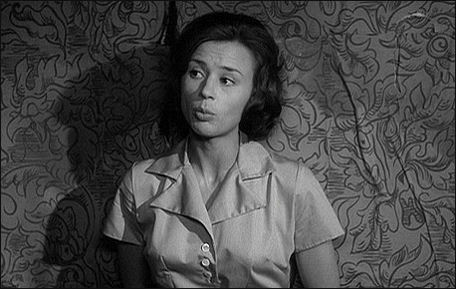
There was actually a little more than talking going on. There was enough of an attraction that after 90 minutes or so Andersson suggested that we could perhaps leave the party (some invitational soiree on behalf of Swedish filmmakers that was happening in some cavernous space in Soho or Tribeca) and head uptown and…who knew?
I knew one thing: an attractive middle-aged woman (she was nudging 50 but looked a good ten or twelve years younger) who had once been entwined with the great Ingmar Bergman was now somewhat interested in me. I was certainly flattered. If you believe that lovers pass along certain particles and auras to each other and that these are somehow absorbed and become part of who and what they are for the rest of their lives, I was thinking that on some ethereal level I might absorb a little residual Ingmar.
But instead of grabbing a cab, Andersson arranged for us to ride uptown in a limo with a group of her Swedish film industry friends, including actor Erland Josephson, who had starred in several Bergman films himself including Hour of the Wolf, The Touch, Cries and Whispers and Scenes from a Marriage.
There were five or six of us crammed into the back seat, and it was only a matter of ten or twelve seconds before they all realized what was going on and starting making joke after joke. In Swedish, of course, but translations were unnecessary.
The mockery and the giggling and the howling went for two or three minutes, but it felt like a non-stop barrage to me. I tried to smile and be a good sport at first, but after a minute or so my eyes froze over. I distinctly remember Josephson being the worst of them. He was slightly in his cups and looking at me with a certain fiendish glee as he let go with one derisive snort after another. The import, more or less, was “Hah!…you worthless nobody!…you think you are good enough to lie down with Harriet?…think again!”
By the time we were let off at Andersson’s hotel at 59th Street and 7th Avenue, I was on the verge of vomiting. It was all I could do to say “very nice meeting you” to Andersson before turning and walking off. She’d been howling along with the rest of them, after all. Nice.
No “Bourne” surge above $50 million?
I’ve been told that a $70 million-plus haul for The Bourne Ultimatum this weekend is out of the question. I’ve been thinking that it might just happen because the word is out that it’s the best action film in many a moon — an instant genre classic — and that it’s not particularly sadistic or even brutal, and that these elements may result in heavier-than- normal patronage from teens, women and family auds. The counter-argument is that Casino Royale opened to $40.8 million and The Bourne Supremacy did $52.5 million “so there’s very little family/four-quadrant element to this, so it virtually can’t jump to those upper numbers,” as one guy put it.
Maxim-Screen Gems horndog movies
Why were films like Fast Times at Ridgemont High, Porky’s, American Pie and The Last American Virgin “both commercially and artistically successful? Because the creators drew from real-life experiences, and therefore made movies that reflected the genuine nostalgia they felt for those experiences.
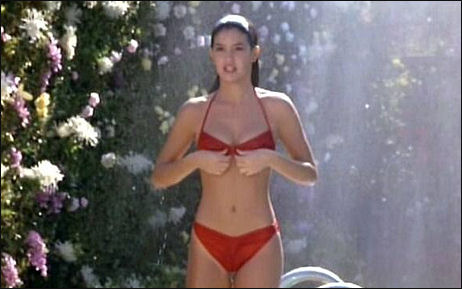
“These films weren’t made from an assembly line, where a group of old men sitting around a boardroom tried to come up with ‘shockingly hilarious’ bits to stitch into a sex comedy. These films — well, except perhaps for Porky’s — had sincere characters and solid story construction upon which to hang the naughty bits.”
So says a rant by The Rec Show’s “Ray” about a 7.30 Michael Fleming story in Variety about an alliance between Maxim Films and Screen Gems to make a series of young-guy horndog movies.
Big Duhhh?
Which director working today is the ultimate anti-Antonioni? A filmmaker who not only expresses an overwhelming indifference to the “haunting nothingness” element woven into the films of Michelangelo Antonioni, but whose films seem to be strenuously arguing with this — films that seem to say over and over that there’s no such thing as spiritual ennui or alienation, and that each and every particle of each and every moment in our lives is filled with vibrancy and connectivity. Or should I ask if there’s any filmmaker at all out there who seems to be at least aware of this age-old current? Or has “nothingness” become so prevalent that alluding to it in any way, shape or form would be regarded by audiences as a big “duhhh”?
Antonioni is dead
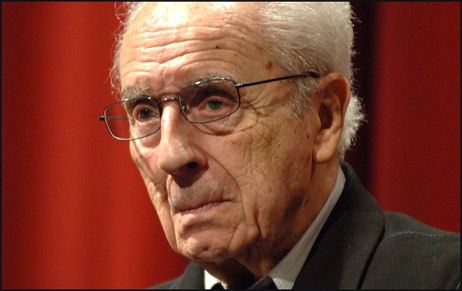
When I wrote my Ingmar Bergman obit yesterday morning, I called him “one of the four or five greatest film directors of the 20th Century.” And now Michelangelo Antonioni, the director of such drop-dead classics as L’Avventura, Blow-Up, L’Eclisse, La Notte and The Passenger who also belonged to this select quartet or quintet, is dead also. He and Bergman passed the same day — yesterday — according to most news services. An old man dying is never a tragedy, but two guys of this stature going within hours of each other…whoa.
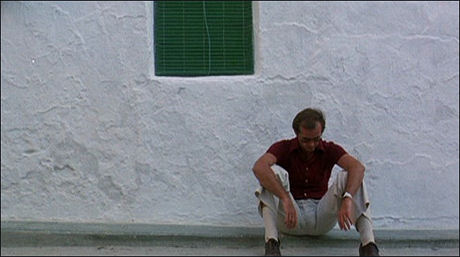
The shallow view of Antonioni’s unquestioned genius period — L’Avventura to Blow Up — is that no one ever made better movies about the elite classes in the grip of exquisite nothingness. The longer, fuller view is that no one ever made better films about nothingness, period.
Very little happens in these and other almost-as-good Antonioni films (like Il Grido, Red Desert, Zabriskie Point)…but they’re all inescapably haunting. A little voice tells you each and every time you’re watching L’Eclisse or L’Avventura, “I can’t precisely explain to myself what this film’s about, but I know each and every frame is a bringer of some kind of fundamental, deep-down current…I can feel it in my soul.”
In his landmark films of the early to mid ’60s, Antonioni captured a certain spiritual ennui — feelings, intimations and observations of profound emptiness, alienation…a drifting-away from meaning and tradition. He was capturing the beginnings of the modernist flu that was infecting the moneyed classes back then, and has since enveloped everyone everywhere (even the guys in Entourage), and he did so with such immaculate composition and clarity that you can watch these films today and come away stunned at their immediacy, altogetherness and absolute lack of anything resembling fat. They do not date.
Pop in the Blow-Up DVD and chapter-flip to the moment when David Hemmings, portraying a hip London photographer who simultaneously knows everything and nothing, is snapping pictures of that couple in that park in suburban London — a younger woman and an older, well-dressed man, standing maybe 50 or 60 yards away. The thing that absolutely wows is the way a strong wind is rustling some nearby bushes and branches of trees, and how Antonioni somehow makes this primeval activity seem absolutely fraught with existential spookiness, and at the same time perfectly natural and innocuous.
James Toback once told me a story about a coarse-sounding distributor (he may have been a bigwig with a company called Brut Films, which financed Fingers) who referred to this visionary artist as “Tonioni.” I’ve always laughed at this knowing there’s a measure of implied respect when even the worst people know about a certain film artist. It doesn’t matter if they get his or her name right; the fact that the brutes know him means everything.
The essence of Antonioni’s visual style is a frequent use of “lengthy tracking shots of human figures against a barren natural landscape or a scene of urban sterility,” a highbrow essayist once wrote. “He’s a visionary of emotional alienation, so morbidly convinced of the apartness of people that he sometimes ends his film by photographing figures in a landscape. There’s a feeling of social breakdown — a profound unease under the surface of things — permeating his work, but this is also accompanied (and this is the nub of his work) with a spellbinding visual grace.”
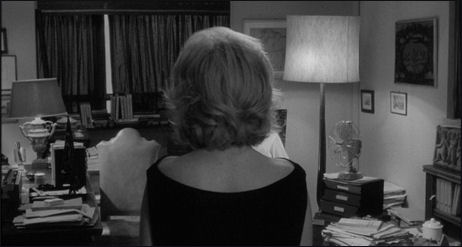
N.Y. Times critic Stephen Holden once described the Antonioni vibe as “brooding metaphysical mood music.”
In ’05 I was obliged to teach three UCLA extension film classes as part of my deal to host Sneak Previews. So for one of the classes I decided to go loopy and show Antonioni’s L’Eclisse (The Eclipse), an exquisitely composed black-and-white film about alienation and spiritual drainage among the aspiring classes in 1962 Rome.
I told the students this was a movie in which almost nothing happens, and that they may feel bored or frustrated by it initially. But I promised them they would never forget it, and that if they didn’t stop being film buffs they would eventually understand its greatness, although probably, in most of their cases, not until they hit their 30s or 40s.
I acknowledged that it’s essentially a movie about, in a manner of speaking, “nothing”…about a couple of attractive people (Monica Vitti, Alain Delon) eyeballing, toying and flirting with each other and having a bit of sex in the third act, but otherwise doing and saying relatively little, without anything resembling a story between them and certainly without any pronounced conflicts or resolutions.
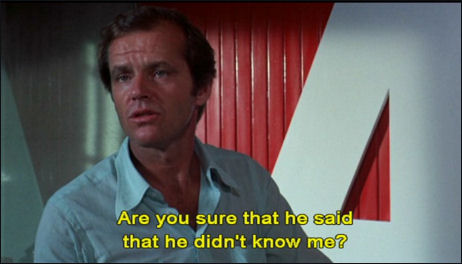
But it has a certain seep-through effect. There’s a torrent of small things in L’ecclise that stay with you — dispirited looks, hints of eros and emotional voids, meditative moments, intimations of ennui and pointlessness. It doesn’t “say” anything but there are echoes all through it.
I showed them L’Eclisse because I know it’s one of the most sophisticated films of the 20th Century, and because the students would probably never see it on their own (it had recently come out on a spiffy new Criterion DVD) and because, as I said to them before showing it, no one in the commercial or semi-commercial realm is making films like this any more.
Critic and essayist David Thomson wrote the following a couple of years ago: “I can watch the world through Michelangelo Antonioni ‘s eyes forever. He is the greatest stylist of the modern era, and The Passenger may be my favorite film. It’s the one I think of offering whenever people ask that question. And they ask a lot.
“No, it’s not in my top ten, but sometimes I think The Passenger is the one I like the best, by which I fear I mean it’s the film I’d most like to be in, instead of just watching.
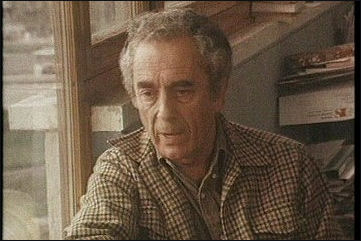
“Dream-projecting ourselves into films we really like is what many — most — of us do, I think, when we’re really taken by them. And when we’re watching films that we respect or admire but aren’t that into, that’s all we’re doing — watching from our side of the window.
“Every time I’ve re-watched any of Antonioni’s five or six greatest — La Notte, Blow-Up , L’eclisse, Il Grido, L’Avventura — I’ve felt this exact same urge to dissolve into a spectral cellluloid spirit, and disappear into the world of these films and wander around and maybe never come back. What would it be like to hang around in an Antonioni film after the movie is ‘over’? Mesmerizing, I would think.”