

“Yippee-Ki-Yay” — spoken by Bruce Willis in the original Die Hard — is not the greatest one-liner in action movie history, as Eric Lichtenfeld suggests in this Slate “Summer Movies” piece. In this context the word “greatest” would have to mean “most satisfying in a zingy, bull’s-eye sense.” Without question, the line that takes the cake in this respect is “Hasta la vista, baby” — spoken by Arnold Schwarzenegger in Terminator 2: Judgment Day.
Bloggers blab
Last night’s “Who Let The Blogs Out” poolside chat was okay, but it only really got going during the last 15 or 20 minutes. Moderator and Variety columnist Anne Thompson did a fine job, but I knew we weren’t quite doing the expected thing when I saw an attractive 30-something couple get up and leave about 20 minutes in. “Uh-oh, we’re dying,” I told myself. My only consolation is that the walk-out couple was very attractive, and attractive people tend to be a little more vapid than others. (Ask Woody Allen.)
Would-be panelist Kevin Roderick of LA Observed copped out at the last minute, telling Thompson he was ill and tired and had to pick up his dry cleaning and take his dog to the vet for an emergency appendectomy. Awards Daily‘s Sasha Stone and L.A. Fishbowl‘s Kate Coe performed nicely, and I kind of muddled through.
The W poolside setting was beautiful, though. I talked to two guys at the Sicko party later on who said they’ve been to the W for drinks on a weekend night, and one of them said he was charged $20 bucks for a beer. After hearing this I immediately wondered, “Where is Tyler Durden living right now? Still in L.A.? Maybe he’s looking for fresh volunteers.”
Sicko thoughts
After the W hotel chat I ran over to the Sicko premiere screening at the Academy and…man, am I lucky! I was born with tough Anglo-German genes and I hardly ever get sick. God help me if it were otherwise, and God help all of us if the U.S. health care system isn’t radically overhauled some day soon, meaning that the corporate slimeballs and politicians who are profiting wildly off the misery of many need to be exposed and tarred and run out of town.
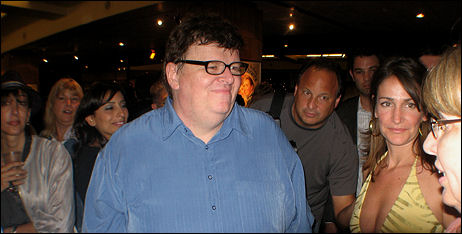
Michael Moore during last night’s Sicko after-party — Tuesday, 6.26.07, 10:25 pm
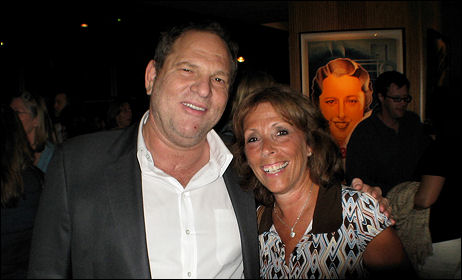
Harvey Weinstein, Phyllis David
Sicko for the second time is still funny and infuriating and a very full meal. There’s no way you’ll come out of it complaining that it didn’t give you enough to think or get angry about. And it’s still quite stirring — it made me feel all mushy toward the end when I saw it in Cannes, and the same thing happened again last night. The crowd was applauding at this and that observation or quip, but the basic current in the room was one of simple, gentle compassion for people who need it…for people everywhere.
The prosecutorial thrust of Sicko is in the details about the general horridness of the U.S. heath care system. And god, what a sickening and inhumane thing that has been for too many people — not the uninsured (which the film barely deals with) but middle-class, for-the-most-part-employed, tax-paying Regular Joes.
I also came out of last night’s screening feeling all the more enraged at the naysayers and nitpickers who’ve been trashing Moore for boiling a very complex situation down to a few simplistic strokes. Moore has done that, yes, but documentarians have to find simple truths in the big tangle. And yes, the stories and situations he passes along in the film don’t convey the entire story and are, of course, slanted. The U.S. health care system may not be quite as venal as portrayed, and the systems in Canada, England and France are, of course, problematic in this and that way.
But Sicko is flawless as a statement of caring — help people who need help, show them some love and TLC, and damn to hell any privately managed health-care system that’s even one half as heartless and abusive as ours, and double-damn those conservative pricks who’ve spent all kinds of energy trying to debate and ridicule what Moore is fundamentally saying here.
Getting sick in this country isn’t a viable financial option if you aren’t insured up the wazoo, and that’s a contemptible state of affairs. Health care should be as free as the cops and the firemen and the libraries that every municipality pays for — end of discussion.
Sicko makes you feel like a human being in the way that Michael Bay or Len Wiseman movies make you feel the other way. Again, Moore’s comparisons between the U.S. system and those in Canada, England and France are incomplete, but watch this film and your heart will tell you that what Moore is saying is essentially true.
I don’t believe that the people he speaks to in this film are lying or fabricating, and I don’t believe they’ve been scripted. When a fire station captain in Havana, Cuba, tells a group of 9.11 workers that all firefighters from every town and country are family, that’s not a lie. I’m basically saying that I believe what Sicko is basically telling me, and there’s no way I’ll listen to the bullshit from the various right-wing, corporate-funded spokespersons who are trying to trash it.
As Moore said during a Sicko press conference, “The French have the best health-care system in the world, and that’s not my opinion. That’s how the World Health Organization rates them. None of them is perfect, but it’s not my role to make criticisms. It’s my role as an American to say, why don’t we take the best elements you’re doing and blend them together, and call it the American system?”
No system is perfect, but Americans “have to take the profit motive out of health- care,” as Moore has said time and again. “It’s as simple as that.” Are you hearing that, status-quo defenders? If there is a Debating God, your ass will soon be grass.
Die Hard screening politics
Faced with an either-or situation, I chose to see Peter Berg‘s The Kingdom last Monday night and not Len Wiseman‘s Live Free or Die Hard, which I was invited to see at Westwod’s Avco by Fox publicity. This was my only Die Hard shot, I was told, so I decided to shine the Avco and pay to see it at a commercial screening on Wednesday. (I’ll probably be going to today’s 4:15 pm show at the Grove.)
What follows may sound insubstantial or overly inside-baseball or anecdotal to some, but it’s a weird snapshot that gives you a taste of what advance-screening policies and politics can be like.
I saw David Poland at last Monday night’s screening of The Kingdom at the Arclight, and yet he somehow saw LFODH in time to write a review last night. How did this happen with Monday’s Avco screening ostensibly being the only time Fox had shown it to non-junket press? A freind told me this morning that Fox had a LFODH screening last Friday that Poland (who had openly complained about the Monday evening LFODH conflict situation on the Hot Blog, just as I did last Friday) was either invited to or heard about and wangled himself into.
Fox publicity read my belly-aching item and therefore knew that this conflict was giving me pause, but they chose not to alert me to the Friday screening. And yet Poland somehow got into it, and today he took a huge dump on the movie.
It would be nice if we lived in a fairer world on a more level-type playing field, but we don’t and that’s that. I can roll with it. Missing LFODH wasn’t the end of the world, although paying to see it later this afternoon will be undoubtedly painful.
Poland disses “LFODH”
Live Free or Die Hard “is an epic piece of shit,” writes The Hot Button‘s David Poland. And yet “as stupid and incompetently made as Live Free of Die Hard is, I laughed a lot. It is so amazingly bad that it really is kind of good. It’s agonizingly bad, and resultingly, a lot of fun.” A few minutes after reading this, I spoke to a guy who’s seen it (unlike myself) and he shrugged off the Poland-isms. “It’s not that bad,” he said. “It’s just another dumb Die Hard movie. It’s has some good scenes, some material that works.”
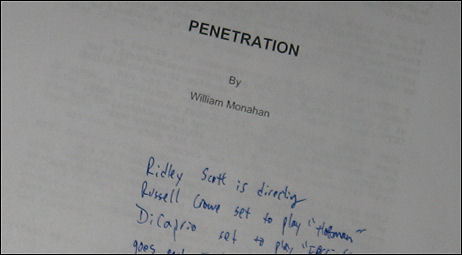
McCarthy on “Cite Soleil”
“Few documentaries could be as different as March of the Penguins and Ghosts of Cite Soleil, a scary, fascinating documentary about gang life in Haiti’s worst slum. If only due to the access achieved, there has never been anything quite like Asger Leth’s film; it’s amazing it even exists and that the director is still alive. Rough as can be in both content and style, Ghosts will be welcome everywhere tough, provocative docus are shown.” — from Todd McCarthy‘s 6.26.07 Variety review.
Gazzale to succeed Firstenberg
Does the appointment of Bob Gazzale as the American Film Institute’s new president and CEO signify any kind of change? He’ll replace Jean Firstenberg this coming November and….then what? Will he re-think the idea of coming up with new variations of AFI Best Lists in order to produce more AFI Awards TV shows (i.e., revenue streams)? Or he’s just going to glad-hand and groove along and continue to let this once respected organization be seen more and more as a remnant of its former self, as something basically flabby and sleepy, as an organizational emblem of Hollywood’s over-50 milquetoasts?
Tarsem Singh’s “The Fall”
Tarsem Singh wishes he could get more people to watch The Fall, which might lead to a distribution deal down the road. I don’t want to sound like more of a slacker than I already am, but I can’t even make myself read this Patrick Goldstein column about Singh’s situation, much less see the movie. It screened at last September’s Toronto Film Festival, but it sounded a little airy-fairy and nobody grabbed me by the lapels and said “see it!,” so I shined it.
Poolside Chat…again
Reminding for the last time about tonight’s Film Independent Poolside Chat at the W Hotel at 7pm. Variety‘s Anne Thompson will moderate, and the guests will be L.A. Observed columnist Kevin Roderick, former Oscarwatch.com columnist Sasha Stone (her site is now called Awards Daily) and myself. Don’t count on Perez Hilton showing — he’s in a very emotional place right now.

Nikki Finke and David Poland passed. I’m back on the bike at 8:05 pm in order to attend the Sicko premiere at the Academy, which technically starts at 8 pm.
Spielberg tribute
In a press release about the forthcoming TCM documentary Spielberg on Spielberg (airing July 9th at 8 pm), George Lucas is quoted as follows: “Steven is the consummate filmmaker. He has an extraordinary ability to make brilliant movies — brilliantly artistic, brilliantly entertaining, and brilliantly successful. Steven’s genius is that he knows, innately, how to communicate through film. He is one of the few directors I know who can actually edit in his head while he is filming.”
Here’s HE’s compassionate revision of this statement, which I’ve sent along to TCM publicists: “Before he compromised and then totally muddied up his once-hallowed reputation with forehead slappers like 1941, The Color Purple, Always, Empire of the Sun, Hook, Amistad, A.I., Catch Me If You Can, The Terminal and Munich, Steven Spielberg was once (i.e., from 1975 to 1982) regarded as a consummate filmmaker. He seemed to have an extraordinary ability to make brilliant movies — stylistically vivid (although not very artistic), often entertaining, and, of course, financially successful.
“The money part is what finally counts for industry mainstreamers who derive satisfaction from showing obeisance before power and kowtowing to the heavyweights. This is built into our DNA — monkeys do the same thing — so try and understand. At the same time please understand that if Spielberg’s films had not been so enormously profitable for so long, TCM would not have produced this documentary. You know it, we know it…and now our cards are on the table.
“Spielberg’s mid ’70s to early ’80s rep was based on the fact that he once knew, innately, how to communicate through film. There was a downside to this, however. What Spielberg communicated all too clearly by having Tom Cruise‘s son turn up alive at the end of War of the Worlds was that he’d turned into a total sentimental sap.”
Mamie Gummer
It’s not exactly a bad time to push Mamie Gummer, but it’s not the greatest time either. She’s Meryl Streep‘s look-alike actress daughter who plays the younger 1950s version of her mom’s character in Lajos Koltai‘s Evening, which opens Friday. There are just two problems. One is that Evening, a baahing little lamb of a movie, is being sent out this weekend into a forest filled with wolves. Another is that Gummer’s obvious resemblance to her mom runs 100% counter to the idea behind Claire Danes portraying a young Vanessa Redgrave, since Danes looks nothing, nothing, nothing like Redgrave when she was in Blow-Up.