

Will Ferrell vs. Pearl, the confession machine. “She’s what we call a loose cannon…we don’t control her!”
Paris Hilton goons
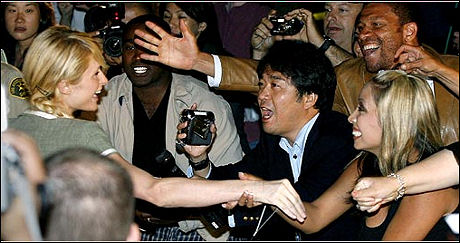
There are four or five cretins in this photo giving adoring, you-go-girl smiles to Paris Hilton as she got out of the slammer. Blowups of their faces (especially the vapid-looking blonde with the big white teeth and the large African-American guy with the light brown leather jacket) need to be put online and posted on telephone poles and construction sites all over Los Angeles.
Weekend tracking
No question about it — Ratatouille is going be the #1 film this coming weekend. It’s tracking at 82, 36 and 13, which is very high for a family film. Tracking never picks up on the full b.o. gobsmack of animated fare.
Live Free or Die Hard (20th Century Fox, opening tomorrow) will perform impressively this weekend, but I’m betting that opening day will be the biggest of the five. The word-of-mouth will half-help and half-hurt, and so the Sunday-night total will be strong but short of historic. 89, 40 and 16 means $25 to $30 million for the weekend, maybe $40 million for the five days.
Sicko did terrific business in Manhattan last weekend, but it’s tracking at 47, 20 and 4. Not bad but not great. “People don’t want to see a movie about health care,” blah, blah…but what people don’t seem to understand is that Sicko makes you melt in the final act. I’ve never once teared up in my life over the idea of regular people receiving lousy health care, but Sicko changed all that.
A marketing guy contends that “the real problem with Sicko‘s awareness and interest levels is that Harvey Weinstein “does band-aid spending” on ads and TV buys, and that “money flows through his hands like concrete.”
You Kill Me, expanding this weekend, could use a shot of some kind — 22, 21 and zero.
Evening (Focus Features, opening Friday), a relatiojnship drama aimed at older couples and mature women, doesn’t have much of a pulse…27, 22 and 2.
Transformers is going to be (big surprise) huge — 91, 42 and 13. The head-scratcher is the length — two hours and 20-something minutes for a picture that has to appeal to kids and young teens? The reason for this is that no one tells Michael Bay and Steven Spielberg anything — they’re surrounded by flunkies, cocooned in their own realm.
Harry Potter and the Order of the Pheonix is racking up monster numbers even though it doesn’t open until 7.11 — 91, 50 and 15.
License to Wed (Warner Bros., 73), the Robin Williams comedy that preemed last night at the Arclight, is looking weak — 68, 24 and 2. And Captivity, the latest torture porn entry, is at 25, 21 and 1.
Timothy Olyphant
After doing an above-average job with a romantic lead role in Catch and Release, Timothy Olyphant is back wearing his evil-and-dangerous mask in Live Free or Die Hard. One-trick-pony villains embody the very essence of movie boredom, and Olyphant has always been a multi-colored performer — a witty darkman with a touch of perversity, a clever kidder, an existential tightrope walker, an absurdist comedian.
I haven’t seen every last Olyphant performance, but his drug-dealer character in Go is, to my mind, still the best thing he’s ever done. He’s been fine in a lot of things since (I liked his work in Deadwood), but he’s never played anyone as darkly brilliant and funny and surprisingly vulnerable as Todd Gaines, the bare-chested wise ass with the Santa Claus cap and the ecstasy tabs. That character was written and performed with just the right balance and attitude.
“Die Hard” is yesterday’s news
“To be honest, of all the things I had to consider making the movie — the story, the characters, the actors — the hardest thing for me was the action sequences. There’s only so much left that you can do with action. I think we’ve done a good job, but I really had to rack my brains to try to think of something fresh.” — Live Free or Die Hard director Len Wiseman speaking to USA Today‘s Scott Bowles.
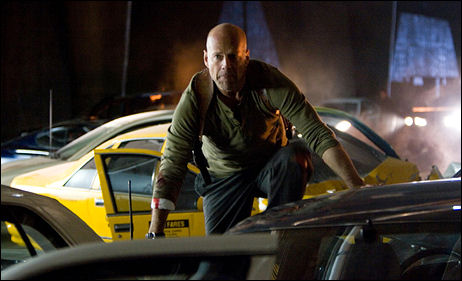
One tactic Wiseman decided upon, according to Bowles, was to quadruple up on the explosions. “Just about everything blows up in Live Free or Die Hard,” the piece observes. “Laptops. Fire extinguishers. Nerds’ apartments. But the fourth installment of the franchise (20th Century Fox, 6.27) comes at a time when audiences are yawning at things that go boom. And this summer hasn’t exactly been kind to spectacle.”
Wiseman also jacked things up with a few CG cartoon-y bits, to go by the trailer.
Another way to make action seem hot and breathless and super-cool (even though this too is starting to feel old) is to to use a lot of jerky hand-held footage and cut it all together at an almost too-fast rate.
I could have gone to the Live Free or Die Hard all-media screening in Westwood last night, but I felt it was more important to see another action flick that’s been getting good buzz. And this film (I can’t write about it just yet) definitely goes the jerky-fast route. And as far as it goes, it works pretty well. There are explosions in this new film also, but they’re relatively few so when they happen, they count.
I was particularly impressed by the action in the third act. Everyone will be; it’s the big selling point. There’s one action scene in particular that ups the ante on that scene in Phillip Noyce‘s Clear and Present Danger when Harrison Ford and a bunch of government guys are trapped and fired upon by gunmen on a small street. We’ve obviously seen it before (in “Grand Theft Auto” as well as on the big screen), but it’s good rock ‘n’ roll.
(Jesus H. Christ — I agreed not to write any kind of review of this film, and last night David Poland went up with a full-on review with all the trimmings. The movie I’ve been speaking of is Peter Berg‘s The Kingdom. Here’s how the game works these days: (1) The publicist says “see our movie, but please don’t review it yet,” (2) You say, “Thanks” and “okay, I won’t,” (3) The movie is screened and a competitor goes home and writes about it immediately, title and all, and (4) You call up the publicist and say, “What the…?”)
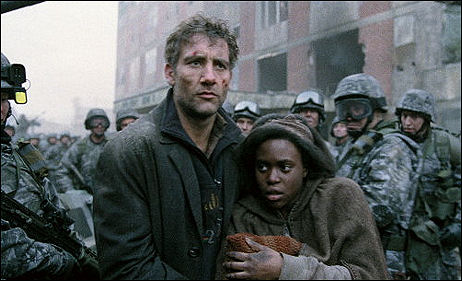
One thing Len Wiseman doesn’t seem to understand is that only one relatively recent action film has really and truly blown minds ands raised the bar: Alfonso Cuaron‘s Children of Men.
At no time did this landmark film make you feel as if the director and the cinematographer were trying to throttle your pulse rate with a torrent of explosions, whiplash photography and crazy machine-gun cutting. It made you feel as if you were there, neck deep in it, and it was all really and truly happening. It wasn’t invested in “action” as much as the reality around it, trusting the audience to absorb the fear on their own terms and to stay with the story as it moved along. Emmanuel Lubezki‘s photography was relatively smooth and continuous but without the cut-cut-cut — scenes went on for seven or eight minutes straight.
Aesthetically and technically, atmospheric “belief” is the new end-all and be-all in the action movie realm. Forcing it doesn’t really work any more. The more it seems as if the director is trying to work you over every which way, the less engaged and excited you’re going to feel. And the more that a director tries to really put you in the middle of a seemingly “realistic” situation — one that smacks of the real deal in dozens of different ways — and is also open to unpredictable and sometimes chaotic shifts, which is how any real-world action-and-death situation feels, the more you’re going to buy into it. For now.
Penn’s “Wild” copy
I wonder what the story is behind a deliberately perverse decision by Paramount Vantage marketers to describe Sean Penn‘s credits on Into The Wild (9.21) in a blatantly non-grammatical way? The one-sheet says “screenplay and directed by Sean Penn.” Obviously it should either say “screenplay and direction by Sean Penn” or “written and directed by Sean Penn.”
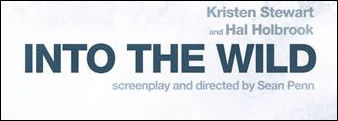
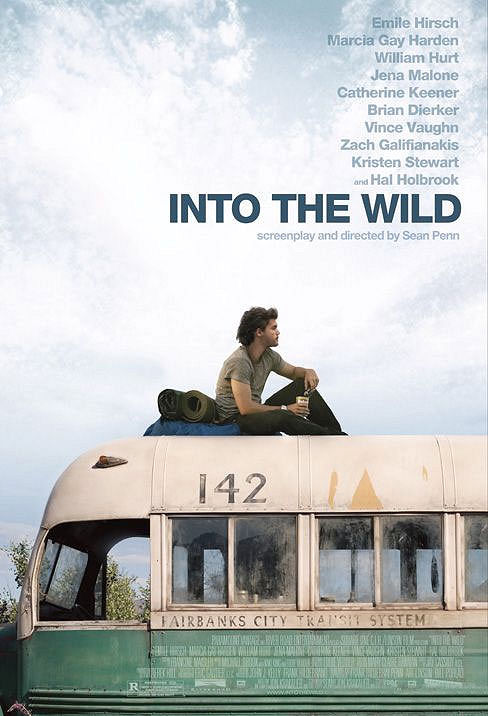
Did Penn go ballistic and say, “I don’t care about grammatical….this is how I want it”? Because he knew it would get attention in the way “The Birds is coming” got attention? Strange. Lame. Here’s the exclusive trailer on My Space.
“To be honest, of all the things I had to consider making the movie — the story, the characters, the actors — the hardest thing for me was the action sequences. There’s only so much left that you can do with action. I think we’ve done a good job, but I really had to rack my brains to try to think of something fresh.” — Live Free or Die Hard director Len Wiseman speaking to USA Today‘s Scott Bowles.
One tactic Wiseman decided upon, according to Bowles, was to quadruple up on the explosions. “Just about everything blows up in Live Free or Die Hard,” the piece observes. “Laptops. Fire extinguishers. Nerds’ apartments. But the fourth installment of the franchise (20th Century Fox, 6.27) comes at a time when audiences are yawning at things that go boom. And this summer hasn’t exactly been kind to spectacle.”
Wiseman also jacked things up with a few CG cartoon-y bits, to go by the trailer.
Another way to make action seem hot and breathless and super-cool (even though this too is starting to feel old) is to to use a lot of jerky hand-held footage and cut it all together at an almost too-fast rate.
I could have gone to the Live Free or Die Hard all-media screening in Westwood last night, but I felt it was more important to see another action flick that’s been getting good buzz. And this film (I can’t write about it just yet) definitely goes the jerky-fast route. And as far as it goes, it works pretty well. There are explosions in this new film also, but they’re relatively few so when they happen, they count.
I was particularly impressed by the action in the third act. Everyone will be; it’s the big selling point. There’s one action scene in particular that ups the ante on that scene in Phillip Noyce‘s Clear and Present Danger when Harrison Ford and a bunch of government guys are trapped and fired upon by gunmen on a small street. We’ve obviously seen it before (in “Grand Theft Auto” as well as on the big screen), but it’s good rock ‘n’ roll.
(Jesus H. Christ — I agreed not to write any kind of review of this film, and last night David Poland went up with a full-on review with all the trimmings. The movie I’ve been speaking of is Peter Berg‘s The Kingdom. Here’s how the game works these days: (1) The publicist says “see our movie, but please don’t review it yet,” (2) You say, “Thanks” and “okay, I won’t,” (3) The movie is screened and a competitor goes home and writes about it immediately, title and all, and (4) You call up the publicist and say, “What the…?”)
One thing Len Wiseman doesn’t seem to understand is that only one relatively recent action film has really and truly blown minds ands raised the bar: Alfonso Cuaron‘s Children of Men.
At no time did this landmark film make you feel as if the director and the cinematographer were trying to throttle your pulse rate with a torrent of explosions, whiplash photography and crazy machine-gun cutting. It made you feel as if you were there, neck deep in it, and it was all really and truly happening. It wasn’t invested in “action” as much as the reality around it, trusting the audience to absorb the fear on their own terms and to stay with the story as it moved along. Emmanuel Lubezki‘s photography was relatively smooth and continuous but without the cut-cut-cut — scenes went on for seven or eight minutes straight.
Aesthetically and technically, atmospheric “belief” is the new end-all and be-all in the action movie realm. Forcing it doesn’t really work any more. The more it seems as if the director is trying to work you over every which way, the less engaged and excited you’re going to feel. And the more that a director tries to really put you in the middle of a seemingly “realistic” situation — one that smacks of the real deal in dozens of different ways — and is also open to unpredictable and sometimes chaotic shifts, which is how any real-world action-and-death situation feels, the more you’re going to buy into it. For now.
Tom Nutjob vs. Germany
Bryan Singer‘s Valkyrie, a thriller about the real-life attempted assassination of Adolf Hitler, apparently won’t be filming in Germany due to a German defense ministry ruling denying permission because of star-producer Tom Cruise‘s allegiance to Scientology. The Germans feel that Scientology is a con and not a legitimate religion (whatever that means), but it seems excessive to say “nein” to a major American film company trying to shoot in their country just because of Tom Nutjob. I mean, it’s not like Singer is trying to shoot Battlefield Earth there.
Cruise is going to play Col. Claus von Stauffenberg, the man who led the anti-Hitler plotters. Think about that — Joel Goodsen in Risky Business playing a senior level German military guy during World War II.
For me to truly believe Cruise in that role, Singer is going to have to start Cruise off the way Stanley Kramer started things off for Maximillian Schell in Judgment in Nuremberg — by having him speak German for a couple of scenes, and then work out some visual signal that tells the audience, “Okay, no more German — we’re switching to the English-language. We just didn’t want you to think we’re one of those lame Germany-based American films in which Germans speak nothing but German-accented English.”
New Yorker critic David Denby has called Lajos Koltai‘s Evening (Focus Features, 6.29) “one of the rare movies that are too sensitive for their own good.” My sentiments exactly, I’m afraid, except for Denby’s use of the word “rare.” Movies that overdose on moist-eyed sensitivity are almost a genre unto themselves.
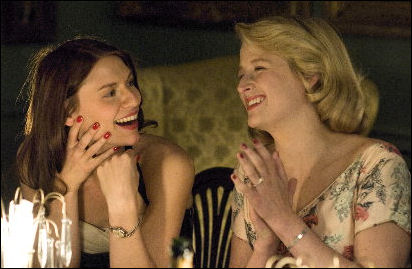
I’m not speaking of chick flicks precisely, but…well, yeah, I mostly am. Episodic chick flicks about suffering that isn’t alleviated until the characters have gotten old or died in some sudden or painful way, or variations of same written by gay guys, or super-sensitive-couples-in-trouble movies, or ones about sensitive families coping with the tragedy gene (i.e., The Virigin Suicides).
Movies that are too much in love with the notion of its characters (i.e., which are often middle-aged women or gay guys, and occasionally teenaged boys) as gentle reeds in a raging river. Movies that not only wear their exquisitely sensitive natures on their sleeves, but use them as soporifics or sedatives. So much so that 20 or 30 minutes in your inner child is crying out for the stern hand of Michael Bay or Eli Roth or Brett Ratner.
There’s a very slender line between sadistic sensitivity and sensitivity that seems genuinely caring and welcome and appropriately applied. The former is about pushing sensitivity while the latter seems to more into letting it happen at the right times and according to the rules of human nature.
Rodrigo Garcia‘s Nine Lives and Herbert Ross‘s Boys on the Side do it right; Michael Pressman‘s To Gillian on Her 37th Birthday and Michael Mayer‘s A Home At The End of The World (novel and screenplay by Michael Cunnigham) do it wrong.
The Hours, which was adapted to the screen by David Hare but based on a novel by Evening‘s screenwriter Michael Cunningham (again!), tried to smother its audience in the goo of massive grief. The mantra of that film was “we’re really hurting — feel our pain,” and the reason some people wet themselves over this film is that it refused to let up. I wasn’t relieved when Nicole Kidman‘s Virginia Woolf finally drowned herself — I was overjoyed.
The United States of Leland, the Ryan Gosling drama about a juvenile who’d killed a young boy, was certainly guilty of laying it on too thick.
Alan Parker‘s Shoot The Moon (’82) was, in my judgment, about a world of adult relationships that was almost grotesquely prickly-sensitive.
I once read a Bo Goldman screenplay called Monkeys, based on a novel by original Evening author Susan Minot, and the sensitive vibes that came out of that script felt like longshoremen poking their fingers in my neck.
Other offenders off the top of my head: Rob Reiner‘s The Story of Us, Rose Troche‘s The Safety of Objects, Jocelyn Moorhouse‘s A Thousand Acres (referred to by press junketeers as “A Thousand Minutes”) and Shainee Gabel‘s A Love Story for Bobby Long (a.k.a., “Bobby Way-Too-Long”).
This is only the tip of the iceberg. There are probably dozens more. Submissions, please.
Sizemore to the slammer
Poor, addicted, self-destructive Tom Sizemore — a walking car wreck in a town filed with drug-meltdown cases — has been doing his level-best for years to erase his career and poison himself in the bargain. The simplest and cleanest procedure would be to kill himself, but it appears that Sizemore is into half measures. TMZ reported this morning he was sentenced to 16 months in the slammer (Donovan Correctional Facilty, near San Diego) for violating his probation in a 2004 methamphetamine conviction.
TMZ = Walter Winchell of the ’40s
Two zippy quotes from Allison Hope Weiner‘s 6.25 N.Y. Times piece about Harvey Levin’s TMZ. One is Levin himself saying that despite initial reservations about launching a celebrity website, “I started seeing that if you don’t have time periods and publishing cycles, you can publish on demand and beat everybody.” The other is a non-identified publicist equating Levin’s power with that of columnist Walter Winchell in his 1940s heyday. “If you have something you know [TMZ] will like, you tip them to it,” he says. “It’s kind of the old way you dealt with the old-time gossip columnists…you have to occasionally feed them an item…you have to be in the game with them…if you’re a publicist and the only time you call up is to complain about an item, they’ll laugh at you.”
Members Only pitch
The single worst TV ad for a line of pseudo-hip ’80s jackets by a celebrity pitchman ever made or aired. In fact, it ranks as one of the worst ads ever, for anything, in any medium. (I’m posting this because of Phil Leotardo‘s goombah nephew…figure it out.) Thanks to Mutiny Co.’s Jamie Stuart for passing this along.
Theatres you like but don’t patronize
This is hard to explain, but here goes: as much as I love the fact that slightly grubby sub-run theatres like Lyndon Golin‘s Regency Fairfax and the Silent Movie theatre a block or two south are doing pretty well, I never really feel like actually driving over and plunking down five or six bucks for a cheap seat at either establishment.
That sounds shitty and unhelpful, but most of us are fairly passionate about seeing movies only at deluxe, blue-chip locations or at home on DVD, and no in-betweens. Call them high-thread-count venues….I don’t care…but I just don’t want to schlub it when I’m out seeing a film. Same deal with the New Beverly Cinema…wait, they’ve put in new seating and have cleaned up the sticky floors?
And yet I love the fact that others in the Fairfax disrict (i.e., the nearby retirement-age community, under-30s with not much money, etc.) love the Fairfax and the Silent Movie theatre. The Fairfax district would be immeasurably harmed if either one of these theatres were to shutter. I mean that. Is this coming out right?