The Long Play

A long ways down the road is The Long Play, a movie driven by the re-teaming of Martin Scorsese and Departed screen- writer William Monahan. Paramount Pictures is funding the development of the script, which reportedly follows two guys “through 40 years in the music business, from the early days of R&B to contemporary hip-hop.”

What’s that…the late ’50s to the late ’90s? No way…no way in hell. Two friends getting older, grayer and fatter as the years roll on and the music gets shittier? The evolution of great pop music from the early ’60s to the present (which would obviously be seen as a history of the changes in U.S. culture from the time of late Eisenhower/early Kennedy to post 9/11 George Bush) it its own epic. A six-hour documentary would have trouble making sense of it. A single narrative 120 or 140-minute drama can’t hope to capture or encompass such a saga.

The Long Play is a good title, though.

Monahan is also working with Leonardo DiCaprio on an adaptation of a late ’06 Hong Kong thriller called Confessions of Pain, with Warner Bros. cutting the checks. The IMDB says the Hong Kong original is about a detective helping a friend to investigate the mysterious death of his father.”

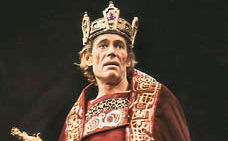
If you were studying Peter O’Toole just before Forest Whitaker was named the winner of the Best Actor Oscar, and then at the precise moment that it happens, it’s clear O’Toole wanted to hear his own name very badly (who wouldn’t?) and that he was pretty much primally shattered when he didn’t. It’s a look of “oh dear God, it’s happened again.”

O’Tooler recovers quickly and applauds Whitaker like a gentleman, but those facial spasms got to me. He wore that same haunted look in 1980 during the curtain call for a critically-despised Old Vic production of Macbeth that O’Toole was starring in. (Some in the audience were booing; others were half-clapping at best — the rudest crowd I’ve ever been a part of.)

The sly old goat should have won on Sunday night. The reason he did (apart from his enervated campaigning and the fact that he started too late) is that Venus didn’t deliver any lump-in-the-throat moments and wasn’t that widely liked.

HIlary and “Casablanca”

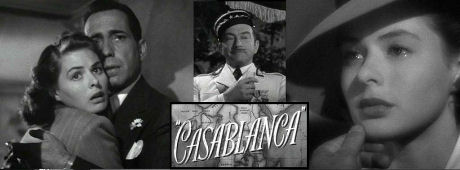
Hilary Clinton‘s main problem is that she appears too cautious, too calculating and over-scripted. If you ask me she’s demonstrated this in an unmistakable way by having recently told CNN’s Bill Schneider and Douglas Hyde that her favorite all-time movie is Casablanca.


Anyone who says Casablanca is their all-time favorite film is deliberately trying to sound bland and unsophisticated

What a totally softball, timid-ass thing to say…Casablanca! A perfect film of its type (I still enjoy it from time to time), but way too sanctified and high-pedestal-ed. All you can say is, “That’s the best film she could think of?” Casablanca is on the level of The Wizard of Oz, Gone With the Wind and The Sound of Music, for God’s sake..

If I were Hilary and I wanted to choose a film that would reflect something a little about myself but also wouldn’t offend potential supporters, I’d go for Network or Heaven Knows, Mr. Allison or From Here to Eternity…something smart and tight but not so oppressively bronzed. Anything but Casablanca. This totally settles it — I’m voting for Barack Obama. Wait, I’ve already indicated that.

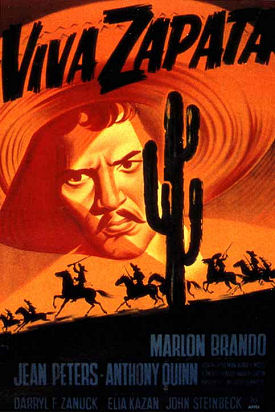
Sen. John McCain has lost his mind over supporting the Iraqi troop surges, but I totally respect his best-film choice — Elia Kazan‘s Viva Zapata (’52), about Mexican revolutionary Emiliano Zapata (Marlon Brando) and his rebellion against the dictatorship of president Porfirio Diaz in the early 1900s. (Isn’t Zapata supposed to come out on DVD via Fox Home Video sometiime this year?)

Gore’s carbon-footprint problem

This is mildly disturbing only because the global-warming deniers and the reactionaries are going to use stories like this to justify careless consumption across the board. That said, Al Gore, no matter what his individual carbon footprint might be, needs to reconsider how such stories will affect the overall green effort. He probably needs to live in a much more spartan fashion. Besides, he’ll lose weight that way.

Murphy departure finals

A perfect confirmation about Eddie Murphy having left the Kodak auditorium after he didn’t win the Best Supporting Actor Oscar has arrived by way of L.A. Times columnist Joel Stein, who spent last Sunday night hanging at the Hollywood Bowl parking lot with all the top celebrity limo drivers, one of them being Murphy’s driver, Karlo Ateinza, who’s been hauling Murphy around for the last seven years.

“Karlo wasn’t having a great night because Murphy lost early,” writes Stein. “I”m really sad. I feel sorry. He should have won it,’ Karlo said. ‘But Alan Arkin is good.’

“Karlo, who drives Murphy only when he isn’t needed by Keanu Reeves, Sandra Bullock or Colin Farrell (Reeves and Bullock both needed him last year, so they rode together), said he figured he’d be home by midnight. ‘He’s not a party animal,’ Karlo said. ‘Last night, he went to two parties, stayed for 45 minutes and went back home.’ After the Golden Globes, Murphy went straight home. Even though he won.

“Though he was worried about Murphy’s mood, Karlo tried to convince himself that the boss wouldn’t be ornery. ‘When he got the Golden Globe, he just put it in the car and he was the same Eddie Murphy. So maybe he won’t care.’

“Right then, at 6:52 p.m., long before Jennifer Hudson would win her Oscar, Karlo’s cellphone rang. ‘I have to go right now,’ he said. ‘I have to pick him up.'”

There’s also this report from the Daily Mail‘s Baz Bamigboye: “If there was an award for worst loser, Eddie Murphy would surely have nailed it.

“He was tipped to take the best supporting actor Oscar for his role in Dreamgirls but lost out to 72-year-old Alan Arkin, who played a drug-addicted grandfather in Little Miss Sunshine. Minutes later Murphy stormed out of the venue and went home — breaking an Oscars taboo of being ungracious in defeat.”

Theres also this “Celebrity News” report by Us magazine’s Noelle Hancock: “Is Eddie Murphy a sore loser? After failing to nab the award for Best Supporting Actor to Little Miss Sunshine√ɬ¢√¢‚Äö¬¨√¢‚Äû¬¢s Alan Arkin, Murphy tried to brush off the loss, telling Us, ‘It’s fine. It happens. It’s OK.’

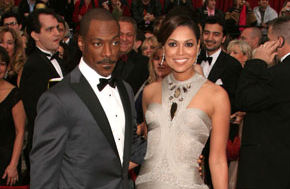
“But clearly it wasn’t. Shortly thereafter Murphy, 45, and girlfriend Tracey Edmonds left the show in a huff and didn√ɬ¢√¢‚Äö¬¨√¢‚Äû¬¢t return. Thanks to the early exit, the actor didn√ɬ¢√¢‚Äö¬¨√¢‚Äû¬¢t see any of his Dreamgirls castmates perform and missed out on costar Jennifer Hudson√ɬ¢√¢‚Äö¬¨√¢‚Äû¬¢s win for Best Supporting Actress.”

The New Disorder

In a New Yorker piece called “The New Disorder,” David Denby discusses the trend of dense, complex, interwoven plots in movies from Pulp Fiction to Babel.

“The Guillermo Arriaga-Alejandro Gonzalez Inarritu films are hardly the sole topsy-turvy narratives out there,” he notes. “In recent years, we’ve had movies, like Adaptation (written by the antic confabulator Charlie Kaufman), that are explicitly about the making of movies, and others, like Eternal Sunshine of the Spotless Mind (also written by Kaufman), that move forward dramatically by going backward in time.

“Then, there is a related group of clogged-sink narratives, like Traffic, Syriana and Miami Vice, which are so heavily loaded with subplots and complicated information that the story can hardly seep through the surrounding material. Syriana made sense in the end, but you practically needed a database to sort out the story elements; the movie became a weird formal experiment, testing the audience’s endurance and patience.

“Some of the directors may be just playing with us or, perhaps, acting out their boredom with that Hollywood script-conference menace the conventional ‘story arc.’ But others may be trying to jolt us into a new understanding of art, or even a new understanding of life. In the past, mainstream audiences notoriously resisted being jolted. Are moviegoers bringing some new sensibility to these riddling movies? What are we getting out of the overloading, the dislocations and disruptions?”

Plurality of “Others”

“After the wonderfully imaginative Mexican movie Pan’s Labyrinth chalked up three quick victories — for art direction, makeup and cinematography — it must have looked to most people like a major upset when it lost best foreign-language film to the German The Lives of Others,” writes Newsweek‘s David Ansen.

“But the entire Academy doesn’t vote in this category, only those members who have seen all five nominated films. Which means that closer to 500 people, rather than 5,800 (the membership of the Academy), choose the winner, and anyone with his ear to the ground could hear the enthusiasm that Florian Henckel von Donnersmark‘s tale of the East German Stasi generated in Hollywood screening rooms.

“Had The Lives of Others gotten a wider release in ’06 (it only played a one-week qualifying run in Los Angeles) it would probably have received nominations in other categories as well, such as original screenplay and perhaps even direction.”

Mood ghoul

Zodiac director David Fincher “is not a police-procedural-type guy. He’s not a people-type guy. He’s a mood ghoul. I don’t think he can relate much to moral outrage. What occupies him is how to send you home antsy, unsure of what you’ve seen but sure it was worse than you think. He gives you the existential willies.” — from New York critic David Edelstein‘s just-up review.

Lee on “Zodiac”

“With a runtime of over two and a half hours, Zodiac super-charges every minute with a maximum of minutiae,” writes Village Voice critic Nathan Lee. “Dizzyingly dense, intricate in the extreme and relentlessly swift, it’s the most information-packed procedural since JFK, though far more restrained when it comes to theorizing.

“The screenplay, meticulously engineered by James Vanderbilt, has been adapted from a pair of books by Robert Graysmith (Jake Gyllenhaal), a cartoonist at the Chronicle who glommed on to the Zodiac case and eventually took it on as his life’s work. Everything has been checked against verifiable sources, then staged with the utmost fidelity and precision; note how Fincher resists dramatizing the events in Paul Stein‘s cab, sticking to a representation of his known route.

“The result is an orgy of empiricism, a monumental geek fest of fact-checking, speculation, deduction, code breaking, note taking, forensics, graphology, fingerprint analysis, warrant wrangling, witness testimony, phone calls, news reports. ‘I felt like I was stuck in a filing cabinet for three hours,’ complained one viewer. Exactly!

“Termite art par excellence, Zodiac burrows for the sake of burrowing, as fascinated by its own nooks and crannies as Inland Empire. It operates with the back-and-forth insistence of a scanner arm, gathering, filtering, digitizing, and storing an immense catalog of analog enigmas. It might have been titled A Scanner Darkly.”

Brushing crumbs away

Defamer has posted a video of Clint Eastwood‘s wife Dina brushing something off his lap during Martin Scorsese‘s thank- you speech, and it’s nothing. And to see it, you have to sit through the whole sequence — Coppola/Lucas/Spielberg presenter jive, the big announcement, Scorsese kissing and hugging those near and dear, addressing the audience, thanking the Departed cast, etc.