Talkign to “Zodiac’s” Graysmith

Termite art — that ‘s the best term I’ve heard so far (taken from a recent review by the Village Voice‘s Nathan Lee) that summarizes the aesthetic essence of Zodiac. And when you talk to Robert Graysmith, the author of the two Zodiac books (“Zodiac” and “Zodiac Unmasked“) that served as the basis of “Jamie” Vanderbilt‘s script, you get the idea that he’s a kind of termite himself — a relentless eater and chomper of information.
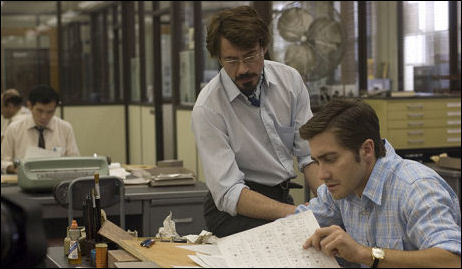
Graysmith is the main character in the film (wth his name used and everything), and he’s played by Jake Gyllenhaal in exactly this mold — a guy who can’t stop absorbing and gathering data. Graysmith sure as hell was that guy when he was on the Zodiac set and watching Fincher make the film. He wrote a book about it calling “Shooting Zodiac” (Berkeley Books) but he’s ambivalent about having it published, for some reason. He’s guessing, I suppose, that the attention given to the film over the next few weeks will surge sales of his two “Zodiac” books and his editor doesn’t want a third Graysmith/”Zodiac” book confusing anyone.

The book will probably come out concurrent with the Zodiac DVD, which is going to be a mother in terms of extras and docs. The DVD’s production budget, Graysmith says, is around $1.5 million.

I mentioned my opinion that the end of the film should perhaps have ended like Vanderbilt’s screenplay did, with “Graysmith”/Gyllenhaal delivering an eight- or nine-page soliloquy that reviews all the persuasive evidence in support of Graysmtih’s belief that Arthur Leigh Allen was the Zodiac slayer.

On the page, this scene works as a kind of crescendo-climax. It’s not entirely satisfying but it gives a semblance of half-assed completion and finality, even if Allen was never arrested for the killings. Fincher’s chose, however, not to try and deliver any kind of ending along these lines, even an intellectual one. Graysmith says that Fincher told Vanderbilt at one point, “Jamie, we’re not trying to convince the audience [of Allen’s guilt]…,that’s not what the movie’s about.”
“We’re satisfied that it was Allen,” Graysmith says. “There was all kinds of evidence…footprints in the garden…I think he was deliberately pitting the police departments against each other…I think it’s this guy.”

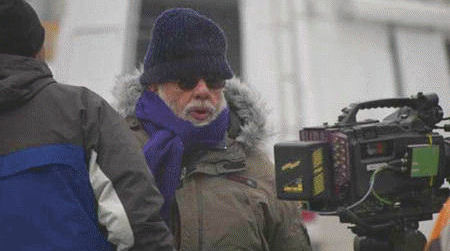
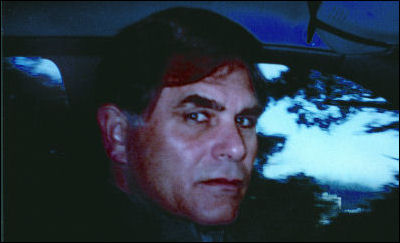
Graysmith will be at Thursday night’s Zodiac premiere on the Paramount lot, at which time I hope to take a picture or two. The above jpeg was provided, believe it or not, by his publicist.

I like this riff on the film by Entertainment Weekly‘s Owen Gleiberman:

“Explaining a mystery is an act of reassurance. It makes us feel that chaos has been defeated, and the forces of order restored. Zodiac, David Fincher’s vastly intricate and dazzling drama about the hunt for the serial killer who terrorized the San Francisco Bay Area starting in 1969, offers no such soothing closure, and that’s part of what’s haunting about it. It spins your head in a new way, luring you into a vortex and then deeper still, fascinating us as much for what we don’t know as what we do.”

Roly-poly cancer patient

The Bucket List‘s IMDB synopsis says it’s about two terminally ill older guys — Jack Nicholson, Morgan Freeman — who “escape from a cancer ward and head off on a road trip with a wish list of to-dos before they die.” I’m not going to make any negative assumptions because Rob Reiner is directing. Just because North, Ghosts of Mississippi, The Story of Us, Alex & Emma and Rumor Has it bit the dust is no reason to think rashly.

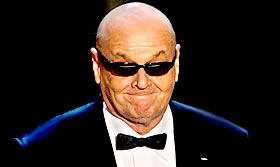
The problem, for me, is this: Nicholson looks too well-fed to play a dying cancer patient. I’ve looked at a lot of online photos of people with chemo baldness and they’re not all emaciated or even thin, so I can’t say Nicholson’s appearance is necessarily inaccurate. But I’ve seen or run into several late-stage cancer patients with concentration-camp bodies in my time. Plus Nicholson has always radiated a certain boisterous life force, and it seems you’d have to do more than shave his head to make look like a man withered by cancer and facing death.

If he had dropped 30 or 40 pounds for the role a la Christian Bale, then I’d be on board. But Jack can’t do that. Jack has his pleasures, his lifestyle…Jack has to be Jack. So a grinning, hale and hearty, roly-poly dying cancer patient will have to do.

The Bucket List (Warner Bros.) is due to come out in November, but the IMDB says it’ll open in Argentina on 9.20.07.

Fake Smith photos

This Radar Online report about the National Enquirer running fake Anna Nicole Smith body-bag photos is icky and surreal. If once a magazine indulges itself in running faked Photoshop images, very soon the editors will come to think little of running intrusive and sometime sloppily reported stories about celebrities; and from that to paying low-life sources and running photos of celebs in their out-of-shape bodies at the beach, and finally to general obnoxiousness and tackiness.

Traditional media vs. online

“An even greater challenge to both newspapers and broadcast networks is the growing power of the internet as a news distribution platform,” reads an online summary for News War, a four-hour PBS Frontline special examining the political, cultural, legal, and economic forces challenging the news media today.

Jeff Fager, executive producer of 60 Minutes, says “we haven’t seen the model for how broadcast journalism is going to end up on the Internet, but it has to go there. I mean, you don’t see anybody between 20 and 30 getting their news from the evening news; you see them getting it online.”

An even more seminal quote comes from Markos Moulitsas of Daily Kos, one of the country’s most popular blogs and a reportedly receiver of 3 to 5 million visitors per week. “People want to be part of the media,” Moulitsas tells Frontline. “They don’t want to sit there and listen anymore. They’re too educated. They’re taught…to be go-getters and not to sit back and be passive consumers. And the traditional media is still predicated on the passive consumer model — you sit there and watch.”

Trainspotting

Nine days ago this foreign-shores guy listed the 10 greatest speeches and monologues, and every last one was an AFI cliche that nobody wants to be reminded of ever again.

He even gets the Trainspotting speech wrong, which he excerpts as follows: “Choose life. Choose a job. Choose a career. Choose a family, Choose a big television, Choose washing machines, cars, compact disc players, and electrical tin openers. Choose good health, low cholesterol and dental insurance. Choose fixed-interest mortgage repayments. Choose a starter home. Choose your friends… Choose your future. Choose life.”

That’s okay, but nowhere near as good as the rant that plays at the very end, to wit:

“So why did I do it? I could offer a million answers, all false. The truth is that I’m a bad person, but that’s going to change, I’m going to change. This is the last of this sort of thing. I’m cleaning up and I’m moving on, going straight and choosing life. I’m looking forward to it already. I’m going to be just like you: the job, the family, the fucking big television, the washing machine, the car, the compact disc and electrical tin opener, good health, low cholesterol, dental insurance, mortgage, starter home, leisure-wear, luggage, three-piece suite, DIY, game shows, junk food, children, walks in the park, nine to five, good at golf, washing the car, choice of sweaters, family Christmas, indexed pension, tax exemption, clearing the gutters, getting by, looking ahead, the day you die.”

Copplas’s “Youth Without Youth”

The Permalink doesn’t work but Screen Grab posted a short item yesterday about Francis Coppola having begun to screen Youth Without Youth. The low-budget, European-shot film “was shown to invited guests at Lucasfilm’s headquarters in the Presidio” within the last couple of days, the copy reads. Here’s the uh-oh part: “The filmmaker’s invitation stressed that the movie, Coppola’s first in 10 years, is intended to be particularly personal, in keeping with ‘the great cinema of Europe and Japan that had first inspired me to become a filmmaker myself.”

In other words, a possibility exists that Youth Without Youth — I’m very sorry to say this but I know the signs — is a Nuart one-weeker waiting to happen. It may not be this at all, of course (and I hope it isn’t), but the warning buzzer has sounded. When a filmmaker says to his friends (forget the press) that they need to adjust expectations before seeing it, you know it’s probably an incomplete salad of some kind. A director saying “it comes from my heart” always means trouble. I wish it were otherwise.

If a movie is in the zone, you don’t need to say anything. It is what it is and you don’t need to lay down special silver or fine-cloth napkins.

The official website synopsis says that Youth Without Youth stars Tim Roth “as Dominic Matei, a professor whose life changes after a cataclysmic incident during the dark years prior to World War II. Becoming a fugitive, he is pursued through far-flung locations including Romania, Switzerland, Malta and India.” The themes of the film, says Coppola, are about “time, consciousness and the dream- like basis of reality. For me it is indeed a return to the ambitions I had for my work in cinema as a student.”

YWY also stars Alexandra Maria Lara (Downfall), Bruno Ganz (Downfall, The American Friend, Nosferatu), Marcel Iures (Peacemaker, Hart’s War) and introduces Alexandra Pirici. The IMDB page says Matt Damon has a small role of some kind.

One could deduce from Coppola’s remarks that Youth Without Youth may not have some or perhaps any of the usual qualities of strong narrative cinema — a punchy-grabby beginning, story tension, a gathering thematic weight, a great ending (surprising, darkly ironic, gently meditative) and so on. Or maybe it does and Coppola is just being coy. The film may be wondrous on some level. Coppola has said that creatively he feels like he’s 17. Maybe it’s a new L’Avventura of some kind. I don’t want to be cynical about this. I just know that whenever a filmmaker says, “Before you watch this film…,” it’s cuidado time


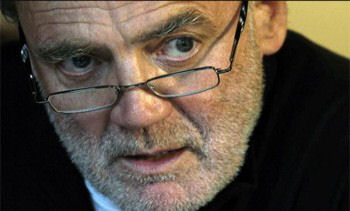
Youth Without Youth costar Bruno Ganz

Somebody who was at the screening (or who heard from someone who was there) said that “all the talk at the party — in awestruck tones indicating that Coppola’s aim had been fulfilled — was about imagination and metaphor and vision.” It’s probably better to wait until someone who really doesn’t care one way or the other has a chance to see it and share a straight-from-the-shoulder reaction.

Maher on beers and opportunity

“The thing about America, is that it is without walls. You can get almost anywhere if you insist upon it. There are no credentials for [talk-show hosting]. There’s no kind of credentials to be president! Except age and place of birth. It’s kind of a low bar. I hope that next time people go to the polls they vote for the guy who can read rather than the guy they’d rather have a beer with.” — Real Time‘s Bill Maher talking to Time‘s Ana Marie Cox.

Wells response: As Maher knows, red-state cultural conservatives — particularly the religious types — have pretty much one goal in mind when they vote for President, which is get a person into the White House who will uphold and reaffirm right-thinking, God-fearing cultural and religious values in this country, and thereby help to stop the once-great U.S. of A. from sliding into the crawling green swamp of liberal anything-goes values, the most odious of these being (a) gay marriage, (b) stem-cell research and pro-choice, and (c) buying into the “myth” of global warming (which, if it really catches on, will keep hard-working people from burning all the fossil fuels and punching as big a hole in the Ozone layer as they damn well please, because it’s their absolute God-given right as free Americans to destroy the world if they so choose).

That is why so many red-state Mensas out there use the “Dating Game”criteria. They’re interested in what kind of person the candidate is deep down. Does he/she a reasonably modest and humble sort? Does he/she believe in a higher power? Is he/she decent, compassionate, folksy? Does he/she understand and empathize with the values of regular working people as opposed to the rich blue-state elites? This is why Barack Obama may have a real chance — because he’s very sincere and dug in on the Christianity-God stuff, and because he doesn’t radiate effete east-coast power-broker vibes.

Of course, many in the rural red-state genius camp are suspicious of people of non-Anglo pigmentation and couldn’t possibly vote for a President whose middle name is Hussein. “What’s in a name?” William Shakespeare once wrote. “That which we call a rose would smell as well by any other name.” I don’t keer whut yuh say — I ain’t votin for no guy with a name like that to run this country.

Rock is an alien

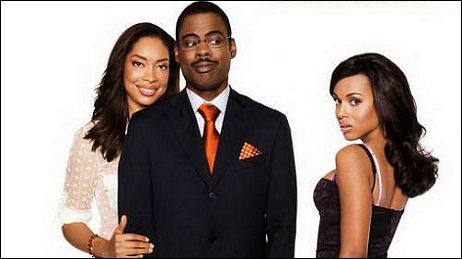
I haven’t seen Chris Rock‘s I Think I Love My Wife (Fox Searchlight, 3.16), but there’s a fundamental problem with the basic premise. Rock, who directed, co-wrote and stars, plays a bespectacled, suit-wearing husband (Gina Torres is the wife) who develops an extra- marital itch for a hot lady (Kerry Washington). The problem is that I don’t believe Rock could get worked up about anything other than some matter that immediately affects the business fortunes of Chris Rock.

Some actors project empathy, vulnerability…a regular-guyness. At best, Rock projects the vibe of a whip-smart, slap-happy alien.

I don’t believe that Rock (or any permutation of him) could ever really be in any kind of recognizable marriage — to me, he always seemed totally married to his act. I’m not even sure I can believe Rock as a guy who has sex. With anyone. It’s even a struggle to imagine him jerking off. Rock is about being on-stage and kicking ass — energy, nerve, focus…how to deliver a joke in exactly the right way. This combined with his obvious intelligence is why he’s so good.

I believe Rock as a guy bristling at the conventions of marriage, which is partly what his character seems to be about. But I don’t believe him as an regular shmoe capable of being committed to a wife , and definitely not a guy who would care enough about sex (extra-marital or otherwise) to go after it with any effort. I don’t know Rock at all — I’ve had exactly one 12-second discussion with him at a party. But I honestly feel that HAL 9000 in 2001: A Space Odyssey projects more humanity.

Ruffalo talks to Faraci

A smart salute for Mark Ruffalo, an actor with a solid-gold attitude who shudders at the idea of ever going “waah, waah, waah” over anything. CHUD’s Devin Faraci asked him about the tension that reportedly kicked in when fellow Zodiac costar Jake Gyllenhaalwas asked by director David Fincher to do dozens of takes for certain scenes. Here’s an excerpt:


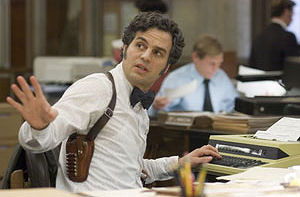
Ruffalo as Det. Dave Toschi in David Fincher‘s Zodiac

Faraci: “Some of your strongest scenes in the movie are with Jake Gyllenhaal. What’s he like to work with?”

Ruffalo: “He was good. I’ve known Jake for a long time, and it was good to work with him. It was fun to see him really kind of stretch his wings with somebody like Dave Fincher. They were tough scenes, and they took a lot of building, but I’m happy the way they ended up. It’s a good performance, and I think it’s one of his best. As much as he talks about being put through the wringers, it paid off for him.

Faraci: “Was that your experience with Fincher as well? Jake talked to the New York Times about how difficult the process was for him, and Fincher is known for being very exacting. Was your experience similar to his?”

Ruffalo: “I can only respect an artist like Fincher. I can only respect somebody who puts that kind of demands on himself and the people around him. I can only respect a man who doesn’t think good enough is good enough. So I didn’t see it the way some people saw it — to me that’s ‘waah waah waah.’

“I mean, to me, we get paid a lot of money and there are people who work a lot frickin’ harder…most everyone on the set. If you had to do a few extra takes…to hear that makes me cringe. Please, God…don’t think we’re all like this.”

Absolutely false

Here’s an Eddie Murphy observation from someone who was at the Kodak. I’m not trying to beat a dead horse — it’s just that this person doesn’t agree with the descriptions about Murphy bolting in some kind of fuming, petulant fashion.

“I was at the Oscars, sitting towards the front in the orchestra, and I watched Eddie Murphy leave the auditorium. He passed less than twenty feet away from me and I watched him very carefully because I knew the loss for Best Supporting Actor had to sting and was hoping he was just taking a short break and would return soon.

“For the record, he did not ‘storm out’. He did not ‘leave in a huff’. Those phrases imply a mien of anger and agitation that were simply not present. To the contrary, Eddie was composed and polite and waited patiently for those in front of him to exit the theater first. He was as cool and gentlemanly as a person could be under those circumstances.

“The phrases ‘storm out’ or ‘leave in a huff’ may be figuratively true (it’s arguable), but they are absolutely false in any literal sense. Anyone who repeats those phrases is misrepresenting what actually happened at the moment when Mr. Murphy left the auditorium, and perpetuating a falsehood. There are enough lies in Hollywood. Let’s not add one more to the pile.”