There are only two…okay, maybe three powerhouse performances in the Best Supporting Actress ranks right now. The top slot is absolutely owned by Da’Vine Joy Randolph‘s bereaved, drinking-too-much cook in Alexander Payne’s The Holdovers.
Almost in the same realm as Randolph is Penelope Cruz‘s fuming and resentful Laura Ferrari in Michael Mann‘s Ferrari — she has a single scene in which she completely owns and rules.
I still haven’t seen Jodie Foster‘s performance as the…best friendo or girlfriend of Annette Bening‘s titular character in Nyad. You could also throw in Viola Davis‘s mother-of-Michael Jordan performance in Ben Affleck‘s Air. You could even throw in Rachel McAdams‘ caring, supportive mom performance in Are You There God? It’s Me, Margaret.
Due respect but you can almpst certainly forget Julianne Moore in May December, America Ferrera in Barbie (that great third-act rant), Emily Blunt in Oppenheimer.
I haven’t yet seen Vanessa Kirby in Napoleon (HE’s NYC screening of Ridley Scott‘s film happens on 11.14) or Danielle Brooks in The Color Purple.
J. Robert Oppenheimer (1902 — 1967) and Leonard Bernstein (1918 – 1990) were well-born, well-educated Jewish geniuses of the 20th Century and internationally famous giants in their respective fields (physics and music)..men who rocked their realms and left indelible cultural impressions while unmistakably shaping and changing the 20th Century in historic terms…in short household names, known to every school kid who ever cracked open a book.
Gifted, mercurial and selfish (as many if not most creative-genius types tend to be), both men led dramatic and to some extent conflicted personal lives (and certainly a professionally turbulent one in Oppie’s case). They both smoked like chimneys, causing Oppenheimer to die of throat cancer and Lenny to die of lung failure and a heart attack. And now, as fate would have it, both men are the subjects of major, highly praised motion pictures in 2023, and both directed by gifted and intense and highly exacting auteurs (Chris Nolan and Bradley Cooper) — Universal’s Oppenheimer and Netflix’s Maestro (11.22).
Both films are intense and rich and brilliant, but in my heart and mind there is no comparison in terms of the viewing pleasure and emotional upheaval factor — no contest at all.
Maestro lifts you up and fills your heart and sends you plunging into baptismal waters, and in the final act really melts you down emotionally and symphonically and leaves you devastated and knocked flat by way of a pair of world-class performances — Cooper’s, of course, but especially from the truly astounding, heart-melting Carey Mulligan. Maestro is a knockout and a tantalizer that opens doors and allows floodgates of feeling to pour into your heart and chest cavity and which really excites and seizes and gets you deep down.
Oh, and that stupid prosthetic nose thing that so many idiots were talking about last summer? Cooper’s Bernstein schnozz is totally fine and an absolute non-issue.
On the other end of the emotional scale is Oppenheimer — a film which, for all its concentrated IMAXed brilliance, feels cerebral and instructive, chilly and compressed and rather airless and tiring…altogether a rather forced deck of cards that puts you in a hard leather saddle upon a galloping steed and yet ultimately feels like a nag with a bad leg. Nolan takes you to Planet Oppenheimer, all right, while surfing a tragic wave, but at the same time it’s a real bear to get through, a three-hour endurance test while Maestro is a more-more-more, take-me-with-you experience.
During my first Oppenheimer viewing I looked at my watch and was utterly crestallen when I realized there was another two full hours to go…dear God, no!…while I never even thought about the running time when I was watching Maestro.
I’m sorry but I felt much closer to the Lenny genius than the Oppie genius…both fascinating super-fellows of the Hebrew persuasion, and more power to them. It’s just that the Oppie flick made me feel like an exhausted student in an airless, under-heated, claustrophobic classroom while the Lenny trip made me simultaneously ache for poor Felicia Montealegre (Mulligan) while feeling (especially in the third act starting with the Thanksgiving Day Snoopy argument) like I had wings on my heels** and for all the energy expenditure not once does Cooper say “God help me but I adore cock” and not once does Mulligan say “God help us but you adore cock.”
And that scene when Lenny gently flat-out lies to his daughter (Maya Hawke) about whether or not certain rumors she’s been hearing are true or not…that look on his face as the lie settles into his soul…devastating! And that’s just one of the standout moments in a film filled with them.
On top of which there isn’t a single woke bone in Maestro’s body.
I saw Bradley Cooper‘s Maestro yesterday afternoon at Dolby 88, starting around 4 pm. 130-something minutes later I came out positively elated and humming…floating on a cloud. It’s one of the two or three best films of the year (right up there with Poor Things and The Holdovers, and may even possibly be the El Supremo), and is easily the most stylistically audacious film of the year.
It’s arty, man…fully and delightfully so. It uses “glancing, elliptical storytelling,” as a friend describes it. And, as I’ve noted, it leaves out loads of biographical material. No working on West Side Story, no composing the On the Waterfront score, no Radical Chic Black Panther party with Tom Wolfe taking notes.
Maestro is basically Scenes From An Unusual Marriage — Bradley Cooper‘s Leonard Bernstein and Carey Mulligan‘s Felicia Montealegre. Theirs is a real marriage as well as a kind of beard marriage with Lenny and Felicia siring and raising three happy kids under flush circmstances, but with Lenny mainly behaving like a happy gay guy, which he is outside the immediate homestead.
No miserable gay stuff, no Montgomery Clift-like conflicts. Lenny simply adores cock alongside his primary, lifelong passion for music (conducting, composing, teaching). At first Felicia is okay with this arrangement, but eventually she’s not. It starts to rankle and wound. It worsens.
Who knew how the film would play? So I went in expecting to possibly be underwhelmed or even appalled. Glenn Kenny has called it “weak tea”, after all, and there’s a male critic I won’t name who’s called it “terrible.” It’s generally been approved across the board, but it’s also fending off a small number of haters. Suffice that I sat down with guarded expectations.
So it started and almost right away I was watching a black-and-white sequence with a young Cooper bounding out of bed in 1943 and running straight into Carnegie Hall…running to the turbulent and percussive opening bars of Bernstein’s On The Waterfront score, and I was saying to myself “okay, wait…this is pretty good.”
15 or 20 minutes later I was watching a black-and-white dance rehearsal of 1945’s On The Town (three white-uniformed sailors performing vigorous ballet) and then Cooper became one of the sailors, and I was saying “hold on, this is really good.”
And around the 90-minute mark a mild-mannered writer I came with — sitting right next to me, a middle-aged straight guy, mature and not given to drinking, drug-taking or wacked emotional spillage — this dude was weeping over a scene that I won’t describe. And I’ll tell you this — before yesterday I hadn’t sat next to a weeping guy at a screening in my entire life. This means something,
So does this: If you feel as if you’re over-hearing intimate dialogue in a movie rather than listening to dialogue that’s been written and performed, you’re experiencing a different kind of film.
Plus roughly 90% of Maestro is framed within a 1.37 aspect ratio, and roughly a third or maybe 40% of that 90% is in monochrome. Only the very beginning and the very end are presented in what looked to me like a standard Academy aspect ratio (or 1.85).
I wasn’t just delighted with Maestro — I was levitating.
The first thing I did after the 4 pm screening ended was call a friend who knows the “it’s terrible” guy and suggest that he might want to think about submitting to some form of professional therapy. Then again Time critic Stephanie Zacharek is as high on Maestro as I am, I’ve been told, and right how it’s got an 84% Rotten Tomatoes rating, which is obviously pretty good.
Right now all I want to do is see Maestro again in a screening situation. I wouldn’t mind seeing it in a theatre, but Dolby 88 has an excellent sound system and I’d like to keep it on this level for a while.
Maestro will hit theatres on Wednesday, 11.22 (eyeball to eyeball with Napoleon and the 60th anniversary of JFK’s murder). It will begin streaming on Netflix just before Christmas — on Wednesday, 12.20.
“Why is it that every other culture gets a pass but the West is exclusively the sum of the worst things it’s ever done? You think only white people ever colonized? Historians estimate that the very non-Western Mr. Genghis Khan killed 40 million people, and that was in the 13th Century. He singlehandedly may have reduced the world’s population by 11%.”
I saw Sofia Coppola’s Priscilla last night, and it has a certain depressive, despairing, slow-paced, fade-to-black quality that some viewers might find…well, respectable. I understand why certain critics have approved. It’s austere.
And anti-male, of course. Coppola has been drawing water from this well over and over (i.e., a beautiful, young, sensitive princess is trapped in an authoritarian, male-dominated world) — here she’s added a #MeToo “expose the bastards!” ingredient.
I didn’t hate it but Priscillasure moves like a turtle, and the cinematography is too dimly lighted and funereal even. (That or the foot-lambert levels are way below SMPTE standards at the Westport AMC plex where I saw it.) And some of the whispered, all-but-inaudible dialogue is all but impossible. Subtitles!
All I know is that the longer the film went on, the more my pulse dropped.
As I was exiting the theatre I overheard a youngish, palefaced brunette tell her mom (same characteristics) that she “loved it.” As she stood in the lobby I told her I had also just seen Priscilla, and that I was wondering (without tipping my own hand) what in particular she had loved. “It’s just that it tells the story from her viewpoint!” she exclaimed. “The others (Elvis films, I assumed she meant) have all told it from his.”
You’re right, I said — it certainly has Priscilla’s back.
If you’ve read “Elvis and Me“, Priscilla Presley‘s 1987 tell-all, or are familiar with the main story points (Elvis’s refusal to have intercourse before marriage, his pattern of infidelity including affairs with Ann-Margret, Nancy Sinatra and many others, the drug use, his dictatorial nature and random violence, Priscilla’s affair with a martial-arts instructor named Mike Stone, Elvis’s raping Priscilla when he learned of the affair), it’s important to understand that Coppola’s film sidesteps or underplays this material and in some cases ignores it entirely.
She was determined not to make a “this happened and then that happened” biopic. She wanted to suggest and hint but not be especially blunt about anything.
The result, frankly, is boredom, albeit a respectable form of it — the kind that many critics have approved of.
David Leitch will never be forgiven for having directed Bullet Train…never. The ex-stunt man’s other directing offenses include Atomic Blonde (’17) and Deadpool 2 (’18). Imagine being Leitch himself and being stuck 24/7 in the fucking chowderhead head of his…God.
Last night I ordered a modestly priced Caesar Salad at Orem’s Diner, but for some reason my appetite faded. So I brown-bagged it, brought it home, put it in the fridge. My plan this morning was to do a wash at the Wilton Laundromat and then hit the library or the River Road Starbucks for the usual arduous filing.
So I grabbed my loaded-down leather computer bag, my bright-red laundry bag, a plastic container of Tide and the clear plastic Ceasar Salad container, and carried it all to the the car. I put the Caesar on the car roof while loading the back and front seats. No hurry, nice and careful. I started the engine, backed the car out and headed south to the laundromat.
It wasn’t until this evening around 7 pm that I realized what had happened with the Ceasar. I’m figuring it held on for two or three minutes as I drove along the winding country roads, but once I hit the gas on Route 7 the wind blew it off and the plastic container with all that Romaine lettuce and those chicken chunks and cherry tomatoes splattered and scattered big-time…it couldn’t have been a pretty sight.
I’m imagining what the person driving behind me must have thought: “God, will ya look at that absent-minded asshole?…he probably doesn’t even know what’s happened…who’s going to pick this mess up?…what if some hungry deer tries to eat some of the lettuce and chicken and some guy driving and texting isn’t paying sufficient attention?”
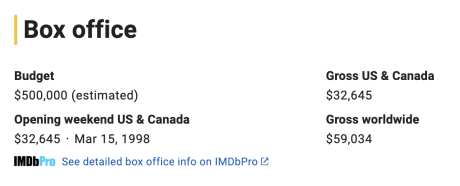
Several years ago Entertainment Weekly critic Owen Gleibermanwrote that Martin Scorsese‘s “volcanic” Mean Streets — one of the greatest debut efforts of all time if you don’t count Who’s That Knocking On My Door? and Boxcar Bertha — “barely made pocket change back in 1973, [having] grossed all of $3 million.”
In fact, both IMDB Pro and thenumbers.com report that Mean Streets grossed $32,645 domestic (U.S. and Canada) and somewhere in the vicinity of $59,034 worldwide. The Numbers actually reports that the global take was $50,539.