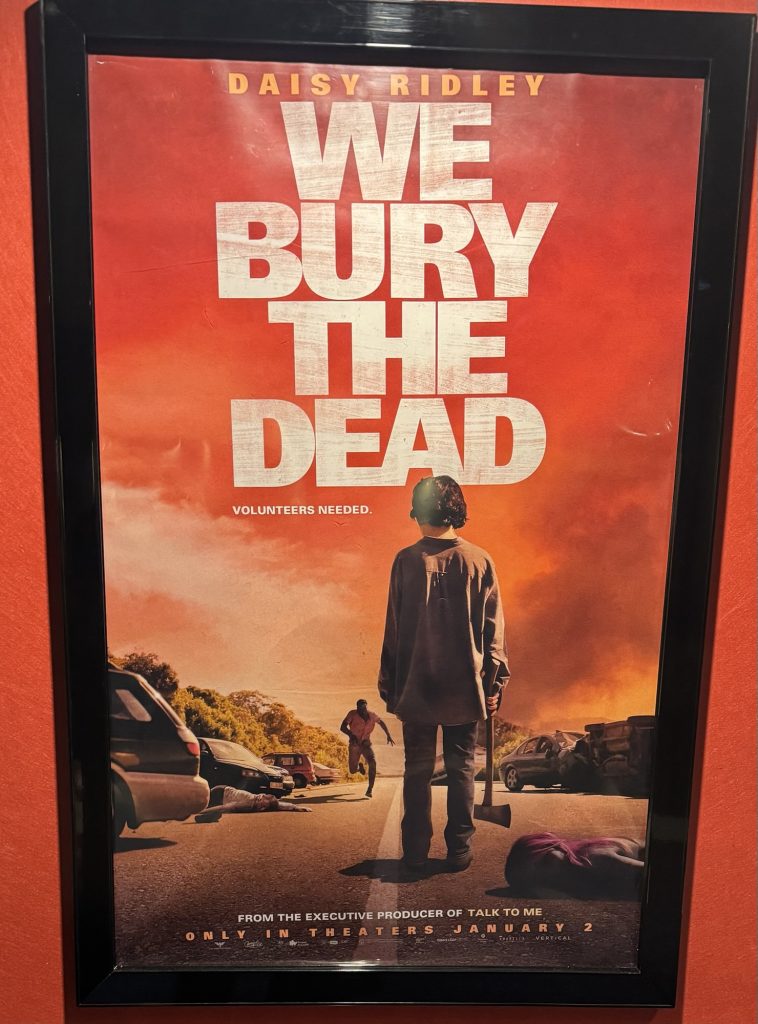
I’m sorry that Daisy Ridley’s career has fallen off. I’m sorry, I mean, that she’s apparently been reduced to accepting paycheck roles in second-tier popcorn fare (zombieflicks, a subpar StarWars spinoff or two, romcoms, minorbiopics).
My first reaction to this BuryTheDead poster was “could this be karma payback for admitting ten years ago that she wasn’tuptospeedonCary Grant?”
I want Ridley to find her way out of the thicket. My heart goes out.
I’m not saying Volodymyr Zelensky wishing for the literal death of Vladimir Putin is unwarranted, but literally saying this in so many words is highly unusual.
“Brick” is a popular New York City slang term, particularly in the Bronx, Queens and Long Island, used to describe extremely cold weather. Originating in the 1980s-90s, it suggests the cold hits as hard as a brick, or refers to cold city buildings.
Meaning: Extremely cold outside. Example: “It’s brick out there”.
Origin: Likely originated from urban slang in New York City (Harlem/Bronx) during the 1980s or 1990s.
Context: Used when temperatures are freezing; sometimes related to the feeling of brick buildings in winter, which are described as being ten times colder than the air.
Regional Usage: Primarily associated with New York City, but also used in neighboring areas like Long Island.
By the time this reasonably decent confrontation scene came along (Rose Byrne vs. Conan O’Brien), I was exhausted from the sheer effort of sitting through this damned thing. Depleted, emptied out, spent.
Conan O’Brien is Rose Byrne’s therapist in IF I HAD LEGS I’D KICK YOU, coming to theatres on October 17. #IfIHadLegsIdKickYou #MaryBronstein #RoseByrne #ConanOBrien #A24 #VVSFilms #therapy #therapist #moviescene #movieclip #cinema #film
Jimmy (Burns & Co., 11.6.26) is obviously a sentimental, low-budget, family-friendly attempt at ennobling and glorifying James Stewart‘s World War II experience as a bombardier in the European theatre. Pic was directed by Aaron Burns, whose company Burns & Co. also produced.
Burns & Co. mission statement: “In the truest sense of the word, Burns & Co. is a company of creatives crafting timeless adventure films and stories for the enjoyment of families around the world.”
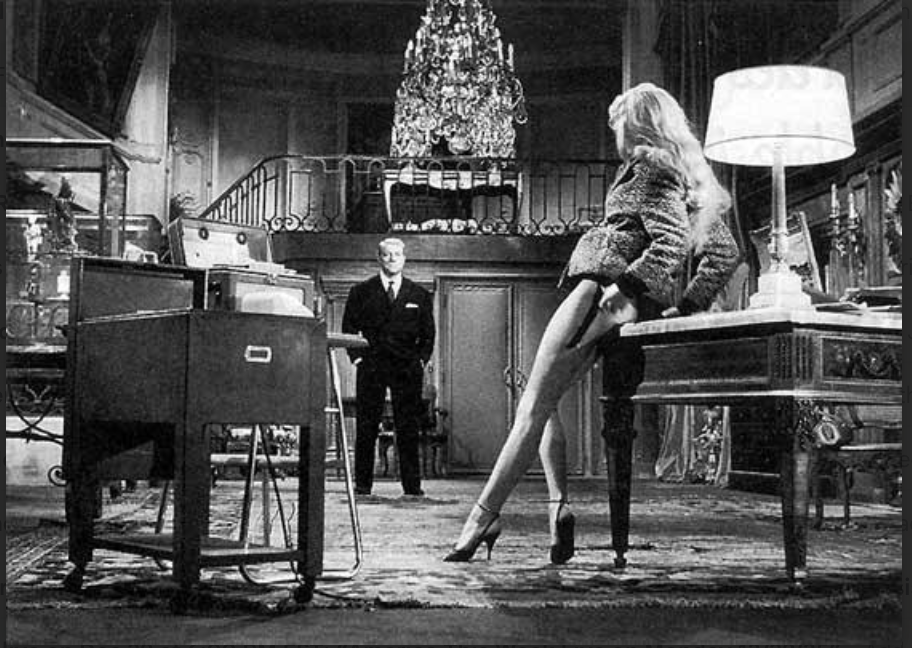
Directed by Claude Autant-Lara, In Case of Adversity (En cas de malheur, titled Love Is My Profession in the U.S.) is a French-Italian film noir about a 50ish established attorney (Jean Gabin) falling for a hell-bent blonde hottie (Brigitte Bardot).
Pic was released in France on 9.17.58, nine months before the appearance of Francois Truffaut‘s The 400 Blows (5.4.59) and 22 months before Jean-Luc Godard‘s Breathless (5.16.60).
From Owen Gleiberman’s 12.28 Bardot essay: “Looking back and watching Bardot’s movies now, you see hints and echoes of so many of the actresses who would come after her, from Maria Schneider to Nancy Allen to Dominique Sanda to Uma Thurman to Adèle Exarchopoulos to Sydney Sweeney.
“She was marketed as a pin-up, yet she was a singular presence who forged a path of sensual and spiritual fearlessness. And part of it is that she insisted, just as the Madonna of the ’80s and ’90s did, that for a certain kind of performer (her kind), sexuality was inseparable from artistry. Bardot’s eroticized projection of female identity was itself a transcendent performance. If God created woman, Bardot made you feel like she had created herself. Only time will tell if the future is female. But once she’d made her mark, the future was most definitely Bardot.
Just-sent HE email….EXTRA SPECIAL, END-OF-2O25 “MARTY SUPREME” GATECRASHERS OPPORTUNITY…sent to Gatecrashers fraternity at 12:25 om eastern…
Happiest of holidays to Fellow Gatecrashers,
Don’t listen to my obnoxious bigmouth ranting….by all means vote only as you choose on your lonesome…but please consider the thrust of the following….because the spirit is upon me, I swear…I’m speaking not from my own determinations or from this or that tower of arrogant know-it-all-ism…I’m truly speaking for the revolutionary pitch of things…it’s definitely happening right now.
All good people of taste and conscience and especially those who recognize the value of NOT choosing a hard-left ideological film for the Best Picture Oscar as this would further stigmatize the Hollywood community as lefty fruit-loop fanatics who live on their own secular planet, and who have no understanding or appreciation of real life and real values as they exist outside the glitzy woke ghetto….
With Josh Safdie‘s MARTY SUPREME having broken though critically and box-office-wise over the just-finished Christmas holiday weekend, now is the time for The Gatecrashers to recognize the fundamentally populist, artistic and zeitgeist-driven truth of things and get behind SENOR SUPREME as a way of proclaiming the truth of things…of not only stopping ONE BATTLE AFTER ANOTHER’s Oscar momentum but tipping the balance of opinion away from PTA’s admittedly well made, hard-left, ludicrously-plotted, father-daughter fantasy….
MARTY SUPREME is this year’s ANORA, and ONE BATTLE AFTER ANOTHER is this year’s THE BRUTALIST….
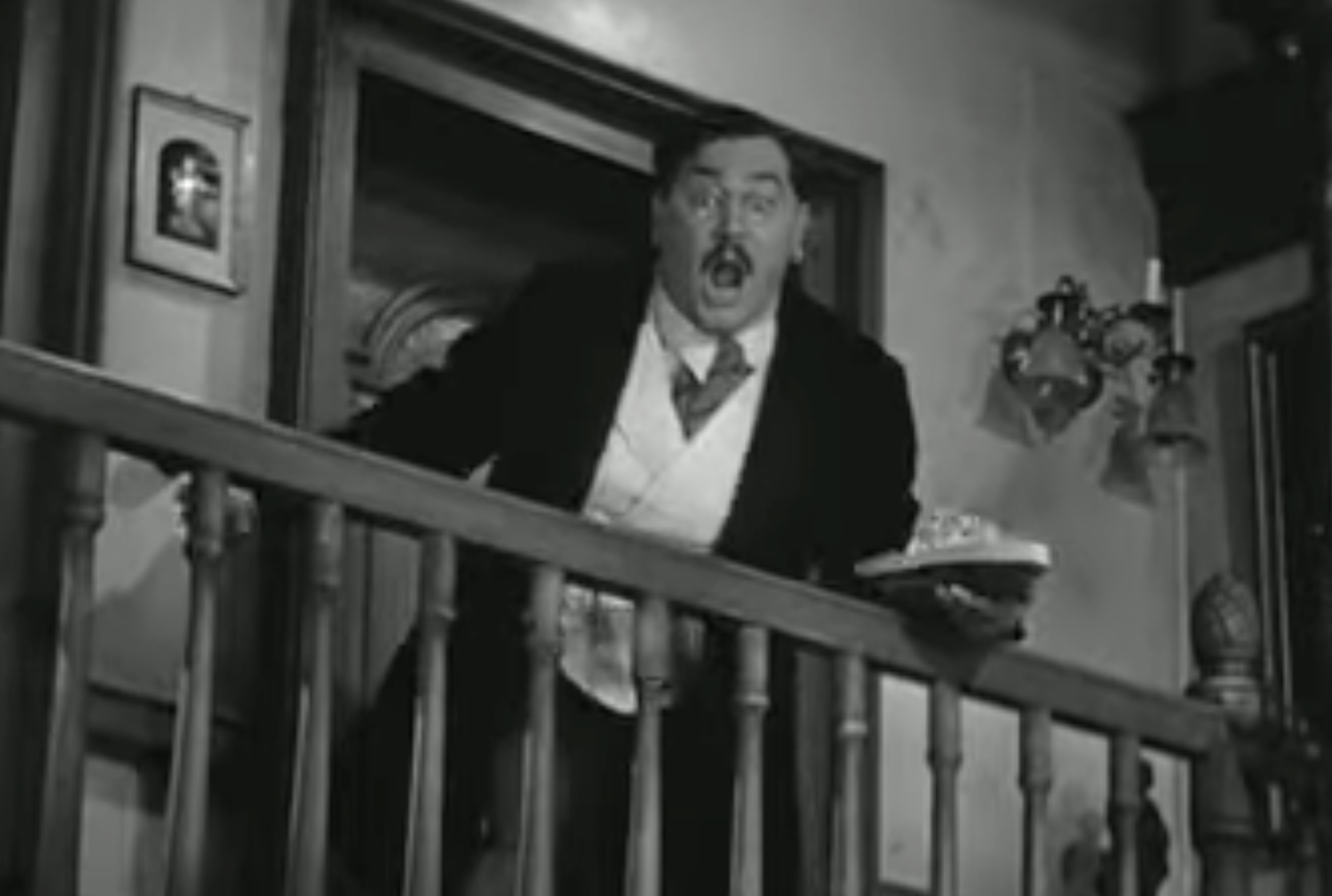
Join Timothee Chalamet‘s orange-pingpong-ball crusade!…No politics, just pogo sticks ….jump on your steed, unsheath your saber and join Teddy Roosevelt‘s rough riders as they thunder up San Juan Hill…NOW IS THE TIME! Remember that T.R. nutter from Frank Capra‘s Arsenic and Old Lace? “CHAAAAAARGE!”
Obviously you guys are under no obligation to vote for MARTY SUPREME because I’m urging you to do so, but now is the moment….Chalamet’s First Army has blown a hole through the woke siegfried line and NOW IS THE TIME for General George S. Patton‘s Third Army to rush through and seize the initiative! MARTY SUPREME-OLA….yes!!
A week ago the Best Picture race was boring everyine to tears, and now, as Michael Caine would say, the bloody doors have been blown off.
Shut that OBAA shit down!…shut it the fuck down!
Please refresh your ballots ASAP so we can post the results just before or certainly just after New Year’s Day. Claude AI has made the balloting so easy, so snappy….a fucking breeze.
“‘Bonnie and Clyde‘ is a 1968 French-language song written by Serge Gainsbourg, and performed by Gainsbourg and Brigitte Bardot. The song is based on an English-language poem written by Bonnie Parker herself a few weeks before she and Clyde Barrow were shot, titled “The Trail’s End”. The French song was released on two 1968 albums: Gainsbourg’s Initials B.B., and Gainsbourg and Bardot’s Bonnie and Clyde.” — Wiki page.
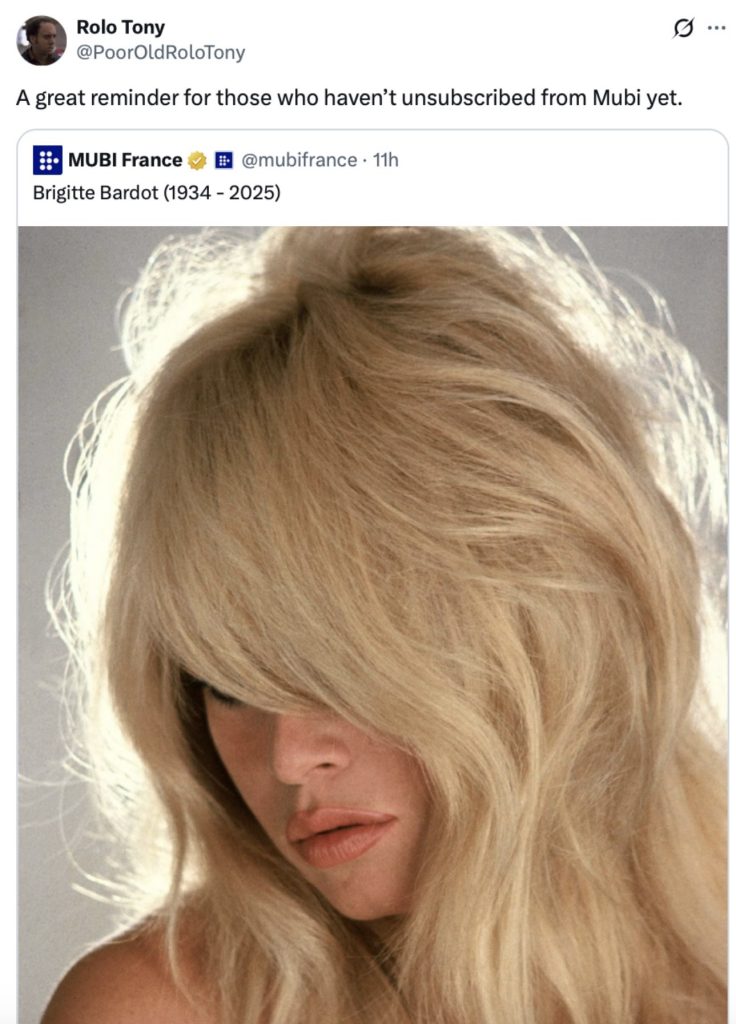
So MUBI subscribers should unsubscribe because MUBI France is respectfully acknowledging Brigitte Bardot’s passing or….what, is streaming one or two of her films? Lefty fanatics like RoloTomassi…sorry…fanatics like RoloTony make me want to vomit.
When you get right down to it I’ve seen only five Brigitte Bardot films (AndGodCreatedWoman, TheNightHeavenFell, AVeryPrivateAffair, Contempt, Viva Maria).
On top of which throughout my life I’ve failed to catch what Bardot herself said was her only truly good one — Henri-George Clouzot’s LaVerite (’60).
Bardot’s death at age 91 settles it — I’ll stream LaVerite (aka Truth) this evening.
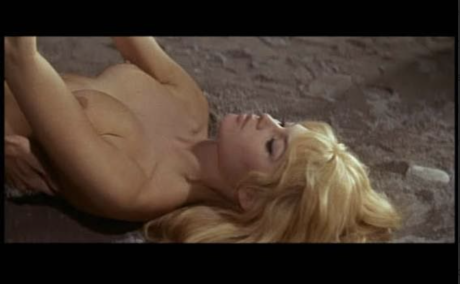
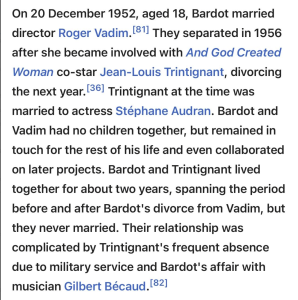
You could argue that Bardot’s grandest achievement was splashing into the sexually tepid waters of the straightlaced ‘50s and heating things up by way of brazen, unapologetic nudity and infinite intimations of erotic delight…starting with her break-out performance in And God Created Woman (‘56) and for a good 12 to 15 years after, Bardot inspired hundreds of millions of stiffies among men living grim lives of quiet desperation.
Sex, sex, sex, nudity, nudity, nudity, barefoot barefoot barefoot, pear-shaped ass pear-shaped ass pear-shaped ass…teasing erotica, playfully defiant manner…damp tongue, luscious lips and heavily mascara’ed eyes.
Bardot certainly went her own way, and didn’t shrink from saying what she damn well thought and felt. Passion was her guiding light. From her mid teens through her early ‘40s it was mostly dudes who lit her fire, and then, starting in the early to mid ‘70s, the welfare and protection of pets and animals became her primal cause.
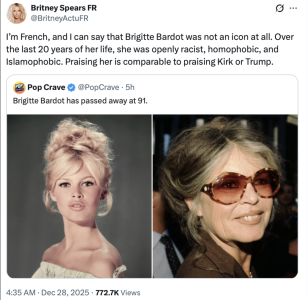
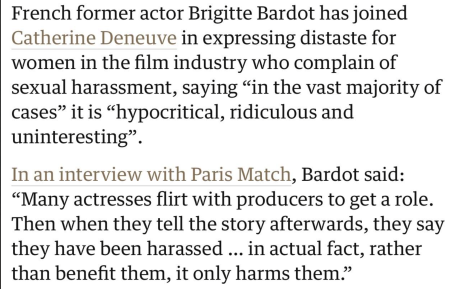
The older Bardot got the less liberal or even tolerant she seemed. When she hit her 70s and 80s her racial views weren’t that far from Alain Delon’s, and in the late 20teens she made it clear she was no friend of the #MeToo movement.
Physically she was primarily known for her pouty expressions and blonde tousled hair (although she was born a brunette). Behaviorally she admitted to being a habitual infidel, time and again. She admitted not long ago to having “done” over a hundred guys in her lifetime…energetic and frisky, yes, but almost par for the course by the standards of the ’70s and ’80s.