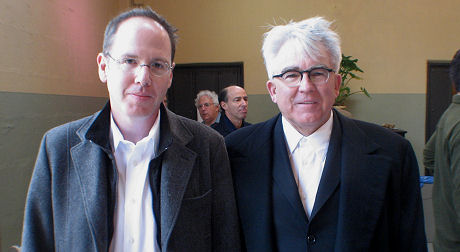
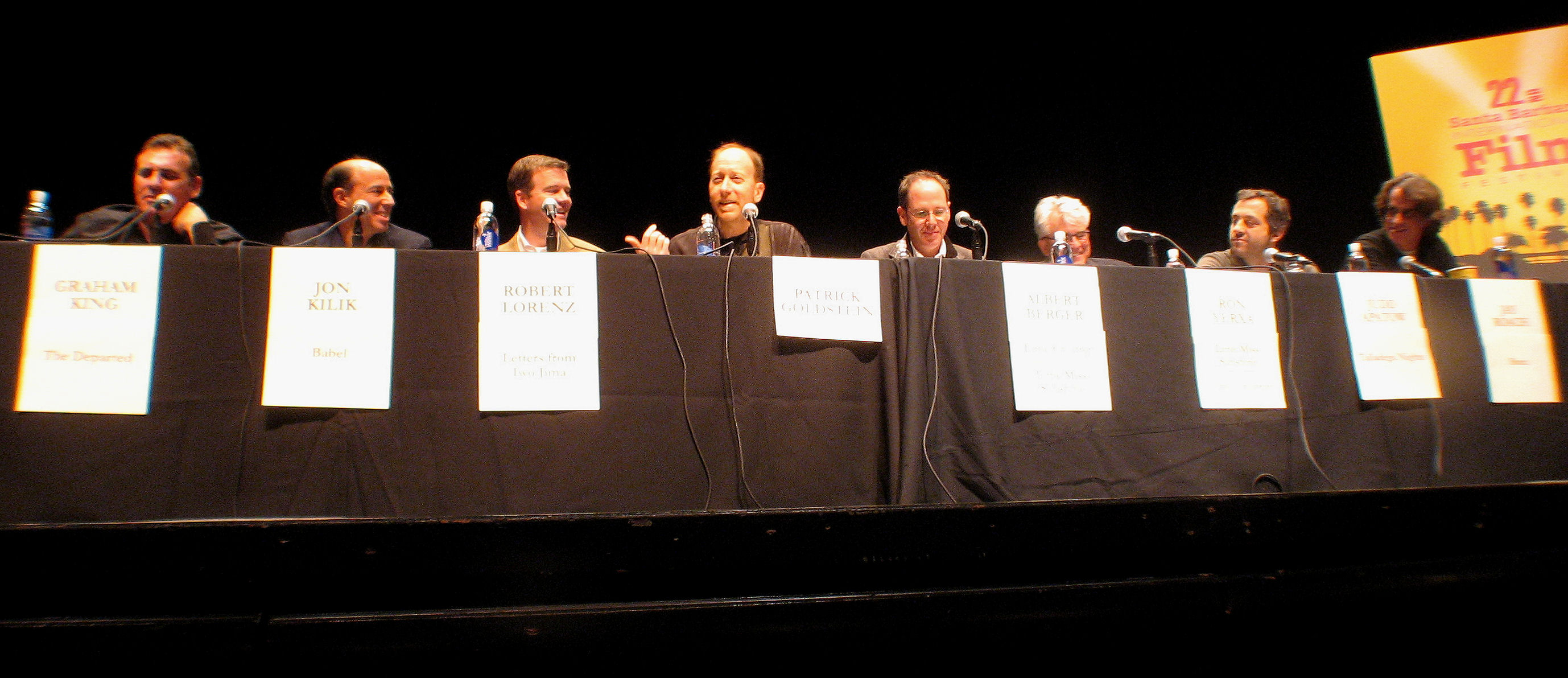
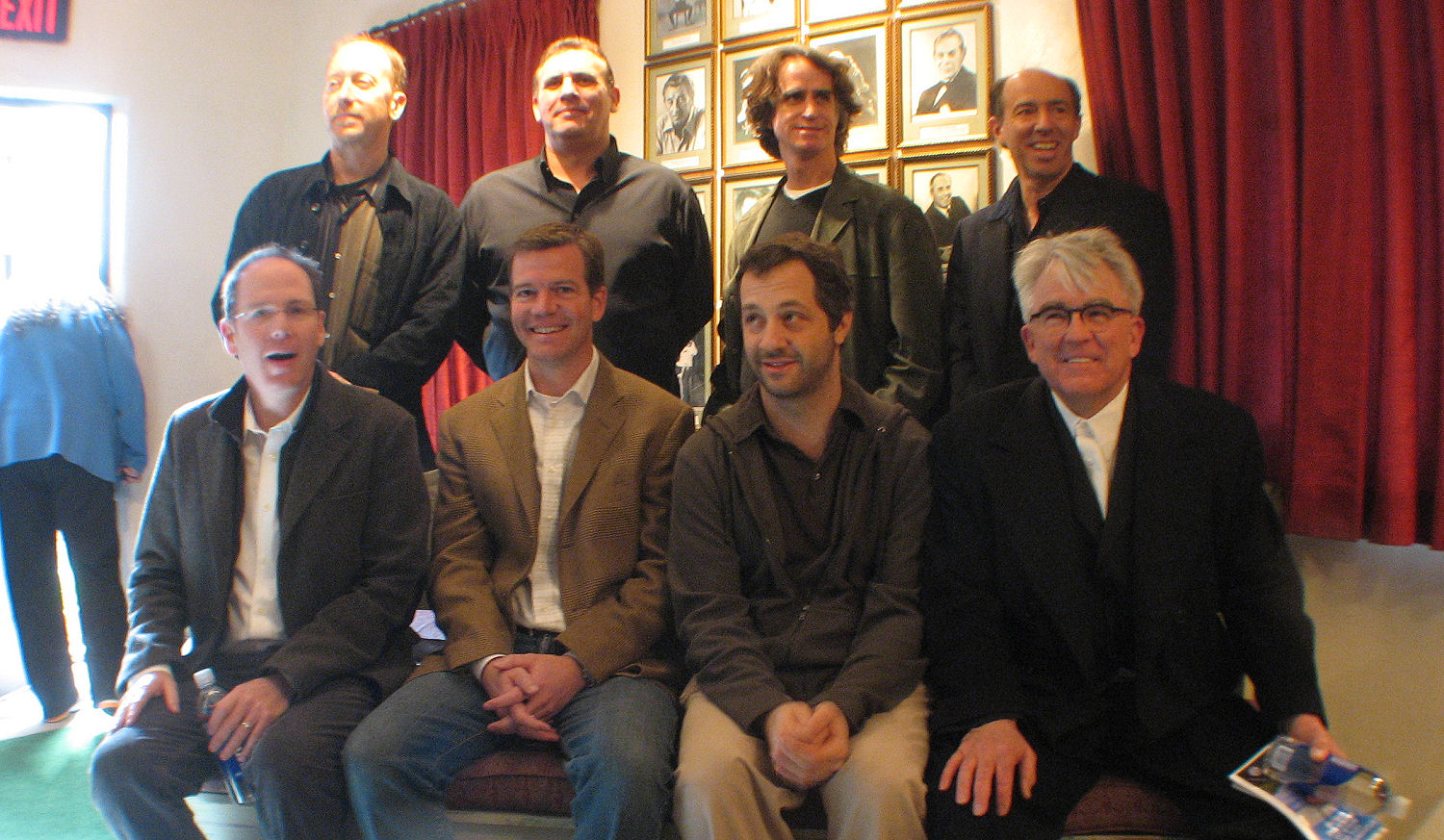
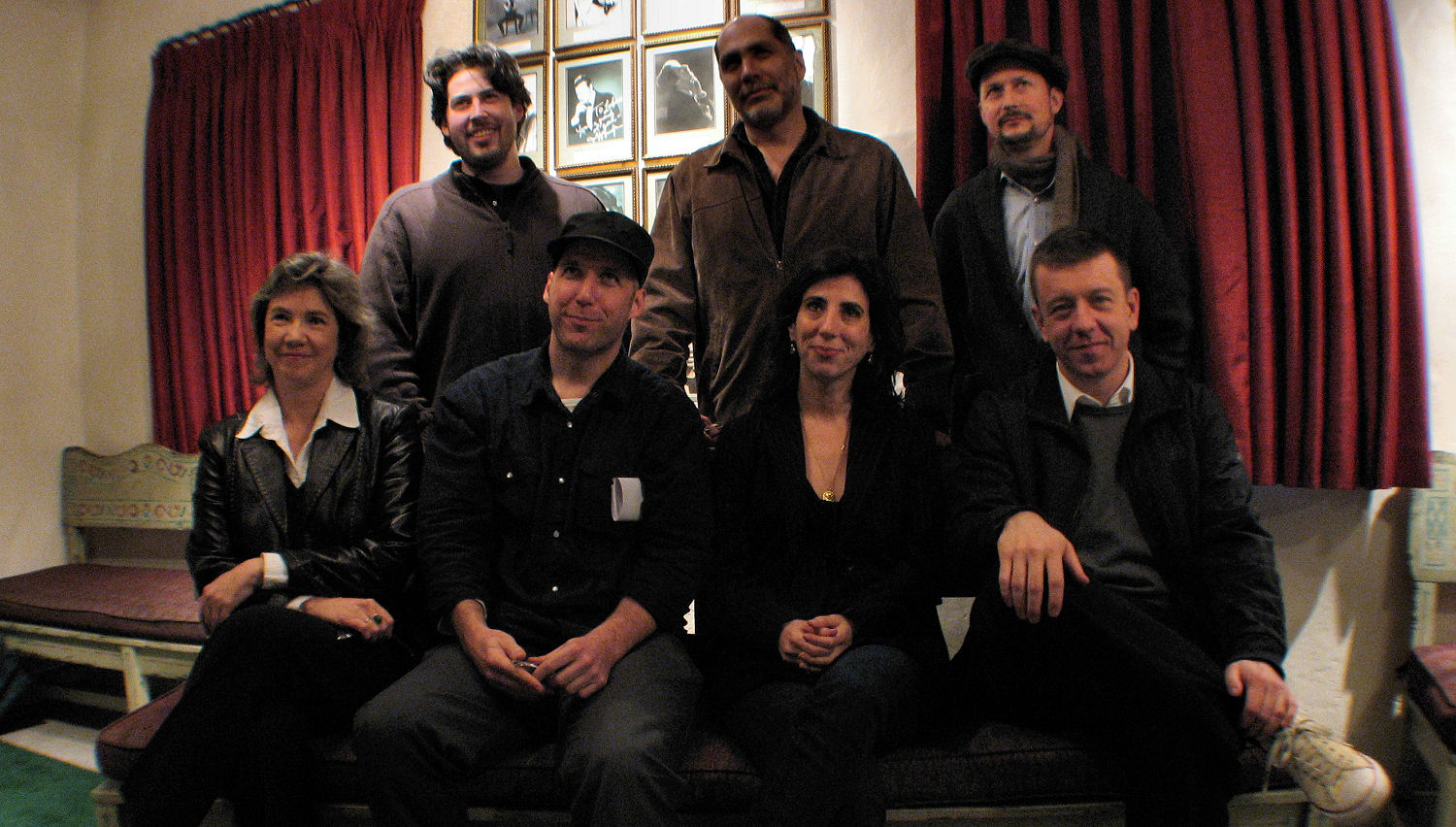
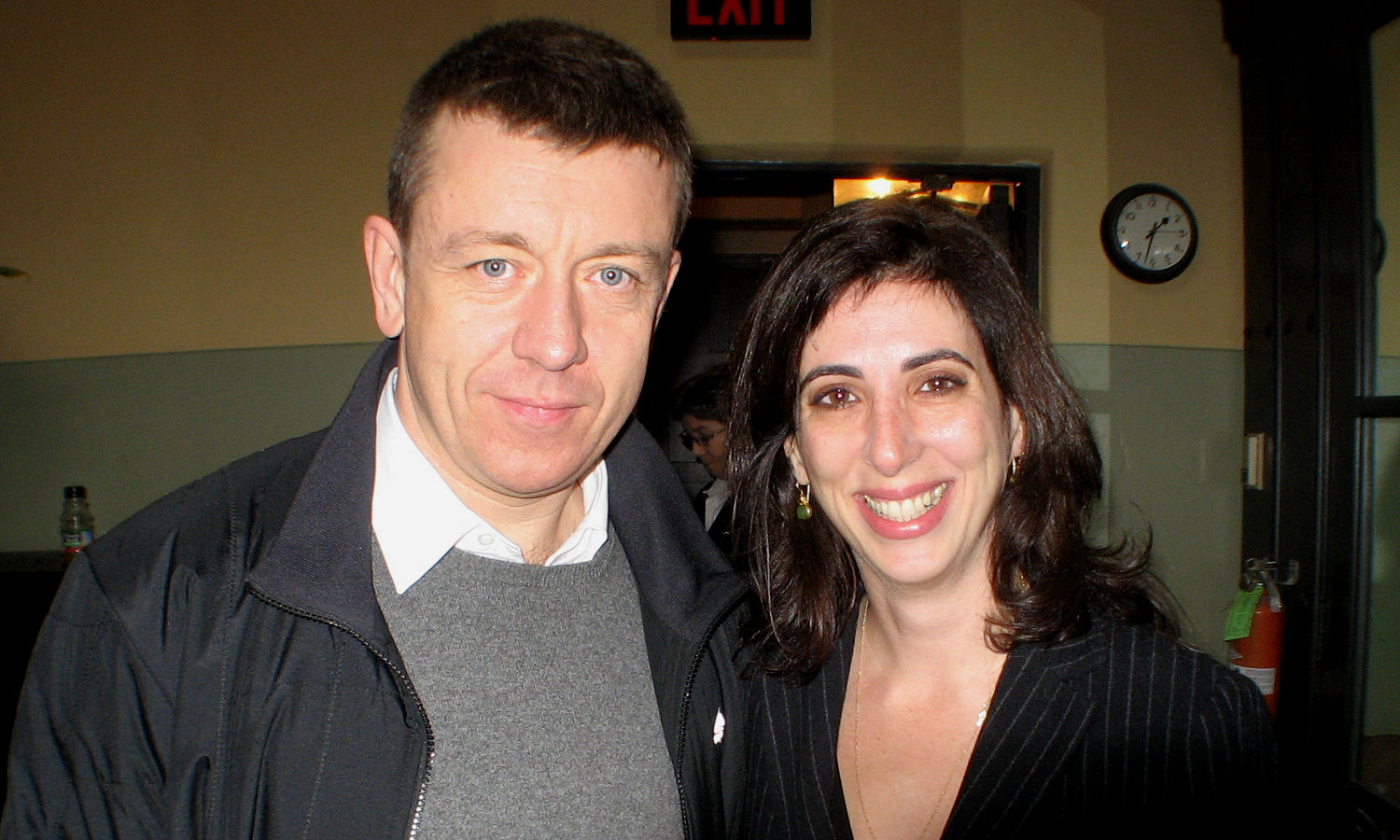
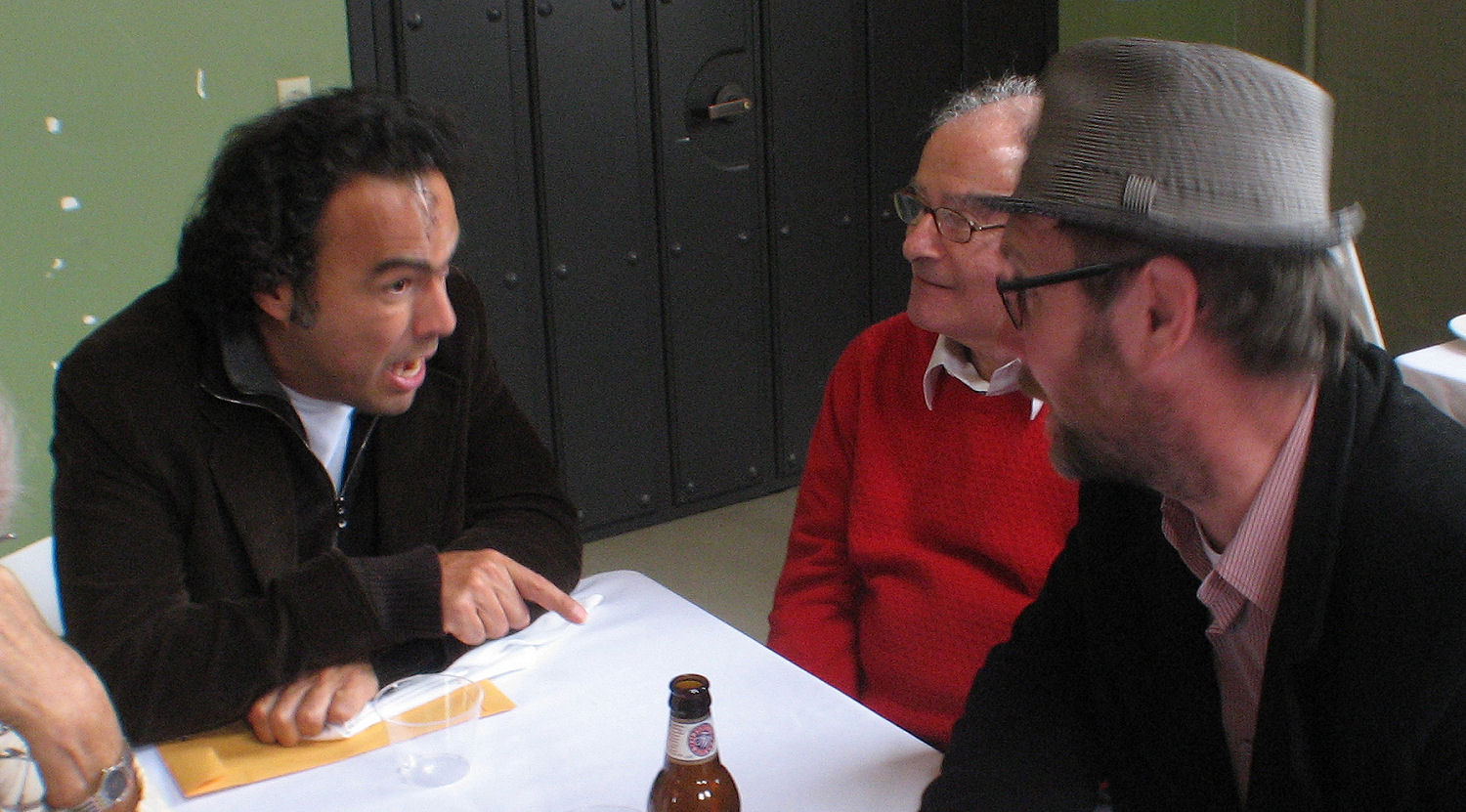
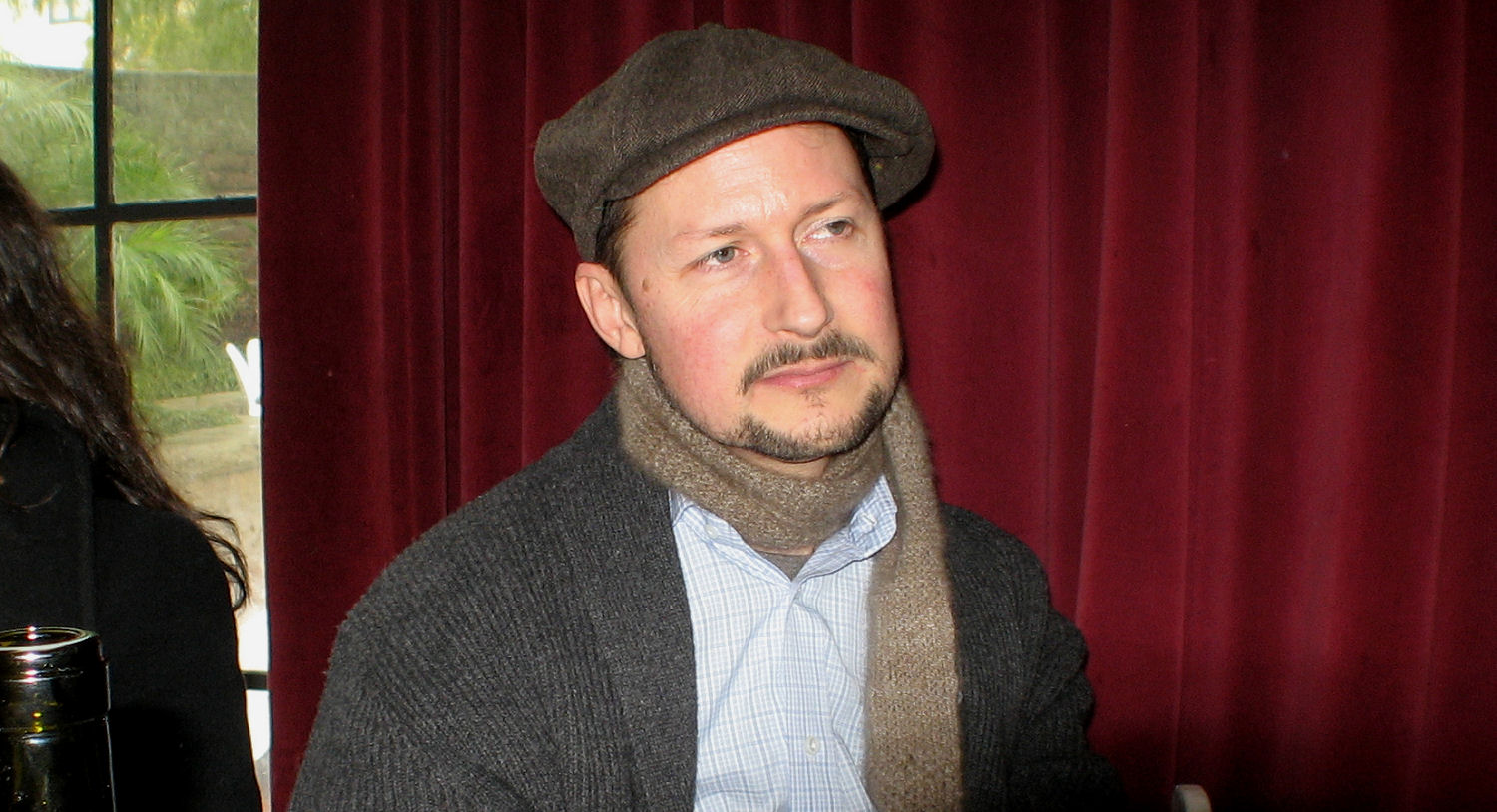
Producers Graham King, Jon Kilik, Robert Lorenz, L.A. Times columnist Patrick Goldstein, producers Albert Berger , Ron Yerxa, Judd Apatow and Jay Roach during “Movers and Shakers” panel at Santa Barbara’s Lobero Theatre — Sunday, 1.28.07, 11:25 am

The Envelope‘s Tom O’Neil is reporting that O’Toole won’t be at tonight’s SAG Awards, but says that Miramax publicist Andrew Goldstein (did Tom mean to write Andrew Bernstein?) has confided that O’Toole “will attend the Oscar nominees lunch on February 5” and then stick around “for a few days” before retreating back to London. He’ll come back for the Oscar show some two and a half weeks later.
A whole N.Y. Times piece about Grindhouse — two high-style wankoff movies made in the spirit of ’70s exploitation flicks, one directed by Robert Rodriguez, the other by Quentin Tarantino — and not a single mention of the film’s most fascinating element, which is how heatedly and lasciviously Rodriguez will photograph actress Rose McGowan in his segment, called “Planet Terror.”
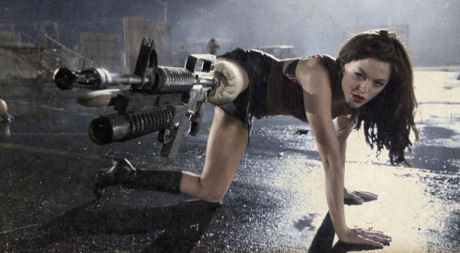
Rodriguez, a very clever and likable guy who, being a kind of lapsed Catholic, appears to regard women as either Madonnas or floozies, tends to make his actresses look hot and saucy in his films. He dressed and photographed Salma Hayek like a pistol-hot wet dream in Desperado and From Dusk to Dawn, and one naturally presumes that the ardor behind his on-set affair with McGowan during filming of “Planet Terror” (which led to the end of his 16-year marriage to Elizabeth Avellan) will be captured, so to speak, in the way in which he dresses and films her.
And yet Times writer Whitney Joiner writes only about the usual technical-attitude genre-homage stuff. Said it before, saying it again: Rodriguez and Tarantino seem to be chronically lazy genre filmmakers, incapable of creating a single honest (i.e., unreferenced) thought or emotion about anything real, indulging time and again in ironic (i.e., insincere) B-movie trappings and posturings — style, pizazz, attitude, etc. They’re both lost…totally lost.
In person, Leonardo DiCaprio is “polite, charming, makes jokes, engages eye contact. And manages in an almost Rock Hudson-like way to give almost no hint whatsoever of his actual personality,” writes the Guardian‘s Carole Cadwalladr. I know what she means — Leo’s definitely a bit of a hider when he talks to the press — but “in an almost Rock Hudson-like way”?
Romantic comedies “seem to have fallen out of step with modern life,” writes N.Y. Daily News guy Joe Neumaier, the result being that “moviegoers are experiencing a kind of cinematic bed death when it comes to meet-cute flicks and affairs to remember.”
He mentions recent or soon-to-open examples like Catch and Release (a dud), Music and Lyrics, Daddy’s Little Girls and Starter for 10 (which I instantly dismissed after catching it at the Toronto Film Festival), but emphasizes that “audiences and romantic comedies are going through a bad patch, and it’ll take more than a pint of Haagen-Dazs and a crying jag” to forget The Wedding Date, Must Love Dogs , Just Like Heaven, the moderately detestable Failure to Launch and Woody Allen‘s disastrously bad Scoop.
There’s at least one romantic comedy I’ve seen that feels half in step with modern life, or at least a female sector of modern urban life — Zoe Cassavetes‘ Broken English (Magnolia Pictures), which played at Sundance ’07. Alas, Neumaier pays it no mind.
“From its first screenings here at the 2007 Sundance Film Festival, the micro-budget Irish film Once, rejected by many a festival en route to Park City, has generated word-of-mouth bordering on euphoria,” Chicago Tribune critic Michael Phillips writes in today’s (Sunday) edition.
“It’s a marvelous film, described by writer-director John Carney as “a musical, maybe.” It may well be the best music film of any stripe since Stop Making Sense a generation ago, and yes, that includes Chicago and Dreamgirls.
“Shot in under three weeks for less than $150,000, funded entirely by the Irish national film board, Carney’s so-called ‘video album’ has made the stars and the director the toast of Park City. ‘Thank God, really. Sundance has been amazing for us,’ Carney says.
“A rough cut” of Once played at two festivals last year, one in Galway, Ireland, the other in the Czech Republic. And yet Carney tells Phillips that “Toronto turned it down, Edinburgh turned it down, Telluride turned it down.” Shoutout to Tom Luddy: You saw Once and you deep-sixed it? Dude, what’s up with that?
Sundance juror awards are untrustworthy in that every year there’s always one or two “huh?” calls. This is partly due to a long-established tendency of Sundance jurors to select recipients for inside-the-beltway political reasons, and partly due to the film festival aesthetic that tends to honor films that are nourishing (in the same way that boiled squash is nourishing) but not necessarily riveting or transcendent.

This isn’t to say the 2007 Sundance Film Festival Award Winners are neces- sarily suspect; only that the Grand Jury awards rarely deliver ground-truth appraisals like the Audience Awards do.
Hence, the two Sundance award winners most likely to enjoy good relations with the outside world (i.e., actually play in theatres with paying, popcorn-eating customers) are James C. Strouse‘s Grace is Gone, which won the Dramatic Audience Award, and John Carney‘s Once, which took the Dramatic World Cinema Audience Award.
Less likely to encounter Average Joe audiences are Irene Taylor‘s Hear and Now, which won the Audience Award: Documentary, and David Sington‘s In The Shadow of the Moon, although I heard excellent things about the latter. Something tells me I won’t be seeing until it it hits DVD; I’d love to somehow see it sooner.
The winners of the Grand Jury prizes, selected by courtly elites with culturally ingrown tastes, are the least likely of all to reach any kind of marginal, much less sizable, audience. Sounds hard, but that’s how it usually shakes down.
The Grand Jury Prize: Documentary was given to Jason Kohn‘s Manda Balat (Send A Bullet), which two people told me to see during the festival. (In one ear, out the other.) The Grand Jury Prize: Dramatic went to Christopher Zalla‘s Padre Nuestro. Eva Mulvad and Anja Al Erhayem‘s Enemies of Happiness won the World Cinema Jury Prize: Documentary. And Dror Shaul’s Sweet Mud was given the World Cinema Jury Prize: Dramatic.
Two fascinating panel discussions happened today at the Santa Barbara Film Festival. I recorded both with my Olympus WS-300M, which I put right smack dab on the stage, five feet in front of the panelists…and it didn’t quite work. The voices sound echo-y and a bit faint. There’s a lot of good stuff in both discussions, but you’d do well to listen with headphones. They both last over an hour.
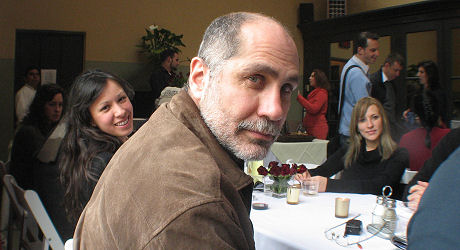
The first was “Directors on Directing”, which kicked off at 11 am. It was moderated by Peter Bart, producer and co-host of AMC’s “Sunday Morning Shootout,” with directors Alejandro Gonzalez Inarritu (Babel), Todd Field (Little Children), Gil Kenan (Monster House), Valerie Faris and Jonathan Dayton (Little Miss Sunshine), and John Lasseter (Cars).
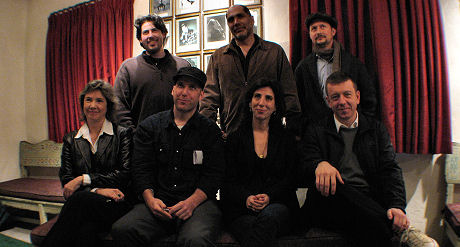
“It Stars With the Script”, a screenwriters’ panel moderated by Hollywood Reporter columnist Anne Thompson, began at 2 pm. Screenwriters Michael Arndt (Little Miss Sunshine), Guillermo Arriaga (Babel), Todd Field (Little Children), Aline Brosh McKenna (The Devil Wears Prada), Peter Morgan (The Queen/The Last King of Scotland), and Jason Reitman (Thank You For Smoking) participated.
The SAG Awards will air on TNT and TBS Sunday evening. My eyelids, trust me, are at half-mast as I type these projections/assessments:

Forest Whitaker — whose performance as Idi Amin Dada was hugely enjoyable in a frightening sort of way, although I never felt it went past (i.e., deeper than) that level of engagement — will almost certainly win the Best Actor award.
Helen Mirren is oppressively locked as the winner of the Best Actress trophy, although I really and truly feel that Penelope Cruz gives a much stronger, earthier, fuller performance in Volver.
Leonardo DiCaprio (who was totally screwed by Warner Bros. marketing/publicity’s handling of his two acting award campaigns) ought to win the Best Supporting Actor award for his Departed performance hands-down, although the winner will probably be Eddie Murphy or Jackie Earl Haley.
The Best Supporting Actress race is between Dreamgirls‘ Jennifer Hudson and Little Miss Sunshine‘s Abigail Breslin, and I can’t tell if the recent LMS surge and the Dreamgirls downturn will affect the voting, but I’m /guessing presuming Hudson will eke out a victory. Maybe.
The Departed gang gets my personal vote for the SAG ensemble acting award, but the smart money is going with the Little Miss Sunshine team winning in this category, which will probably happen.
The Once word-of-mouth seems to have taken hold and distributors are finally looking to buy it. One distrib chief has confided a sincere hope that his/her company will acquire it sometime later this week, “although there are 5 other distributors circling,” he/she confided this morning.
Epic Movie will be #1 this weekend with a projected $17,368,000 by Sunday night. It wasn’t press-screened, is said to be a piece of shit and will almost certainly be over and out the door by next week or the week after. Joe Carnahan‘s Smokin’ Aces (which I don’t give a damn about seeing) will manage a decent $14,129,000 on 2200 screens, roughly $6300 a print. Night at the Museum will be #3 with $8,601,000 for a total cume of $215,900,000. (The American public likes what it likes.)
Catch and Release will end up in fourth place with $7,737,000 — 1600 theatres, 4700 a print…fair but far from encouraging. And fifth place Stomp the Yard will earn $6,980,000 this weekend.
Dreamgirls is going to attain a total cume of $85,900,000 by Sunday night, but it’s sinking and sputtering. It’ll make about $5,946,000 this weekend, for an average of $2100 a theatre. Dreamamount added about 500 theatres this weekend but it’ll be down 26% regardless. It’ll probably eke out $100 million, okay, but it’s over — they didn’t get the key nominations, they’ll be losing theatres in a week or two, and it’s all downhill from here on. They’ll be down to a $3 or $3.5 million haul next weekend.
The Pursuit of Happyness will come in seventh with $4,449,000. Pan’s Labyrinth, bolstered by six Oscar nominations, has added about 300 theatres and will do about $4,119,000. The Queen will do about $3,852,000, having added 300 theatres. The Hitcher will do about $3,375,000. Blood and Chocolate, a horror flick, will end up with $1,900,000…$1600 a theatre at 1200 theatres…forget it.
“What made me finally relax is that during one of the moments we were showing clips, [Helen Mirren] reached out for my hand and squeezed it and said I was doing a good job. Can you believe that?! At the end of the tribute, right before Bill Macy was to come out, the lights dimmed. She once again reached for my hand and squeezed it. ‘This was lovely,’ she said. ‘Once in a lifetiime, thank you.’ I looked up, and she had tears in her eyes.” — Santa Barbara Film Festival director Roger Durling, writing on his festival blog about last night’s Mirren tribute at the Arlington.