

With Dreamgirls out of the running, which of the five nominated Best Picture films is the front-runner at this stage? Opinions, please. I suspect that Little Miss Sunshine is going to get dissed the most between now and ballot-closing day, even though the odds of winning don’t seem all that great because Jonathan Dayton and Valerie Faris weren’t jointly nominated for Best Director. LMS could win , of course. As a a big-name producer told me after last weekend’s PGA win, “Sunshine is the only [likely] Best Picture nominee without negatives — it’s a very good film and everybody likes it.”
Why “Dreamgirls” dumped
“It’s obviously possible for a movie to get nominated for Best Picture without its lead actors getting their own nominations. But is it possible for a film to be a Best Picture contender when its lead performances were widely panned, even by people who otherwise liked the movie? I’m referring, of course, to Beyonce Knowles, Jamie Foxx and Dreamgirls.

“Let’s face it — as much as everyone seemed to like Eddie Murphy and Jennifer Hudson, and as much as you could legitimately call this an ensemble picture, Jamie Foxx and Beyonce Knowles were the ostensible leads. The fact that they didn’t register in their roles might not entirely be their faults; look at the script. But whoever should be blamed, those are two pretty big holes right at the center/forefront of the film.
“Can anyone remember another Best Picture nominee about which most people said, ‘Yeah, I really loved that movie, even though the two leads were no good?’ I can’t even come up with a non-nominee right now that had viewers saying that en masse.
“For me, there were lots of other reasons why Dreamgirls was a failure, but I think that one had to at least subliminally factor into the voting among people who liked it a lot more than I did.
“I’m pleased with its omission. I can remember, after one of the very first screenings, when you quoted one lone naysayer to the effect that it was possible that it wouldn’t even get a nomination. That seemed far-fetched at the time, given the love, but when I shortly thereafter caught a screening, I wrote in wanting to affirm whatever hesitations you were having, just as another reality check.
“And I’m glad you’ve been temperate on the movie all along. I don’t think it deserves major hate, and I don’t begrudge you or anyone who liked it a little more than me for having some good things to say about it. But the idea that anyone really thought this was Best Picture material still floors me. Of course, I thought that about Crash, too. Nice to see the gods of rationalism prevail this time.
“Go, Departed. Go, Peter O’Toole. I don’t hate Little Miss Sunshine but please, God, don’t let it win.” — Los Angeles based journalist, in an e-mail received around 9:30 ayem.
DiCaprio double credit
Once again, Warner Bros. deserves double credit as far as Leonardo DiCaprio is concerned — a plus for getting him a Best Actor nomination in Blood Diamond (!), a not-very-good film, and a minus for not putting him up for Best Actor in The Departed, which would have been the right and proper move because the guy is flat-out great in the “mole” role. Congrats also to Mark Wahlberg for his Best Supporting Actor nomination.
Tough luck
“Many in our office are still getting over the fact that Dreamgirls was snubbed. I say, tough luck!” — New York-based advertising executive in just-received e-mail.
Flimsy Borat nomination
The morning’s flimsiest call has to be the Best Adapted Screenplay nomination for the Borat gang — Sacha Baron Cohen & Anthony Hines & Peter Baynham & Dan Mazer. Adapted from “Da Ali G Show” because of very similar elements, concept, attitudes, etc.
The Oscar nom rundown
You can get the whole Oscar nomination rundown anywhere at this point, but my two favorites are Variety and Oscar Watch. I just wish that the esteemed Sasha Stone would boldface her categories.
Best Foreign Language Films
No Best Foreign Language Film nomination for Pedro Almodovar‘s Volver? And I was shocked, frankly, that Susanne Bier‘s After the Wedding, her weakest film ever, was nominated in this category. Guillermo del Toro‘s Pan’s Labyrinth and Florian von Henckel Donnersmarck‘s The Lives of Others were nominated….good calls. Less enthusiasm in this corner for Days of Glory and Water, but fine.
Greengrass for Best Director
Another significant surprise (and a feather in the cap of not only Universal Oscar strategist Tony Angellotti but every impassioned, hard-pushing advocate of United 93 in the industry and press circles): Paul Greengrass, the director of United 93 — a movie that many Academy members reportedly refused to even see, has been nominated for Best Director. A significant victory, no question. Whoda thunk it?
We’ll never know the precise vote tallies, but this indicates that the vote to nominate United 93 for Best Picture was (probably) fairly sizable. A very surprising thing, and a hint that the Academy’s “deadwood” faction (geezers, reactionaries, old schoolers) isn’t as strong as presumed.
“Dreamgirls” Shocker
Dreamgirls, the musical that many, many people (David Poland included) said over and over would win the Oscar for Best Picture, hasn’t even been nominated for Best Picture….double, no, triple-strength shocker!…an omission that will live in the annals of Oscar nomination history.

Eight Dreamgirls noms, but not for Best Picture
The gloom clouds hanging over the Dreamgirls camp right now are extremely dark and Cecil B. DeMille-y. For what it’s worth, my sincere condolences to Bill Condon, Larry Mark, Terry Press, Nancy Kirkpatrick, David Geffen and the gang. I never hated Dreamgirls or campaigned for its demise, and while we all knew it couldn’t win the Best Picture Oscar, I honestly thought it would be nominated this morning for Best Picture.
I think it’s entirely fair to say in the wake of the Dreamgirls Best Picture wipeout that there is now a supportable cautionary assumption called the Curse of Poland. Phantom of the Opera, Munich and now Dreamgirls — if David Poland pushes your movie early and hard for Best Picture during the final months of the year, the producers and publicists behind this film will have reason for concern.
Abigail Breslin
The Salt Lake City NBC channel cut off the live feed from the Academy right in the middle of the announcement of Best Adapted Screenplay nominees (I know…why am I watching television at all?), but the first early surprise (prior to the impact grenade of Dreamgirls‘ non-inclusion among the Best Picture nominees) was Little Miss Sunshine‘s Abigail Breslin getting nominated for Best Supporting Actress. That’s an indicator of general industry sentiment about this Fox Searchlight film, and a further suggestion that Sunshine might really win the Best Picture race.
“Once” is the shit
John Carney‘s Once, which I finally saw last night at 10:40 pm or thereabouts, is the Sundance heart & soul movie everyone’s talking about. And you don’t need to be an NYU film scholar to understand why. A kickaround, no-star Irish musical love story, Once has an ether-like spirit that anyone who’s truly been in love will recognize in a flash.
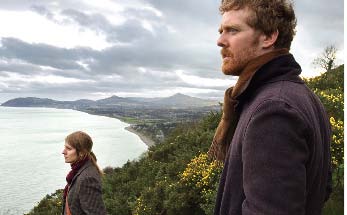
Once costars Marketa Irglova (l.), Glen Hansard (r.)
It’s about a pair of Dublin-based musicians — a scruffy, red-bearded troubadour (folk-rocker Glen Hansard, best known for his Irish group The Frames) and a young Czech immigrant mom (pianist and singer Marketa Irglova) — falling for each other by learning, singing and playing each other’s songs. That’s it…the all of it. And it’s more than enough.
It’s unique but gently lulling. It’s about struggle and want and uncertainty, but with a kind of easy Dublin glide-along attitude that makes it all go down easy. It’s all about spirit, songs and smiles, lots of guitar strumming, a sprinkling of hurt and sadness and disappointment and– this is atypical — no sex, and not even a glori- ous, Claude Lelouch-style kiss-and-hug at the finale. But it works at the end — it feels whole, together, self-levitated.
Carney’s decision to go with no-name actors (the early plan was for Cillian Murphy to play the troubador or “busker”) was risky; distributors are apparently concerned that Once isn’t commercial enough. That, ladies and gents, is the voice of timidity. Unless I’m crazy Once is going to win the Sundance Audience Award. (I could be wrong, of course, but the current in the Holiday Village theatre where it showed last night was quite palpable.)

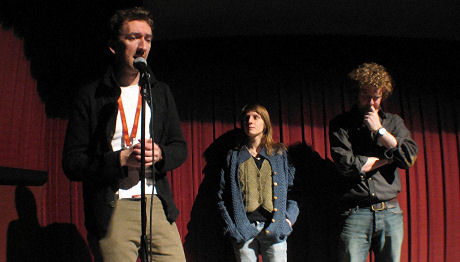
Irglova, Hansard performing after last night’s screening of Once at the Holiday Cinemas — Monday, 1.22.06, 12:25 am
Trust me — there isn’t a woman or a soulful guy out there who won’t respond to Once if they can be persuaded to just watch it. The trick, obviously, is to make that happen, and I admit there may be some resistance. Initially. But once people sit back and let it in (and they’d have to be made of styrofoam for that not to hap- pen), the game will be more or less won. Settled, I mean. I don’t know if Once will make $5 million or $25 million or more or less, but it definitely has the stuff that people go to movies for.
Carney doesn’t give names to Hansard and Irglova’s characters, but it doesn’t matter. He sings songs to Dublin tourists for money while fixing vacuum cleaners for his dad’s shop; she, separated from her Czech husband and raising a small daughter with her mother, is a skilled pianist and singer who sells roses to tourists. And they seem like a match waiting to happen the moment they meet.
Things start off when she tells him she really likes a song he’s been singing, and also that she has a vacuum cleaner that needs fixing. The first big moment happens when he strums and sings one of his tunes in a music shop, and she quickly figures out harmony and piano accompaniment. Their next move is deciding to record an album together, which they manage to pay for (i.e., the studio rental) by finagling a $2000 loan from a bank. They get some street musicians to play accompaniment. The tracks turn out beautifully.
But Hansard is still hung up over a girlfriend who dumped him and moved to London, and he suddenly decides to go there also, mainly to pursue his music career but also to possibly rekindle things. And Irglova’s thinking the best thing for her daughter is to try again with her estranged husband. Will things work out between them regardless? Or is the musical connection enough, or even greater than the proverbial emotional and hormonal sparks?
During the post-screening q & a Carney called Once a musical in the tradition of Singin’ in the Rain, Carousel, Brigadoon and the like. It isn’t that, of course — it’s a groundbreaking musical in the vein of A Hard Day’s Night, Cabaret and Dancer in the Dark…a new kind of funky street musical with a fresh idea. A key component is that the film never seems to be pushing all that hard, which can be a huge plus in the right hands.
Hansard and Irglova’s characters obviously love each other for what they have in their hearts plus their ability to say this musically, and we get to absorb all this like flies on the wall. The tension is whether or not they can take things to the proverbial next level. Life is hard, love is harder…but music is all joy.

The sound was fucked and gurgly when the film first began to roll around 10:15, so Carney had it stopped and a team of tech-heads fiddled around and re-threaded the film. It started up again around 10:35 or 10:40 pm. It ran 88 minutes. Then Carney, Hansard and Irglova came up for a q & a, and then the musicians sang a beautiful tune heard a couple of times in the film called “Falling Slowly.”
Hansard and Irglova currently have an album out with all the songs from Once — it’s called “The Swell Season.” An official Once soundtrack CD will presumably be released later this year, concurrent with the theatrical release.
Note: I would have had this piece up this morning if it hadn’t been for the awful technical issue that occured around breakfast time — my apologies to all. And thanks to those who corrected my incorrect spelling of Hansard’s band — The Frames, not the Flames.




Saved!
Hollywood Elsewhere has been out of business all day long due to an incorrectly installed DBD module, which affected my ability to go into Movable Type. The problem started at 8:15 this morning; the subsequent 11 or so hours were absolute hell. The problem was finally solved ten minutes ago by a genius named Chris Tillet. I’m asking that everyone observe a moment of grateful silence for the 2% or 3% of tech support people out there who actually know a thing or two and use their nimble noggins.